

Bad faith insurance lawyers near me: Protect 2025
When Insurance Companies Break Their Promise to You
Finding bad faith insurance lawyers near me becomes critical when your insurance company denies, delays, or underpays your legitimate claim without reasonable justification. Here’s what you need to know:
Quick Guide to Bad Faith Insurance Lawyers:
- What they do: Represent policyholders when insurers act unreasonably or dishonestly
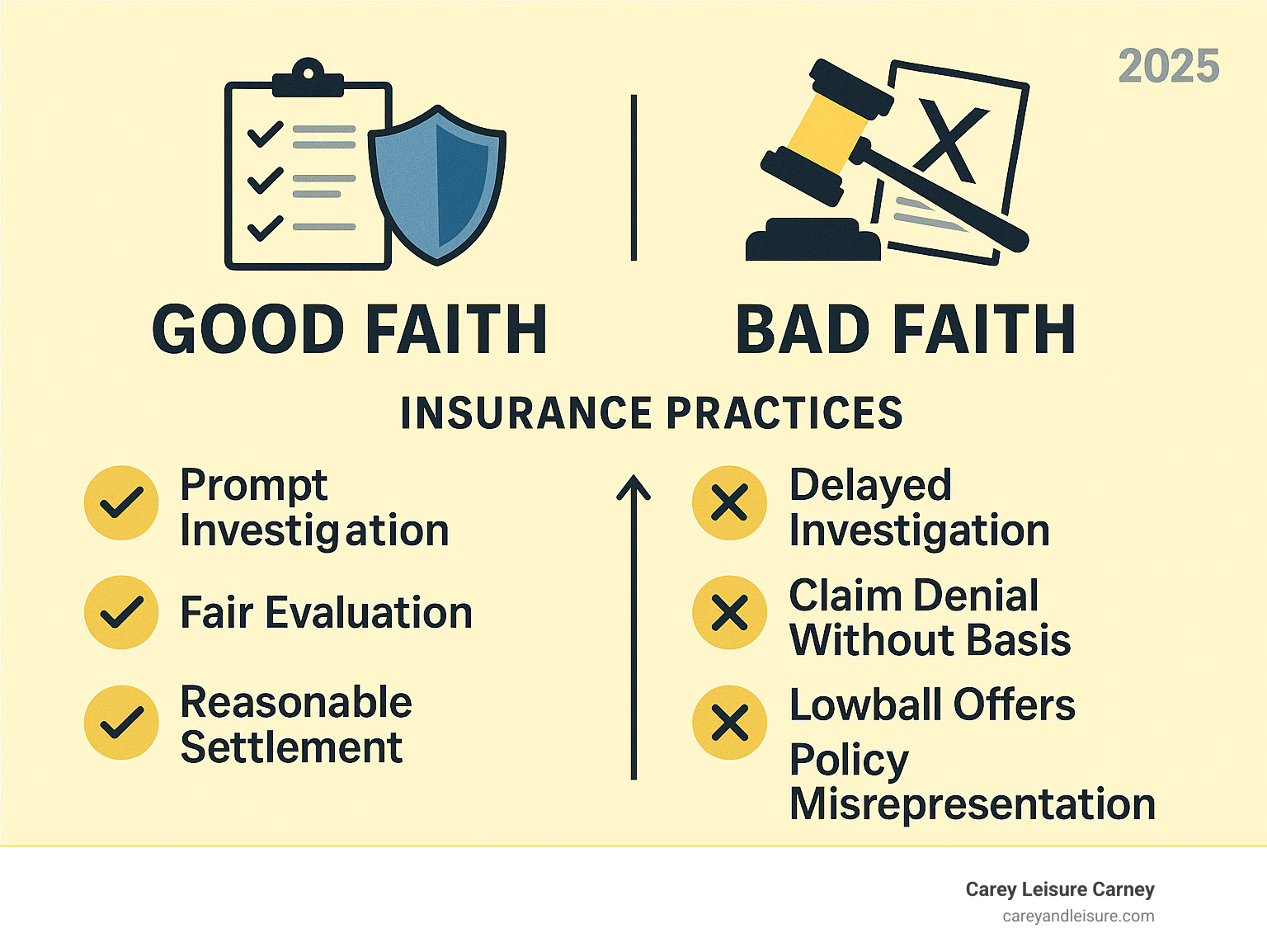
- When you need one: Claims denied without investigation, unreasonable delays, lowball offers, policy misrepresentation
- Cost: Most work on contingency fees (no upfront costs, paid only if you win)
- Damages recoverable: Policy benefits plus emotional distress, attorney fees, and sometimes punitive damages
You pay your premiums faithfully, expecting your insurance company to honor their end of the deal when disaster strikes. But sometimes, insurers prioritize profits over policyholders.
Insurance companies are profit-driven entities and some may resort to bad faith tactics to protect their bottom line at the expense of policyholders, according to legal experts who specialize in these cases.
When your claim gets wrongfully denied or you receive a settlement offer that’s insulting compared to your actual damages, you’re not just dealing with a business dispute. You’re facing a violation of the implied covenant of good faith and fair dealing that exists in every insurance contract.
The research shows that bad faith practices have grown to what some consumer advocates call “epidemic proportions.” Insurance companies employ specialists specifically trained to interpret claims in ways that protect company profits rather than help injury victims.
Don’t let them burn you twice – first with the original injury or loss, then with unfair claim handling.
What Constitutes Insurance Bad Faith?
Think of insurance as a promise between friends. You pay your premiums faithfully, and your insurance company promises to have your back when life throws you a curveball. But this isn’t just any ordinary promise—it’s backed by something called the implied covenant of good faith and fair dealing.
This legal concept means your insurer must act honestly and fairly throughout your entire relationship, especially when you need them most. As we explain in our guide on What is Bad Faith?, this covenant forms the backbone of every insurance contract, whether it’s written in the fine print or not.
Unfortunately, insurance companies are businesses first. Their shareholders expect profits, and sometimes that creates a conflict of interest with your legitimate claim. When an insurer puts their bottom line ahead of their duty to you, that’s when bad faith enters the picture.
Bad faith happens when your insurance company engages in unreasonable conduct during the claims process. They might investigate your claim with a predetermined outcome in mind, or they might look for any excuse—no matter how flimsy—to deny or underpay your claim. The legal duty of good faith and fair dealing requires them to treat your claim with the same care they’d want for their own family members.
The tricky part? Bad faith can be subtle. It’s not always an outright “no”—sometimes it’s death by a thousand paper cuts through delays, inadequate investigations, and lowball offers designed to wear you down.
Red Flags: Common Signs of Bad Faith
Wondering if your insurance company is playing fair? Here are the warning signs that should make you consider searching for “bad faith insurance lawyers near me”.
Unjustified denial is the most obvious red flag. Your insurer denies your claim without a reasonable basis, gives you vague explanations, or twists policy language like a pretzel to avoid paying. Sometimes they’ll deny coverage without even bothering to investigate properly.
Inadequate investigation is another telltale sign. Your insurer has a duty to conduct a prompt, thorough, and fair investigation. If they’re dragging their feet, transferring your claim between adjusters like a hot potato, or ignoring key evidence, that’s a problem.
Unreasonable delays can be just as damaging as outright denial. Maybe they’re taking forever to return your calls, “losing” your paperwork repeatedly, or finding new reasons to stall every time you think you’re making progress. They might be hoping you’ll give up or accept whatever crumbs they offer.
Lowball settlement offers are particularly frustrating. Your insurer knows what your claim is really worth, but they offer you a fraction of that amount and act like they’re doing you a favor. This is especially common when they think you don’t know any better.
Misrepresenting policy terms is another classic move. They might tell you something isn’t covered when it actually is, or they might interpret policy language in ways that would make a dictionary weep. They’re counting on you not reading the fine print or understanding your rights.
For liability cases, refusing to defend a lawsuit when they’re supposed to can leave you high and dry. If someone sues you and your policy includes defense coverage, your insurer can’t just abandon you because it’s inconvenient for them.
Threatening behavior toward policyholders crosses a clear line. Whether it’s trying to intimidate you into accepting a low offer or discouraging you from getting legal help, these tactics reveal their true colors.
The key to protecting yourself is documentation. Keep detailed records of every conversation, email, and expense. Our guide on Documenting Evidence in Personal Injury Claims shows you exactly how to build a paper trail that protects your interests.
The Claims Process and Where Bad Faith Arises
Understanding how the claims process typically works helps you spot problems before they spiral out of control. Think of it as a roadmap with potential potholes marked along the way.
Filing a claim starts the clock ticking. You submit your initial claim, and your insurer has legal obligations from that moment forward. This is where you want to be especially careful about how you present your case.
Assignment of an adjuster comes next. This person becomes your primary contact and handles the investigation. A good adjuster can make the process smooth, but a bad one can turn it into a nightmare through bias or incompetence.
The investigation phase is where most bad faith issues surface. Your adjuster should gather information fairly, interview witnesses objectively, and assess damages accurately. Red flags include using multiple adjusters to create confusion, conducting biased investigations, or ignoring evidence that supports your claim.
Claim decision time reveals your insurer’s true intentions. A denial without reasonable basis or a partial approval that severely undervalues your claim often signals bad faith. They should explain their reasoning clearly and point to specific policy language or evidence.
If your claim is approved, settlement negotiation begins. This is where patience and strategy matter most. Insurers might use pressure tactics, make lowball offers, or misrepresent what you’re entitled to receive.
Bad faith isn’t always one dramatic moment—it’s often a pattern of unreasonable behavior throughout this entire process. Insurance companies must act diligently and fairly at every step, not just when it’s convenient for them.
Our team understands the complex dynamics of pre-litigation negotiations with insurance companies. We know their tactics and how to counter them effectively, as detailed in The Ins and Outs of Pre-Litigation from an Expert.

Your Legal Options: Breach of Contract vs. a Bad Faith Claim
When your insurance company fails to honor their obligations, you’re not left without recourse. Understanding your legal options is crucial because the type of claim you pursue determines what damages you can recover. You typically have two main paths forward: a breach of contract claim or a bad faith claim.
Think of it this way: a breach of contract claim is like holding someone accountable for breaking a written promise. If your insurance policy clearly covers your damages and the company refuses to pay, they’ve violated the contract’s explicit terms. This is straightforward but limited—you can generally only recover what the policy should have paid in the first place.
A bad faith claim goes much deeper. It’s not just about getting what you were owed—it’s about holding the insurance company accountable for how they treated you during the claims process. When insurers act unreasonably, dishonestly, or put their profits ahead of your legitimate claim, they’ve violated something called the “implied covenant of good faith and fair dealing.”
Here’s how these claims differ:
| Feature | Breach of Contract Claim | Bad Faith Claim |
|---|---|---|
| Basis | Violation of explicit policy terms | Unreasonable conduct in handling your claim, violating duty of good faith and fair dealing |
| Damages | Policy benefits only | Policy benefits PLUS additional damages (emotional distress, attorney fees, punitive damages) |
| Proof Required | Show the policy covers your loss and insurer won’t pay | Prove the insurer acted unreasonably or dishonestly in investigating, evaluating, or paying claim |
In Florida, policyholders benefit from strong protections under state law. The Florida statutes on bad faith specifically outline what constitutes unfair and deceptive practices by insurance companies. This law gives you additional tools to fight back when insurers act improperly.
Bad faith claims are often considered “tort” claims rather than simple contract disputes. This distinction matters because tort law recognizes that some wrongs deserve more than just basic compensation—they deserve consequences that deter future bad behavior.
The experienced attorneys at Carey Leisure Carney understand both contract law and tort law principles. We know how to evaluate your situation and determine which approach—or combination of approaches—gives you the best chance of full recovery. Our team has handled countless Personal Injury Lawsuits and understands the nuances of insurance law that can make or break your case.
What Types of Damages Can Be Recovered?
The type of claim you pursue dramatically affects your potential recovery. Understanding what damages are available can help you see why working with experienced bad faith insurance lawyers near me is so important.
In breach of contract cases, your recovery is typically limited to the policy benefits you should have received. If your policy covered $50,000 in damages and the insurer wrongfully denied your claim, you might recover that $50,000 plus interest. While this gets you what you were owed, it doesn’t address the additional harm their wrongful denial caused.
Bad faith claims open the door to much more comprehensive recovery:
Policy benefits are just the starting point. You’ll still recover what the insurance company should have paid under your policy.
Consequential damages cover the ripple effects of the insurer’s bad faith. Maybe you couldn’t pay your mortgage because they delayed your claim, damaging your credit. Perhaps you had to take high-interest loans to cover medical bills. These financial consequences can be recovered.
Economic losses include lost wages if you had to miss work dealing with their unreasonable claims handling, or business income lost due to their delays.
Emotional distress damages recognize that insurance companies’ bad faith conduct can cause genuine psychological harm. The stress of fighting with your own insurance company while dealing with an injury or loss can be overwhelming.
Attorney’s fees are often recoverable in bad faith cases—meaning the insurance company pays for your legal representation. This levels the playing field against well-funded insurance companies.
Punitive damages are designed to punish particularly egregious conduct and deter future bad faith behavior. While not available in every case, they can be substantial when insurers act with malice or reckless disregard for your rights.
Our team at Carey Leisure Carney has extensive experience maximizing recovery for our clients. We understand the complexities of calculating damages in bad faith cases, including the often-overlooked consequential damages that can significantly increase your recovery. As detailed in our guide on Compensation for Pain and Suffering in Florida: What You Need to Know, Florida law provides multiple avenues for recovery when insurance companies fail to meet their obligations.
The difference between a contract claim and a bad faith claim can literally be the difference between getting what you were originally owed and getting full compensation for all the harm the insurance company caused. That’s why having experienced legal counsel evaluate your situation is so important.