

Uninsured motorist claim Florida: #1 Essential Guide
Why Florida Drivers Need a Safety Net Against Uninsured Motorists
Uninsured motorist claim Florida protection is critical because one in five Florida drivers lacks proper insurance coverage. If an uninsured or underinsured driver hits you, you could face thousands in medical bills and lost wages with no one to pay them—unless you have Uninsured Motorist (UM) coverage.
Quick answer: What is an uninsured motorist claim in Florida?
- What it is: A claim filed with your own insurance company when an at-fault driver has no insurance or insufficient coverage
- What it covers: Medical bills, lost wages, pain and suffering, and other damages not fully covered by Florida’s mandatory Personal Injury Protection (PIP)
- Who needs it: Every Florida driver—UM coverage is optional but essential, given Florida’s high uninsured driver rate
- When to use it: After exhausting PIP benefits, when the at-fault driver is uninsured, underinsured, or involved in a hit-and-run
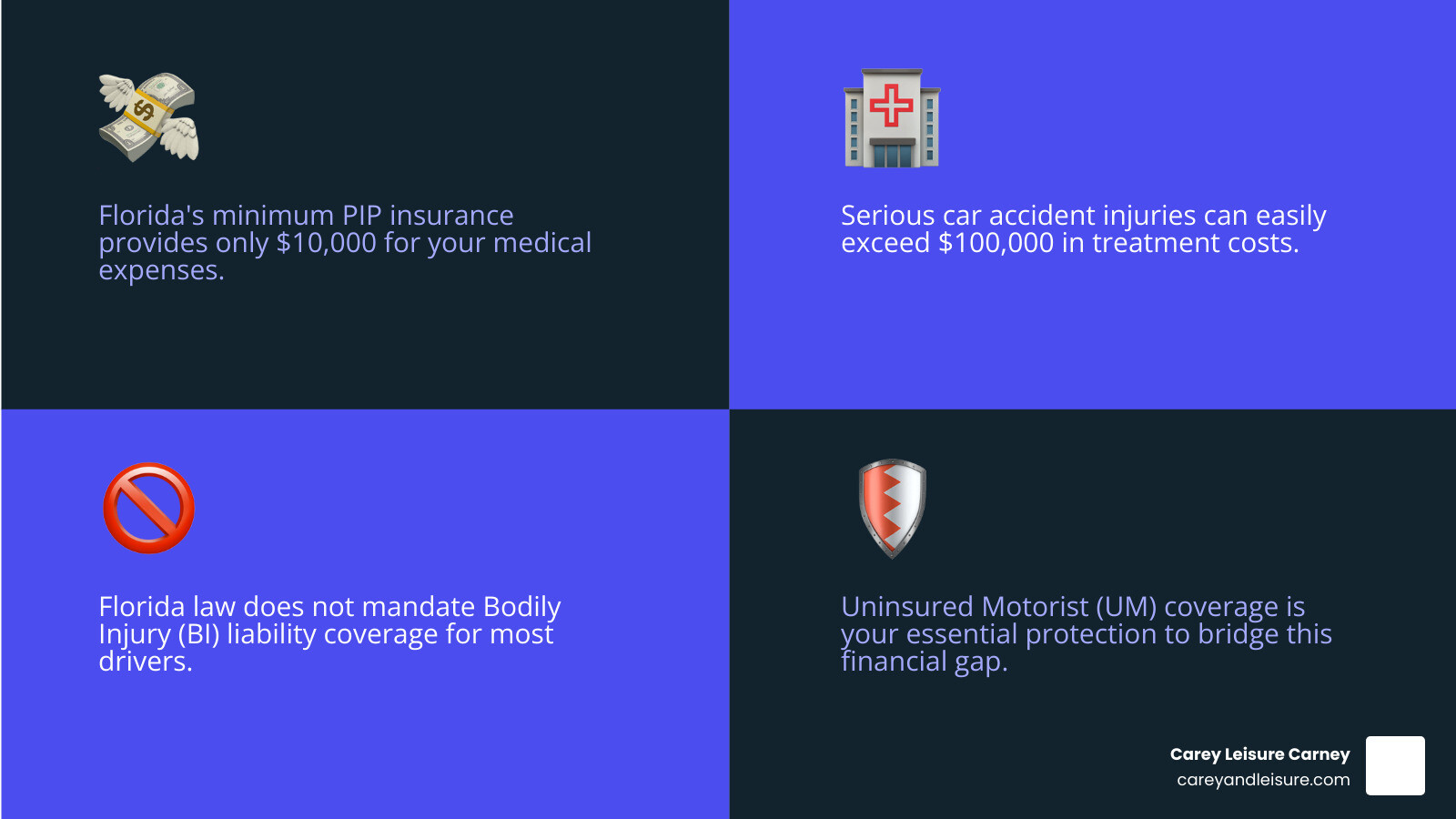
Florida requires only $10,000 in Personal Injury Protection (PIP) and $10,000 in Property Damage Liability (PDL)—but not Bodily Injury coverage. That means the driver who hits you may have zero ability to pay for your serious injuries. As of July 2025, approximately 902,812 Florida vehicles remain uninsured, and in 2015, Florida had the nation’s highest percentage of uninsured drivers at 26.7%.
UM coverage acts as your financial safety net. It steps in when the at-fault driver cannot pay, covering medical expenses beyond PIP’s 80% limit (up to $10,000), replacing lost income, and compensating you for pain, suffering, and permanent injuries. Without it, your only option may be suing an individual driver who likely has no assets—a costly and often futile process.
I’m Thomas W. Carey, a board-certified civil trial lawyer who has guided over 40,000 injury matters across Florida since 1988, including countless uninsured motorist claim Florida cases where UM coverage made the difference between financial recovery and ruin. My firm, Carey Leisure Carney, focuses exclusively on protecting injured Floridians and their families through every step of the claims process.
Why Uninsured Motorist Coverage is Essential in Florida
Florida’s unique insurance landscape often leaves drivers vulnerable. While we might assume every driver on our roads, from Clearwater to Wesley Chapel, carries adequate insurance, the reality is far from it. Florida operates under a “no-fault” system, which primarily dictates how initial medical expenses are handled after an accident. All registered vehicles in Florida must carry a minimum of $10,000 in Personal Injury Protection (PIP) and $10,000 in Property Damage Liability (PDL) insurance. This is the bare minimum to get your vehicle on the road. For more details on these requirements, you can refer to the official Florida Insurance Requirements.
What’s often overlooked, and critically important, is that Florida law does not mandate Bodily Injury (BI) liability coverage for most drivers. BI coverage is what pays for the other person’s medical expenses, lost wages, and pain and suffering if you are at fault for an accident. The absence of mandatory BI coverage creates a significant gap in protection. If an at-fault driver has no BI coverage, or very minimal coverage, and you suffer serious injuries, your PIP benefits might quickly be exhausted, leaving you to shoulder the remaining costs. This is where the importance of self-protection through Uninsured/Underinsured Motorist (UM/UIM) coverage truly shines.
What is Uninsured/Underinsured Motorist (UM/UIM) Coverage?
Think of UM/UIM coverage as your personal guardian angel on Florida’s busy roadways. It’s designed to protect you and your loved ones when the at-fault driver either has no insurance (Uninsured Motorist, or UM) or their insurance isn’t enough to cover your damages (Underinsured Motorist, or UIM). In Florida, these two types of coverage are typically combined into one, often simply referred to as UM coverage.
So, what exactly does it do? If you’re involved in an accident caused by an uninsured or underinsured driver, your UM/UIM policy steps in to pay for your bodily injuries and other damages, just as if the at-fault driver had adequate insurance. This protection extends beyond just you, the policyholder. It typically covers your spouse and any resident relatives living in your household, offering a comprehensive safety net for your entire family. While optional, its importance cannot be overstated in a state like ours.
The Alarming Rate of Uninsured Drivers in Florida
The high rate of uninsured drivers in Florida isn’t just a statistic; it’s a daily risk. Recent data shows that as of July 2025, the uninsured motorist rate is 5.44%, translating to approximately 902,812 uninsured vehicles. That’s nearly a million vehicles on our roads, from St. Petersburg to Trinity, without the liability insurance needed to cover an accident.
While 5.44% is an improvement, Florida has faced much higher rates. In 2015, our state had the highest percentage of uninsured drivers in the U.S. at a staggering 26.7%. Recent studies still suggest that as many as one in five Florida drivers lack automobile insurance. These numbers mean that every time you get behind the wheel, or even walk or cycle, there’s a substantial chance you could encounter a driver who cannot financially compensate you if they cause an accident. You can explore more data on this topic at the Uninsured motorist rate data page.
Rejecting UM Coverage: A Risky Decision
Given the statistics, choosing to reject UM coverage in Florida is, frankly, a gamble we strongly advise against. While Florida law requires insurers to offer UM coverage, it also allows you to reject it or select lower limits. However, this rejection must be made in writing on an approved form that clearly advises you of the implications. As outlined in Florida Statutes section 627.727(1), this form must explicitly state, “You are electing not to purchase certain valuable coverage which protects you and your family or you are purchasing uninsured motorist limits less than your bodily injury liability limits.”
What happens if you don’t have UM coverage and an uninsured driver causes an accident that leaves you seriously injured? Your primary recourse would be your PIP benefits, which are capped at $10,000 and only cover 80% of medical bills and 60% of lost wages. Once those are exhausted, you’re on your own. You could attempt to pursue the at-fault driver directly through a personal injury lawsuit. However, this path is fraught with challenges. Uninsured drivers often lack significant assets, making it incredibly difficult, if not impossible, to collect any judgment you might win. Imagine winning a $100,000 judgment only to find the driver has no property, no savings, and no steady income to garnish. It’s a frustrating and often futile exercise, leaving you with mounting bills and no compensation.
How UM/UIM Coverage Protects You Financially

When an uninsured or underinsured driver turns your world upside down, your UM/UIM coverage acts as a crucial financial lifeline. Unlike claims against an at-fault driver’s insurance (which are “third-party” claims), filing an uninsured motorist claim Florida with your own insurance company is a “first-party” claim. This means your own insurer steps into the shoes of the absent or insufficient insurer, providing the coverage you need. This protection is broad, covering you as the policyholder, your family members, and even passengers in your vehicle. It’s also vital in scenarios like hit-and-run accidents, where the identity of the at-fault driver is unknown, or if you’re injured as a pedestrian or cyclist by an uninsured motorist.
What Damages Does UM/UIM Pay For?
So, what exactly can your UM/UIM coverage help you recover? The list is comprehensive, designed to cover the full spectrum of losses you might experience:
- Medical Bills Beyond PIP: While your PIP coverage will pay the first $10,000 (80% of medical, 60% of lost wages), serious injuries can quickly exceed this. UM/UIM steps in to cover the remaining medical costs.
- Lost Wages Beyond PIP: If your injuries prevent you from working, UM/UIM can compensate for income lost beyond what PIP covers.
- Future Medical Treatment: For long-term or permanent injuries, UM/UIM can cover the projected costs of future surgeries, therapy, and medications.
- Pain and Suffering: This is a crucial benefit not covered by PIP or health insurance. UM/UIM can compensate you for the physical pain, emotional distress, and reduced quality of life caused by your injuries.
- Permanent Injury: If your injuries result in permanent impairment, such as limited mobility or chronic pain, UM/UIM can provide compensation for this lasting impact.
- Scarring and Disfigurement: Visible injuries that cause emotional distress or impact your appearance are also compensable under UM/UIM.
- Wrongful Death: In the tragic event of a fatality caused by an uninsured or underinsured driver, UM/UIM can provide benefits to the surviving family members.
Stacked vs. Non-Stacked UM: A Critical Choice
One of the most important decisions you’ll make regarding your UM coverage is whether to choose “stacked” or “non-stacked” protection. This choice significantly impacts the amount of coverage available to you, especially if you own multiple vehicles.
| Feature | Stacked UM Coverage | Non-Stacked UM Coverage |
|---|---|---|
| Definition | Combines UM limits from all vehicles on your policy. | Provides a fixed UM limit per accident, regardless of vehicles. |
| Coverage Example | If you have 3 cars, each with $50,000 UM, you get $150,000 in coverage. | If you have 3 cars, each with $50,000 UM, you get $50,000 in coverage. |
| Cost | Generally higher premium. | Generally lower premium. |
| Best For Whom | Multi-vehicle households, maximum protection, families with multiple drivers. | Single-vehicle owners, budget-conscious drivers who prioritize lower premiums. |
How stacking multiplies coverage: With stacked UM, if you own three vehicles, each insured with $50,000 in UM coverage, you would effectively have $150,000 in coverage available for a single accident. This is particularly beneficial for families with multiple cars registered in their names.
Non-stacked limitations: Non-stacked coverage, conversely, limits you to the UM amount for the specific vehicle involved in the accident, regardless of how many other vehicles you have insured. While it’s a more economical option upfront, it can leave you significantly underinsured if you suffer severe injuries in an accident with an uninsured driver.
While stacked UM has a higher premium, the added cost is often a worthwhile investment when weighed against the potential for massive medical bills and lost income after a serious accident.
Uninsured vs. Underinsured Scenarios
Understanding the difference between uninsured and underinsured situations is key to grasping how your UM/UIM coverage works.
- Uninsured Scenario: This is when the at-fault driver has no bodily injury liability insurance whatsoever. In this case, your UM coverage steps in directly to cover your damages, acting as if it were the at-fault driver’s policy.
- Underinsured Scenario: This occurs when the at-fault driver does have bodily injury liability insurance, but their policy limits are insufficient to cover the full extent of your damages. For example, if the at-fault driver has Florida’s minimum $10,000 BI coverage, but your medical bills, lost wages, and pain and suffering amount to $50,000, your Underinsured Motorist (UIM) coverage can bridge that $40,000 gap (after their $10,000 policy is exhausted).
For UIM coverage to kick in, you typically must first exhaust the at-fault driver’s available policy limits. Your UIM policy then pays the remaining damages up to your own UIM limits. This ensures you’re not left with significant out-of-pocket expenses due to another driver’s inadequate coverage.
The Steps to Filing an Uninsured Motorist Claim in Florida

Being involved in an accident is chaotic enough, but when the other driver is uninsured, it adds another layer of stress. Even though you’re dealing with your own insurer for an uninsured motorist claim Florida, you still need to prove the other driver was at fault for the accident and that their lack of insurance caused you damages. Comprehensive documentation from the scene is crucial. Here’s a breakdown of the steps we guide our clients through:
Step 1: Immediate Actions After the Accident
What you do in the moments and hours following an accident can significantly impact your claim.
- Call 911 Immediately: Even if the accident seems minor, call the police. A police report is invaluable for documenting the accident details, establishing fault, and identifying the other driver and their insurance status.
- Seek Medical Attention: Your health is paramount. Get checked out by a medical professional as soon as possible, even if you don’t feel immediate pain. Some injuries manifest days or weeks later. For PIP benefits, initial medical treatment must be received within 14 days of the accident.
- Exchange Information: Get the other driver’s name, contact information, driver’s license number, and vehicle information (make, model, license plate). Crucially, ask for their insurance information. If they admit to having no insurance, make a note of it.
- Document the Scene: If it’s safe to do so, take photos and videos of everything: damage to all vehicles, skid marks, road conditions, traffic signs, weather, and the general surroundings. This visual evidence can be critical.
- Get Witness Contact Details: If anyone saw the accident, get their names and phone numbers. Their independent accounts can be powerful evidence.
- Do Not Admit Fault: Even a casual “I’m sorry” can be misconstrued as an admission of guilt. Stick to the facts and do not discuss fault with anyone at the scene except the police. Similarly, avoid telling anyone you are “okay” or “fine” if you are unsure about your injuries.
Step 2: Notifying Your Insurance Company
As soon as possible after the accident, you need to notify your own insurance company. Be clear that you were involved in an accident and that the other driver may be uninsured or underinsured, and that you intend to file an uninsured motorist claim Florida. Provide them with a copy of the police report and any other documentation you collected. While you must cooperate with your insurer, be cautious about providing recorded statements without first consulting with an attorney. Even your own insurance company has adjusters whose job is to minimize payouts.
Step 3: Proving Your Damages
To recover the maximum compensation, you’ll need to carefully prove the full extent of your damages. This involves:
- Gathering Medical Records: Collect all medical bills, doctor’s notes, diagnostic test results (X-rays, MRIs), and treatment plans. These documents establish the nature and severity of your injuries.
- Documenting Lost Income: Obtain pay stubs, employer statements, and tax records to prove any wages you’ve lost due to your injuries.
- Keeping a Pain Journal: Regularly document your pain levels, how your injuries impact your daily life, and any emotional distress you’re experiencing. This personal account can be powerful evidence for pain and suffering.
- Following Your Doctor’s Treatment Plan: Adhering to your medical advice is vital. Gaps in treatment or failure to follow recommendations can be used by the insurance company to argue your injuries aren’t as severe as claimed.
- The Role of an Independent Medical Exam (IME): Be aware that your insurance company may request you attend an IME with a doctor of their choosing. This is a common tactic, and while you generally must comply, it’s wise to discuss it with your attorney beforehand.
Navigating Legal Challenges and Your Rights
Dealing with the aftermath of an accident is stressful enough, but when an uninsured motorist claim Florida is involved, the complexities can escalate. Understanding your policy and how to interact with insurance adjusters is crucial. While your insurance company is contractually obligated to pay your UM claim, they are still a business. Their adjusters are trained to minimize payouts, and the process can often feel adversarial, even when you’re dealing with your own insurer.
What to Do If You Don’t Have Coverage for an Uninsured Motorist Claim in Florida
If you were involved in an accident with an uninsured driver and, unfortunately, did not purchase UM/UIM coverage, your options become significantly limited, but not entirely non-existent.
- Relying on PIP: Your Personal Injury Protection (PIP) will be your first line of defense, covering 80% of your medical expenses and 60% of your lost wages, up to $10,000. However, for serious injuries, this amount is often quickly exhausted.
- Using Health Insurance: Your personal health insurance can cover medical bills beyond PIP, but it won’t cover lost wages, pain and suffering, or other non-economic damages. You’ll also be responsible for deductibles and co-pays.
- Suing the At-Fault Driver Personally: You can file a lawsuit directly against the uninsured driver who caused the accident. If you win, you’ll get a judgment. However, as we’ve discussed, collecting on that judgment can be incredibly difficult if the driver lacks assets or income. Many uninsured drivers simply don’t have the financial means to pay a significant judgment, leaving you with a legal victory that offers little practical relief.
Understanding Insurance ‘Bad Faith’
Even when you have UM coverage, your own insurance company has a legal duty to handle your claim in “good faith.” This means they must act fairly and honestly toward you. If they fail to do so, you may have grounds for a “bad faith” claim against them. Examples of bad faith include:
- Unreasonable Claim Denial: Denying your uninsured motorist claim Florida without a legitimate reason.
- Unjustified Delays: Dragging out the investigation or payment process without cause.
- Failure to Investigate: Not properly investigating your claim or ignoring evidence.
- Lowball Offers: Offering a settlement that is substantially less than the proven value of your damages.
- Refusal to Pay: Refusing to pay a valid claim even when liability and damages are clear.
If your insurer acts in bad faith, you have the right to sue them for damages beyond your policy limits, potentially recovering interest, attorney’s fees, costs, and even additional damages caused by their bad faith actions. This is a complex area of law, and a skilled attorney is essential to steer it.
How an Attorney Can Help with Your Uninsured Motorist Claim in Florida
Dealing with an uninsured motorist claim Florida can be overwhelming, especially when you’re recovering from injuries. This is where an experienced personal injury attorney becomes your most valuable asset. At Carey Leisure Carney, our Board-Certified attorneys, with over 100 years of combined experience, specialize in auto accident claims across Clearwater, Largo, New Port Richey, Spring Hill, St. Petersburg, Trinity, and Wesley Chapel. We offer:
- Evaluating Your Case: We assess the full extent of your damages, including future medical needs, lost earning capacity, and pain and suffering, ensuring no stone is left unturned.
- Negotiating with the Insurance Company: We handle all communication and negotiations with your insurer, protecting you from tactics designed to minimize your payout. Our direct attorney access means you’re always speaking with an expert.
- Proving Damages: We work with medical experts, economists, and other professionals to build a compelling case that clearly demonstrates your losses.
- Handling Legal Procedures: From filing paperwork to adhering to statutes of limitations, we manage every legal detail, ensuring your claim progresses smoothly.
- Fighting a Denied Claim: If your claim is unfairly denied, we are prepared to challenge your insurer, including pursuing a bad faith claim if necessary.
- Maximizing Your Compensation: Our personalized service means we are dedicated to securing the full and fair compensation you deserve, allowing you to focus on your recovery.
Frequently Asked Questions about Florida UM Claims
How much does UM coverage cost in Florida?
The cost of UM coverage in Florida varies based on several factors, including your driving record, the type of vehicle you drive, where you live (e.g., Clearwater vs. a more rural area), and the limits of coverage you choose (stacked vs. non-stacked). While it does add to your premium, UM coverage is often a relatively inexpensive investment compared to the potentially catastrophic financial losses you could face after a serious accident with an uninsured driver. Many insurance professionals and attorneys strongly recommend keeping UM coverage, viewing it as a worthwhile expense for the significant financial security it provides. We encourage you to get quotes from various insurers to see how affordable this crucial protection can be for you.
How does UM coverage interact with PIP and health insurance?
This is a common and excellent question! Here’s the breakdown of how these coverages typically interact in Florida:
- PIP is Primary: In Florida’s no-fault system, your Personal Injury Protection (PIP) is always the first line of defense for your medical bills and lost wages, regardless of who was at fault. It covers 80% of medical expenses and 60% of lost wages, up to its $10,000 limit.
- UM is Secondary for Injuries: Once your PIP benefits are exhausted, your UM coverage kicks in to cover additional medical expenses, lost wages, and other damages (like pain and suffering) caused by the uninsured or underinsured driver. It fills the gaps left by PIP.
- UM Covers Gaps Left by Health Insurance: While your health insurance can help with medical bills, it will not cover lost wages or, crucially, pain and suffering. UM coverage can bridge these gaps, covering your remaining medical bills (after health insurance), deductibles, co-pays, and the non-economic damages that health insurance ignores. This makes UM coverage vital for comprehensive recovery.
Can I file a UM claim for a hit-and-run accident?
Yes, in most cases, your UM coverage will apply to a hit-and-run accident. This is one of the most critical protections UM offers, as the at-fault driver is, by definition, uninsured (or at least their insurance information is unknown). However, there are usually specific requirements you must meet:
- Report to Police: You must report the hit-and-run accident to the police promptly. This helps validate your claim and provides an official record.
- Physical Contact: Many UM policies in Florida require physical contact between your vehicle and the hit-and-run vehicle for coverage to apply. Check your specific policy language or consult with us to understand this requirement.
If you’re a victim of a hit-and-run in areas like Largo or New Port Richey, your UM coverage can be a lifesaver.
Get the Protection You Deserve
We’ve explored the intricate world of uninsured motorist claim Florida protection, from Florida’s unique no-fault laws and alarming uninsured driver rates to the critical difference between stacked and non-stacked coverage. The bottom line is clear: UM coverage is not just an optional add-on; it’s an indispensable safeguard for your financial well-being on Florida’s roads. The risk of being underinsured or hit by an uninsured driver is simply too high to ignore.
Taking control of your financial safety means understanding your insurance options and making informed choices. If you or a loved one has been involved in an accident with an uninsured or underinsured motorist, our team at Carey Leisure Carney is here to help. With Board-Certified attorneys boasting over 100 years of combined experience, we provide direct attorney access and personalized service to guide you through every step of the claims process. We are dedicated to protecting injured Floridians and their families across Clearwater, Largo, New Port Richey, Spring Hill, St. Petersburg, Trinity, and Wesley Chapel.
Don’t steer the complexities of an uninsured motorist claim Florida alone. Let our expertise work for you.
Contact us for a free evaluation of your car accident case today.