Largest Insurance Bad Faith Verdicts: Top 3 Shockers!
When Insurance Companies Break Their Promise: Understanding Massive Bad Faith Verdicts
Largest insurance bad faith verdicts have shattered records in recent years, with juries awarding anywhere from millions to over $145 million when insurers betray their policyholders. These verdicts send a clear message: when insurance companies act in bad faith—denying valid claims, delaying critical payments, or putting profits over people—they will be held accountable.
Here are some of the most significant insurance bad faith verdicts on record:
- $145.26 million – Colorado jury award to Fermin Salguero-Quijada against NorGUARD Insurance (2024) for denying rehabilitation after a traumatic brain injury
- $114 million – Nevada verdict against USAA ($100M punitive, $14M compensatory) for delaying a TBI claim after a rear-end collision
- $112 million – Indiana federal jury verdict against seven insurers in a quota-share arrangement
- $84 million – Verdict for bad faith denial of disability benefits (Ceimo v. Paul Revere)
- $61.6 million – Verdict for bad faith denial of disability benefits (Merrick v. Paul Revere)
- $42 million – Judgment for breach of duty to defend (Murriel-Don Coal Co. v. Aspen Insurance)
- $40 million – Texas verdict against Brotherhood Mutual Insurance for church storm damage claim
These aren’t just numbers. They represent real people—construction workers, accident victims, church congregations—who were denied the coverage they paid for when they needed it most. Insurance companies promised to protect them, then failed to deliver.
Bad faith happens when an insurer breaches the implied covenant of good faith and fair dealing. This means refusing to pay valid claims, delaying investigations without reason, offering settlements far below what’s owed, or denying claims without proper explanation. In the worst cases, insurers prioritize their bottom line over their policyholders’ lives.
When a 20-year-old construction worker falls 15 feet and suffers a severe brain injury, his workers’ compensation insurer should provide immediate, comprehensive care. When that insurer instead denies him specialized rehabilitation for ten months—rehabilitation that could have helped him regain independence—the consequences are devastating. The family becomes the caregiver. The bills pile up. The injured worker’s future dims. That is bad faith in action.
The good news? Courts and juries are pushing back. Punitive damages—awards designed to punish wrongdoing and deter future misconduct—have reached historic highs. A $60 million punitive award in one Colorado case. A $100 million punitive verdict in Nevada. These aren’t accidents. They’re jury verdicts that reflect outrage at insurer misconduct.
As Thomas W. Carey, a board-certified civil trial lawyer with over 35 years of experience, I’ve witnessed how the largest insurance bad faith verdicts have evolved to hold insurers accountable when they abandon their policyholders. Throughout my career representing injury victims across Florida, I’ve seen the devastating impact when insurance companies prioritize profits over people’s lives.
What Is Insurance Bad Faith and How Do You Spot It?
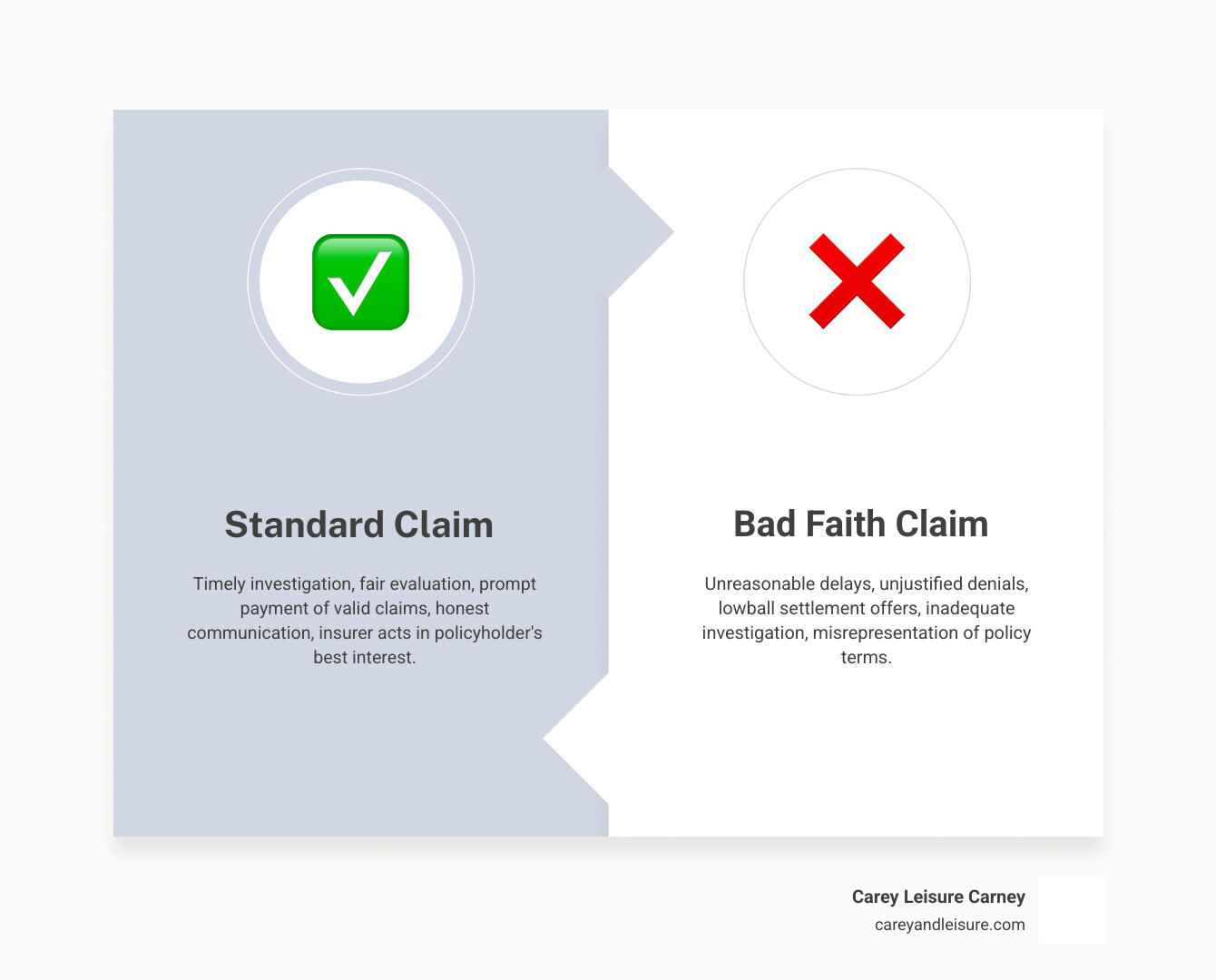
At its core, insurance bad faith occurs when an insurance company fails to uphold its fundamental obligation to act fairly and honestly toward its policyholders. Every insurance contract, whether for your car, home, or health, contains an “implied covenant of good faith and fair dealing.” This means your insurer has a legal duty to handle your claim reasonably and promptly, not just pay it. When they breach this duty, it can lead to severe consequences for you and significant penalties for them, including some of the largest insurance bad faith verdicts we’ve seen.
In Florida, we understand that when you pay your premiums, you expect your insurer to be there when disaster strikes. Unfortunately, some insurance companies prioritize their bottom line over their policyholders’ well-being. This can manifest in two main types of bad faith: first-party and third-party claims.
When an insurer is found to have acted in bad faith, the damages awarded can be substantial. Beyond covering the original claim amount (compensatory damages), juries can impose punitive damages. These are not about compensating the victim but punishing the insurer for egregious conduct and deterring similar behavior in the future. We’ll dig deeper into punitive damages later, but suffice it to say, they are often what drive these verdicts into the millions.
If you’re dealing with an insurance company in Clearwater, Largo, New Port Richey, Spring Hill, St Petersburg, Trinity, or Wesley Chapel, Florida, and suspect they’re not playing fair, it’s crucial to recognize the signs. For more detailed information on how we can help with these complex situations, visit our page on bad faith insurance claims.
First-Party vs. Third-Party Claims
Understanding the distinction between first-party and third-party bad faith is key to knowing your rights:
First-Party Bad Faith: This occurs when your own insurance company (the “first party”) acts unreasonably or unfairly in handling your claim. This could involve your health insurance, disability insurance, auto insurance (like Uninsured/Underinsured Motorist – UM/UIM coverage), or property damage insurance (homeowners, hurricane damage, etc.). For example, if your own auto insurer denies your valid UM/UIM claim, alleging you’re exaggerating your injuries, that’s a first-party bad faith issue. The goal of your first-party policy is to protect you directly.
Third-Party Bad Faith: This arises when your insurance company fails to protect you from a claim made by someone else (the “third party”) against you. This is common in liability coverage, such as auto liability or professional liability. If you’re involved in an accident and someone sues you, your insurer has a duty to defend you and, if possible, settle the claim within your policy limits. If they unreasonably refuse to settle, leading to a judgment against you that exceeds your policy limits (an “excess judgment”), they could be liable for the full amount of that judgment due to third-party bad faith. They essentially gambled with your financial future and lost.
Common Red Flags of Insurer Misconduct
Dealing with insurance claims can be stressful enough, but it becomes infuriating when your insurer seems to be actively working against you. Here are some common red flags that might indicate your insurer is acting in bad faith:

- Denying a claim without explanation: If your claim is denied, your insurer should provide a clear, detailed reason and cite the specific policy language. Vague or shifting explanations are a warning sign.
- Failing to conduct a prompt and thorough investigation: Insurers have a duty to investigate claims quickly and completely. If they drag their feet, ignore evidence, or don’t interview key witnesses, they may be acting in bad faith.
- Offering significantly less than a claim is worth (lowball offers): While negotiation is normal, an offer that is a fraction of your actual damages, without reasonable justification, can be a sign of bad faith. They might be trying to pressure you into accepting less than you deserve.
- Delaying payment for undisputed claims: If part of your claim is clearly covered and undisputed, but the insurer delays payment for an unreasonable amount of time, this can be bad faith. This is especially frustrating when you need funds for medical care or repairs.
- Misrepresenting the law or policy language: An insurer might try to convince you that your policy doesn’t cover something it clearly does, or misinterpret legal obligations to their advantage.
- Threatening the policyholder: If an adjuster uses intimidating language, threatens to drop your coverage, or suggests legal action against you for pursuing a valid claim, that’s a serious red flag.
These tactics are often part of a “delay, deny, defend” strategy that some insurers employ to minimize payouts. We believe that no policyholder in Florida should have to endure such treatment.
A Record of Justice: The Largest Insurance Bad Faith Verdicts
The sheer size of some largest insurance bad faith verdicts reflects more than just the financial losses suffered by policyholders; they often represent a jury’s outrage at corporate accountability failures. When an insurer, a company built on trust, abandons its policyholders in their time of need, juries send a powerful message. These cases highlight how insurers are held accountable, particularly when their actions lead to catastrophic injuries, significant property damage, or the denial of crucial benefits. This is why having skilled legal representation is so vital. If you’ve been wronged, know that there are Lawyers That Sue Insurance Companies who can help level the playing field.
Case Study: The Record-Shattering $145.26M Verdict for a Traumatic Brain Injury
One of the most recent and impactful verdicts comes from Colorado, where a jury awarded a staggering $145.26 million to Fermin Salguero-Quijada. This case involved a young construction worker who suffered a severe traumatic brain injury (TBI) after falling from a ladder. His workers’ compensation insurer, Norguard Insurance, was found to have acted in bad faith by denying him critical rehabilitation for ten months.
The $145,000,000 jury verdict inFermin Salguero-Quijada’s case wasn’t just about a contract gone wrong. It was about justice for a young man whose life was permanently altered, and whose family was forced to shoulder unimaginable burdens because an insurer chose denial over decency. The insurer’s conduct meant that instead of receiving specialized inpatient rehabilitation, Fermin was sent home on a commercial flight, leading to permanent damage and a life-altering impact. The jury’s verdict, including $60 million in punitive damages, underscored their belief that the insurer prioritized profits over the worker’s recovery, forcing his family to become full-time caregivers without the financial or medical support they deserved. This case serves as a stark example of how insurer obstruction can have devastating, long-term consequences.
Case Study: The $114M Verdict Against USAA and Its Lessons on the Largest Insurance Bad Faith Verdicts
Another significant verdict, illustrating the severe repercussions for insurers, was the $114 million awarded to Timothy Kuhn in Nevada. This bad faith case against USAA stemmed from a 2018 rear-end collision that left Kuhn with a traumatic brain injury. Despite initially acknowledging Kuhn was not at fault, USAA later improperly denied and delayed his claim, even arguing in court filings that he was responsible for the crash.
USAA’s tactics included an initial lowball offer of $10,000, despite a policy limit of $250,000. It took years, and the eve of trial, for USAA to finally offer the full policy limit. The jury, however, saw through these delays and denials, awarding Kuhn $100 million in punitive damages and $14 million in compensatory damages. The full trial wasrecorded gavel-to-gavel by Courtroom View Network. This substantial punitive award signals a jury’s strong disapproval of an insurer’s handling of a claim and highlights the legal risks insurers face when they prioritize litigation strategy over their policyholders’ interests. It’s a powerful reminder that “delay, deny, defend” can backfire spectacularly.
Case Study: When Insurers Abandon Their Policyholders
Bad faith isn’t limited to personal injury claims; it extends to property damage and other policy types. Consider these cases:
Green Acres Baptist Church (Texas): A Texas jury awarded Green Acres Baptist Church nearly $40 million, including $35 million in punitive damages, in a bad faith dispute against Brotherhood Mutual Insurance Company. The church’s claim for storm damage was allegedly withheld for nearly four years, causing significant hardship. This verdict emphasizes that even institutions can be victims of insurer bad faith and that juries are prepared to punish such delays.
Murriel-Don Coal Co. v. Aspen Insurance (Kentucky): In this case, a $42 million judgment was awarded for breach of duty to defend. The insurance company abandoned a small coal company that had been sued following a car accident involving one of its workers. The insurer’s failure to defend its policyholder left the company exposed and led to a massive judgment against the insurer for its bad faith actions. This highlights the critical importance of an insurer’s duty to defend its policyholders, especially when facing lawsuits.
These cases, though from other states, serve as powerful examples of the types of bad faith conduct insurers can engage in and the massive verdicts that can result when policyholders stand up for their rights.
The Power of Punitive Damages: Why Juries Award Millions
When we discuss the largest insurance bad faith verdicts, the conversation invariably turns to punitive damages. These are not merely about compensating a victim for their losses; they are about punishing egregious behavior and deterring future misconduct. Juries award millions in punitive damages when they are shocked by an insurer’s conduct, viewing it as a breach of trust and a disregard for human well-being.

Punitive damages are distinct from compensatory damages, which cover actual losses like medical bills, lost wages, and pain and suffering. Punitive damages serve two main purposes:
- Punishment: To penalize the insurer for particularly reprehensible conduct, such as fraud, malice, or a willful and wanton disregard for the policyholder’s rights.
- Deterrence: To send a clear message to the offending insurer, and the insurance industry as a whole, that such actions will not be tolerated and will carry severe financial consequences.
The insurer’s wealth can sometimes be a factor in determining the size of punitive damages, as a larger award may be needed to have a deterrent effect on a multi-billion dollar corporation. However, there are constitutional limits to these awards, ensuring they are not “grossly excessive.”
Understanding the Legal Framework for the Largest Insurance Bad Faith Verdicts
The U.S. Supreme Court has established guideposts for reviewing punitive damage awards to ensure they comply with the Due Process Clause of the Fourteenth Amendment. Two landmark cases are particularly relevant:
BMW of North America, Inc. v. Gore (1996): This case set out three key guideposts for courts to consider when reviewing punitive damages:
- The degree of reprehensibility of the defendant’s misconduct: How bad was the insurer’s behavior? Was the harm physical or economic? Was the policyholder financially vulnerable? Was the conduct repeated or isolated? Did it involve deceit or malice?
- The disparity between the actual or potential harm suffered by the plaintiff and the punitive damages award: This often refers to the “ratio” of punitive to compensatory damages.
- The difference between the punitive damages awarded and the civil penalties authorized or imposed in comparable cases: What are the fines or penalties for similar misconduct under state law?
State Farm Mutual Automobile Insurance Co. v. Campbell (2003): This case further clarified the constitutional limits on punitive damages, particularly emphasizing the “single-digit ratio” guideline. The Supreme Court found a $145 million punitive damages award, where compensatory damages were $1 million, to be excessive and in violation of the Due Process Clause. The Court suggested that few awards exceeding a single-digit ratio between punitive and compensatory damages would satisfy due process, and when compensatory damages are substantial, a lesser ratio (perhaps equal to compensatory damages) might be the constitutional limit. You can read the full opinion here: STATE FARM MUT. AUTOMOBILE INS. CO. v. CAMPBELL, 538 U.S. 408 (2003).
The Campbell case also cautioned against punishing a defendant for out-of-state conduct that was lawful where it occurred or for hypothetical claims of other parties. Evidence of out-of-state conduct is only relevant if it has a direct “nexus” to the specific harm suffered by the plaintiff and demonstrates deliberateness and culpability in the state where the tort occurred.
These legal precedents ensure that while juries can deliver massive verdicts to punish bad faith, the awards must still be reasonable and proportionate to the harm caused and the reprehensibility of the insurer’s actions.
What to Do If You Suspect Your Insurer Is Acting in Bad Faith
If you’re in Florida and suspect your insurance company is acting in bad faith, it can feel like you’re fighting a Goliath. However, with the right steps and strong legal representation, you can protect your rights and seek the justice you deserve. Here’s what we advise our clients:
Step 1: Document Everything
This cannot be stressed enough. From the moment you file your claim, keep meticulous records. This includes:
- All correspondence: Save every email, letter, and written communication from your insurer.
- Notes on phone calls: For every phone conversation, record the date, time, who you spoke with, and a detailed summary of what was discussed.
- Claim submissions: Keep copies of your original claim, all supporting documents, and any additional information you provide.
- Medical records: Maintain copies of all medical reports, bills, and any documentation related to your injuries or treatment.
- Repair estimates/photos: For property damage claims, keep all estimates, invoices, and photos or videos of the damage.
A comprehensive paper trail is your best defense against an insurer attempting to deny or delay your claim without justification.
Step 2: Put It in Writing
Whenever possible, communicate with your insurance company in writing. If they deny your claim or propose a lowball settlement, insist on a detailed written explanation, citing the specific policy provisions they are relying on. This forces them to commit to a position and creates a clear record. Avoid verbal-only agreements, as these are difficult to prove later. Written communication is your secret weapon.
Step 3: Consult with an Experienced Attorney
Insurance companies have vast resources and teams of lawyers dedicated to minimizing payouts. Trying to steer a bad faith claim on your own can be overwhelming and lead to unfavorable outcomes. This is where an experienced legal team can make all the difference.
We, at Carey Leisure Carney, understand the intricacies of insurance bad faith law in Florida. Our Board-Certified attorneys, a distinction held by only 2% of Florida lawyers, bring over 100 years of combined experience to the table. We offer direct attorney access and personalized service, ensuring you’re not just another case file.
An attorney specializing in bad faith insurance can:
- Review your case: Determine if your insurer’s actions constitute bad faith under Florida law.
- Understand your options: Explain the legal avenues available to you, including pursuing compensatory and punitive damages.
- Fight for fair compensation: Aggressively negotiate with the insurer and, if necessary, take your case to court to ensure you receive the full value of your claim and any additional damages you are owed.
When you’re facing an insurer acting in bad faith, having skilled legal representation can truly level the playing field. Don’t let their tactics intimidate you into settling for less than you deserve. If you’re looking for Bad Faith Insurance Lawyers Near Me in Clearwater, Largo, New Port Richey, Spring Hill, St Petersburg, Trinity, or Wesley Chapel, Florida, we are here to help.
Conclusion: Holding Insurance Giants Accountable
The largest insurance bad faith verdicts serve as powerful reminders that no entity, no matter how large, is above the law. When insurance companies breach their implied covenant of good faith and fair dealing, denying valid claims, delaying critical payments, or putting profits over people, they face severe legal and financial repercussions. These verdicts are not just about individual justice; they are about sending a clear message to the entire insurance industry: uphold your promises or pay the price.
For policyholders in Florida, understanding your rights and recognizing the signs of bad faith is paramount. From the initial claim denial to prolonged delays or unfair settlement offers, every interaction with your insurer should be carefully documented. When insurance companies often prioritize their bottom line, the critical role of experienced legal counsel cannot be overstated.
At Carey Leisure Carney, we are committed to holding insurance giants accountable. Our Board-Certified attorneys have dedicated their careers to representing injury victims and fighting for their rights. If you suspect your insurer is acting in bad faith and you’re in Clearwater, Largo, New Port Richey, Spring Hill, St Petersburg, Trinity, or Wesley Chapel, Florida, we are ready to stand by your side. Don’t let an insurance company’s bad faith tactics dictate your future. Contact our experienced bad faith insurance lawyers today for a consultation and let us help you seek the justice and compensation you deserve.