
Beyond Injury: The Impact of Loss of Consortium
Understanding the Hidden Losses When a Loved One Is Injured
Loss of consortium is a legal claim that compensates family members—typically spouses—for the loss of companionship, intimacy, support, and services they experience when a loved one suffers a severe injury or death due to someone else’s negligence.
Quick Definition:
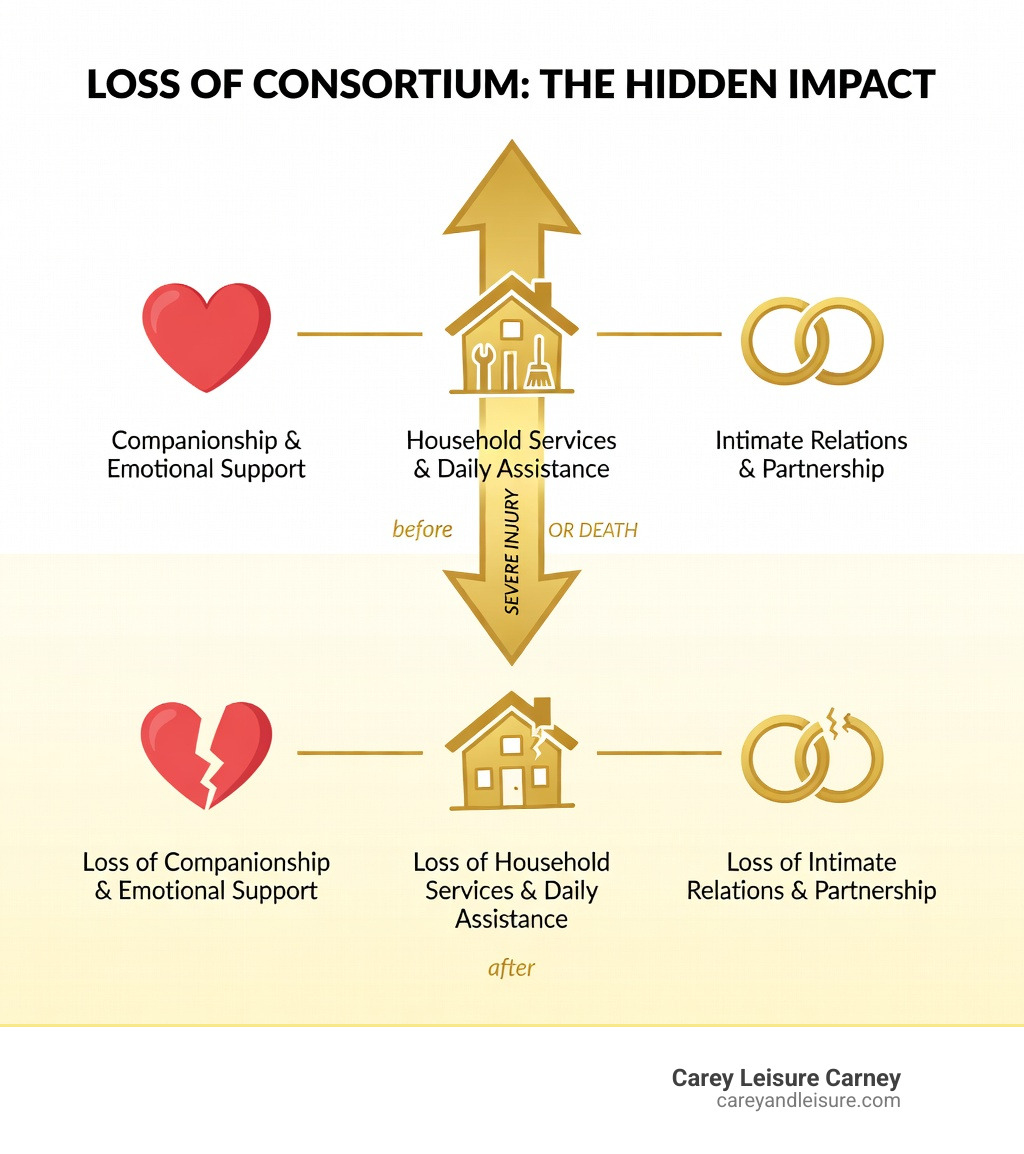
- What it covers: Loss of love, affection, companionship, sexual relations, emotional support, and household services
- Who can file: Spouses, unmarried domestic partners (in Florida), and in some cases, parents or minor children
- When it applies: Severe, permanent, or life-altering injuries, or wrongful death
- Claim type: Non-economic damages, filed alongside the injured person’s lawsuit
- Key requirement: Must prove the relationship was permanently altered by the injury
When someone you love is catastrophically injured in an accident, the ripples extend far beyond medical bills and lost wages. You may become a full-time caregiver instead of a partner. Your conversations shift from shared dreams to medication schedules. The person you built a life with may still be physically present, but the relationship you cherished has fundamentally changed.
This is the reality behind loss of consortium claims—a recognition that negligence doesn’t just harm the victim; it damages the family unit itself. These claims acknowledge that when a traumatic brain injury erases your spouse’s personality, or a spinal cord injury ends your shared activities, you’ve suffered a real, compensable loss even though you weren’t physically hurt.
In Florida personal injury and wrongful death cases, the law permits family members to seek compensation for these intangible losses. Unlike economic damages that cover medical expenses or lost income, loss of consortium addresses the emotional and relational devastation that often proves even harder to bear than financial hardship.
As Thomas W. Carey, I’ve guided families through loss of consortium claims for over three decades, helping spouses, parents, and children secure recognition for the profound ways negligence has altered their most important relationships. These claims require sensitive handling and a deep understanding of both Florida law and the human cost of catastrophic injury.
Loss of consortium further reading:
What is loss of consortium?

In the simplest terms, loss of consortium refers to the deprivation of the benefits of a family relationship. While the injured person seeks compensation for their physical pain and financial losses, their loved ones may seek damages for the “intangible” benefits that have vanished.
According to the Loss of consortium definition provided by legal experts, these are considered non-economic damages. They don’t have a specific receipt or invoice attached to them, but they are incredibly valuable to the quality of human life.
The Evolution of the Claim
The history of loss of consortium is quite fascinating, if a bit outdated. Under old English common law, a husband was essentially considered to have a “property interest” in his wife. If she was injured, he could sue for the loss of her “services” (housework) and “society” (companionship). Interestingly, for a long time, wives did not have the same right to sue if their husbands were injured.
This changed significantly with the landmark case Hitaffer v. Argonne (1950), which recognized that a wife has an equal right to the companionship and services of her husband. Today, the law views marriage as a partnership of equals.
Key Elements of Consortium
When we talk about “consortium” in a modern Florida courtroom, we are looking at several distinct elements:
- Love and Affection: The emotional bond and warmth between partners.
- Companionship: The ability to spend time together, share hobbies, and enjoy each other’s presence.
- Sexual Relations: The loss of intimacy or physical connection.
- Household Services: Practical help like cooking, cleaning, child-rearing, and home maintenance.
- Emotional Support: The “shoulder to lean on” during difficult times.
Proving a Loss of Consortium Claim in Florida
Proving a claim for loss of consortium in Florida requires more than just showing that an accident happened. Because these damages are non-economic, they are inherently subjective. To succeed, we must demonstrate a clear “proximate cause”—meaning the defendant’s negligence directly led to the breakdown or impairment of the relationship.
Economic vs. Non-Economic Damages
It helps to understand where this fits into a larger personal injury case. In Florida, damages are typically split into two categories:
| Feature | Economic Damages | Non-Economic Damages |
|---|---|---|
| Examples | Medical bills, lost wages, therapy costs | Pain and suffering, loss of consortium, mental anguish |
| Quantification | Easy to calculate with bills and paystubs | Difficult to quantify; relies on jury discretion |
| Documentation | Receipts, invoices, tax returns | Journals, testimony, expert witness opinions |
For a deeper dive into how these categories work in our state, see our guide on Understanding pain and suffering compensation.
Evidence Requirements
In Clearwater and across Florida, courts look for specific types of evidence to validate a claim:
- Testimony: This is the most powerful tool. The uninjured spouse or family member must often testify about how the relationship has changed.
- Relationship Journals: We often advise our clients to keep a journal documenting daily struggles—times when the injured partner couldn’t attend a child’s graduation, or nights when the pain was too great for intimacy.
- Medical Expert Witnesses: Doctors can testify about the “permanent injury” status. If an injury is permanent, the loss of consortium is also likely permanent, which significantly increases the value of the claim.
- “Before and After” Evidence: Photos of the couple hiking or traveling before the accident contrasted with the reality of a hospital bed or wheelchair can be very moving for a jury.
Injuries Leading to Claims
Not every “fender bender” qualifies for a loss of consortium claim. In Florida, the injury usually needs to be “significant and permanent.” Common injuries we see in these cases include:
- Traumatic brain injuries (TBI) that alter personality or cognitive function.
- Spinal cord injuries resulting in paralysis.
- Catastrophic injuries like amputations or severe disfigurement.
- Chronic, debilitating neck and back injuries.
Who is Eligible to File for Relational Damages?
While spouses are the most common claimants, Florida law has expanded to recognize that other family members suffer when a loved one is hurt.
Spousal Rights and Same-Sex Marriage
The most straightforward claim is made by a legal spouse. Following the legalization of same-sex marriage, these rights extend fully to all married couples. You can read more about the evolution of Same-sex marriage and consortium claims to see how the law has modernized.
Children and Parents
In Florida, the “filial” (parent-child) relationship is also protected, but with specific caveats:
- Minor Children: A minor child can sometimes claim loss of parental consortium if a parent suffers a “significant permanent injury” that destroys the parent-child relationship.
- Parental Claims: Conversely, parents may be able to claim damages if their minor child is catastrophically injured or killed.
Wrongful Death
If the injury is fatal, the loss of consortium claim becomes part of a larger wrongful death claim. In these tragic cases, the “loss of net accumulations” and the emotional loss of the survivor are central to the lawsuit. We also handle specialized cases such as funeral home malpractice when a family’s grief is compounded by negligence.
Unmarried Domestic Partners
Florida is one of the more progressive states regarding “relational interest.” In certain circumstances, unmarried domestic partners may be eligible to bring a claim, provided they can prove a stable, long-term, committed relationship that mirrors a marriage.
The Derivative Nature and Challenges of the Lawsuit
It is vital to understand that a loss of consortium claim is “derivative.” This means the claim “derives” from the injured person’s underlying personal injury case. If the injured person cannot prove that the defendant was negligent, the spouse’s claim for loss of consortium will also fail.
Privacy Concerns and Defense Strategies
This is the part of the guide where we have to be very honest: filing for loss of consortium can be intrusive. Because you are asking for money based on the quality of your relationship, the defense will try to prove that the relationship wasn’t that great to begin with.
Common defense strategies include:
- Prior Separations: If the couple lived apart or filed for divorce in the past, the defense will use this to argue the “loss” wasn’t caused by the accident.
- Infidelity: Evidence of affairs can be brought up to diminish the “value” of the companionship.
- Social Media Scrutiny: Defense attorneys will scour your Facebook and Instagram. If you post a photo of yourself smiling at a party, they may argue you aren’t actually suffering from a loss of companionship.
Jury Discretion and Comparative Negligence
There is no “calculator” for these claims. A jury in Clearwater or St. Petersburg will listen to the evidence and decide what the loss is worth based on their own impressions. This makes the valuation “speculative.”
Additionally, Florida’s comparative negligence laws apply. If the injured spouse was 20% at fault for the slip and fall or car accident, the loss of consortium award will likely be reduced by that same 20%.
Frequently Asked Questions about Loss of Consortium
What is the statute of limitations for a loss of consortium claim in Florida?
In Florida, the statute of limitations for most personal injury claims—including the derivative loss of consortium claim—is generally two years from the date of the accident. If the claim involves a wrongful death, the timeline is strictly two years from the date of death. Missing these deadlines can permanently bar you from seeking compensation.
How are damages calculated for loss of consortium?
As mentioned, there is no fixed formula. However, juries often look at:
- The age of the couple.
- The stability of the marriage before the accident.
- The life expectancy of both parties.
- The severity of the deprivation (e.g., is the spouse now a 24/7 caregiver?).
- The nature of the services lost (e.g., did the injured spouse handle all the finances and home repairs?).
Can I file for loss of consortium if my partner survived the accident?
Yes! In fact, many of the largest loss of consortium awards occur in non-fatal cases where the survivor requires lifelong care. A traumatic brain injury or spinal cord damage can leave a spouse physically present but emotionally or mentally absent, which is a profound loss that the law recognizes and compensates.
Conclusion
At Carey Leisure Carney, we understand that an accident doesn’t just happen to one person—it happens to a whole family. Whether the injury resulted from negligent security, a dog bite, or a complex premises liability case, the impact on your marriage and home life is real.
Our Board-Certified attorneys have over 100 years of combined experience in Clearwater, Largo, and the surrounding Florida communities. We specialize in navigating the sensitive nature of these claims, ensuring that the “hidden losses” of an accident are brought to light and properly compensated.
If your spouse or family member has been severely injured due to medical malpractice or any other form of negligence, you don’t have to carry the emotional burden alone. To understand what your personal injury case is worth and to explore your rights regarding loss of consortium, we invite you to reach out for a personalized consultation.
We provide direct attorney access and a compassionate approach to personal injury lawsuits, helping you seek justice for every way your life has changed. Check out our personal injury settlement examples to see how we’ve helped others, or read our catastrophic injury complete guide for more information.
Contact a Clearwater wrongful death attorney today to schedule your free case evaluation.