

Don’t Get Wrecked Twice: The Essential Guide to Finding Your Motorcycle Crash Attorney
Why Motorcycle Crash Attorneys Are Your First Line of Defense After an Accident
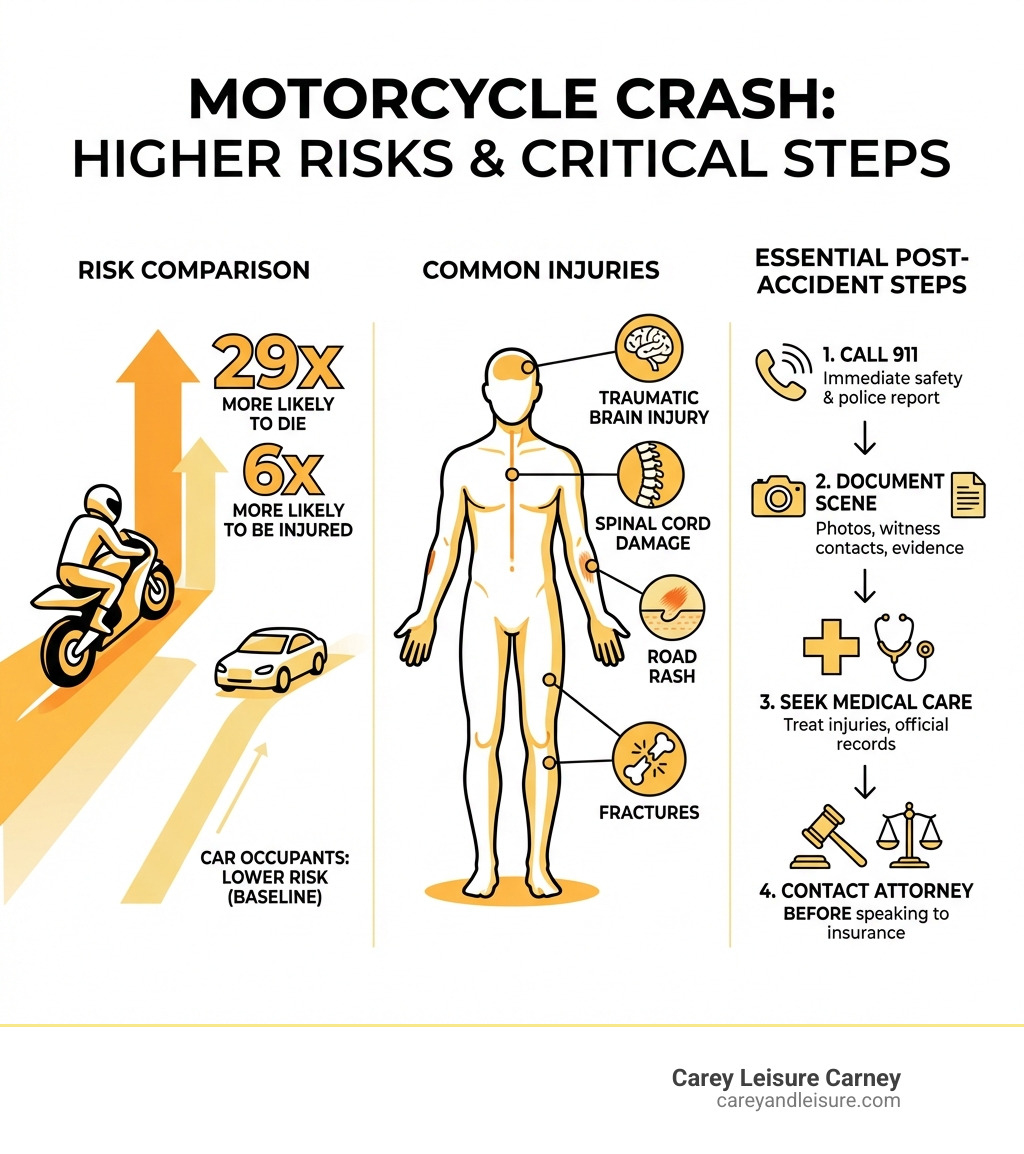
Motorcycle crash attorney services are essential because motorcyclists are 29 times more likely to die and six times more likely to be injured in a crash compared to car drivers. After an accident, you need immediate help to:
- Protect your legal rights from insurance companies seeking low settlements.
- Gather critical evidence like police reports, photos, and medical records.
- Steer complex insurance claims often biased against motorcyclists.
- Calculate your full damages, including future medical care and lost wages.
- Meet strict legal deadlines (typically 2-4 years depending on your state).
The freedom of riding comes with devastating vulnerability. With no protective shell, airbags, or seatbelts, a crash can lead to catastrophic injuries, mounting bills, and insurance adjusters who stereotype you as a “reckless rider.” The aftermath is overwhelming—you’re in pain, unable to work, and facing an insurance company already building a case to minimize or deny your claim.
You need a specialized advocate who understands motorcycle accident law. These claims involve unique challenges like severe injuries, rider bias, and complex liability. The insurance company has a team of lawyers protecting their bottom line; you deserve the same expertise fighting for your recovery.
I’m Thomas W. Carey, founding partner of Carey Leisure Carney. As a board-certified civil trial lawyer since 1988, I’ve guided thousands of injury cases—including complex motorcycle crash claims—to secure multi-million-dollar results for riders across Florida. This guide will explain how to protect your rights, build a strong claim, and choose the right motorcycle crash attorney to maximize your compensation.
The High Stakes of a Motorcycle Crash: Unique Dangers and Immediate Actions
Motorcyclists have a unique connection to the road, but this also exposes them to severe risks. Lacking the protective features of a car, riders are profoundly vulnerable, and even a minor collision can become a life-altering event.

The statistics are stark, but these aren’t just numbers; they represent lives irrevocably changed and futures derailed. The aftermath of a motorcycle crash involves severe injuries and shock because a rider’s body absorbs the full impact. This vulnerability highlights the importance of knowing what to do after a crash to protect your health and legal rights.
Common Motorcycle Accident Injuries and Their Impact
When a motorcyclist is involved in a collision, the injuries sustained are frequently catastrophic. We often see a range of severe injuries, each with its own potential for long-term consequences:
- Road Rash: More than a simple scrape, severe road rash can remove layers of skin and muscle, causing infections, nerve damage, and permanent scars that may require skin grafts.
- Traumatic Brain Injuries (TBI): Even with a helmet, the head is vulnerable. TBIs range from concussions to severe brain damage, causing cognitive issues, memory loss, and lifelong disability.
- Spinal Cord Injuries: Impacts to the back or neck can damage the spinal cord, leading to paralysis, chronic pain, and loss of bodily function.
- Broken Bones and Fractures: Crash forces often cause multiple fractures in the limbs, pelvis, and ribs, which may require surgery and lead to permanent mobility loss or chronic pain.
- Amputations: Severe accidents can crush or sever limbs, requiring amputation and drastically changing a victim’s life.
- Internal Injuries: Torso trauma can damage internal organs, causing internal bleeding and other life-threatening complications that need immediate surgery.
These injuries often demand extensive, long-term medical treatment and rehabilitation. The emotional and psychological toll can be equally devastating, leading to PTSD, depression, and anxiety. For more on severe injuries and their impact, you can refer to insights provided by the Insurance Information Institute.
Critical Steps to Take Immediately After an Accident
The moments following a motorcycle accident are chaotic, but your actions can profoundly impact your health and future legal claim. Here are the critical steps to take:
- Call 911 Immediately: This ensures medical professionals assess your injuries and law enforcement creates an official accident report, which is crucial evidence.
- Seek Medical Evaluation: Accept medical attention at the scene and visit an ER or your doctor as soon as possible. Some serious injuries, like TBIs or internal bleeding, aren’t immediately apparent. Thorough medical documentation is the bedrock of your case.
- Document the Scene (If Able): If your injuries permit, take photos and videos of everything: vehicle damage, road conditions, traffic signs, skid marks, and any visible injuries.
- Gather Witness Information: Get names and contact information from anyone who saw the accident. Independent witnesses provide invaluable testimony.
- Report to Police: Ensure a police report is filed. It contains initial observations, witness statements, and sometimes a preliminary determination of fault.
- Avoid Admitting Fault: Do not apologize or admit fault. Statements made at the scene can be used against you by insurance companies.
- Preserve Evidence: Do not repair or salvage your motorcycle without proper documentation. Preserve damaged gear, including your helmet, as it can provide evidence of impact.
Your health is paramount. Follow all medical advice diligently, as deviations from your treatment plan can be used by insurance companies to devalue your claim.
Building Your Claim: Common Causes, Proving Fault, and Crucial Evidence
After addressing your immediate safety and medical needs, the next phase is understanding how the accident happened and who was at fault. This is where the legal battle begins.

Many people wrongly blame motorcyclists for accidents, assuming reckless behavior. However, data shows a different story: in two-thirds of multi-vehicle motorcycle accidents, the other driver violated the motorcycle’s right-of-way, causing the collision.
The Most Common Causes of Motorcycle Accidents
Motorcycle accidents are typically the result of specific acts of negligence by other drivers. Here are some of the most common causes we see in Florida:
- Left-Turning Vehicles: A leading cause is a driver turning left who fails to see an oncoming motorcycle, misjudges its speed, or fails to yield. This makes intersections particularly dangerous.
- Unsafe Lane Changes / Blind Spots: Drivers who fail to check their blind spots before changing lanes can cause catastrophic accidents, as motorcycles can easily be hidden from view.
- Distracted Driving: Texting, talking on the phone, or other distractions take a driver’s focus off the road. According to the Insurance Information Institute (III), this causes thousands of deaths annually and is deadly for motorcyclists.
- Speeding Cars and Trucks: Excessive speed reduces a driver’s reaction time and increases impact force, creating significant hazards.
- Failure to See the Motorcycle: Often, drivers simply fail to see motorcycles due to carelessness or “inattentional blindness.” This failure to detect riders is a primary cause of accidents.
- Road Hazards: Hazards like potholes, gravel, or debris are minor issues for cars but can cause a motorcyclist to lose control and suffer serious injuries.
- Drunk or Impaired Driving: Impaired driving severely affects judgment, coordination, and reaction time, making drunk drivers a lethal threat to motorcyclists.
Understanding ‘Comparative Negligence’ in Your Case
Florida operates under a “pure comparative negligence” system. This means you can still recover damages even if you were partially at fault, but your compensation will be reduced by your percentage of fault. For example, if you are found 20% at fault for an accident with $100,000 in damages, you would receive $80,000.
This system is why an experienced motorcycle crash attorney is so crucial. Insurance companies will aggressively try to shift blame onto you to reduce their payout. We work to ensure fault is fairly apportioned based on evidence, not bias.
Essential Evidence for a Strong Motorcycle Accident Claim
Building a strong claim requires meticulous evidence collection. Here’s what we typically gather:
- Police Reports: An official account of the accident, witness information, and sometimes a preliminary finding of fault.
- Photos and Videos: Visual evidence from the scene (damaged vehicles, road conditions, injuries) is incredibly powerful. Dashcam or surveillance footage can be invaluable.
- Witness Statements: Independent witnesses can corroborate your account and counter biased narratives.
- Medical Records: All documentation of your injuries, treatment, and medical bills, which establish the extent and cost of your injuries.
- Damaged Gear and Property: Your damaged motorcycle, helmet, and gear are physical evidence of the crash’s severity.
- Expert Testimony: In complex cases, we may use accident reconstructionists, medical experts, and economic experts to prove fault and calculate future damages.
The goal is to paint a clear, undeniable picture of how the accident occurred and the full extent of your damages.
Why You Need a Motorcycle Crash Attorney: Navigating Insurance and Bias
After a traumatic crash, you shouldn’t have to battle aggressive insurance companies while recovering from severe injuries. An experienced motorcycle crash attorney is essential. We stand between you and the tactics designed to minimize your payout, fighting for your rights and ensuring you receive fair treatment.
The Role of an Experienced Motorcycle Crash Attorney
When you’re injured, your focus should be on recovery. Our role is to handle all the complexities of your claim, allowing you to heal. Here’s how we help:
- Case Investigation: We conduct a thorough investigation, gathering all necessary evidence, including police reports, medical records, and witness statements to build the strongest possible case.
- Calculating Total Damages: We work with medical and economic experts to accurately calculate your full damages, including future medical care, lost wages, and pain and suffering.
- Handling All Communications: We become your single point of contact for all legal and insurance matters, so you won’t have to deal with aggressive adjusters or confusing paperwork.
- Negotiating with Insurers: We have extensive experience negotiating with insurance companies. We know their tactics and how to counter them to secure a fair settlement.
- Filing Lawsuits and Court Representation: If a fair settlement cannot be reached, our board-certified attorneys are prepared to take your case to court and fiercely advocate for your rights.
Our commitment is to your long-term stability, not just a quick settlement.
How Insurance Companies Handle Motorcycle Claims
Insurance companies are businesses focused on minimizing payouts. After a motorcycle accident, they employ various tactics:
- Lowball Settlement Offers: They may offer a quick, small settlement, hoping you’ll accept before understanding your long-term costs. Never accept an offer without consulting your attorney.
- Requesting Recorded Statements: Adjusters may ask for a recorded statement to twist your words and devalue your claim. Refer all such requests to your attorney. As Investopedia explains, an insurance adjuster’s job is to find information to limit your settlement.
- Delaying Tactics: They may drag out the process, hoping you’ll become frustrated and accept a lower offer.
- Disputing Injury Severity: Insurers often question the severity of your injuries, suggesting they are pre-existing or not caused by the accident.
- Using the “Reckless Rider” Stereotype: Insurance companies often try to portray motorcyclists as reckless to imply you were at fault. We aggressively challenge this unfair bias.
Overcoming Bias Against Motorcyclists
One of the most frustrating aspects of these claims is the pervasive bias against riders. Insurance adjusters and even jurors may assume motorcyclists are reckless, leading to unfair blame and reduced compensation.
We understand this bias and work to overcome it by building a fact-based narrative that highlights the other driver’s negligence. We use evidence to prove you are a responsible rider, not a “daredevil.” This includes:
- Presenting your clean driving record.
- Demonstrating your adherence to Florida’s motorcycle laws.
- Highlighting your participation in motorcycle safety courses.
- Utilizing accident reconstruction to prove the other driver’s fault.
Our goal is to ensure your case is judged on its merits, not on unfair stereotypes.
The Road to Recovery: Understanding Compensation, Timelines, and Choosing Your Lawyer
Navigating the aftermath of a motorcycle accident involves understanding your potential compensation and the legal process. With the right legal team, you can focus on healing while we handle the heavy lifting.
What Compensation Are You Entitled To?
If another’s negligence caused your motorcycle accident, you may be entitled to economic and non-economic damages. Unlike car accidents, Florida’s Personal Injury Protection (PIP) “no-fault” insurance does not apply to motorcycles. This means your claim for medical expenses goes directly against the at-fault driver’s liability insurance.
Here’s a breakdown of potential damages:
- Economic Damages (Quantifiable Financial Losses):
- Medical Expenses (Past and Future): All costs for ER visits, hospital stays, surgery, therapy, medication, and long-term care.
- Lost Wages: Compensation for income lost while unable to work.
- Loss of Earning Capacity: Compensation for a long-term reduction in your ability to earn income.
- Property Damage: Cost to repair or replace your motorcycle and damaged gear.
- Non-Economic Damages (Non-Monetary Losses):
- Pain and Suffering: Compensation for physical pain and discomfort.
- Emotional Distress: For anxiety, depression, and trauma resulting from the accident.
- Loss of Enjoyment of Life: For the inability to engage in hobbies and activities you once enjoyed.
In Florida, motorcycle injury claimants do not have to prove a permanent injury to recover these damages, a critical distinction your motorcycle crash attorney will leverage.
Legal Deadlines and the Typical Claim Timeline
Time is of the essence. Florida’s statute of limitations gives you two years from the date of the accident to file a personal injury lawsuit. Missing this deadline means losing your right to seek compensation forever.
The claim timeline can vary widely:
- Initial Investigation & Medical Treatment (Weeks to Months): We gather evidence while you undergo medical treatment. Fully understanding your prognosis is key to valuing your claim.
- Negotiation (Months): Once we have a clear picture of your damages, we submit a demand to the insurer and begin negotiations. Many cases settle here.
- Litigation (1-3+ Years): If negotiations fail, we file a lawsuit. This involves findy (exchanging information), mediation, and potentially a trial. While most cases settle before trial, we are always prepared to go the distance for you.
How to Choose the Right Motorcycle Crash Attorney
Choosing the right motorcycle crash attorney is a critical decision. It requires specialized knowledge. Here’s what to look for:
- Board Certification: Seek attorneys Board-Certified in Civil Trial Law. Held by only 2% of Florida lawyers, this signifies elite experience. Carey Leisure Carney has multiple Board-Certified attorneys, offering top-tier representation.
- Specific Experience with Motorcycle Cases: Ensure your attorney has a proven track record with motorcycle accident claims, which have unique legal nuances and biases.
- Trial Record: You need an attorney with a successful trial record. Insurers offer better settlements when they know your lawyer is prepared to fight in court.
- Client Testimonials and Reputation: Check reviews and testimonials. A strong reputation for client satisfaction and successful outcomes indicates a quality firm.
- Direct Attorney Access and Personalized Service: Don’t be just a case number. Seek a firm offering direct attorney access and personalized attention. At Carey Leisure Carney, we pride ourselves on this direct, client-focused approach.
- Contingency Fee Structure: Reputable firms, including ours, work on a contingency fee basis. You pay no upfront fees, and we only get paid if we win your case.
We have locations in Clearwater, Largo, New Port Richey, Spring Hill, St Petersburg, Trinity, and Wesley Chapel, Florida, ready to serve you.
Conclusion
Riding a motorcycle offers a unique freedom, but it also carries unique risks. If you’ve been involved in a motorcycle crash in Florida, you’re facing significant challenges: severe injuries, mounting medical bills, lost wages, and the daunting task of battling insurance companies often biased against riders.
Don’t get wrecked twice by trying to steer this complex legal landscape alone. An experienced motorcycle crash attorney is your strongest ally, providing the expertise, resources, and advocacy needed to protect your rights and secure the compensation you deserve. We understand the nuances of Florida law, the tactics of insurance adjusters, and how to effectively counter unfair stereotypes.
At Carey Leisure Carney, we bring over a century of combined experience and board-certified specialization to every case. We provide personalized service, direct attorney access, and a relentless commitment to achieving the best possible outcome for your recovery and future. Let us handle the legal fight so you can focus on what truly matters: your healing.
Contact a motorcycle accident attorney for a free consultation today. We’re here to help you get back on the road to recovery.