

Denied claim attorney: 3 Steps to Win
When an Insurance Claim Denial Threatens Your Recovery
A denied claim attorney specializes in helping policyholders challenge insurance companies that refuse to pay legitimate claims, using legal expertise to appeal denials, fight bad faith tactics, and secure the compensation you’re entitled to under your policy.
When You Need a Denied Claim Attorney:
- Your insurance claim was denied, underpaid, or unreasonably delayed
- The insurance company is requesting excessive documentation or making unreasonable demands
- Your claim involves complex policy language or disputed coverage terms
- You suspect the insurer is acting in bad faith (misleading you, failing to investigate properly, or pressuring you to accept less)
- The claim value is substantial, involving significant medical bills, property damage, or lost income
- You’ve exhausted internal appeals and need legal representation for negotiation or litigation
You faithfully pay premiums for health, auto, property, and disability insurance, trusting your insurer will honor its promise when disaster strikes. But insurance companies deny thousands of claims every day, often prioritizing their bottom line over your legitimate needs.
After an accident, you cooperate with the investigation, provide all the paperwork, and expect your insurer to cover your losses. Then the news comes back: claim denied. The frustration, on top of dealing with medical bills, property damage, and lost wages, can feel overwhelming.
But a denial letter is not the final word. Insurers are for-profit businesses that employ teams to find reasons to deny or reduce claims. A denied claim attorney is essential because they understand complex policy language, know insurer tactics, and can fight back with legal expertise.
This guide explains why claims get denied, how to recognize bad faith practices, what a denied claim attorney does, and the steps to take after a denial. Whether you’re facing a denied auto, property, health, or disability claim, understanding your rights is the first step toward getting the compensation you deserve.
As Thomas W. Carey, a board-certified civil trial lawyer who has handled roughly 40,000 injury matters in Florida since 1988, I’ve seen how insurers exploit policies to deny valid claims—and how a skilled denied claim attorney can turn denials into fair recoveries. My firm specializes in holding insurers accountable.
Why Insurance Companies Deny Valid Claims
Insurance companies are for-profit businesses. Their goal to minimize payouts often leads to denied or undervalued claims, a situation we see regularly across Florida.
Common Reasons for Denial Across Policy Types
Insurers use many reasons to deny claims, some legitimate and many not. Here are the most common:
- Profit Motive: At the heart of many denials is the insurer’s desire to protect its profits. Paying out less means more money for them.
- Complex Policy Language: Insurance policies are notoriously dense, filled with jargon, exclusions, and conditions that can be incredibly difficult for the average person to understand. Insurers often exploit this complexity, using technicalities or vague language to justify a denial.
- Exclusions and Conditions: Many policies have specific exclusions (things not covered) or conditions (things you must do for coverage to apply). For example, a standard homeowner’s policy generally won’t cover flood damage unless you have a separate flood insurance policy. Similarly, auto claims might be denied if you used your personal vehicle for commercial purposes without informing your insurer.
- Insufficient Evidence: The insurance company might claim you haven’t provided enough proof of your loss or injury. This can include lack of proper documentation, photos, videos, medical records, or repair estimates.
- Missed Deadlines: Policies often have strict deadlines for notifying the insurer of a loss or filing a claim. Missing these can result in a denial, even if your claim is otherwise valid.
- Alleged Misrepresentation: Insurers might claim you misrepresented facts on your application, such as prior claims, health issues, or how a vehicle is used. They might even try to cancel your policy retroactively.
- Incomplete Information: Simple errors like incorrect billing codes, missing information, or unreturned requests for additional documents can lead to denials.
- Lack of Maintenance: For property claims, insurers might argue that damage was due to a lack of proper maintenance, rather than a sudden, covered event.
- Disputed Liability/Facts: In auto accident claims, the insurer might dispute who was at fault, or the extent of your injuries. They might argue that your injuries were pre-existing or not caused by the accident.
- Underpayment of Claims: Rather than an outright denial, insurers might offer a “lowball” settlement that doesn’t adequately cover your damages.
Here’s a quick look at how claim denials can differ across various types of insurance:
| Claim Type | Common Denial Reasons |
|---|---|
| Property (Home/Commercial) | Policy exclusions (e.g., flood, mold, wear and tear), insufficient documentation of damage, disagreement on damage valuation, alleged lack of maintenance, cause of loss disputed (e.g., hurricane vs. pre-existing), high deductibles. Commercial property claims can be especially complex due to business interruption losses. |
| Auto | Disputed liability, insufficient evidence of injury/damage, policy exclusions (e.g., using personal car for commercial purposes like Uber/Lyft without proper coverage), driving under the influence, unlicensed driver, fraud/misrepresentation, delay in seeking medical treatment, inadequate settlement offers. Florida’s PIP (Personal Injury Protection) can also have complex denial reasons. |
| Health | “Not medically necessary,” “experimental” treatment, out-of-network provider, lack of prior authorization, clerical errors, pre-existing conditions, late filing. According to AARP, 200 million health insurance claims are denied annually. |
| Disability | Not meeting the policy’s definition of “disabled,” insufficient medical evidence, failure to follow prescribed treatment, misrepresentation, lack of “objective” evidence for subjective conditions (like chronic pain or mental health issues). A majority of disability insurance claims nationwide are denied in the initial application process. |
The Difference Between a Legitimate Denial and Bad Faith
Not all denials are wrongful; sometimes, a claim isn’t covered or you failed to meet a policy requirement. This is a legitimate denial.
However, a denied claim attorney often deals with bad faith. Florida law requires insurers to act in good faith, meaning they must investigate thoroughly, communicate promptly, and settle claims when liability is clear. When an insurer unreasonably denies, delays, or underpays a valid claim without a legitimate basis, they may be acting in bad faith, which is illegal. Our team at Carey Leisure Carney are experts in fighting bad faith tactics to turn an unfair denial into a powerful legal claim.
The Role of a Denied Claim Attorney in Your Fight for Justice
When an insurer denies your claim, it feels like an unfair fight. A skilled denied claim attorney levels the playing field, using legal expertise and resources to counter the insurer’s tactics.

How a Denied Claim Attorney Deciphers Complex Policy Language
Insurance policies are complex legal contracts filled with jargon. Insurers often use this complexity to deny claims based on obscure clauses.
Our attorneys at Carey Leisure Carney have spent decades studying and interpreting these documents. We know how to:
- Identify Coverage: We carefully review your policy to pinpoint exactly what coverage applies to your specific loss or injury.
- Challenge Exclusions: We analyze any cited exclusions to determine if they genuinely apply to your situation or if the insurer is misinterpreting them.
- Clarify Ambiguous Terms: If policy language is vague or open to interpretation, we argue for the interpretation that favors you, the policyholder.
- Uncover Legal Loopholes: We understand how insurers use legal loopholes and technicalities to avoid paying and develop strategies to counter them.
- Examine Endorsements and Riders: We ensure all additional coverages or modifications to your policy are properly considered.
We ensure that the insurance company cannot hide behind convoluted language to deny you what you are rightfully owed.
Strengthening Your Case with Evidence and Expert Support
A claim is only as strong as its evidence. After a denial, the burden of proof is on you. A denied claim attorney works to gather, organize, and present compelling evidence to bolster your claim.
This often involves:
- Gathering Documentation: We collect all relevant paperwork, including your policy, the denial letter, medical records, police reports, repair estimates, photos, videos, and any other correspondence.
- Hiring Experts: For property claims, we might bring in independent public adjusters, engineers, or contractors to accurately assess damages and provide unbiased estimates. For personal injury or disability claims, we consult with medical professionals to document the full extent of your injuries and their impact on your life. We can even bring in accident reconstructionists for complex auto claims.
- Proving the Full Value of Your Loss: We don’t just look at immediate damages. We assess all potential losses, including future medical expenses, lost wages, pain and suffering, and loss of earning capacity, ensuring your claim reflects the true cost of your injury or damage.
Negotiating a Fair Settlement
With a robust case, we negotiate with the insurer. They often start with lowball offers, but we won’t let you accept less than you deserve.
Our negotiation process includes:
- Communicating with the Insurer: We handle all communications with the insurance company, protecting you from their tactics and ensuring every interaction is documented.
- Submitting a Demand Letter: We present a comprehensive demand letter outlining your damages and the legal basis for your claim.
- Countering Lowball Offers: We strategically counter any inadequate offers, providing a strong rationale for the compensation you deserve.
- Mediation: If direct negotiation stalls, we may pursue mediation, where a neutral third party helps facilitate a settlement discussion. (You can learn more about mediation at www.law.cornell.edu/wex/mediation).
- What is a Proposal for Settlement? In Florida, a “Proposal for Settlement” is a formal offer made by one party to another in a lawsuit. If the offer is rejected and the final judgment is at least 25% more favorable to the party who made the offer, that party may be entitled to recover attorney’s fees and costs. This can be a powerful tool in encouraging reasonable settlements and something we are well-versed in using (see our article What is a Proposal for Settlement?).
Our goal is always to secure the maximum financial recovery for you, whether through negotiation or, if necessary, by taking your case to court.
Recognizing and Combating Insurance Bad Faith
If your insurer drags their feet, denies your claim without good reason, or offers a pittance after you’ve paid premiums for years, it might be insurance bad faith.
Common Bad Faith Tactics Used by Insurers
Insurance bad faith occurs when an insurance company fails to uphold its duty to act fairly and honestly with its policyholders. In Florida, this is governed by Florida Statute 624.155. Our attorneys are keenly aware of the signs of bad faith, which can include:
- Unreasonable Delays: Prolonging the investigation, repeatedly requesting the same documents, or simply ignoring your calls and letters. Delays in processing claims are a common tactic used by insurance companies to wear down policyholders.
- Failure to Investigate: Not conducting a thorough and unbiased investigation into your claim. They might ignore crucial evidence or fail to interview key witnesses.
- Misrepresenting Policy Terms: Lying about what your policy covers, making misleading statements, or twisting policy language to deny your claim.
- Undervaluing Your Claim: Offering a settlement that is significantly less than the true value of your damages, often based on flawed assessments or algorithms that don’t account for accurate repair costs.
- Threatening the Policyholder: Using intimidation tactics or pressure to get you to accept a low offer or drop your claim entirely.
- Offering Less Than the Claim is Worth: This is a classic move. They know you need the money, so they hope you’ll take whatever they offer, even if it’s far below what you’re entitled to.
- Uncommunicated Policy Changes: Altering policy terms without proper notification to the insured.
Bad faith warning signs:
- Vague denials without a clear, specific reason.
- Excessive delays in communication or payment.
- Repeated requests for information you’ve already provided.
- Ignoring medical evidence or expert opinions.
- Pressure to accept a quick, low settlement offer.
- Threats to cancel your policy if you don’t comply.
Pursuing a Bad Faith Lawsuit
If your insurer acted in bad faith, we can pursue a lawsuit against them. This is separate from a claim appeal and argues the insurer breached its contract and acted unlawfully.
In a successful bad faith claim, you may recover more than the original claim amount, including:
- Additional Damages: Financial losses caused by the denial, such as attorney’s fees and court costs.
- Emotional Distress: Compensation for the mental anguish and stress caused by the insurer’s unfair practices.
- Punitive Damages: In egregious cases, courts may award punitive damages to punish the insurer for their misconduct and deter similar behavior in the future.
Florida law punishes insurers for acting in bad faith. Our firm, Carey Leisure Carney, has experience holding insurers accountable under Florida Statute 624.155 to ensure our clients receive full compensation. You can explore this further by visiting our page on Bad Faith Insurance Lawyers Near Me.
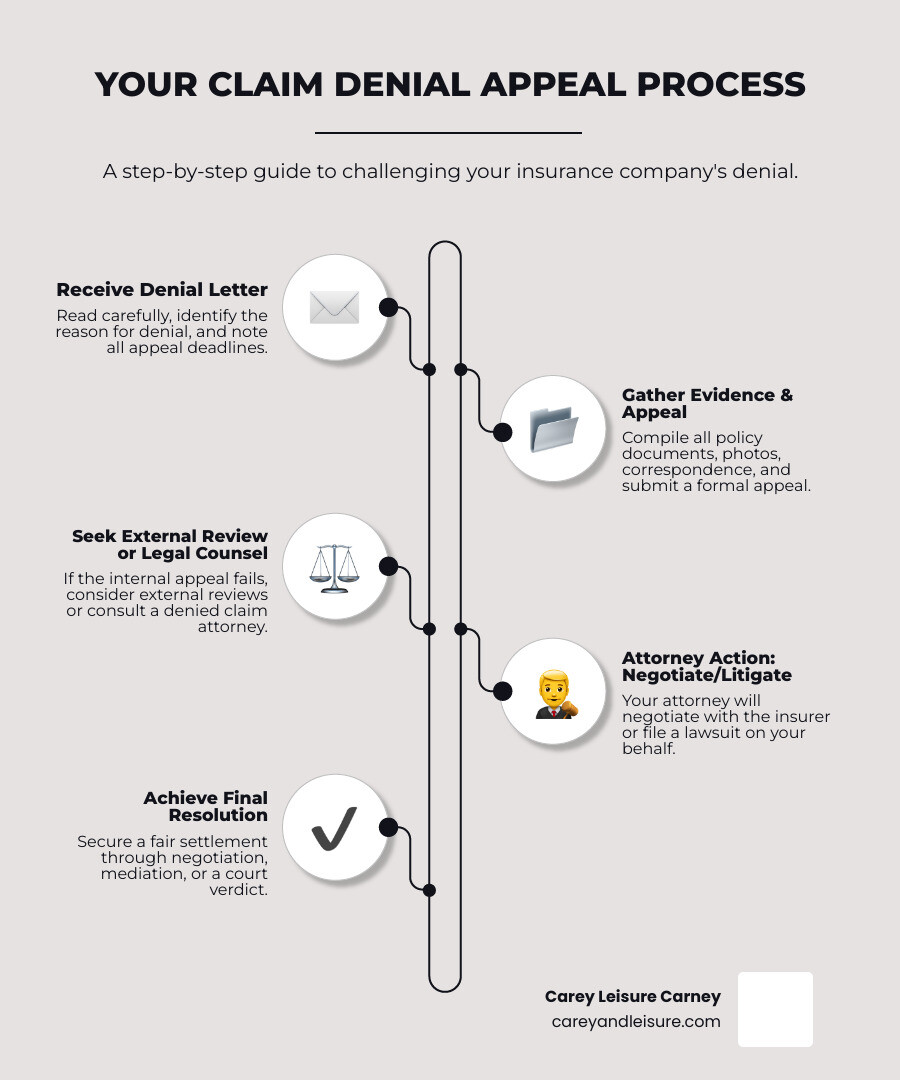
Your Step-by-Step Action Plan After a Denial
A denial letter is frustrating, but it’s not the end. It’s a signal to take control and fight for your rights. Acting quickly and methodically is key.
Step 1: Immediately After Receiving the Denial Letter
- Do Not Panic: Take a deep breath. This is a common tactic, and many denials are overturned.
- Read the Letter Carefully: The letter must state the specific reason for denial. Understanding this is the first step in your counter-argument.
- Note All Deadlines: Your denial letter will likely mention deadlines for appeals. Mark these down immediately and do not miss them. Missing an appeal deadline can severely jeopardize your case.
- Request Your Complete Claim File: You have a right to your entire claim file, including all notes, communications, and internal reports related to your claim. This information can be invaluable in understanding how the insurer processed your claim and identifying any potential bad faith.
Step 2: Gather Your Evidence and Build Your Appeal
The strength of your appeal is in your evidence. A well-documented case is harder for an insurer to ignore.
- Organize Your Policy Documents: Have your complete insurance policy readily available. Highlight sections related to your coverage and any exclusions mentioned in the denial letter.
- Collect Photos and Videos of Damage/Injury: For property damage, this includes before-and-after photos, videos of the damage, and any related repair estimates. For personal injury or disability claims, gather all medical records, doctor’s notes, test results, and prescriptions.
- Compile All Correspondence: Keep a detailed log of every phone call, email, and letter with the insurance company, noting dates, times, and the names of people you spoke with.
- Write a Formal Appeal Letter: This letter should clearly state your policy number, claim number, the date of denial, and why you believe the denial is incorrect. Reference specific policy language and attach all supporting documentation. Be factual, clear, and courteous. We often help clients draft these letters, ensuring they are legally sound and persuasive.
- How To Appeal a Denied Insurance Claim: The process involves submitting this detailed letter, often with additional evidence, to your insurer’s internal appeals department. If that fails, you may have the right to an external review by an independent third party, especially for health insurance claims (as per cms.gov/cciio/resources/fact-sheets-and-faqs/indexappealingdenials).
Step 3: When to Hire a Denied Claim Attorney vs. Handling It Alone
While you can appeal on your own, hiring a denied claim attorney is essential in certain situations:
- Simple Clerical Errors: If the denial is due to an obvious mistake, like a wrong billing code, you might be able to resolve it with a quick call to your provider or insurer.
- Complex Legal Disputes: If the denial involves complex policy language, disputed liability, or a significant amount of money, a lawyer’s expertise is invaluable.
- High-Value Claims: For substantial medical bills, extensive property damage, or long-term disability benefits, the stakes are too high to go it alone.
- Suspected Bad Faith: If you suspect the insurer is acting in bad faith (unreasonable delays, misleading information, etc.), you absolutely need a lawyer to hold them accountable.
- When the Insurer Refuses to Negotiate: If your internal appeal is denied and the insurer remains unyielding, legal intervention often forces them to take your claim seriously.
- Free Consultation Benefits: Many firms, including ours, offer a free initial consultation. This allows you to discuss your case, understand your options, and get a professional opinion without any financial commitment. It’s never too soon to talk to a lawyer.
Frequently Asked Questions about Denied Insurance Claims
Here are answers to common questions based on our experience serving clients throughout Florida.
What are my rights under Florida’s Homeowner’s Claims Bill of Rights?
Florida law provides specific protections for homeowners dealing with insurance claims. Under Florida’s Homeowners Claims Bill of Rights, you have several key rights:
- Right to Acknowledgement: Your insurance company must acknowledge your claim within 14 days of receiving it.
- Right to a Decision: Within 30 days of you submitting proof of loss, the insurer must inform you if your claim is fully covered, partially covered, or still under investigation.
- Right to Prompt Payment: The insurer must pay in full, pay the undisputed portion, or deny your claim within 90 days of submission.
- Communication Requirements: You have the right to receive prompt and fair communication throughout the claims process.
- Mediation Options: If you dispute a settlement offer or a denial, you may be entitled to mediation, and for sinkhole damage claims, a free Neutral Evaluation.
- Interest on Late Payments: For claims made after January 1, 2022, if your payment is late, the insurer may be responsible for paying interest.
These rights are crucial tools in holding your insurer accountable. Our denied claim attorneys are experts in ensuring your insurer adheres to these legal requirements.
How do claim denials differ for health, disability, and property insurance?
While the core principle of fighting denials remains, the specifics vary significantly:
- Health Insurance Appeals: The process typically involves an internal appeal with the insurance company, followed by an external review by an independent third party if the internal appeal fails. Federal law often entitles patients to this external review. You have 180 days to file an internal appeal after receiving a denial.
- ERISA for Employer-Provided Disability: Employer-provided disability insurance claims are often governed by a complex federal law called ERISA (Employee Retirement Income Security Act of 1974). This law has strict deadlines and procedural requirements. You must exhaust all administrative remedies (internal appeals) before filing a lawsuit, and there’s typically a 180-day deadline to appeal an ERISA claim denial.
- Property Claims: Denials often revolve around damage valuation, the cause of the loss (e.g., whether roof damage was from a hurricane or pre-existing wear and tear), or policy exclusions. Attorneys frequently work with independent adjusters and engineers to counter the insurer’s assessments.
- Auto Claims: These often involve disputes over liability (who was at fault), the extent of injuries, or policy interpretations regarding vehicle usage. Florida’s no-fault PIP coverage also has specific rules and potential denial points.
Each type of insurance has its own unique set of challenges and legal frameworks that a specialized denied claim attorney can steer.
How much does it cost to hire an attorney for a denied claim?
We know you’re facing financial strain, which is why we work on a contingency fee basis for denied insurance claims.
What does this mean for you?
- No Upfront Costs: You don’t pay us any attorney’s fees unless we successfully recover compensation for you.
- Attorney Fees Paid from Settlement: Our fees are a percentage of the settlement or award we secure on your behalf.
- How Fees Are Calculated: The percentage is agreed upon upfront, so there are no surprises.
- Insurer May Have to Pay Fees: In many Florida bad faith cases, if we win, the insurance company may be legally required to pay our attorney’s fees and costs, further reducing your out-of-pocket expense.
Our goal is to make legal representation accessible so you can fight for justice without worrying about immediate legal bills.
Get the Compensation You Deserve
A denied insurance claim is incredibly frustrating. You uphold your end of the bargain, but the insurer says “no.” However, a denial is not the final word; it’s the start of a battle you don’t have to fight alone.
This guide shows you have rights and legal options to challenge unfair denials. A dedicated denied claim attorney can decipher policies, gather evidence, combat bad faith, and negotiate fair settlements, making all the difference.
At Carey Leisure Carney, we are Board-Certified attorneys, a distinction held by only the top 2% of Florida lawyers. With over 100 years of combined experience, we offer direct attorney access and personalized service to clients in Clearwater, Largo, New Port Richey, Spring Hill, St. Petersburg, Trinity, and Wesley Chapel. We meet hardship with compassionate counsel and aggressive advocacy. Don’t let an insurance company’s denial add insult to injury.
Contact our bad faith insurance lawyers near you for a free consultation today. Let us help you resolve your case so you and your family can move forward.