
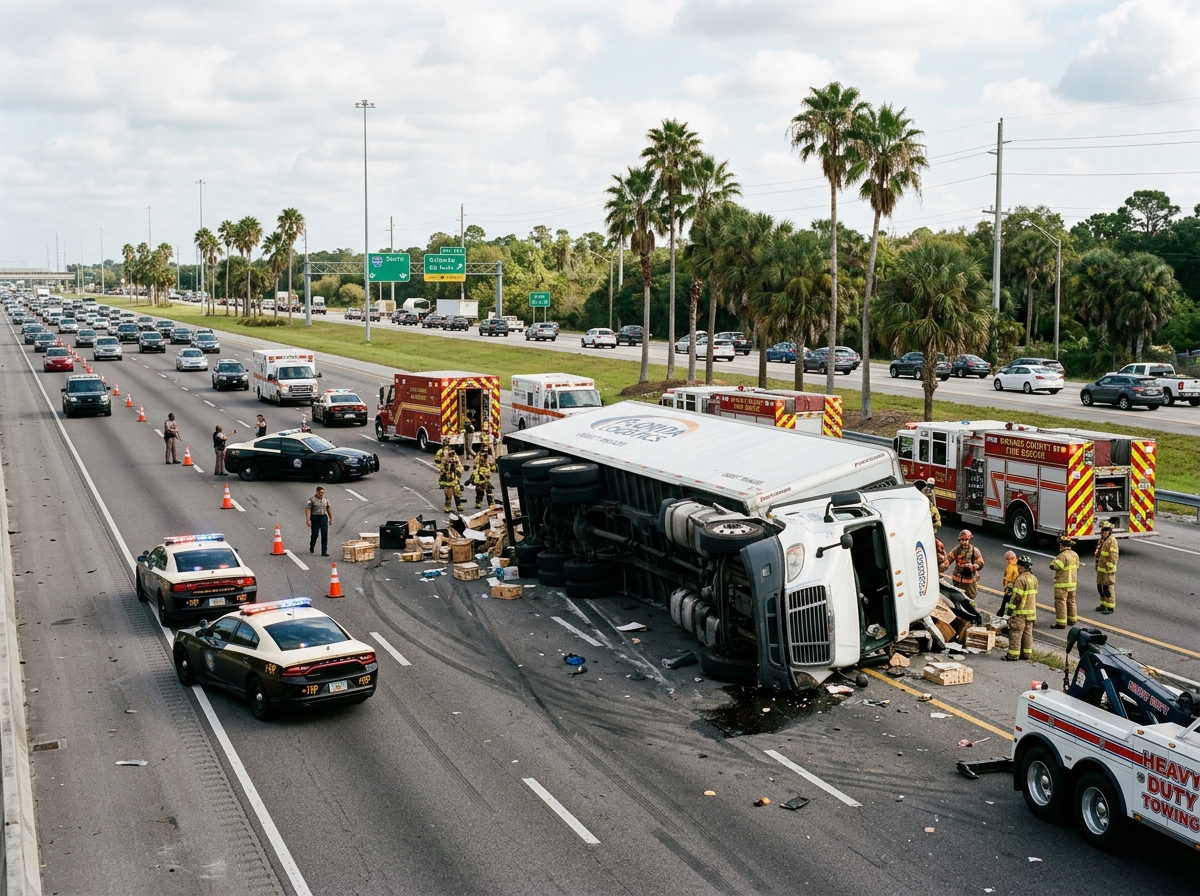
Drunk Drivers, Head-On Collisions, and Wrongful Death: Your Legal Options
When a Fatal Truck Accident Destroys Your Family: What You Need to Know
Truck accident wrongful death claims give families the legal right to seek compensation when a loved one is killed due to someone else’s negligence on the road.
Here’s a quick overview of your key legal options in Florida:
| Step | What It Means |
|---|---|
| File a wrongful death claim | A personal representative sues on behalf of surviving family members |
| Identify all liable parties | This can include the driver, trucking company, cargo loaders, and more |
| Recover damages | Compensation for lost income, funeral costs, and loss of companionship |
| Act within 2 years | Florida’s statute of limitations gives you two years from the date of death to file |
| Hire a specialized attorney | Trucking cases involve federal regulations and multiple insurers — complexity demands expertise |
Losing someone in a commercial truck crash is devastating. These aren’t ordinary accidents. A fully loaded semi-truck can weigh up to 80,000 pounds — and when one of those vehicles collides with a passenger car, the results are often fatal. In 2018 alone, large truck crashes killed 4,136 people across the U.S., with the vast majority being passenger vehicle occupants, not truck drivers.
Florida families face an especially difficult road ahead — not just emotionally, but legally. Trucking companies move fast to protect themselves. Evidence disappears. Insurance adjusters call early with low offers. Knowing your rights from the start can make all the difference.
I’m Thomas W. Carey, founding partner of Carey Leisure Carney and a board-certified civil trial lawyer with decades of experience handling truck accident wrongful death and serious injury cases across Florida. Having personally experienced the devastating loss of a loved one due to another driver’s negligence, I bring both legal skill and genuine understanding to every family I represent.
Simple guide to Truck accident wrongful death:
Understanding a Truck Accident Wrongful Death Claim in Florida

When we talk about a truck accident wrongful death claim, we are referring to a specific type of civil lawsuit. Under Florida Statutes, this claim arises when a person’s death is caused by the “wrongful act, negligence, default, or breach of contract” of another person or entity.
In the context of a commercial vehicle crash, this means that if your loved one would have been entitled to file a personal injury lawsuit had they survived, the estate now has the right to bring a claim for damages. According to the National Safety Council, large trucks frequently cause accidents that result in catastrophic loss of life, often due to the sheer size disparity between a commercial rig and a passenger vehicle.
In Florida, the law requires a “personal representative” to file the lawsuit. This individual is usually named in the deceased person’s will or appointed by the court. While the personal representative files the paperwork, they do so on behalf of the surviving beneficiaries, such as a spouse, children, or parents. Navigating these rules requires a deep understanding of Florida wrongful death laws, which dictate exactly who can recover what.
Common Causes of Fatal Commercial Vehicle Crashes
Commercial truck accidents are rarely “accidents” in the sense that they couldn’t be avoided. Most are the result of specific negligent behaviors.
- Drunk Driving and Impairment: Despite strict federal “zero-tolerance” policies, some drivers operate under the influence of alcohol or controlled substances.
- Head-On Collisions: These often occur when a fatigued driver drifts into oncoming traffic or attempts an unsafe pass on a two-lane road in areas like Spring Hill or Wesley Chapel.
- Driver Fatigue: Research shows that nearly 20% of long-haul truckers have admitted to falling asleep at the wheel. The pressure to meet deadlines leads many to ignore rest requirements.
- Distracted Driving: Whether it’s a cell phone, a GPS device, or eating while driving, a split second of distraction in an 80,000-pound vehicle is a recipe for tragedy.
- Mechanical Failure: Nearly one in five trucks on the road has defects so serious—like faulty brakes or worn tires—that they should be taken out of service immediately.
The physics involved in these crashes is terrifying. To help visualize why these accidents are so much more dangerous than standard car crashes, consider the impact force:
| Vehicle Type | Average Weight | Impact Force at 60 MPH |
|---|---|---|
| Passenger Car | 4,000 lbs | Baseline |
| Fully Loaded Semi | 80,000 lbs | 20x the force of a car |
When this much weight is involved, the human body simply cannot withstand the impact. This is why truck accident injuries are so frequently fatal for those in smaller cars.
Proving Negligence in a Truck Accident Wrongful Death Case
To win a truck accident wrongful death case, we must prove four key elements:
- Duty of Care: The truck driver and company had a legal obligation to operate safely.
- Breach of Duty: They failed that obligation (e.g., speeding, driving too many hours).
- Direct Causation: This failure directly caused the accident.
- Damages: The death resulted in actual financial and emotional losses for the survivors.
Proving these points requires high-tech evidence. We look at “Black Box” data (the Electronic Control Module) which records speed and braking patterns. We also analyze Electronic Logging Devices (ELD) to see if the driver violated federal hours-of-service rules. Understanding the truck accident claims process is about knowing how to secure this data before the trucking company “accidentally” deletes it.
Identifying Liable Parties Beyond the Truck Driver
One of the biggest mistakes families make is assuming only the truck driver is responsible. In reality, multiple parties may share the blame. This is known as multi-party liability, and it is a cornerstone of truck accidents and car crashes litigation.
- The Trucking Company: Under the doctrine of “vicarious liability,” employers are responsible for the actions of their drivers. They can also be sued for negligent hiring or failing to train their staff properly.
- Maintenance Contractors: If a third-party mechanic failed to fix a known brake issue, they could be held liable.
- Cargo Loaders: If a trailer was improperly loaded, causing it to tip or jackknife, the company that loaded the freight may be responsible.
- Parts Manufacturers: If a tire blow-out or steering failure was caused by a defective part, the manufacturer might be at fault.
By identifying every possible defendant, we can tap into multiple insurance policies, including umbrella policy coverage, which is often necessary to fully compensate a family for their loss.
The Role of Federal Regulations in a Truck Accident Wrongful Death Investigation
The trucking industry is governed by the Federal Motor Carrier Safety Administration (FMCSA). These rules are not suggestions; they are federal law.
When we investigate a fatal crash in Clearwater or St. Petersburg, we look for violations of:
- Hours of Service (HOS): Rules that limit how long a driver can be behind the wheel without a break.
- Maintenance Requirements: Strict schedules for inspecting brakes, tires, and lights.
- Medical Certification: Ensuring the driver was physically fit to operate a heavy vehicle.
A violation of an FMCSA rule is powerful evidence of negligence. This is why the role of a truck accident lawyer is so critical—we know exactly which logs to pull and which regulations were likely ignored to save the company a few dollars.
Compensation and the Florida Statute of Limitations
In Florida, the compensation available in a truck accident wrongful death case is divided into two categories:
- Economic Damages: These are the “receipt-based” losses. They include medical bills incurred before death, funeral and burial expenses, and the loss of the deceased’s future earnings and benefits.
- Non-Economic Damages: These are the human costs. They include the loss of companionship, protection, and guidance, as well as the mental pain and suffering of the survivors.
It is vital to understand that you have a limited window to act. Florida has a two-year statute of limitations for wrongful death claims. If you do not file your lawsuit within two years of the date of death, you may be forever barred from seeking justice.
However, “acting” should happen much sooner than two years. Evidence like skid marks, dashcam footage, and driver logs can disappear within weeks or even days. We often send “spoliation letters” immediately to legally compel trucking companies to preserve this evidence. For more details on the types of recovery available, see our guide on fatal accident claims.
Frequently Asked Questions about Fatal Truck Accidents
Who is eligible to file a wrongful death claim in Florida?
The personal representative of the estate must file the claim. However, the “survivors” who can receive compensation include the spouse, children (including adult children in many cases), and parents. Additionally, any blood relative or adoptive sibling who was partly or wholly dependent on the deceased for support may be eligible. You can read more about wrongful death eligibility to see how it applies to your specific family dynamic.
How long do I have to take legal action after a fatal crash?
As mentioned, the limit is generally two years from the date of death. But don’t wait. In cities like New Port Richey or Largo, local police reports and witness memories fade quickly. Hiring a wrongful death lawyer in St. Petersburg or your local area early ensures that an independent investigation starts while the trail is still warm.
Why are truck accident cases more complex than car accidents?
Trucking cases involve a “web” of defendants. You aren’t just fighting an individual; you are fighting a corporation with a high-value insurance policy and a team of lawyers ready to blame your loved one. These cases require expert witnesses—like accident reconstructionists and medical experts—to prove exactly what happened. The complexity of truck accident claims is why you need a firm with the resources to go toe-to-toe with national trucking lines.
Conclusion
At Carey Leisure Carney, we understand that no amount of money can replace the person you lost. But we also know that a truck accident wrongful death lawsuit provides the financial security your family needs to move forward and the accountability the negligent parties deserve.
With over 100 years of combined experience and Board-Certified trial attorneys—a distinction held by only the top 2% of lawyers in Florida—we provide the sophisticated representation usually reserved for large corporations, but with the personalized, warm service of a local Clearwater firm. You will have direct access to your attorney, not just a paralegal or assistant.
If you have lost a loved one in Clearwater, Largo, New Port Richey, Spring Hill, St. Petersburg, Trinity, or Wesley Chapel, we are here to help.
Contact a Clearwater truck accident attorney today for a free, compassionate consultation. We handle cases on a contingency fee basis, meaning you pay nothing unless we win for you.