
Gross Negligence Employment Law: Master Your Rights 2025
Understanding Gross Negligence Employment Law: What You Need to Know
Gross negligence employment law addresses situations where an employee or employer acts with such extreme carelessness that it goes far beyond a simple mistake. Understanding this concept is critical, as many of the roughly 5,000 workplace fatalities and 2.8 million nonfatal injuries reported annually in the U.S. raise questions about liability.
What is Gross Negligence in Employment?
- Extreme departure from reasonable care or conduct
- Reckless disregard for the safety or rights of others
- Conscious indifference to potential consequences
- More severe than ordinary negligence (a simple mistake) but may fall short of willful misconduct (intentional harm)
- Can lead to immediate termination, lawsuits, or loss of legal protections
While the legal definition varies by state, the core concept is consistent: gross negligence involves an entire failure to exercise care or conduct so careless it suggests a complete disregard for others’ safety. As California’s legal framework describes it, it is “an extreme departure from the ordinary standard of conduct.”
This distinction matters enormously. While ordinary negligence might result in a warning, gross negligence can lead to immediate termination, disqualification from unemployment benefits, personal liability lawsuits, and substantial OSHA fines (up to $156,259 for willful violations).
I’m Thomas W. Carey, a board-certified civil trial lawyer who has guided roughly 40,000 injury matters across Florida since 1988. My experience includes securing multi-million-dollar results in cases where the distinction between ordinary mistakes and reckless disregard became the pivotal legal question.
Defining Gross Negligence in the Workplace
Not all carelessness at work is equal. Gross negligence employment law deals with the most extreme cases—where a lack of care is so profound it suggests a conscious indifference to the consequences or the safety of others.
Legally, gross negligence is often defined as “an extreme departure from the ordinary standard of conduct” or “an entire failure to exercise care.” As California’s legal definition describes, it’s conduct so careless it “raises a presumption of conscious indifference to consequences.”
For conduct to be considered gross negligence, several elements must be present: a duty of care was owed, that duty was breached in an extreme or reckless way, the breach directly caused harm, and there was an element of awareness or indifference to the potential consequences. Understanding these elements is the foundation for any related legal or disciplinary action. For a deeper dive, you can explore more information about what is gross negligence.
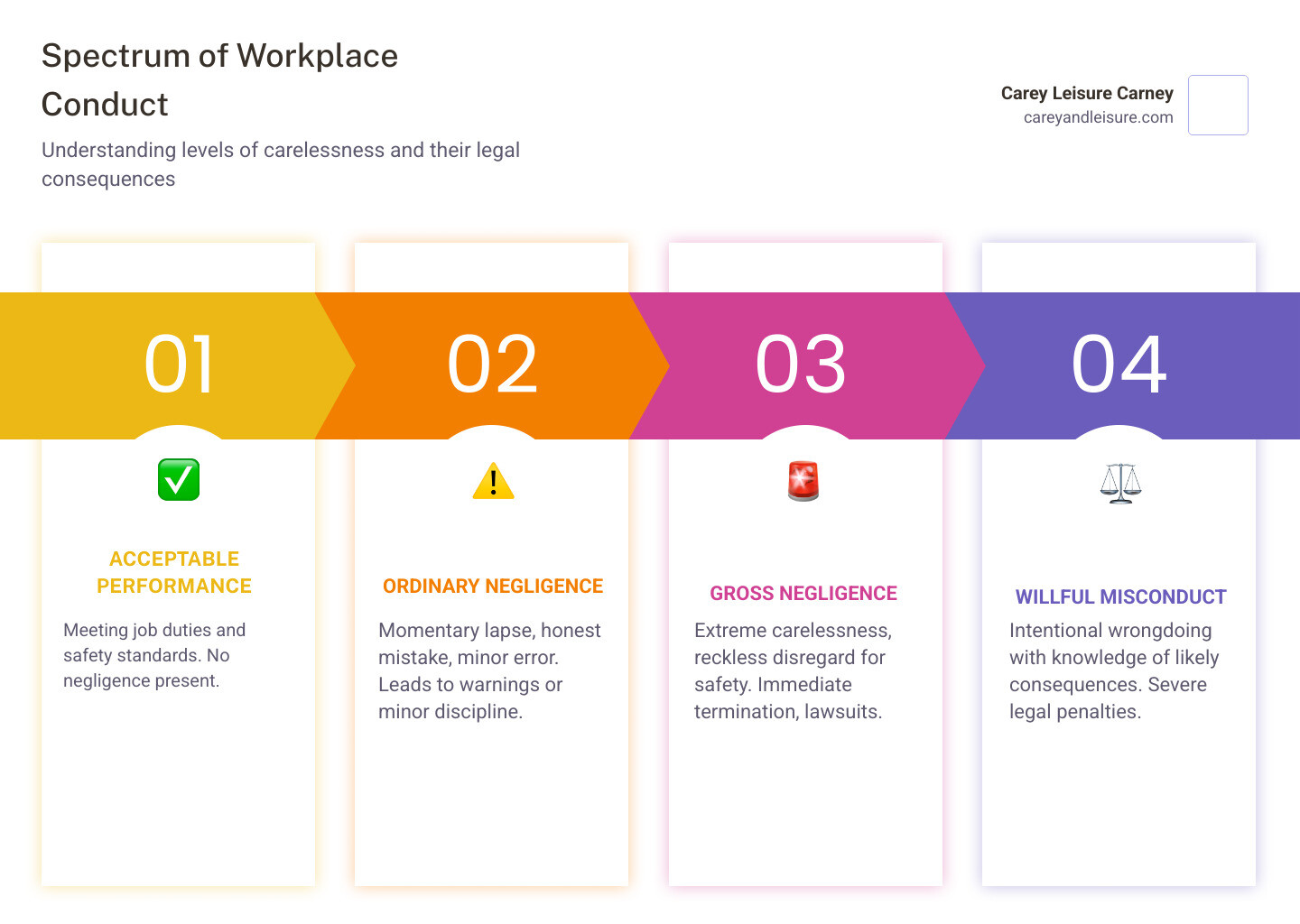
| Category | Definition | Degree of Carelessness |
|---|---|---|
| Ordinary Negligence | A minor lapse in judgment, a simple mistake, or a momentary thoughtlessness. | Moderate. The individual failed to exercise the standard of care that a reasonably prudent person would have exercised in a similar situation. |
| Gross Negligence | An extreme departure from the ordinary standard of conduct; an entire failure to exercise care; or the exercise of so slight a degree of care as to justify a belief in indifference to the interest and welfare of others. | High. Characterized by a severe, reckless disregard for safety or rights, implying conscious indifference to consequences. |
| Willful Misconduct | Intentional wrongdoing, done with knowledge of the likely consequences, and often with an intent to cause harm or a reckless disregard for the safety of others. | Very High. Involves a deliberate act or omission with a wrongful purpose, often disregarding known risks. |
The Key Difference: Ordinary vs. Gross Negligence
The line between ordinary and gross negligence is crucial. Ordinary negligence is an everyday mistake, like an employee forgetting to lock a filing cabinet. It’s a failure to meet the standard of care a reasonably prudent person would exercise and typically results in minor disciplinary action.
Gross negligence is an extreme departure from reasonable conduct. It’s a severe and reckless disregard for safety that shows conscious indifference to consequences. Imagine a forklift operator who repeatedly ignores mandatory safety checks despite warnings, causing a serious accident. This isn’t a simple mistake; it’s a choice demonstrating a profound disregard for others’ welfare. The foreseeability of harm is also key: with gross negligence, the potential for serious harm was obvious, and the person proceeded anyway.
The Role of Intent and Recklessness
Gross negligence is serious but distinct from deliberately trying to cause harm, which is known as “willful misconduct.”
Gross negligence involves reckless disregard. The person should have known their actions were highly likely to cause harm, even if they didn’t specifically intend it. They acted with such extreme carelessness that it shows a conscious indifference to obvious risks.
Willful misconduct goes further. As the Illinois Courts explain, this involves an intentional act or omission “so unreasonable and dangerous that they know or should know harm is highly probable.” The key difference is the wrongful purpose or deliberate action despite known risks. An employee who deliberately tampers with safety equipment to speed up production, knowing it could cause injury, is likely committing willful misconduct.
Proving state of mind is tricky. Gross negligence is typically shown through a pattern of extreme carelessness or a single act so reckless that it speaks for itself, demonstrating a complete disregard for the safety of others.
Examples and Consequences of Gross Negligence
When extreme carelessness leads to injury, death, or massive financial loss, the consequences affect workers, employers, and communities. OSHA violations alone can result in fines up to $15,625 per serious violation, and willful or repeated violations can cost employers up to $156,259, reflecting the law’s seriousness about workplace safety.

Common Examples of Employee Gross Negligence
What does gross negligence employment law look like in practice? It’s where employees cross the line from simple mistakes into reckless disregard for safety or company interests.
- Ignoring Safety Protocols: A construction worker deliberately bypassing safety harnesses on a high-rise project, or an employee working with hazardous materials who refuses to wear mandatory protective gear despite training and warnings.
- Repeated Neglect of Duties: A forklift operator who skips required daily pre-operation checks, leading to catastrophic equipment failure. This isn’t a one-time lapse but a conscious disregard for established procedures.
- Falsifying Records: Deliberately altering safety logs, maintenance records, or quality control reports to cover up neglect, creating conditions where serious harm becomes inevitable.
- Impairment on the Job: Operating heavy machinery, driving company vehicles, or performing safety-sensitive tasks while under the influence of drugs or alcohol.
- Serious Insubordination: Directly disobeying a supervisor’s order regarding a critical safety procedure, leading to an accident.
- Extreme Carelessness with Assets: A senior employee leaving a laptop with sensitive company data unsecured in public, resulting in a massive data breach and catastrophic financial damage.
Consequences for the Employer
When an employee’s gross negligence causes harm, employers face serious consequences.
- Vicarious Liability: Employers can be held responsible for an employee’s actions if they occurred within the scope of employment, leading to lawsuits from injured parties.
- Third-Party Lawsuits: If an employee’s reckless conduct injures a client or member of the public, the employer faces significant personal injury claims. You can learn more about how these cases work on our personal injury lawsuits page.
- OSHA Penalties: Gross negligence leading to a safety violation, especially one causing serious injury or death, can trigger substantial fines. The tragic Tropicana Casino parking garage collapse, which resulted from serious safety lapses, is a sobering example.
- Reputational Damage: News of such incidents erodes public trust, harms employee morale, and makes it harder to attract talent or retain customers.
- Increased Insurance Premiums: Workers’ compensation and liability insurance costs can skyrocket after claims stemming from gross negligence.
Consequences for the Employee
For employees found guilty of gross negligence, the consequences are severe.
- Summary Dismissal: Gross negligence is almost always considered “gross misconduct,” allowing employers to terminate employment immediately, without notice, for a first offense.
- Loss of Unemployment Benefits: Many jurisdictions disqualify employees terminated for gross misconduct from receiving unemployment benefits. Washington’s legal definition of misconduct, for instance, includes conduct that can lead to benefit disqualification.
- Personal Liability Lawsuits: While employers often bear liability, employees can face personal lawsuits, especially if their actions were outside the scope of employment or extremely reckless.
- Damaged Professional Reputation: A dismissal for gross negligence leaves a permanent mark on a professional record, making it difficult to find future employment. For more information, visit our page on the difference between intentional misconduct and gross negligence.
Navigating Gross Negligence Employment Law
When allegations of gross negligence employment law violations arise, the stakes are high for everyone. Whether you’re an employer facing claims or an employee accused of carelessness, understanding the legal process is vital. Having guided countless workplace injury cases, I’ve seen how proper procedures protect everyone—and how shortcuts create legal nightmares.

Employer’s Process for gross negligence employment law Allegations
For an employer, acting hastily can backfire. Firing an employee for gross negligence without due process can lead to a wrongful discharge lawsuit. A defensible process includes:
- Immediate Investigation: Gather all facts, documents, incident reports, and electronic communications. Consider an impartial outside investigator for complex situations.
- Witness Interviews: Document statements from everyone who observed the incident, can speak to standard procedures, or was affected by the negligence.
- Meeting with the Accused: Give the employee a chance to hear the specific allegations and explain their actions. This is a matter of fundamental fairness.
- Formal Hearing and Decision: Hold a documented disciplinary hearing where the employee can respond to the accusations. Issue a clear written decision explaining the findings and reasoning, ensuring it aligns with company policy. This documentation is your shield in case of future litigation, as explained in our guide to the litigation process.
Can an Employee Be Terminated for Gross Negligence?
Yes, absolutely. Gross negligence is a universally accepted reason for immediate termination for cause, often without notice or severance. It fundamentally destroys the trust required in an employment relationship.
Even in “at-will employment” states like Florida, having a documented just cause like gross negligence provides a clear, defensible rationale against wrongful termination claims. The key is to demonstrate both substantive fairness (the gross negligence occurred, and you have evidence) and procedural fairness (you followed a fair process). Meticulous documentation is crucial.
Legal Implications of gross negligence employment law for Employees
Workers’ compensation is typically a “no-fault” system that provides benefits to injured workers while protecting employers from most lawsuits. However, gross negligence can create exceptions to this rule.
In Florida, as per Florida Statutes Chapter 440, workers’ comp is usually the exclusive remedy. But if an employer’s conduct rises to the level of gross negligence or intentional misconduct, or if they fail to carry required insurance, they may lose this liability shield. This allows the injured employee to file a personal injury lawsuit.
This distinction is critical. Workers’ comp benefits are limited to medical bills and partial lost wages. A successful personal injury lawsuit can recover far more, including compensation for pain and suffering, emotional distress, and full economic damages. Our page on personal injury lawsuits explains these differences.
In egregious cases, punitive damages may be awarded to punish the wrongdoer, as Cornell Law explains. However, the bar is high; New Jersey, for example, requires proof of malice, which is beyond even gross negligence.
If you are an employee accused of gross negligence, defenses exist. You might argue your actions were ordinary negligence, that you didn’t owe the alleged duty of care, or that the employer’s investigation was unfair.
How Different States Handle Gross Negligence
Gross negligence employment law is not uniform across the United States. The specific legal details can shift dramatically from one state to another, affecting whether an injured worker can sue their employer, the potential compensation, and the availability of punitive damages.

The Florida Perspective
In Florida, the workers’ compensation system is generally “no-fault,” as outlined in Chapter 440 of the Florida Statutes. If you get hurt at work, you typically receive medical and partial wage benefits regardless of who was at fault. In return, you usually cannot sue your employer for negligence.
However, gross negligence creates important exceptions. If an employer intentionally causes an injury or their conduct is so egregiously reckless it approaches that standard, the workers’ compensation shield may disappear. Another critical exception is if your employer fails to carry legally required workers’ compensation insurance. In these cases, you can sue them directly.
You may also have a third-party claim. Even while receiving workers’ comp, you might be able to sue a negligent third party, like the manufacturer of defective equipment or another contractor on a job site.
This matters because workers’ comp benefits are limited. They do not cover pain and suffering or the full extent of lost earning capacity. A successful lawsuit against an employer (when permitted) or a third party can provide far more comprehensive compensation.
A Look at Other Jurisdictions (CA, NJ, WA)
Other states approach gross negligence with their own unique rules.
California: The state’s jury instructions (CACI No. 425) define gross negligence as “the lack of any care or an extreme departure from what a reasonably careful person would do.” It is treated as an extreme version of ordinary negligence, not a separate claim, which is important because liability waivers that protect against ordinary negligence may not protect against gross negligence.
New Jersey: This state has a tougher stance on punitive damages. Under New Jersey Statutes § 2A:15-5.12, proving gross negligence alone is not enough. A plaintiff must show “an act of malice and a wanton and willful disregard for others,” a higher standard than in most states.
Washington State: The state provides a clear definition of “gross misconduct” for unemployment benefit purposes. RCW 50.04.294 defines it as a criminal act or “conduct…demonstrating a flagrant and wanton disregard of the rights, title, and interests of the employer or a fellow employee.” This statute is crucial for determining eligibility for unemployment after a termination for serious misconduct.
Frequently Asked Questions about Gross Negligence in Employment
We often hear these questions from people trying to understand gross negligence employment law. Here are some clear answers.
Can I be fired for a single mistake?
It depends on the mistake. For an ordinary error, like a typo in an email, termination is unlikely. However, a single act of gross negligence can absolutely justify immediate termination, even for a first offense.
If a single action demonstrates an extreme and reckless disregard for safety or responsibility—such as a forklift operator working while intoxicated—it destroys the trust essential to the employment relationship. In these cases, the severity of the act, not the frequency, is what matters.
Does gross negligence override my employment contract?
In most cases, yes. Even if your contract specifies a notice period for termination, gross negligence is almost always considered a “for cause” dismissal. This means an employer can typically terminate you immediately because your actions represent a fundamental breach of your employment duties.
Most employment agreements and company handbooks contain a clause for termination due to “gross misconduct,” a category that includes gross negligence. While it’s always wise to review your specific contract, acts of extreme carelessness generally give employers the right to bypass standard termination procedures.
How is gross negligence proven in court?
Proving gross negligence is harder than proving ordinary negligence. You must demonstrate that the person’s actions were so reckless that they showed a conscious indifference to the safety of others. This is often a question for a jury to decide.
To build a case, lawyers focus on:
- Duty and Breach: Establishing the duty of care owed and showing how it was breached in an extreme way, using company policies, industry standards, and expert testimony.
- Recklessness or Indifference: Providing evidence that the person knew the risks but proceeded with extreme carelessness. This could include a history of ignored safety warnings or deliberate shortcuts.
- Causation and Damages: Proving the grossly negligent act directly caused the harm and documenting the full extent of the damages.
Witness testimony is also crucial in painting a complete picture for the court. The process requires experienced legal guidance to gather and present this evidence effectively.
Conclusion
Understanding gross negligence employment law is about recognizing when workplace conduct crosses the line from an honest mistake to a reckless disregard for safety. This distinction changes everything, carrying severe consequences for both employers and employees. For employers, it can mean massive fines and liability. For employees, it can lead to immediate termination and lasting professional damage.
The path forward requires clarity. Employers need clear, enforced safety policies and a fair, documented investigation process. Employees must understand that following safety protocols is fundamental to their protection. The legal landscape also varies significantly by state, making local expertise essential. Florida’s workers’ compensation system, for example, has specific rules and exceptions that differ from those in California or New Jersey.
At Carey Leisure Carney, we have over 100 years of combined experience helping people steer these exact situations. As board-certified civil trial lawyers—a distinction held by fewer than 2% of Florida attorneys—we understand the profound impact of workplace gross negligence. We have guided roughly 40,000 injury matters through Florida’s complex legal system, always remembering the person behind the case.
If you are facing a situation involving gross negligence in the workplace, you don’t have to handle it alone. We offer direct attorney access and personalized service to clients in Clearwater, St. Petersburg, Largo, New Port Richey, Spring Hill, Trinity, and Wesley Chapel. For a deeper understanding of these issues, learn more about intentional misconduct and gross negligence. When you’re ready to discuss your case, we’re ready to listen.