

Medical Malpractice Lawyer: 4 Critical Steps
Why Finding the Right Medical Malpractice Lawyer Matters
A medical malpractice lawyer is a specialized attorney who represents patients harmed by substandard medical care. They help prove negligence, steer complex legal procedures, and recover compensation for injuries caused by healthcare providers.
Hiring an experienced lawyer is crucial because these cases require expert medical testimony to prove a provider breached the standard of care. Florida has a strict two-year deadline to file, and cases are expensive, with insurance companies defending them vigorously. An experienced attorney understands how to negotiate and works on a contingency fee, meaning you pay nothing unless you win.
Medical malpractice is a serious issue, cited as the third-leading cause of death in the United States, with over 250,000 deaths annually from medical errors. When a healthcare provider’s negligence causes preventable harm—such as mounting medical bills, lost income, or permanent disability—the consequences are devastating.
Not every disappointing medical result is malpractice. The law requires proof that the provider violated the accepted “standard of care” and that this violation directly caused your injury. Pursuing a claim is complex, involving powerful hospitals, strict procedural rules, and technical evidence.
This guide explains the essential steps to hiring the right medical malpractice lawyer. I’m Thomas W. Carey, a board-certified civil trial medical malpractice lawyer. Since 1988, my firm, Carey Leisure Carney, has guided over 40,000 injury cases in Florida, securing multi-million-dollar results for our clients. We only represent injured people—never hospitals or insurance companies.
Step 1: Determining if You Have a Valid Claim
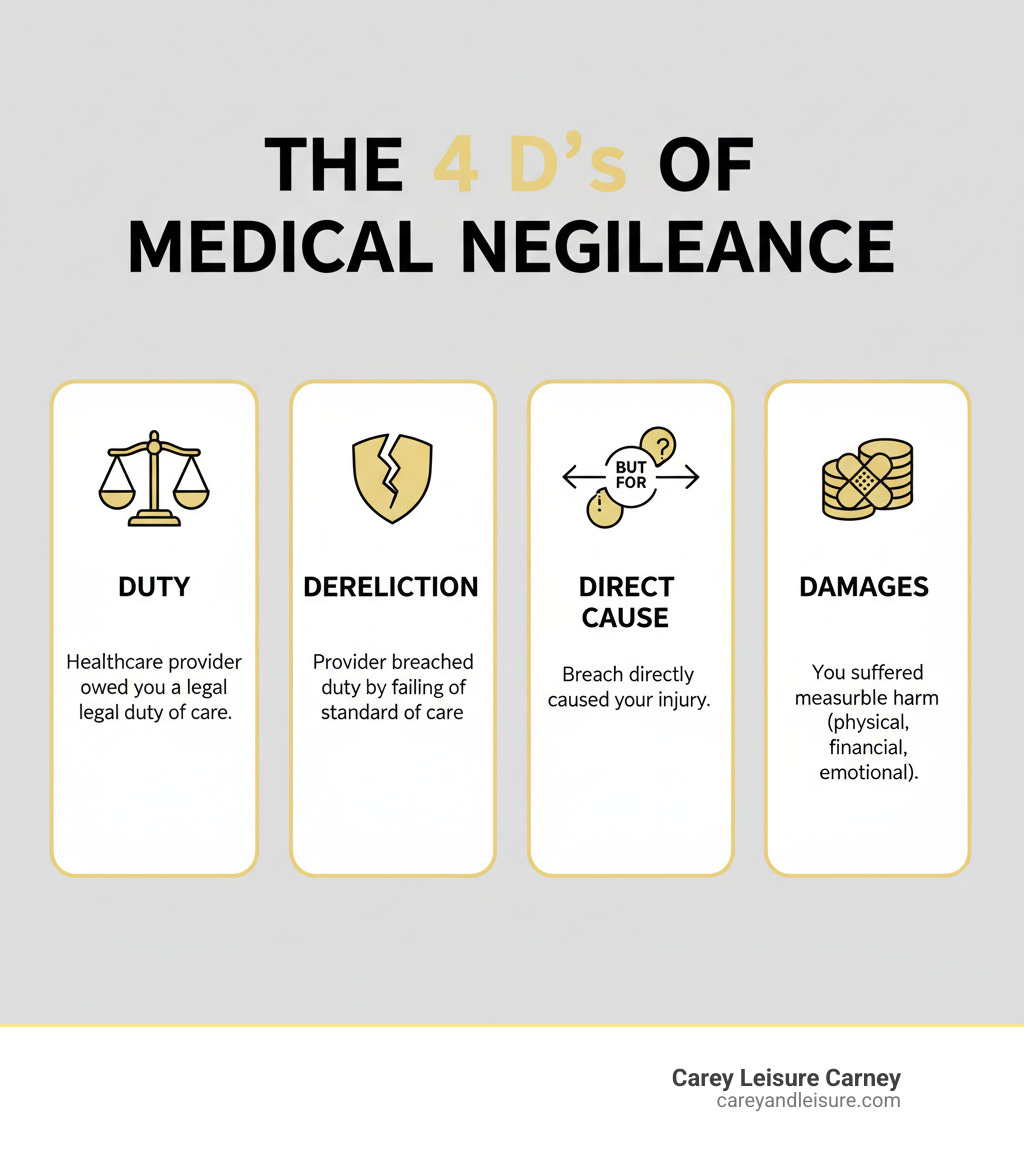
Not every disappointing medical result qualifies as malpractice. Even skilled doctors cannot guarantee perfect outcomes. To have a valid claim, you must prove four essential elements, known as the four D’s of medical negligence:
- Duty: A doctor-patient relationship existed, meaning the provider had a duty to provide care that meets accepted medical standards.
- Dereliction (Breach): The provider breached that duty by acting negligently, with their care falling below the accepted standard.
- Direct Cause: The provider’s negligence directly caused your injury. This is proven with the “but for” test: but for the substandard care, the harm would not have occurred.
- Damages: You suffered actual, measurable harm, such as physical injury, additional medical costs, lost wages, or pain and suffering.
If any of these Elements of a Tort Case are missing, there is no valid claim. Our team at Carey Leisure Carney has decades of experience determining if Medical Malpractice and Bodily Injury in a specific case meet these legal requirements. As your medical malpractice lawyer, our job is to investigate the facts, consult with experts, and determine if negligence occurred. You can learn more about Medical Malpractice Basics to understand how courts view these cases.
Common Types of Medical Malpractice
Medical negligence can occur in any healthcare setting. In our practice serving Clearwater, Largo, New Port Richey, and surrounding areas, we frequently handle the following types of cases:
- Misdiagnosis or delayed diagnosis: This occurs when a provider fails to correctly identify a condition in a timely manner, allowing it to worsen. Common examples include missed diagnoses of cancer, stroke, heart attacks, and autoimmune diseases.
- Surgical errors: These are often egregious mistakes, such as operating on the wrong body part, performing the wrong procedure, leaving instruments inside a patient, or causing careless lacerations to internal organs.
- Birth injuries: These tragic cases involve harm to a newborn or mother due to negligence during pregnancy, labor, or delivery. Examples include oxygen deprivation causing cerebral palsy, mishandling of the baby causing nerve damage, or failing to perform a timely C-section. We have extensive experience with these sensitive cases, which you can read about on our Medical Malpractice Attorney Trinity FL page.
- Anesthesia errors: Mistakes in administering anesthesia can be catastrophic. This includes incorrect dosage, using the wrong drug, or failing to monitor a patient’s vital signs during surgery.
- Medication mistakes: These common errors include prescribing the wrong drug or dosage, or failing to account for a patient’s known allergies or dangerous drug interactions.
- Hospital or nursing negligence: This covers a wide range of failures by staff, such as neglecting a patient’s needs, misreading test results, failing to monitor a patient post-surgery, or making errors in the emergency room.
Step 2: Navigating Florida’s Legal Process and Timelines
Medical malpractice litigation in Florida is highly complex, with specific procedures that must be followed precisely. This is why an experienced medical malpractice lawyer is essential to protect your rights.

The process begins with an intensive investigation. Before a lawsuit can be filed, Florida law requires serving the provider with a notice of intent to sue, which must include an affidavit of merit from a qualified medical expert confirming their belief that negligence occurred. We gather all medical records, consult with experts, and build a strong case while the provider’s insurance company works to minimize their liability.
Most cases settle out of court through negotiation or mediation. However, we prepare every case for trial. An insurance company is more likely to offer a fair settlement if they know your attorney is ready and able to win in court.
Understanding the Statute of Limitations
Florida has strict, unforgiving deadlines for filing medical malpractice claims, known as the statute of limitations. Missing these deadlines will permanently bar your case.
- Two-Year Rule: Under Fla. Stat. Ann. § 95.11(b), you generally have two years from the date you finded (or should have finded) the injury to file a claim. This is the “findy rule.”
- Four-Year Rule: Florida also has a statute of repose, an absolute deadline of four years from when the malpractice occurred, regardless of when you finded the injury. Exceptions are rare.
Time is not on your side. Evidence can be lost and memories fade. Contacting a lawyer immediately is the best way to protect your rights. For more details, see our guide on How Long Do You Have to File a Medical Malpractice Lawsuit in Florida.
What Damages Can Be Recovered?
If you’ve been harmed by medical negligence, you may be entitled to compensation, or “damages,” for your losses. Our goal is to recover the maximum compensation you deserve.
- Economic Damages: These are calculable financial losses, including past and future medical expenses, lost wages, and diminished earning capacity.
- Non-Economic Damages: This compensates for non-financial losses like pain and suffering, emotional distress, loss of enjoyment of life, and permanent disfigurement. A spouse may also claim loss of consortium.
- Punitive Damages: Rarely awarded, these are intended to punish the wrongdoer for gross negligence or intentional misconduct.
In cases of wrongful death, surviving family members can seek damages for funeral expenses, lost financial support, and the loss of companionship and guidance. You can find more information on Types of Damages in Medical Malpractice Cases.
Step 3: The Crucial Role of Evidence and Expert Witnesses
A successful medical malpractice case is built on a foundation of strong evidence and credible expert testimony. We must prove both that the provider was negligent and that their negligence directly caused your injury.

The evidence we gather includes:
- Medical records: Hospital charts, doctor’s notes, lab results, and imaging reports create a timeline of your treatment.
- Bills and receipts: These document your financial losses and the extent of your medical care.
- Witness testimony: Your account, along with statements from family members or other providers, helps complete the picture of what happened.
However, in medical malpractice, this evidence is not enough on its own.
Why Expert Witnesses are Essential
Medical malpractice cases involve complex issues that require specialized knowledge. Expert witnesses—typically physicians with similar qualifications to the defendant—are legally required to interpret this evidence for a judge and jury.
An expert witness is crucial for several reasons:
- They establish the standard of care: The expert defines what a reasonably competent provider would have done in the same situation.
- They identify the breach of duty: They offer a professional opinion on whether the provider’s actions fell below that standard.
- They prove causation: Most importantly, they connect the provider’s negligence directly to your injury, explaining how the mistake led to your harm.
- They explain complex medical topics: They translate medical jargon into understandable terms.
Finding and retaining qualified Expert Witnesses is challenging and expensive, often costing over $10,000 per day. An experienced medical malpractice lawyer has the resources and network to secure the right experts for your case. At Carey Leisure Carney, we have built relationships with respected medical experts across many specialties and have the financial strength to fund these critical aspects of litigation. Without strong expert testimony, a case will almost certainly fail in court.
Step 4: How to Choose the Right Medical Malpractice Lawyer
Choosing the right medical malpractice lawyer is a critical decision. These cases are among the most complex in personal injury law, and your attorney’s skill can significantly impact the outcome.

Take advantage of free consultations to ask key questions: How many cases like mine have you handled? What is your trial experience? Do you have the resources to hire top medical experts? At Carey Leisure Carney, we provide direct access to your attorney and build genuine relationships with our clients, offering the personalized service you deserve.
Finding an Experienced Medical Malpractice Lawyer
Experience is not just a bonus—it’s essential. Look for these key qualifications:
- Specialization: Your attorney should focus on medical malpractice, not just handle it occasionally. We have spent decades mastering the intricacies of Florida’s malpractice laws.
- Trial Experience: Insurance companies know which lawyers are willing to go to trial. An attorney with a strong trial record is in a better position to negotiate a fair settlement. Our firm prepares every case as if it’s going to court.
- Resources: Malpractice litigation is expensive, requiring tens of thousands of dollars for expert witnesses and other costs. Our firm has the financial strength to go up against large hospitals and insurance companies.
- Local Knowledge: Laws vary by state. Our firm is deeply rooted in the Tampa Bay area, with decades of experience in Clearwater, St. Petersburg, and surrounding communities. Learn more about our local expertise at Medical Malpractice Attorney Clearwater FL.
Why a Board-Certified Medical Malpractice Lawyer Matters
How can you verify an attorney’s expertise? Board certification is the answer. Certification by organizations like the American Board of Professional Liability Attorneys is the highest level of professional achievement in this field. It is earned, not bought, and only a small percentage of attorneys achieve it.
To become board-certified, a lawyer must demonstrate substantial experience, pass a rigorous exam, complete extensive continuing education, and receive positive peer reviews. It is an objective, verifiable measure of skill and expertise.
When you hire a board-certified attorney, you are choosing someone whose qualifications have been vetted by their peers. At Carey Leisure Carney, our attorneys’ board certifications reflect our commitment to providing the most knowledgeable and skilled advocacy for our clients.
Frequently Asked Questions About Medical Malpractice
We understand you have questions. Here are answers to some of the most common concerns we hear from clients in the Clearwater, St. Petersburg, and Tampa Bay areas.
How much does it cost to pursue a medical malpractice claim?
We work on a contingency fee agreement, which means you pay no upfront legal fees. Our fee is a percentage of the compensation we recover for you. If we don’t win your case, you owe us nothing for our legal services.
Cases do involve litigation costs, such as expert witness fees, court filing fees, and deposition costs. Our firm typically advances these expenses, and they are reimbursed from the settlement or award if we are successful. This arrangement allows you to seek justice without financial risk. Learn More on contingency fees here.
How are most medical malpractice cases resolved?
The vast majority of cases are resolved through settlement negotiations before trial. Insurance companies often prefer to avoid the cost and uncertainty of a courtroom. The process may involve informal negotiations or a formal process called mediation, where a neutral third party helps both sides reach an agreement. However, if a fair settlement cannot be reached, we are always prepared to take your case to trial to fight for the justice you deserve.
Can I sue if I’m unhappy with my medical results?
Simply being unhappy with a medical outcome is not enough to file a malpractice claim. Medicine is not an exact science, and doctors cannot guarantee perfect results. A “bad outcome” can occur even when a provider delivers competent care.
Medical malpractice only occurs when a provider’s care falls below the accepted standard of care, and this failure directly causes your injury. For example, if a surgeon makes a preventable error that a competent surgeon would not have made, that may be malpractice. The line between a bad outcome and negligence is fine and requires careful legal and medical analysis. A qualified medical malpractice lawyer can evaluate your situation to determine if you have a viable claim.
Conclusion

Understanding your rights is the first step toward justice. This guide has covered the essentials: identifying a valid claim, navigating Florida’s strict deadlines, and knowing what to look for in a medical malpractice lawyer. Experience, specialization, resources, and board certification are not just buzzwords—they are critical qualifications that can define your case’s success.
The clock is ticking. Florida’s statute of limitations is unforgiving, and waiting too long can eliminate your right to seek compensation. Don’t face powerful hospitals and insurance companies alone.
At Carey Leisure Carney, our board-certified attorneys have represented injured people across Clearwater, Largo, New Port Richey, and the greater Tampa Bay area since 1988. We provide direct, personal service and only represent victims—never the institutions that harm them.
Knowledge is power, but action is justice. If you suspect you or a loved one was harmed by medical negligence, contact us today for a free, no-obligation consultation. We work on contingency, so you pay nothing unless we win your case.
For more resources, we invite you to Explore our Medical Malpractice resources for more information.