

Settling for More: The Guide to Handling Your Own Claim
You Can Settle Your Own Car Accident Claim — But Here’s What You Need to Know First
How to settle a car accident claim without a lawyer is something many Florida drivers need to understand — especially after a minor collision leaves you juggling repair bills, missed work, and insurance calls all at once.
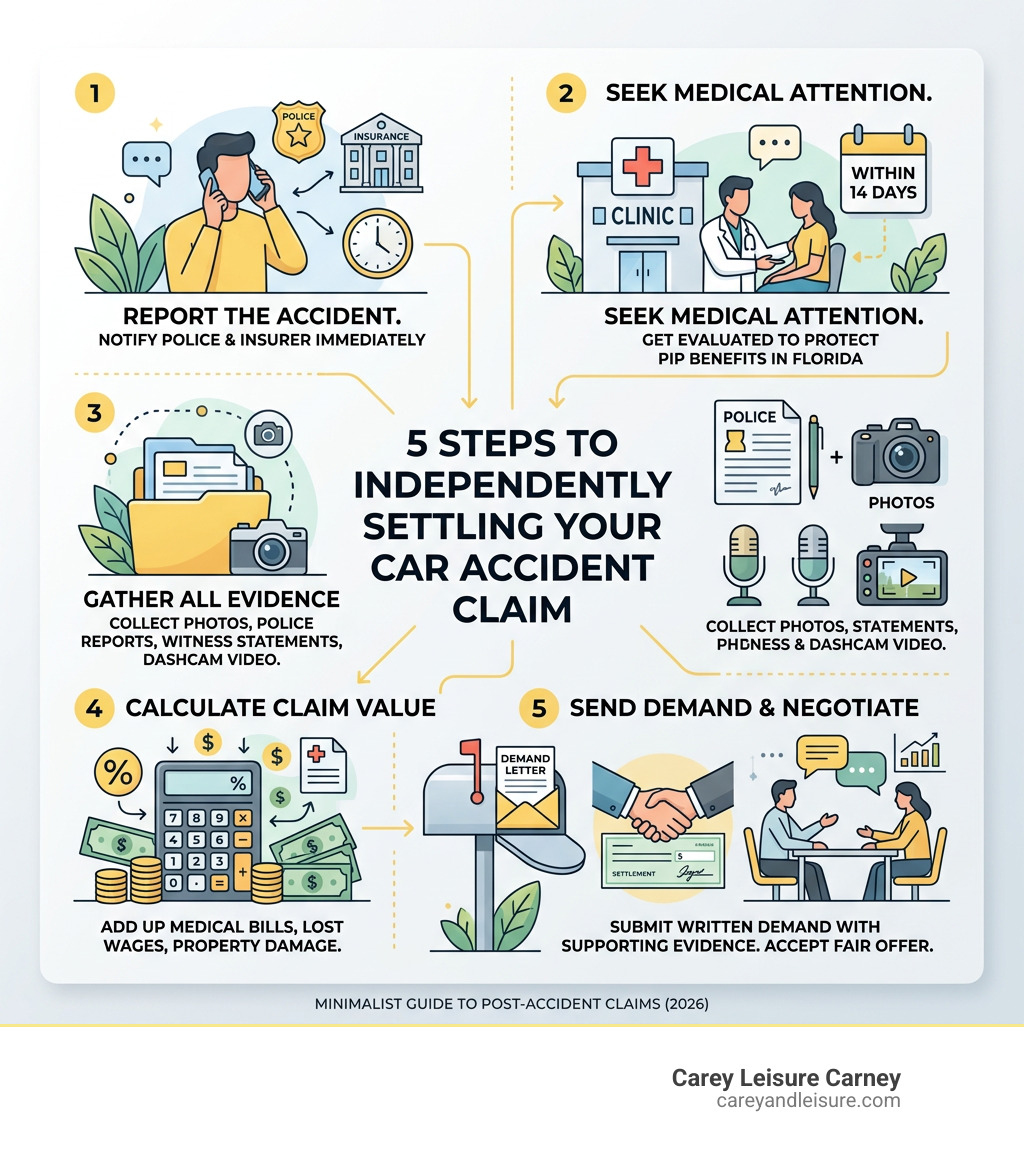
Here’s a quick overview of the process:
- Report the accident — Notify authorities and your insurer promptly
- Seek medical attention — Do this within 14 days to protect your PIP benefits in Florida
- Gather evidence — Photos, police reports, witness statements, dashcam footage
- Calculate your claim value — Add up medical bills, lost wages, and pain and suffering
- Send a demand letter — Submit a written demand to the insurer with supporting evidence
- Negotiate the settlement — Counter lowball offers with documented facts
- Accept or escalate — Sign only when the offer fairly covers your losses, or consider legal help
For minor accidents with clear liability and limited injuries, this process is manageable on your own. But the stakes rise quickly — and so do the risks of getting it wrong.
I’m Thomas W. Carey, founding partner of Carey Leisure Carney and a board-certified civil trial lawyer with over 35 years guiding Floridians through personal injury matters, including thousands of clients weighing exactly how to settle a car accident claim without a lawyer. In the sections below, I’ll walk you through every step honestly — including when going it alone makes sense, and when it doesn’t.
Related content about how to settle a car accident claim without a lawyer:
When is it Safe to Handle Your Own Claim?
We often tell people that not every bump in the road requires a full legal team. If you’ve been in a “fender bender” in Clearwater or St. Pete, you might be wondering if you really need to give us a call. Generally, it is safe to handle your own claim when:
- The injuries are minor: We’re talking about bruises or very minor strains that resolve in a few days.
- Property damage is the main issue: If your bumper is crinkled but you feel fine, you can usually work directly with the insurance adjusters to get your car fixed.
- Liability is crystal clear: The other driver admitted fault, was cited by the police, and there’s no dispute about what happened.
- You have the time: Managing a claim is like a part-time job. You’ll be making calls, scanning receipts, and writing letters.
However, if you have broken bones, required surgery, or missed more than a few days of work, the “DIY” route becomes much more dangerous. Insurance companies are experts at minimizing payouts, and without a professional in your corner, you might leave thousands of dollars on the table. For a deeper dive into those first critical moments, check out our guide on What to Do After a Car Accident Florida.

Determining Fault and Liability
In Florida, determining who is “at fault” is the foundation of any claim that goes beyond your own insurance. While we are a “no-fault” state (meaning your own insurance pays your initial medical bills), the at-fault driver is still responsible for the damage they caused once you hit certain thresholds.
To prove liability on your own, you’ll need to look at:
- The Police Report: This is your strongest piece of evidence. It contains the officer’s objective view of the scene and any citations issued.
- Traffic Laws: Did the other driver violate a Clearwater city ordinance or a state statute?
- Florida’s Financial Responsibility Statutes: These laws require drivers to carry proof of insurance and be responsible for the damages they cause. You can read the specific language in the Florida’s financial responsibility statutes.
Florida follows a system of “comparative negligence.” This means if you are found to be 20% at fault for the accident, your total compensation will be reduced by 20%. If you are more than 50% at fault, you may be barred from recovering anything from the other party at all!
How to Settle a Car Accident Claim Without a Lawyer: A Step-by-Step Guide
If you’ve decided to move forward alone, organization is your best friend. Imagine you are building a case for a judge—even if you never plan to step foot in a courtroom.
First, you must understand the 14-Day Rule. In Florida, if you do not seek medical treatment within 14 days of the accident, you forfeit your Personal Injury Protection (PIP) benefits. This is non-negotiable. Even if you feel “okay,” a quick check-up at a Clearwater clinic is vital. To understand why this coverage is so important, read our breakdown on What Is PIP Insurance Florida.
Gathering Evidence to Support a Claim Without a Lawyer
Evidence is the “currency” of your insurance claim. Without it, your words are just opinions. To build a strong foundation, you need:
- Scene Photos: Take pictures of everything—the damage to both cars, the skid marks on the road, the weather conditions, and even the street signs.
- Witness Statements: If someone saw the crash, get their name and phone number. A neutral third party is much more convincing to an insurance adjuster than you are.
- Dashcam Footage: This is becoming the “gold standard.” If you have a dashcam, save that footage immediately.
- Medical Records: Keep every single piece of paper from the doctor. This includes discharge summaries, prescriptions, and physical therapy notes.
For a comprehensive checklist on what to do when the dust settles, see our article Your Car Crashed Now What.
Calculating the Value of Your Claim Without a Lawyer
This is where most people get stuck. How do you put a price tag on a neck injury or a month of missed soccer games with your kids? We divide damages into two main buckets:
- Economic Damages (Special Damages): These are quantifiable. If you have a receipt or a pay stub, it goes here. This includes medical bills, car repairs, and lost wages.
- Non-Economic Damages (General Damages): This is your “pain and suffering.” It covers the physical pain, emotional distress, and loss of enjoyment of life.
The Multiplier Method: A common way to estimate pain and suffering is to take your total economic damages and multiply them by a number between 1.5 and 5. For a minor injury, you might use 1.5. For a life-altering injury, a lawyer would argue for 5 or more.
| Damage Type | Examples | How to Prove It |
|---|---|---|
| Economic | Surgery bills, ER visits, new bumper, rental car | Receipts, Invoices, Pay stubs |
| Non-Economic | Chronic back pain, anxiety, inability to exercise | Personal diary, witness letters, doctor notes |
To get a better sense of what your specific case might be worth in the Clearwater area, read What Is My Personal Injury Case Worth.
Negotiating with Adjusters and Writing the Demand Letter
Once you have your evidence and your “number,” it’s time to write the Demand Letter. This is a formal document sent to the at-fault driver’s insurance company. It should clearly state:
- Why their insured driver is at fault.
- The extent of your injuries.
- A detailed list of your damages.
- The specific amount of money you are demanding to settle the claim.
Be prepared: the insurance company’s first offer will almost certainly be a “lowball.” They are testing to see if you are desperate or if you don’t know the true value of your claim. Don’t take it personally—it’s just a business tactic. You can learn more about their perspective in The Role of Insurance Companies in a Car Accident.
Avoiding Common Pitfalls in a Claim Without a Lawyer
When you are handling how to settle a car accident claim without a lawyer, the insurance adjuster is not your friend. They might sound friendly on the phone, but their job is to save the company money. Avoid these three traps:
- The Recorded Statement: They will ask to record your side of the story. Say no. They are looking for you to say something like “I feel fine today,” which they will use later to deny that you were injured.
- The “All-Access” Medical Release: They may ask you to sign a release to “get your medical records.” Often, these forms give them access to your entire medical history from birth. They want to find a pre-existing condition to blame for your current pain.
- The Statute of Limitations: In Florida, you generally have two years from the date of the accident to file a lawsuit for negligence (this was recently shortened from four years). If you miss this window, your claim is dead.
Also, you must see a doctor quickly. If you wait three weeks, the insurer will argue that something else caused your injury. Check out How Much Time Do I Have to See Doctor After Car Accident for more details.
Countering Insurer Tactics to Minimize Payouts
Insurance companies have a “playbook” for unrepresented claimants. Here is how to counter them:
- The “Final Offer” Bluff: They might tell you, “This is the most we can offer, take it or leave it.” Usually, this isn’t true. If you have solid evidence, stand your ground.
- The Delay Game: They might stop returning your calls, hoping you’ll get frustrated and accept a lower amount just to be done with it. Keep a log of every time you call them.
- Shifting Blame: They might claim you were speeding or distracted. Counter this with your photos and the police report.
For tips on how to handle that first phone call with the adjuster, read Contacting My Carrier Following Florida Car Accident.
The Risks and Downsides of Settling Without Legal Help
We’ll be blunt: statistics from the Insurance Research Council show that settlements for people who hire a lawyer are, on average, 3.5 times higher than for those who go it alone.
Why? Because we know the law, we know the “real” value of injuries, and the insurance companies know we aren’t afraid to go to court. When you settle on your own, you are essentially playing a high-stakes poker game while showing the other side your cards.
Risks of self-settling include:
- Undervaluing future costs: You might feel better now, but what if you need surgery in two years? Once you sign a settlement, you can never ask for more money.
- Missing hidden insurance: There might be “umbrella” policies or other coverages you don’t know how to find.
- Lien issues: If your health insurance paid for your treatment, they may have a “lien” on your settlement. If you don’t handle this correctly, you could end up owing your entire settlement back to the insurance company.
For more information on what an attorney actually does to earn their keep, visit Auto Accident Attorney.
When to Pivot and Hire a Professional
There comes a point in many DIY claims where the water gets too deep. You should stop negotiating and call us if:
- The insurance company denies liability: If they say it was your fault and you know it wasn’t.
- You have a permanent injury: Any injury that will affect you for the rest of your life requires expert valuation.
- The at-fault driver is uninsured: This adds a layer of complexity that is very difficult to navigate alone. Learn more about this at What Happens If an Uninsured Driver Hits You.
- There are multiple parties involved: If it was a three-car pileup, the insurers will spend all their time blaming each other.
Frequently Asked Questions about DIY Car Accident Claims
Can I get pain and suffering without a lawyer?
Yes, you can. However, it is much harder to justify the amount. You will need to provide “objective” evidence of “subjective” pain—such as journals, testimony from friends, and specific medical diagnoses that correlate with high pain levels.
What is the statute of limitations in Florida?
As of March 2023, the statute of limitations for most negligence-based personal injury claims in Florida is two years. This is a strict deadline. If you are handling your own claim and the two-year mark is approaching, you need to file a lawsuit to protect your rights.
Is the first settlement offer usually the best?
Almost never. The first offer is often a “nuisance settlement”—a small amount they offer just to make you go away. Think of it as the beginning of a conversation, not the end.
Conclusion
Learning how to settle a car accident claim without a lawyer is an empowering way to handle minor mishaps. By staying organized, gathering evidence, and understanding Florida’s unique insurance laws, you can often reach a fair resolution for a simple fender bender.
However, insurance companies have teams of lawyers and adjusters whose only job is to pay you as little as possible. At Carey Leisure Carney, we’ve spent over a century combined fighting those same teams. We are board-certified, which means we are recognized as experts in civil trial law—a distinction held by less than 2% of Florida attorneys.
If you’re feeling overwhelmed, or if the insurance company isn’t treating you fairly, don’t sign anything. We offer free consultations to help you decide if your case is one you can handle or if you need a professional in your corner. Our goal is always to ensure you get the maximum compensation possible. For more tips on maximizing your payout, see How to Get the Most Compensation from a Car Accident Settlement in Florida.
Give us a call today—we’re here to help our neighbors in Clearwater, St. Pete, and throughout the Tampa Bay area.