

Rideshare Accidents Lawyer: 2026 Expert Help
When a Ride-Hailing Trip Goes Wrong: Understanding Your Legal Options
A rideshare accidents lawyer is a specialized attorney who handles injury claims involving Uber, Lyft, and similar companies. They steer the complex insurance and liability issues unique to these cases, including:
- Determining which of the multiple insurance policies applies.
- Proving fault when rideshare companies deny liability.
- Securing crucial evidence like GPS data and app records.
- Negotiating with insurance companies to fight for fair compensation.
- Calculating the full extent of your damages, including medical bills, lost wages, and pain and suffering.
- Filing a lawsuit if a fair settlement cannot be reached.
Rideshare services like Uber and Lyft have transformed how we travel. But when an accident happens, determining who is responsible and which insurance policy applies can be incredibly complicated. The situation often involves the driver’s personal insurance, the rideshare company’s various coverage levels, and potentially other at-fault parties.
The legal landscape is constantly evolving, with states like California and Illinois passing laws that impact driver classification and liability. Insurance coverage also varies depending on the driver’s status at the time of the accident—whether they were offline, waiting for a request, or actively transporting a passenger. This complexity is why these cases require specialized legal knowledge.
You’ll be up against multiple insurance companies and corporate legal teams focused on minimizing payouts. Without a specialized lawyer, you risk settling for far less than your claim is worth or having it denied entirely.
As Thomas W. Carey, a board-certified civil trial lawyer who has handled thousands of injury matters across Florida since 1988, I’ve seen how rideshare companies and their insurers try to avoid responsibility by exploiting gaps in coverage and driver classification. A rideshare accidents lawyer who understands these unique challenges can mean the difference between a denied claim and full compensation for your injuries.
Basic rideshare accidents lawyer terms:
The Complex Web of Liability and Insurance in Rideshare Accidents
The rise of rideshare services has created a complex web of liability. Unlike taxi companies, Uber and Lyft classify their drivers as independent contractors. This distinction has major implications for who is held responsible after an accident, making a rideshare accidents lawyer indispensable.
Florida has specific laws, such as Florida Statute 627.748, that outline the insurance requirements for rideshare companies and their drivers. These regulations are crucial in determining liability.
Rideshare companies use the ‘independent contractor’ model to limit their liability. However, this is a contentious legal issue nationwide, with some jurisdictions holding these companies to a higher standard of care. An experienced rideshare accidents lawyer stays current on these evolving legal interpretations to build the strongest case for you.
Determining which insurance policy applies is a major hurdle. It’s not as simple as using the driver’s personal auto insurance. Rideshare companies have a tiered system of commercial insurance that activates under specific conditions, depending on the driver’s activity. Understanding these distinctions is key. For more info about rideshare policies, it’s important to understand these distinctions.
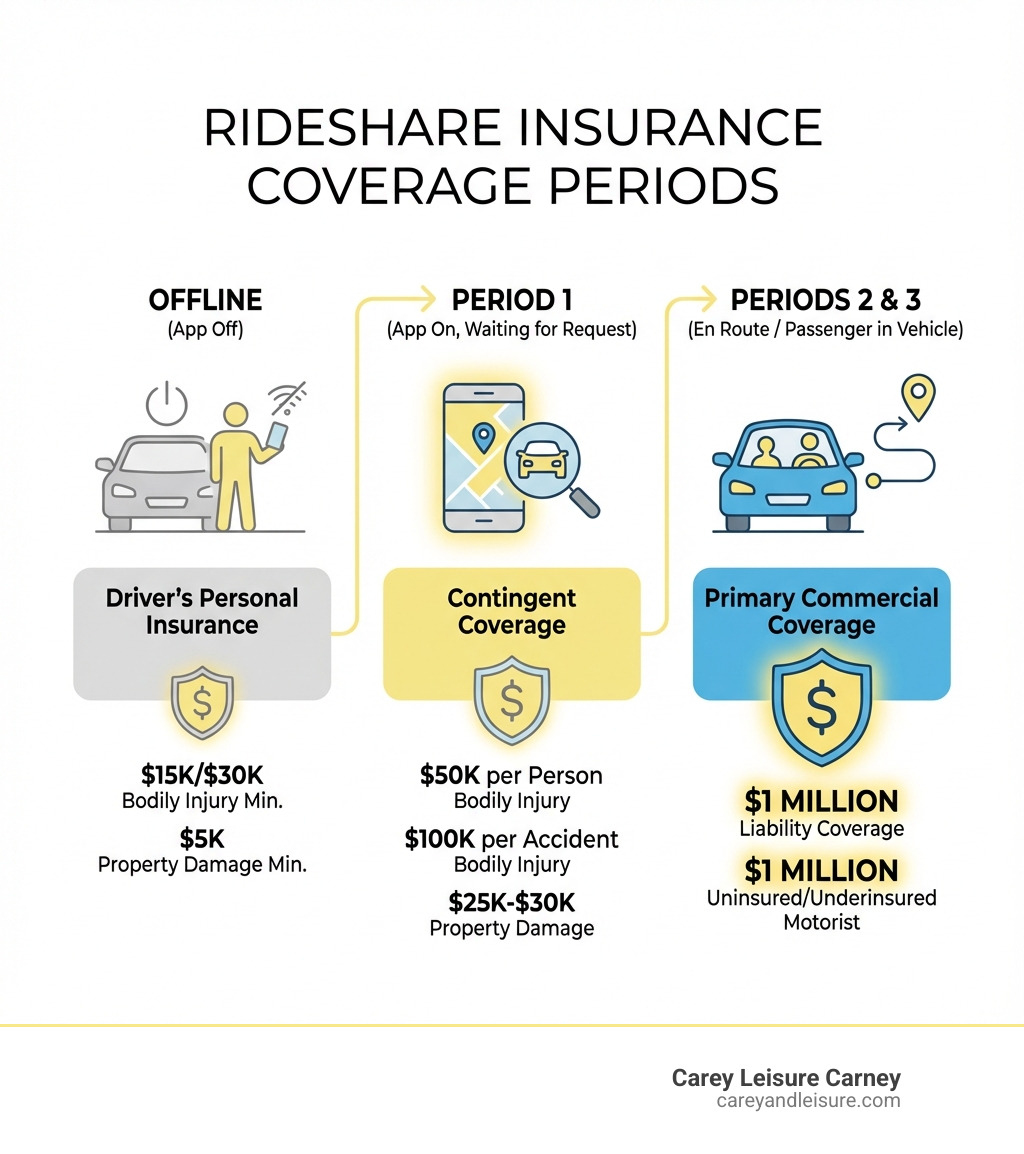
How Rideshare Insurance Coverage Works
The available insurance coverage depends entirely on the driver’s status at the time of the crash. Here’s a breakdown of the insurance periods for rideshare drivers in Florida:
| Driver Status | Description | Insurance Coverage |
|---|---|---|
| Offline | The driver is not logged into the rideshare app. | The driver’s personal auto insurance policy is the primary coverage. These policies must meet Florida’s minimum requirements of $10,000 for personal injury protection (PIP) and $10,000 for property damage liability (PDL). |
| Period 1: App On, Waiting for a Request | The driver is logged into the app and available to accept a ride but has not yet accepted one. | The driver’s personal auto insurance is still primary. If that policy denies coverage, the rideshare company’s contingent liability policy applies. This typically includes at least $50,000 per person for bodily injury, $100,000 per accident for bodily injury, and $25,000 for property damage. |
| Periods 2 & 3: En Route to Pick Up or With Passenger | The driver has accepted a ride request and is on the way to the passenger, or the passenger is in the vehicle. | The rideshare company’s commercial insurance policy provides primary coverage. Florida law requires this policy to have at least $1,000,000 in liability coverage for bodily injury and property damage, plus $1,000,000 in uninsured/underinsured motorist (UM/UIM) coverage. |
Understanding these different policy limits and when they apply is crucial, and it’s often the first step a rideshare accidents lawyer takes when evaluating your case.
Determining Fault in a Multi-Party Crash
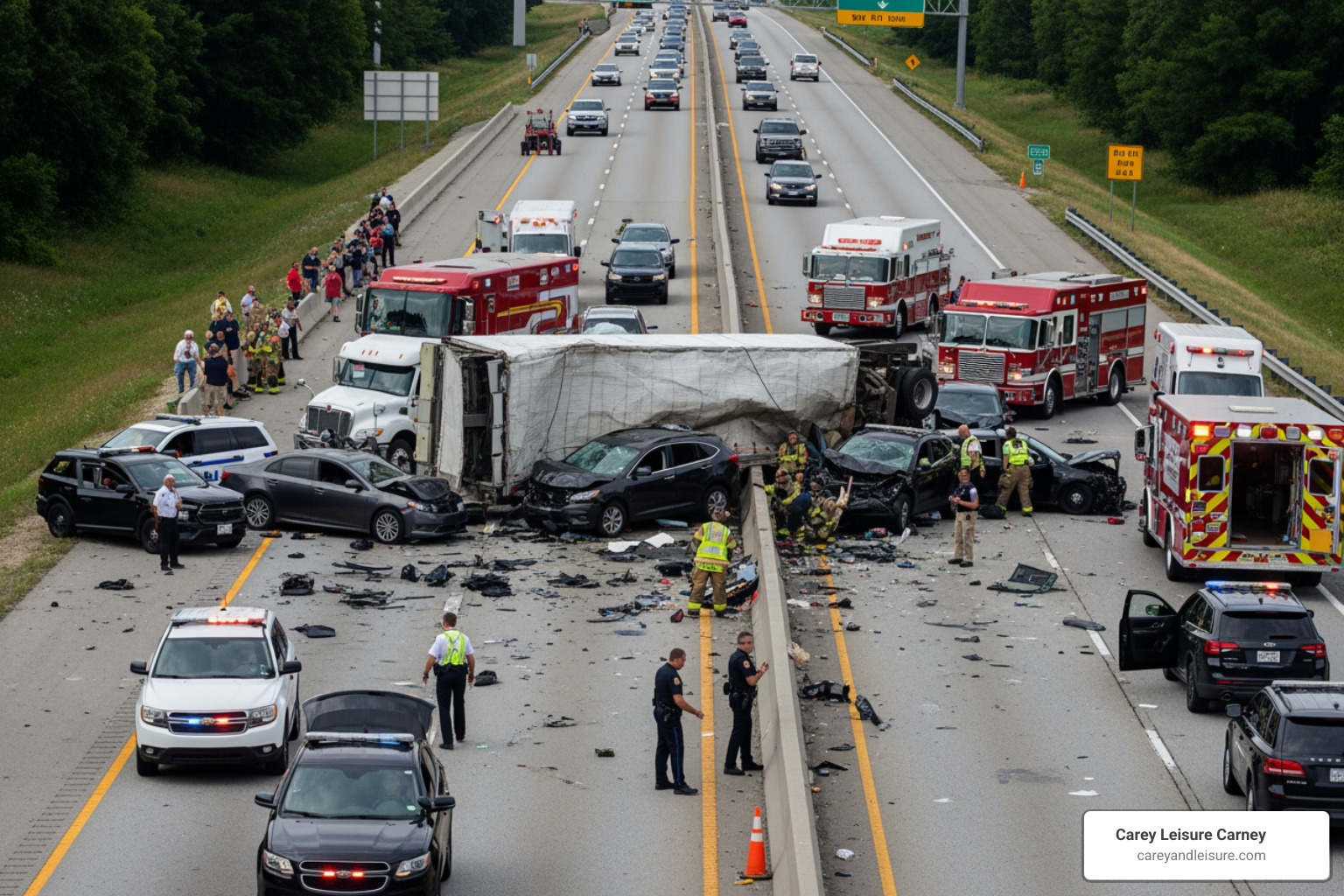
Accidents are rarely simple, and rideshare accidents can be even more tangled. When multiple vehicles are involved, or when there’s a question of shared responsibility, determining fault becomes a complex puzzle.
Florida uses a pure comparative negligence system. This means your compensation can be reduced by your percentage of fault. For instance, if you are 20% at fault for an accident, your recoverable damages are reduced by 20%. This makes a strong, evidence-based legal argument crucial.
A rideshare accidents lawyer will analyze all evidence to establish fault, which could involve:
- Rideshare driver negligence: Distracted driving, speeding, or fatigue.
- Other driver fault: Another vehicle causing the collision.
- Shared liability: Both the rideshare driver and another driver contributing to the crash.
- Evidence analysis: Reviewing police reports, witness statements, and the rideshare company’s electronic data (GPS, app logs) to determine responsibility.
Our goal is to hold all negligent parties accountable and ensure your compensation isn’t unfairly reduced.
Why You Need a Specialized Rideshare Accidents Lawyer
Rideshare accident claims are far more complex than typical car accidents. You’re often facing corporate giants with powerful legal teams, which is why having a specialized rideshare accidents lawyer on your side is essential.
Rideshare companies and their insurers often try to minimize payouts or deny claims. They may use tactics like arguing the driver is an independent contractor, offering lowball settlements, or using delay tactics. An experienced rideshare accidents lawyer knows how to counter these strategies, protect your rights, and fight for the full compensation you deserve. We are not intimidated by large corporations or their insurance companies.
Our team at Carey Leisure Carney will handle the entire legal process for you. We manage all communications with insurance companies, gather evidence, calculate your damages, and take your case to court if necessary. This allows you to focus on your recovery.
Many accident victims worry about the cost of a lawyer. We handle rideshare accident cases on a contingency fee basis. This means you pay no upfront fees. We only get paid if we win your case, ensuring you can seek justice without financial stress.
Investigating the Accident and Gathering Evidence
A strong rideshare accident claim requires a thorough investigation. These cases involve unique digital evidence that is crucial for proving your case.

As your rideshare accidents lawyer, we will immediately work to preserve and collect all relevant evidence, including:
- Police Reports: The official record of the accident.
- Witness Statements: Accounts from anyone who saw the accident.
- Medical Records: Documentation of your injuries, treatments, and medical expenses.
- Rideshare App Data: GPS information, driver activity times, and trip logs to prove the driver’s status.
- Vehicle Maintenance Logs: To check for mechanical failures.
- Photos and Videos: Visual evidence of the scene, vehicle damage, and injuries.
- Driver Background Information: To investigate potential negligent hiring by the rideshare company.
Florida law requires rideshare companies to provide insurance information and driver activity data. We ensure this crucial data is obtained and used to build a strong claim for you.
How a Rideshare Accidents Lawyer Handles Insurance Negotiations
After gathering evidence, the negotiation with insurance companies begins. Their goal is to minimize your payout, not to help you.
Our rideshare accidents lawyer team is skilled in handling insurance negotiations. We will:
- Communicate with all insurance companies on your behalf, protecting you from saying anything that could harm your claim.
- Calculate all your damages, including current and future medical bills, lost income, and pain and suffering.
- Submit a comprehensive demand letter to the insurer, backed by solid evidence.
- Negotiate aggressively to counter lowball offers and secure a fair settlement.
- Protect your rights and ensure you are not pressured into an unfair agreement.
- Guide you through the entire settlement process and, if necessary, take your case to court.
Your Rights and the Legal Process After a Rideshare Crash
If you’ve been involved in a rideshare accident in Florida, understanding your rights and the legal process is crucial. Whether you were a passenger, a rideshare driver, or another motorist or pedestrian, you have specific protections under the law.
- Passenger Rights: As a passenger, you are generally considered blameless and have a strong position to seek compensation from the rideshare company’s insurance and any other at-fault party.
- Driver Rights: If you were a rideshare driver injured through no fault of your own, your rights depend on your app status at the time of the crash and the specific insurance policies in play.
- Pedestrian Rights: If you were a pedestrian or bicyclist hit by a rideshare vehicle, you have the right to seek damages from the at-fault driver and potentially the rideshare company’s commercial insurance.
The statute of limitations is a critical deadline. In Florida, you generally have two years from the date of the accident to file a personal injury claim. Missing this deadline means you lose your right to seek compensation, so it is vital to act quickly.
The legal process usually starts with an insurance claim. We negotiate with the insurance companies on your behalf. If they refuse a fair settlement or deny liability, filing a lawsuit may be necessary. We will advise you on the best course of action for your specific case.
Immediate Steps to Take After an Accident
The moments immediately following a rideshare accident can be chaotic and disorienting. However, the actions you take can significantly impact your health and the strength of your future claim. Here’s what you should do:
- Prioritize Safety: If possible, move your vehicle to the side of the road.
- Call 911: Report the accident to the police and request an ambulance if there are any injuries.
- Seek Medical Attention: Get a medical evaluation, even if you feel fine. Some injuries, like whiplash, may not be immediately apparent. This also creates a crucial record connecting your injuries to the accident. We can help ensure you get the best medical care available in Clearwater, Largo, New Port Richey, Spring Hill, St Petersburg, Trinity, or Wesley Chapel.
- Document the Scene: If you are able, take photos and videos of vehicle damage, road conditions, and any visible injuries.
- Gather Information: Collect the names, contact information, and insurance details of all parties involved, including any witnesses.
- Report the Crash in the App: Report the accident through the Uber or Lyft app. Stick to the facts and avoid discussing fault or injuries.
- Do Not Give a Recorded Statement: Never give a recorded statement to an insurance company without first consulting your rideshare accidents lawyer.
Having an attorney involved early ensures that all critical evidence is preserved and your rights are protected from the outset.
What a Rideshare Accidents Lawyer Can Recover for You
When you’ve been injured in a rideshare accident, our primary goal is to help you recover the maximum compensation possible for all your losses. This compensation falls into two main categories: economic damages and non-economic damages.
Economic Damages: These are quantifiable financial losses that can be calculated:
- Medical Bills: Past and future medical care, including hospital stays, surgery, therapy, and medication.
- Lost Wages: Compensation for income you’ve lost and future lost earning capacity if your injuries are long-term.
- Property Damage: Costs to repair or replace your vehicle or other damaged property.
Non-Economic Damages: These are subjective losses that significantly impact your quality of life:
- Pain and Suffering: Compensation for the physical pain and emotional distress caused by your injuries.
- Loss of Enjoyment of Life: If your injuries prevent you from participating in activities you once enjoyed, you can be compensated for this loss.
Due to confidentiality, we cannot disclose specific settlement amounts. However, our firm has a long history of recovering substantial settlements and verdicts for injury victims across Florida. We are committed to achieving a fair outcome for you.
Common Causes, Injuries, and Misconduct in Rideshare Incidents
Rideshare accidents are about real people suffering real injuries due to negligence. Understanding the common causes can help highlight how these incidents are often preventable.
Several factors, some unique to the industry, contribute to rideshare accidents:
- Distracted Driving: Using the rideshare app for navigation and communication is a major distraction.
- Driver Fatigue: Long hours can lead to dangerously tired drivers.
- Speeding and Rushing: The pressure to complete more rides can lead to aggressive driving.
- Unsafe Pickups/Drop-offs: Stopping in unsafe locations creates hazards for others on the road.
- Unfamiliar Routes: Drivers navigating new areas may make sudden or unpredictable maneuvers.
- Poor Vehicle Maintenance: Drivers are responsible for their own vehicle upkeep, which can be neglected.
Typical Injuries Sustained in a Crash
Injuries from rideshare accidents are similar to other car crashes and can be severe. Passengers in the back seat are particularly vulnerable if they are not wearing seatbelts.
- Whiplash: A common neck injury in rear-end collisions that can cause long-term pain and stiffness. Learn more about whiplash.
- Traumatic Brain Injuries (TBI): Concussions and other head injuries can have debilitating long-term effects.
- Spinal Cord Injuries: These can range from herniated discs to paralysis, often requiring extensive medical care.
- Broken Bones and Fractures: The impact from a collision can easily cause fractures.
- Soft Tissue Damage: Injuries to muscles, tendons, and ligaments can cause chronic pain.
- Psychological Trauma: Victims often experience anxiety, depression, and PTSD, which are compensable damages.
Addressing Rideshare Driver Misconduct
Beyond accidents, rideshare services have unfortunately seen incidents of driver misconduct. This can include:
- Physical Assault: Any unwanted physical contact that causes harm.
- Sexual Assault/Harassment: Unwanted sexual advances, touching, or behavior.
- Harassment: Verbal abuse or intimidation.
- Kidnapping: Unlawfully taking or restraining a passenger.
If you experience misconduct by a rideshare driver in Clearwater, Largo, New Port Richey, Spring Hill, St Petersburg, Trinity, or Wesley Chapel, it’s crucial to:
- Report to the Police: Immediately file a formal report with law enforcement.
- Report to the Rideshare Company: Use the app to report the incident to Uber or Lyft.
- Seek Legal Recourse: A rideshare accidents lawyer can help you pursue a civil claim against the driver and potentially the company for negligent hiring or supervision.
Frequently Asked Questions about Rideshare Accident Claims
We understand you likely have many questions after a rideshare accident. Here are some of the most common ones we hear:
How much does a rideshare accident lawyer cost?
Most rideshare accidents lawyer firms, including Carey Leisure Carney, work on a contingency fee basis. This means:
- No upfront costs: You pay nothing out-of-pocket to hire us.
- We get paid only if you win: Our fee is a percentage of the compensation we recover for you.
- Case expenses: Costs like filing fees are separate from legal fees, and we discuss these with you upfront.
This fee structure ensures that anyone can afford experienced legal representation after a rideshare accident.
Can I sue the rideshare company directly?
Suing the rideshare company directly is challenging because they classify drivers as independent contractors. However, a skilled rideshare accidents lawyer can explore several avenues:
- Challenging Driver Classification: In some cases, drivers can be legally considered employees, making the company directly liable for their negligence.
- Negligent Hiring Claims: We can investigate if the company was negligent in hiring or retaining a driver with a known unsafe history.
- App Malfunctions: If a glitch in the app contributed to the crash, the company could be held responsible.
- Suing the At-Fault Driver: The primary claim is often against the at-fault driver and their applicable insurance, including the rideshare company’s policy.
Your rideshare accidents lawyer will analyze the specifics of your case to determine the most effective strategy for holding all responsible parties accountable.
What if the at-fault driver was uninsured or fled the scene?
Florida has many uninsured drivers. If an uninsured, underinsured, or hit-and-run driver causes your accident, you still have options:
- Rideshare Company’s UM/UIM Coverage: When you are a passenger or the driver is en route, the rideshare company’s $1,000,000 policy typically includes uninsured/underinsured motorist (UM/UIM) coverage. This can cover your damages if the at-fault driver has little or no insurance.
- Your Personal Auto Policy: Your own UM/UIM coverage may also apply, depending on your policy.
- Hit-and-Run Accidents: UM/UIM coverage from either the rideshare company or your own policy is designed to cover damages in these situations.
Navigating these layers of coverage requires expertise. A rideshare accidents lawyer from Carey Leisure Carney will carefully review all available insurance policies to ensure you receive the compensation you deserve, even when the at-fault driver is nowhere to be found or lacks adequate coverage.
Conclusion
Rideshare accidents introduce a unique and complex set of challenges that traditional car accident claims simply don’t have. From the multi-tiered insurance policies that shift based on a driver’s app status to the ongoing debate about driver classification and potential company liability, these cases demand specialized legal knowledge and tenacious advocacy.
Protecting your rights and maximizing your recovery after a rideshare crash means understanding these complexities and having a skilled legal team to steer them. At Carey Leisure Carney, our Board-Certified attorneys, representing the top 2% in Florida, bring over 100 years of combined experience to your side. We offer direct attorney access and personalized service, ensuring that your case receives the attention and expertise it deserves.
Whether you were a passenger, another driver, or a pedestrian injured in a rideshare accident in Clearwater, Largo, New Port Richey, Spring Hill, St Petersburg, Trinity, or Wesley Chapel, we are here to help.
Contact our experienced Rideshare Accident Attorney team for a free consultation today. Let us put our knowledge and dedication to work for you, so you can focus on healing.