
What are the open container laws in florida: Avoid 1 Strict Fine!
Why Florida’s Open Container Rules Matter More Than You Think
What are the open container laws in florida? Florida law forbids drivers and passengers from possessing or consuming alcohol from an open container in a vehicle on a public road. Here’s what you need to know:
Quick Answer:
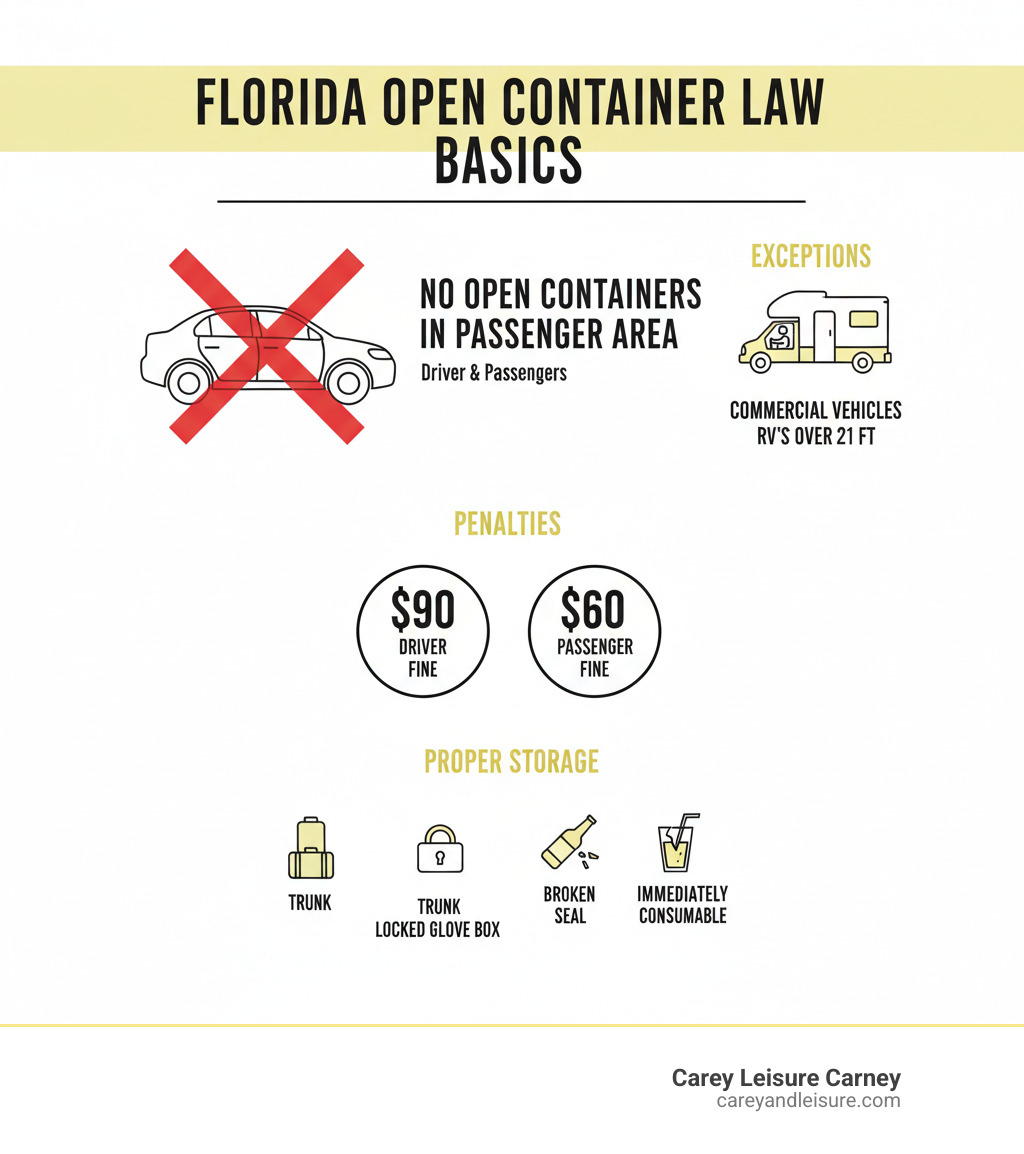
- Drivers: Cannot have an open container of alcohol anywhere in the vehicle unless it’s in a locked trunk or glove compartment
- Passengers: Cannot possess or drink from an open container in the passenger area
- Open Container Defined: Any alcoholic beverage with a broken seal or that is immediately capable of being consumed
- Penalties: Fines up to $90 for drivers, up to $60 for passengers (first offense)
- Exceptions: Passengers in taxis, limos, buses with commercial drivers, and RVs over 21 feet long
Understanding these rules is crucial, whether you’re bringing home leftover wine or heading to a cookout, as it can save you from fines and legal trouble. The law even applies to parked cars on public streets.
The stakes are higher than a simple ticket. An open container can be used as evidence of negligence in a personal injury lawsuit after an accident, complicating an injury victim’s claim for compensation.
I’m Thomas W. Carey, a board-certified civil trial lawyer. Since 1988, my firm has handled thousands of drunk driving and personal injury cases across Florida. We have seen how violations of what are the open container laws in florida can complicate accident claims and hinder a victim’s recovery.
What Exactly Is an “Open Container” in Florida?
To follow what are the open container laws in florida, you must first understand the broad definition of an “open container.”
According to Florida Statute 316.1936, an open container is any alcoholic beverage that is either immediately capable of being consumed or has a broken seal. These two conditions determine its legality in your vehicle. In practice, this means if you can drink from it or the factory seal is broken, it’s an open container. This applies to cans, bottles, flasks, and cups. Even most non-alcoholic beers contain trace amounts of alcohol, so they should be treated like any other alcoholic drink in a vehicle.
The “Broken Seal” Rule Explained
The broken seal rule is where many people unintentionally break the law. The key point is that once the original factory seal on any alcoholic beverage is broken, the container is legally “open.” It doesn’t matter if you’ve consumed any of the contents; the broken seal is what counts.
A factory seal includes a liquor bottle’s wrapper, a can’s tab, or a wine bottle’s original cork. Twisting a cap, popping a tab, or pulling a cork breaks the seal, making it an open container, even if you re-close it. A re-capped beer, an uncorked but unpoured wine bottle, or a tightly sealed whiskey bottle from last week are all considered open containers under the law.
Simply re-tightening the cap is not enough. The law only considers whether the original seal has been broken.
An important exception is for resealed wine from a restaurant. If you don’t finish a bottle of wine with dinner, the restaurant can legally re-cork it for you to take home, but specific sealing and bagging requirements apply, which we’ll cover later.
The bottom line is that a broken seal changes everything. For the exact legal text, see the official text of section 316.1936 Florida Statute.
What Are the Open Container Laws in Florida for Vehicles?
Florida’s vehicle open container laws are strict, designed to prevent alcohol consumption in vehicles and keep roads safe. The law makes it illegal for anyone to possess an open container or consume alcohol in a vehicle, whether as a driver or passenger. This applies even if the vehicle is parked or stopped on a public road.
The term “within a road” is broad, including the roadbed, right-of-way, and sidewalks. This means you can be cited for having an open container in a car parked on the shoulder or in a public lot connected to a road’s right-of-way. The prohibition is comprehensive and applies whether the vehicle is moving or stopped at a red light.

How the Law Applies to Drivers vs. Passengers
A common question is whether passengers can drink if the driver isn’t. The answer is no. Both are subject to the law, but the definition of “possession” differs.
For drivers, the law uses “constructive possession.” If an open container is in the passenger area and not clearly possessed by a passenger, the driver is presumed to possess it. Even if untouched, if the container is accessible, the driver can be cited.
For passengers, the standard is “physical control.” If you are holding an open container or it’s within your immediate reach, it’s considered in your possession.
A driver faces a noncriminal moving violation with a fine up to $90 for a first offense. A passenger faces a nonmoving violation with a fine up to $60. These fines can increase to $500 if contested in court. Passengers also have a legal duty to follow these rules. Open container violations can complicate personal injury claims after an accident. If a drunk driver has injured you, understanding these laws is critical. Learn more about What to do if a drunk driver hit me.
What are the open container laws in florida for legally transporting alcohol?
Florida’s strict laws don’t forbid transporting alcohol. The key is to transport it legally so it’s not “immediately capable of being consumed from.”
The safest place for any open alcoholic beverage is the trunk. In vehicles without a trunk (like SUVs), store it behind the last upright seat. A locked glove compartment or any other locked non-passenger area is also acceptable. The key is that the alcohol is secured and inaccessible to passengers.
Unopened containers with intact seals can be transported in the passenger area, though placing them in the trunk is a good practice to avoid confusion during a traffic stop.
For leftover wine from a restaurant, the establishment must securely reseal the bottle and place it in a bag, often with a receipt. You must then transport it in your trunk, a locked glove compartment, or behind the last upright seat.
Are There Exceptions to the Vehicle Rule?
Florida’s strict open container laws have a few specific exceptions, mostly for passengers in commercial vehicles.
- Passengers in vehicles for hire, such as taxis and limousines, are exempt. The driver must hold a valid commercial driver’s license with a passenger endorsement.
- Buses with properly licensed commercial drivers also fall under this exemption.
- Passengers in self-contained motor homes (RVs) longer than 21 feet can consume alcohol in the living quarters. This exception does not apply to the driver or anyone in the cab while the RV is moving.
What about Uber and Lyft? These services generally do not qualify for the exception because their drivers typically lack the required commercial license. Therefore, an Uber or Lyft is treated like a private vehicle, and passengers cannot have open containers.
These exceptions are narrow. When in doubt, store all alcohol in a sealed container in the trunk.
Penalties for Violating Florida’s Open Container Laws
Understanding the penalties for violating what are the open container laws in florida can help you avoid fines and legal headaches. An open container violation is a noncriminal traffic violation, so it won’t result in a criminal record. However, you will face fines, and it could affect your driving record and insurance rates.
For a driver, it’s a noncriminal moving traffic violation that goes on your driving record and can raise insurance premiums. For a passenger, it’s a noncriminal nonmoving traffic violation, which typically doesn’t affect your driving record. Penalties are outlined in Chapter 318 of the Florida Statutes, and the financial impact can vary depending on how you handle the citation.
What are the open container laws in florida regarding fines and license points?
For a first offense, a driver faces a fine of up to $90, while a passenger faces a fine of up to $60. If you contest the ticket in court and lose, the fine can jump to $500, plus several hundred dollars in court costs.
Drivers also receive three points on their driving record, which can lead to higher insurance rates and potential license suspension. You can learn more at the Details on points deducted from your driving record page on the Florida Highway Safety and Motor Vehicles website.
An open container violation often leads to further investigation. An officer who sees an open container has probable cause to suspect DUI and may request field sobriety or breathalyzer tests. A failed test can lead to DUI charges, which carry severe penalties like license suspension, large fines, and jail time.
We’ve seen many cases where a simple open container charge escalates into a serious DUI case. The consequences of a DUI are far more severe, and if an accident is involved, it can lead to civil liability and DUI punitive damages in Florida coming into play. The initial fine is minor compared to the potential ripple effects, so it’s always safer to store alcohol properly.
Beyond the Car: Rules for Boats, Public Spaces, and More
Alcohol regulations in Florida extend beyond vehicles to boats and public spaces, where rules can vary dramatically by location. Florida counties and cities can create their own, often stricter, alcohol ordinances. What is legal in one town may be illegal in the next. These local rules aim to prevent public intoxication, especially in tourist areas. Always check local rules before drinking in public.

Open Containers on Boats vs. Boating Under the Influence (BUI)
On Florida waters, the rules are more relaxed than on roads: open containers are allowed on boats. Passengers can legally consume alcohol. However, the boat operator must remain sober. Operating a vessel under the influence (BUI) is illegal and has serious consequences.
The legal limit for boat operators is a Blood Alcohol Content (BAC) of 0.08%, the same as for drivers. Exceeding this limit can lead to BUI charges. Florida’s BUI penalties are severe. A first offense can result in fines from $500 to $1,000 and up to six months in jail. Subsequent offenses carry steeper penalties. For a full breakdown, see Penalties for BUI in Florida.
These penalties are harsh because environmental factors on the water—sun, heat, and motion—can amplify alcohol’s effects. While passengers can drink responsibly, operators must stay sober. For more details, review Florida boater regulations.
Can You Drink in Public in Florida?
Drinking in public spaces like parks and beaches is generally prohibited in Florida, but local exceptions exist. Most cities ban drinking on streets and in parks, but some have created designated entertainment districts or “Sip & Stroll” areas.

For example, on Tampa’s Riverwalk, you can carry drinks purchased from approved vendors in special cups during designated hours. Rules are specific to each district. Beaches and parks often have strict “no alcohol” policies. Look for posted signs or check local government websites before you go.
The key takeaway is that local rules vary widely. Always check local ordinances before drinking in public.
What to Do If You’re Charged with an Open Container Violation
Even if you understand what are the open container laws in florida, mistakes happen. If you’re charged with an open container violation, how you react is important.
If pulled over, stay calm and be polite with law enforcement. A respectful attitude can make a significant difference. As the driver, provide your identification, registration, and proof of insurance. Passengers should also provide ID if asked.
Crucially, you do not have to admit guilt. You have the right to remain silent. If asked incriminating questions, you can politely decline to answer by stating you’d prefer to speak with an attorney first.
If you receive a citation, understand the charge, the fine, and the response deadline. Missing deadlines leads to more penalties. As soon as possible, document everything you remember about the stop: the time, location, officer’s statements, and where the container was. These details are crucial if you contest the citation.
Most importantly, contact an attorney immediately. An open container ticket can have unforeseen consequences, like insurance rate hikes or complications in an accident claim. If a DUI charge is possible, legal guidance is essential.
At Carey Leisure Carney, our board-certified attorneys have over 100 years of combined experience with traffic infractions, DUIs, and related personal injury cases. We understand Florida law and can identify potential defenses. If you’ve been injured by an impaired driver, we can help you understand your rights. Consulting with a drunk driving accident attorney can protect your future.
Conclusion
Understanding what are the open container laws in florida is about more than avoiding a fine; it’s about road safety, protecting your driving record, and preventing serious legal trouble. Key details—from the definition of an “open container” (any broken seal) to legal storage locations—are crucial. Florida takes these laws seriously, and so should you.
Penalties start at $60 to $90 but can escalate to $500 plus court costs and license points if contested and lost. An open container can also provide probable cause for a DUI investigation, which carries much more severe consequences. An open container violation can also complicate personal injury cases. After an accident, it can be used as evidence of negligence, making it harder for victims to get compensation for their injuries and losses.
At Carey Leisure Carney, our board-certified attorneys (top 2% in Florida) have over 100 years of combined experience. We understand how these laws intersect with personal injury claims and can provide personalized guidance whether you’re facing a citation or dealing with the aftermath of a drunk driving accident.
Stay informed and make responsible choices. If you find yourself in a difficult legal situation, you don’t have to face it alone. We are committed to fighting for accident victims across Florida.
If you have questions or need to discuss a specific situation, we are here to help. Learn more about Florida’s open container law and your rights on our website, and let us help you move forward with confidence.