

When Big Rigs Collide: A Guide to Truck Accident Injuries
Understanding the Devastating Reality of Truck accident injury
Truck accident injury cases represent some of the most severe and life-altering collisions on our roads. When a commercial truck weighing up to 80,000 pounds collides with a passenger vehicle weighing roughly 4,000 pounds, the results are often catastrophic.
Key Facts About Truck Accident Injuries:
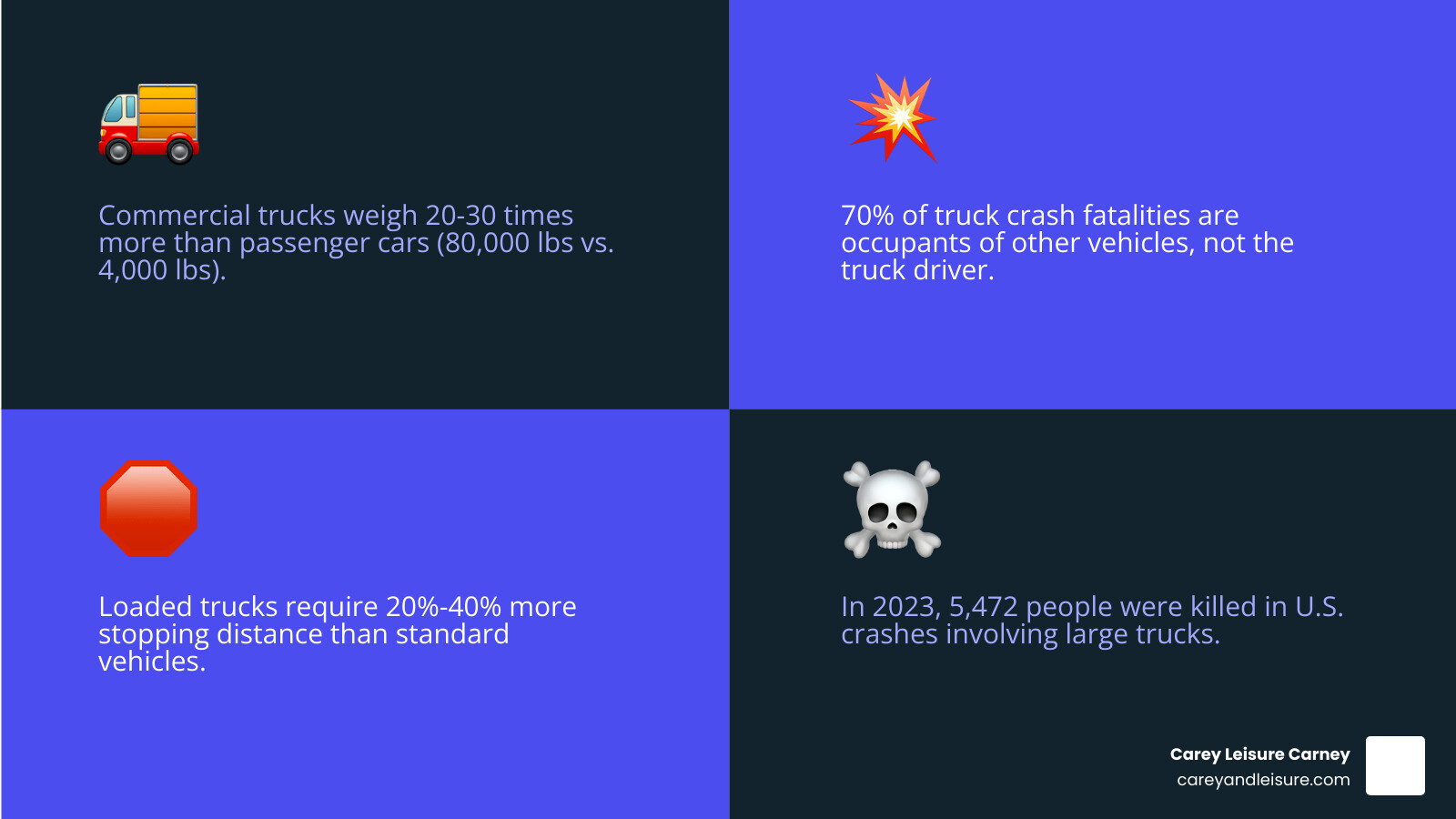
- 70% of truck crash fatalities are occupants of other vehicles, not the truck driver
- Commercial trucks weigh 20-30 times more than passenger cars
- Loaded trucks require 20%-40% more stopping distance than standard vehicles
- In 2023, 5,472 people were killed in crashes involving large trucks across the United States
- 76% of collisions involving large trucks result in serious injury or death
- Common injuries include traumatic brain injuries, spinal cord damage, internal organ injuries, broken bones, and PTSD
The physics of these collisions are unforgiving. When a fully loaded semi-truck strikes a passenger vehicle, the weight disparity means that occupants of the smaller vehicle absorb most of the impact force. The higher ground clearance of commercial trucks also creates deadly underride scenarios where cars slide beneath the trailer, often with fatal consequences.
I’m Thomas W. Carey, a board-certified civil trial lawyer who has guided roughly 40,000 injury matters across Florida since 1988, including numerous catastrophic truck accident injury cases that have resulted in multi-million-dollar recoveries for victims and their families. My experience has shown that acting quickly to preserve evidence and secure skilled legal representation can make the difference between inadequate compensation and full recovery for long-term medical care and lost income.
Discover more about Truck accident injury:
Why Truck Accidents Are More Dangerous Than Car Crashes
When we talk about a truck accident injury, we aren’t just talking about a “fender bender” with a larger car. The sheer physics involved in a collision with a commercial vehicle are staggering. In Clearwater and across Pinellas County, we see these massive machines sharing the roads with family sedans every day, and the disparity is frightening.
The 80,000-Pound Problem
A standard passenger car weighs about 4,000 pounds. A fully loaded commercial tractor-trailer can weigh up to 80,000 pounds. This means a truck is 20 times heavier than your car. When that much mass is in motion, it carries an incredible amount of kinetic energy. According to Fatality Facts 2023 Large trucks, this weight disparity is the primary reason why occupants of smaller vehicles account for the vast majority of deaths in these crashes.
Stopping Distance and Maneuverability
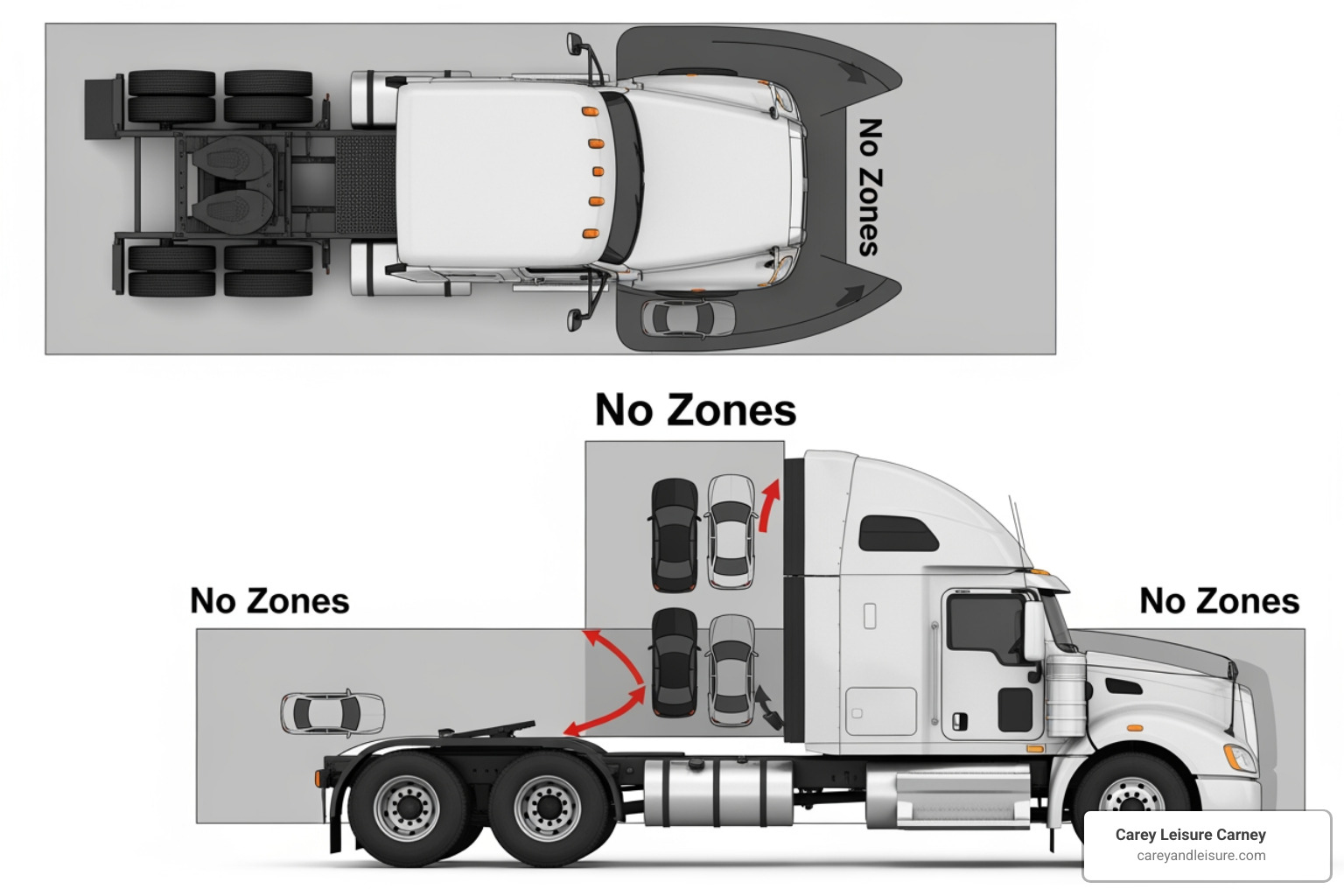
Because of their weight, trucks cannot stop on a dime. A loaded semi-truck requires 20% to 40% more distance to stop than a car. If the road is wet or the brakes are poorly maintained, that distance increases significantly. Furthermore, trucks have massive blind spots—often called “No Zones”—where a passenger car can completely disappear from the driver’s view.
The Underride Risk
Commercial trucks have much higher ground clearance than cars. In a collision, especially a rear-end or side-impact crash, a smaller vehicle can slide directly under the truck’s trailer. These “underride” accidents are frequently fatal because the safety features of the car, like crumple zones and airbags, are bypassed as the trailer enters the passenger compartment at head level. Understanding the differences between Truck Accidents and Car Crashes is vital for any victim seeking justice.
| Feature | Passenger Car | Commercial Semi-Truck |
|---|---|---|
| Average Weight | 3,000 – 5,000 lbs | Up to 80,000 lbs |
| Stopping Distance | ~300 feet (at 65 mph) | ~525 – 600 feet (at 65 mph) |
| Height | ~4-5 feet | ~13.5 feet |
| Ground Clearance | Low | High (Underride risk) |
Common Types of Truck accident injury
The force generated by a big rig collision often results in “polytrauma”—a medical term for multiple, life-threatening injuries occurring at once. At Carey Leisure Carney, we have seen how a single truck accident injury can require years of rehabilitation and multiple surgeries.
Traumatic Brain Injuries (TBI)
A Traumatic brain injury occurs when the brain is violently shaken or struck within the skull. In truck accidents, the “whiplash” effect is magnified. Even if your head doesn’t hit the dashboard, the force of the impact can cause the brain to collide with the skull, leading to permanent cognitive impairment, memory loss, and personality changes. We treat these as catastrophic injuries because of their long-term impact on the victim’s quality of life.
Internal Bleeding and Organ Damage
The blunt force trauma of a truck crash can cause internal organs like the spleen, liver, or kidneys to rupture. These injuries are particularly dangerous because they aren’t always visible immediately after the crash. A victim might feel “fine” due to adrenaline, only to collapse hours later from internal hemorrhaging.
Orthopedic Fractures
The crushing force of a semi-truck often results in complex, comminuted fractures—where the bone is shattered into multiple pieces. These often require the surgical insertion of plates, screws, and rods. While these may seem less severe than a brain injury, the long-term risk of chronic pain and arthritis is high. You can read more about the various Types of Car Accident Injuries to see how they compare to truck-specific trauma.
Catastrophic Truck accident injury and Paralysis
One of the most devastating outcomes we handle is spinal cord damage. The spine is not designed to withstand the force of an 80,000-pound impact.
- Complete vs. Incomplete Injuries: A complete injury means all feeling and ability to control movement are lost below the site of the injury. An incomplete injury means some motor or sensory function remains.
- Quadriplegia and Paraplegia: Depending on where the spine is injured (neck vs. lower back), a victim may face permanent paralysis of all four limbs or the lower half of the body.
Our Spinal Cord Injury Lawyer Complete Guide provides an in-depth look at how we fight for the millions of dollars often required for lifetime care in these cases.
Psychological Impact of a Truck accident injury
We never overlook the “invisible” injuries. Being struck by a massive commercial vehicle is a terrifying, near-death experience. Many of our clients suffer from:
- PTSD: Flashbacks, nightmares, and an inability to drive or be near highways.
- Emotional Trauma: Depression and anxiety resulting from a loss of independence or chronic pain.
- Loss of Enjoyment: The inability to participate in hobbies or family activities.
As your Personal Injury Attorney, we ensure that these psychological damages are factored into your claim.
Leading Causes of Commercial Vehicle Collisions in Florida
Florida is a hub for commerce, meaning our highways like I-75 and US-19 are constantly filled with freight. However, the pressure to deliver goods quickly often leads to dangerous shortcuts.
Driver Fatigue
The Federal Motor Carrier Safety Administration (FMCSA) has strict “Hours of Service” (HOS) regulations. Generally, drivers are limited to 11 hours of driving after 10 consecutive hours off duty. However, some drivers and companies falsify logs to meet tight deadlines. Fatigue can be just as dangerous as alcohol, slowing reaction times and causing “micro-sleeps.”
Improper Cargo Loading
If a trailer is overloaded or the weight isn’t distributed evenly, it can lead to a rollover or a “jackknife” accident. Unsecured cargo can also fall off the truck, creating a deadly obstacle course for Florida drivers.
Brake and Equipment Failure
Trucks require constant maintenance. According to some industry reports, up to 20% of trucks on the road may have defects severe enough that they should be removed from service immediately. Brake failure is a leading cause of rear-end collisions, where the truck simply cannot stop in time.
Distracted or Impaired Driving
Truckers are not immune to the temptations of smartphones. Additionally, while alcohol rates are lower among commercial drivers (around 4% in fatal crashes according to Federal Highway Administration, 2024 data), any impairment is magnified by the size of the vehicle. If you’ve been hit by an impaired driver, our Drunk Driving Accident Attorney team knows exactly how to pursue punitive damages.
Determining Liability and Seeking Compensation
Unlike a standard car accident where you usually just sue the other driver, a truck accident injury claim often involves a web of liable parties. This is where our 100+ years of combined experience becomes your greatest asset.
Who Is at Fault?
- The Driver: For negligence, fatigue, or traffic violations.
- The Trucking Company: Under the legal theory of respondeat superior, an employer is responsible for the actions of their employees. They can also be sued for negligent hiring or failing to maintain the fleet.
- The Manufacturer: If a tire blowout or brake failure was caused by a defective part.
- The Cargo Loader: If improper loading caused the truck to become unstable.
Evidence is Key
To win, we must move fast. Trucking companies have “rapid response teams” that arrive at crash scenes within hours to begin “managing” the evidence. We counter this by:
- Securing the “Black Box”: Formally known as the Electronic Control Module (ECM), this records speed, braking, and GPS data.
- Reviewing ELDs: Electronic Logging Devices show exactly how long the driver had been behind the wheel.
- Maintenance Records: Proving the company knew about a mechanical issue but ignored it.
Our role as your Truck Accident Attorney is to lock down this evidence before it “disappears.” You can learn more about the legal framework in this guide to Driver and Company Liability for Commercial Truck Accidents.
Recoverable Damages for Victims
We don’t just look at your current medical bills; we look at your future. A truck accident injury often requires:
- Medical Expenses: Past surgeries and future rehabilitation.
- Lost Earning Capacity: If you can no longer work in your previous profession.
- Pain and Suffering: Compensation for the physical and emotional agony of the crash.
- Future Care Costs: Home modifications, wheelchairs, and in-home nursing.
Wondering about the value of your claim? Visit our page on What Is My Personal Injury Case Worth? for more details.
Immediate Steps to Take After a Clearwater Truck Crash
What you do in the minutes and days following a crash will directly impact your ability to recover compensation for your truck accident injury.
- Safety First: If possible, move your vehicle out of the flow of traffic. However, in many truck crashes, the car is immobilized. Stay inside with your seatbelt on until emergency responders arrive.
- Call 911: You need a police report. In Florida, a formal report is a cornerstone of any injury claim.
- Gather Evidence: If you are physically able, take photos of everything—the truck’s license plate, the company logo on the trailer, skid marks, and the position of the vehicles.
- Identify Witnesses: Get names and phone numbers. Trucking companies may try to change the narrative later; independent witnesses are vital.
- Seek Medical Attention: Even if you feel “okay,” go to the ER or an urgent care center. As we mentioned, internal injuries and TBIs often have delayed symptoms.
- Do NOT Speak to Adjusters: The trucking company’s insurance adjuster will call you. They may sound friendly, but their goal is to get you to admit fault or settle for pennies.
For a more detailed checklist, see our guide on What to Do After a Car Accident Florida. Our Truck Accident Lawyer Role Guide explains how we take over the communication with insurance companies so you can focus on healing.
Frequently Asked Questions about Truck Accident Injuries
Who can be held liable for my truck accident injuries?
Liability can extend beyond the driver to the trucking company, the vehicle owner, the cargo loading company, and even the manufacturer of defective parts. Because commercial trucks often involve multiple contracts and insurance policies, we investigate every entity involved in the truck’s operation to maximize your recovery.
How do truck accident insurance claims differ from car accidents?
Trucking companies are required by federal law to carry much higher insurance limits—often $750,000 to $5 million or more. This means there is more “money on the table,” but it also means the insurance companies will fight ten times harder to avoid paying. They use aggressive legal teams to protect these high-value policies.
Why is it important to contact a lawyer immediately after a big rig crash?
Evidence in truck accidents is highly perishable. Trucking companies are legally allowed to destroy certain records after a specific period unless a “spoliation letter” is sent by an attorney. We need to secure the truck for inspection before it is repaired and the evidence of the collision is lost forever.
Conclusion
A truck accident injury is a life-altering event, but you don’t have to face the aftermath alone. At Carey Leisure Carney, we pride ourselves on being more than just your legal representatives; we are your advocates and partners in recovery.
With Board-Certified trial attorneys—a distinction held by only the top 2% of lawyers in Florida—we bring a level of expertise and “battle-tested” experience that large trucking companies respect (and fear). We offer direct attorney access, meaning you speak with us, not just a paralegal or an intake specialist.
Whether you are in Clearwater, St. Petersburg, New Port Richey, or Wesley Chapel, we are ready to help you rebuild your life. We operate on a contingency fee basis, which means we don’t get paid unless we win your case.
Don’t let a trucking company’s negligence dictate your future. Schedule a Consultation with us today for a free, no-obligation case evaluation. Let us put our 100+ years of combined experience to work for you.