
Drunk Driving Punitive Damages: 2025 Justice
Why Drunk Driving Victims Deserve More Than Just Basic Compensation
Drunk driving punitive damages are special monetary awards designed to punish drunk drivers for their reckless behavior and deter others from making the same dangerous choice. Here’s what you need to know:
- Purpose: Punish the wrongdoer and prevent future drunk driving incidents
- Standard: Requires “clear and convincing evidence” of gross negligence or willful misconduct
- Amount: Varies by state; Florida caps at 3x compensatory damages or $500,000 (whichever is greater)
- Availability: Not automatic – must be specifically requested and proven in court
- Coverage: Many insurance policies exclude punitive damages, leaving drivers personally liable
In 2021, drunk driving claimed 13,384 lives, 31% of all U.S. traffic fatalities. Behind each statistic is a devastated family. While criminal charges are paid to the state, punitive damages in civil court put money directly into victims’ hands.
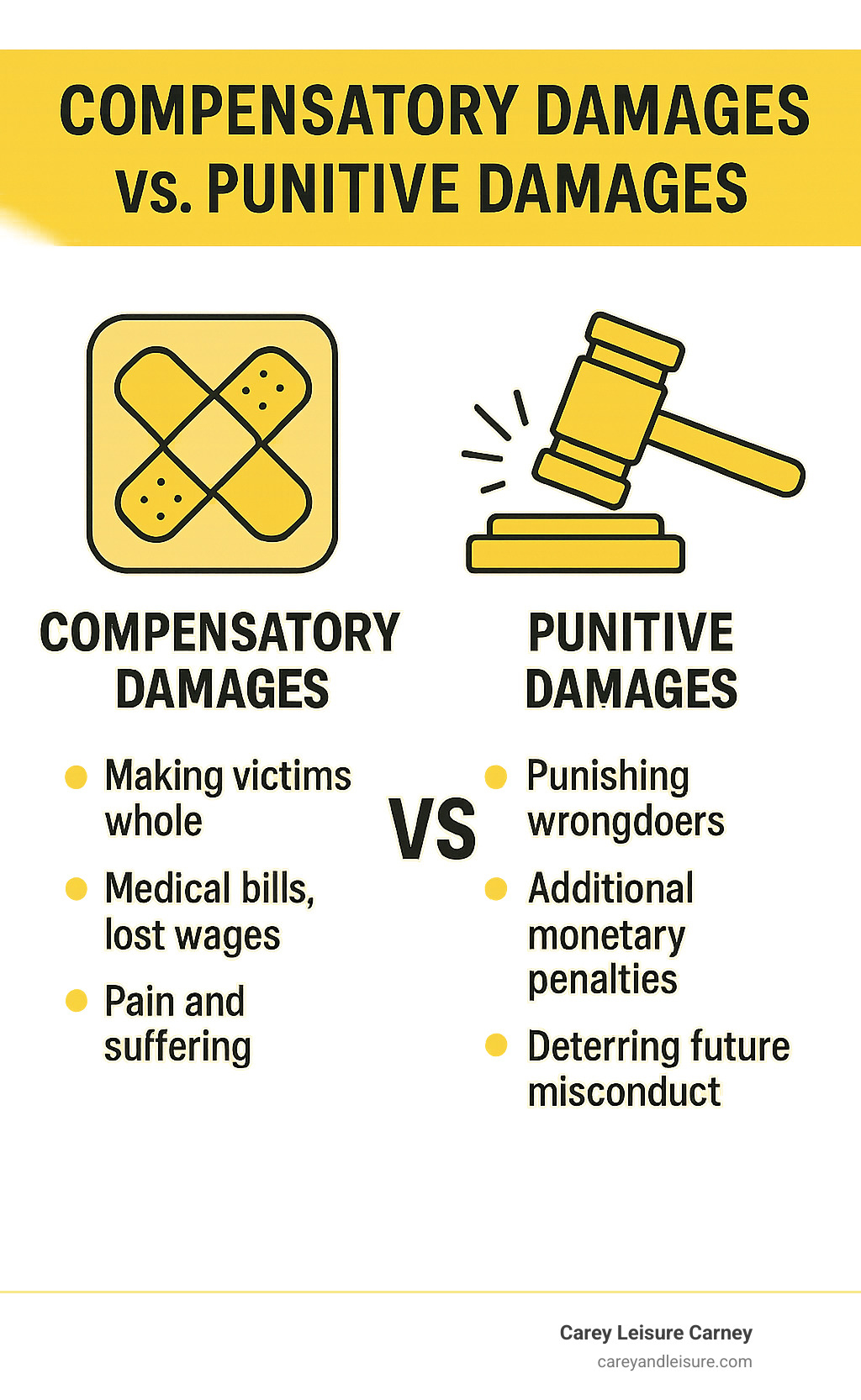
Compensatory damages aim to make you “whole” by covering medical bills, lost wages, and pain and suffering. Punitive damages go further, acting as society’s punishment for outrageous behavior. Many victims don’t realize they may be entitled to both, as the legal system recognizes drunk driving as a conscious decision to endanger others, not just negligence.
I’m Thomas W. Carey, founding partner of Carey Leisure Carney and a board-certified civil trial lawyer who has handled roughly 40,000 injury cases across Florida. After losing my wife Joni to a drunk driver early in our marriage, I’ve dedicated my career to securing drunk driving punitive damages for victims and their families while serving as a leader in anti-DUI advocacy efforts. This guide will help you understand when these powerful damages apply and how to pursue them effectively.
What Are Punitive Damages and How Do They Differ from Compensatory Damages?
When hurt by a drunk driver, you are the victim of a dangerous choice. The law recognizes this by offering two distinct types of damages.

Punitive damages (also called exemplary damages) aren’t about fixing what’s broken – they’re about sending a message. These damages exist to punish the wrongdoer for their outrageous behavior and deter others from making the same reckless choice to drink and drive.
Drunk driving punitive damages are society’s way of saying basic compensation is not enough for such inexcusable behavior. They are reserved for cases where someone showed a complete disregard for human safety, such as choosing to drive while intoxicated.
Compensatory damages, on the other hand, focus on making you whole again. They’re designed to restore you to where you were before that drunk driver changed your life. These damages come in two forms:
Economic damages cover your measurable financial losses. This includes medical bills (both current and future), lost wages from time off work, property damage to your vehicle, rehabilitation costs, and any other out-of-pocket expenses the crash caused.
Non-economic damages address intangible but real losses, such as your pain and suffering, emotional trauma, loss of enjoyment in life, and mental anguish. These damages recognize that some injuries extend far beyond a hospital bill. You can learn more about compensation for pain and suffering in Florida: What you need to know.
Here’s how these two types of damages stack up:
| Feature | Compensatory Damages | Punitive Damages |
|---|---|---|
| Purpose | Reimburse the victim for actual losses | Punish the wrongdoer and deter future misconduct |
| Measures | Actual losses (economic & non-economic) | Egregiousness of the defendant’s act |
| Standard of Proof | Preponderance of the evidence | Clear and convincing evidence |
The key difference? Compensatory damages are about you and your losses. Punitive damages are about the drunk driver’s inexcusable conduct and protecting future victims from similar harm.
The Legal Standard for Drunk Driving Punitive Damages
Securing drunk driving punitive damages is more challenging than getting compensation for your medical bills. The legal bar is set much higher, as courts do not award punishment money lightly.

While regular negligence is carelessness, drunk driving punitive damages require proving something far worse: gross negligence, willful and wanton conduct, or malice. This means showing the driver had a conscious disregard for the safety of others—knowing their actions were dangerous but driving anyway.
Think of it this way: accidentally rear-ending someone while texting might be negligence. But getting behind the wheel after downing several drinks? That’s a deliberate choice to put everyone else at risk.
The burden of proof is also tougher. Instead of the “more likely than not” standard for compensatory damages, we must prove our case by clear and convincing evidence. This is a high standard also used in some criminal cases.
Here in Florida, Florida Statute §768.72 defines gross negligence as conduct showing a conscious disregard or indifference to the life, safety, or rights of others—a fitting description for drunk driving.
Other states have similar standards, though they may phrase them differently. Virginia takes an interesting approach – if a driver’s blood alcohol concentration hits 0.15% or higher, the law automatically presumes willful or wanton conduct for punitive damage purposes. That’s nearly twice the legal limit, showing just how reckless that level of intoxication really is.
Our team at Carey Leisure Carney has extensive experience navigating these complex legal requirements, as detailed in our comprehensive guide on DUI Punitive Damages Florida.
What Actions Make a Drunk Driver Liable for Punitive Damages?
Not every drunk driving case automatically qualifies for punitive damages. Courts look for certain aggravating factors that push the driver’s conduct from merely negligent to truly outrageous.
An extremely high BAC is often a key aggravating factor. A BAC significantly over the 0.08% limit shows serious impairment. For instance, Virginia law presumes willful conduct when the BAC reaches 0.15% or higher. In 2021, 2,039 people died in crashes where the driver had a BAC of .15 g/dL or higher.
Prior DUI convictions show a dangerous pattern, not a one-time mistake. When someone reoffends after being prosecuted and educated about the dangers of drunk driving, courts take notice.
Fleeing the accident scene adds another layer of egregiousness. It shows the driver knew they’d done something terrible and tried to escape responsibility. This kind of behavior demonstrates a callous disregard for the victims they’ve left behind.
Combining drunk driving with excessive speeding or reckless driving – like weaving through traffic, racing, or driving against traffic – amplifies the danger exponentially. It’s not just impaired judgment; it’s actively dangerous behavior that puts everyone at risk.
When drunk driving causes catastrophic injury or death, it highlights just how devastating the consequences of this choice can be. While the severity of injuries alone doesn’t guarantee punitive damages, it certainly underscores the extreme danger the driver created.
Finally, driving on a suspended license – especially one suspended for a previous DUI – shows a complete disregard for the law and public safety. It’s like the driver is thumbing their nose at the legal system designed to protect all of us.
What Evidence Is Needed to Prove a Claim for Drunk Driving Punitive Damages?
Building a winning case for drunk driving punitive damages requires swift, thorough evidence collection to meet the high “clear and convincing” standard.
Police reports are often our starting point. These official documents capture the officer’s observations of the driver’s condition, witness statements, and initial findings. They’re created on the scene by trained professionals who know what to look for.
BAC test results from blood, breath, or urine tests provide concrete proof of intoxication. Field sobriety test videos are also powerful, showing a jury the driver’s impairment—stumbling, slurring, and inability to follow simple instructions.
Witness testimony brings the human element to our case. People who saw the drunk driver swerving before the crash, or who heard them slurring their words afterward, provide compelling evidence of impairment. Sometimes the most powerful testimony comes from the driver’s own admissions – statements they made to police or bystanders about how much they’d been drinking.
We also dig into the driver’s activities before the crash. Bar receipts or credit card statements can show exactly where and how much they were drinking. This helps paint a picture of someone who made a series of bad choices leading up to getting behind the wheel.
Expert testimony helps connect all these dots for the jury. Accident reconstruction specialists can show how impairment contributed to the crash. Toxicologists can explain what those BAC numbers really mean in terms of impairment. Medical experts can detail the severity of injuries and their long-term impact.
Your actions right after the accident are crucial. Knowing what to do after a car accident Florida can preserve vital evidence. Ask police to test the other driver, document any signs of impairment, and get witness contact information.
The key is acting fast. Evidence disappears, memories fade, and surveillance videos get deleted. That’s why it’s so important to get an experienced legal team involved as soon as possible after a drunk driving accident.
State Laws, Damage Caps, and Insurance Coverage
Here’s something that might surprise you: the drunk driving punitive damages available to victims can vary dramatically depending on which state they’re in. It’s like a legal lottery where geography determines your rights.

Take Florida, where we practice. Our state generally caps punitive damages but recognizes that drunk driving is different. Then there’s North Carolina, which takes an even stronger stance by completely removing caps for drunk driving cases. Texas has its own approach, while Virginia creates special rules based on how intoxicated the driver was.
This patchwork of state laws reflects how seriously different jurisdictions view drunk driving. The devastating impact of impaired driving affects every state, but each has developed its own legal response to hold these dangerous drivers accountable.
Are There Limits on Drunk Driving Punitive Damages by State?
Most states do impose statutory caps on punitive damages, but here’s where it gets interesting – many make special exceptions for drunk driving cases.
In Florida, our general rule caps punitive damages at three times your compensatory damages or $500,000, whichever is higher. But lawmakers recognized that drunk driving deserves harsher treatment. If the drunk driver’s conduct was motivated by financial gain through unreasonably dangerous behavior, that cap jumps to four times compensatory damages or $2 million. Even more importantly, there’s no cap at all if we can prove the driver intended to cause harm. You can read the full details in Florida’s punitive damage award cap.
North Carolina takes perhaps the strongest pro-victim stance. While they normally cap punitive damages at three times compensatory damages or $250,000, they completely remove this cap for drunk driving cases. This means victims there can potentially recover substantial drunk driving punitive damages without worrying about artificial limits.
Texas follows a different formula, capping punitive damages at twice the economic damages plus non-economic damages, but not exceeding $750,000 or falling below $200,000.
These differences matter enormously. A victim with identical injuries and circumstances might recover vastly different amounts depending on where their accident happened.
Can Insurance Cover Punitive Damages?
This question keeps insurance companies and lawyers busy, and the answer usually isn’t good news for drunk drivers. Most states say no – insurance shouldn’t cover punitive damages.
Think about it logically. Punitive damages exist to punish wrongdoers and make them think twice before acting recklessly. If insurance picks up the tab, where’s the punishment? The drunk driver walks away financially unscathed while everyone else’s premiums go up to cover their bad choices.
This creates what we call an uninsurable risk. Most insurance policies specifically exclude coverage for punitive damages, especially when they stem from intentional misconduct or gross negligence like drunk driving. The public policy reasoning is sound – we shouldn’t let people escape the consequences of their worst decisions.
What does this mean for victims? It’s actually good news. When a jury awards drunk driving punitive damages, the drunk driver often faces personal financial responsibility for every penny. No insurance company bailout. No spreading the cost among other policyholders. Just direct accountability.
This reality can lead to serious financial consequences for drunk drivers – sometimes even bankruptcy. While we never celebrate someone’s financial ruin, this direct liability serves the exact purpose punitive damages were designed for: making the punishment real and deterring others from making the same dangerous choice.
Pursuing a Claim: The Role of Legal Representation
When you’re hurt by a drunk driver, you’re not just dealing with physical injuries and emotional trauma. You’re also facing a legal battle that can feel overwhelming, especially when pursuing drunk driving punitive damages. The truth is, these cases are significantly more complex than standard car accident claims.

The complexity of punitive damage claims goes far beyond proving someone was negligent. We need to meet that higher burden of proof – “clear and convincing evidence” rather than just “more likely than not.” This means building an airtight case that shows the drunk driver’s conduct was truly outrageous.
Insurance companies know this too. They have teams of experienced lawyers whose job is to minimize what they pay out. They’ll use every tactic in the book to challenge your claim, question your evidence, and argue against punitive damages. Without skilled legal representation on your side, you’re essentially bringing a knife to a gunfight.
That’s exactly why understanding Why you need a personal injury lawyer becomes crucial in these situations. The stakes are simply too high to go it alone.
For the drunk driver, the consequences of a successful punitive damage claim can be life-changing. While they may face criminal charges like fines, jail time, and license suspension, the civil liability is completely separate. Punitive damages often can’t be covered by insurance, meaning they’re personally on the hook for potentially hundreds of thousands of dollars. This financial ruin serves as both punishment and deterrent – exactly what the legal system intends.
How an Attorney Maximizes Your Drunk Driving Accident Claim
At Carey Leisure Carney, we’ve handled these cases for decades, and we know exactly what it takes to secure drunk driving punitive damages for our clients. Our approach is thorough, strategic, and relentless.
We start with a comprehensive case evaluation, examining every detail of your accident to determine whether the drunk driver’s conduct meets the legal standard for punitive damages. This isn’t just about whether they were drunk – we’re looking for those aggravating factors that lift their behavior to truly outrageous levels.
Next comes the detailed work of investigation and evidence gathering. We obtain police reports, BAC test results, and field sobriety test videos. We track down witnesses and secure their testimony. We dig into the driver’s history to find prior DUI convictions or patterns of reckless behavior. Sometimes we even subpoena bar receipts to show exactly how much they drank before getting behind the wheel.
When it comes to filing legal motions, we ensure every procedural requirement is met. We formally request punitive damages and present the legal arguments for why your case qualifies. This isn’t boilerplate work – each motion is carefully crafted based on the specific facts of your case and the applicable state laws.
One of our most valuable skills is arguing against damage caps. In Florida, we know exactly when exceptions apply that can lift the usual caps on punitive damages. We’ve successfully argued for these exceptions, securing our clients awards that might otherwise have been limited by statutory caps.
Negotiating with insurers requires a delicate balance of aggression and strategy. We leverage our reputation and track record to push for settlements that account for both your compensatory damages and the potential for significant punitive awards. Insurance companies know we’re not afraid to go to trial, which gives us tremendous negotiating power.
When cases do go to trial, our Board-Certified attorneys – a distinction held by only the top 2% of lawyers in Florida – bring over 100 years of combined courtroom experience to your case. We know how to present compelling arguments to juries, helping them understand not just what happened, but why punitive damages are necessary to send a message.
Our dedicated Drunk Driving Accident Attorney team has seen how these cases can transform lives. We’re not just fighting for money – we’re fighting for justice, accountability, and the hope that our efforts might prevent another family from experiencing what you’ve been through.
Frequently Asked Questions about Punitive Damages in DUI Cases
When you’re dealing with the aftermath of a drunk driving accident, it’s completely natural to have questions about drunk driving punitive damages. These aren’t everyday legal concepts, and understanding them can feel overwhelming when you’re already dealing with injuries, medical bills, and emotional trauma.
Let me address the most common questions we hear from clients who are considering pursuing punitive damages against drunk drivers.
How much are punitive damages in a drunk driving case?
This is probably the first question on your mind, and I wish I could give you a simple answer. The truth is, there’s no “average” amount for drunk driving punitive damages because every case is unique.
Think of punitive damages like a custom-custom suit – they’re specifically designed to fit the circumstances of your particular case. Several key factors determine the amount:
The severity of the drunk driver’s conduct plays a huge role. A driver with a blood alcohol level barely over the legal limit might face lower punitive damages than someone who was extremely intoxicated, speeding, or had multiple prior DUI convictions. The more outrageous the behavior, the higher the potential award.
The defendant’s financial status also matters. While this might seem unfair at first glance, punitive damages are meant to punish and deter. A $10,000 penalty might devastate someone living paycheck to paycheck, but barely register as a speed bump for a millionaire. Juries consider what amount will actually make an impact.
State caps create another variable. As we discussed earlier, some states limit punitive damages while others (like North Carolina for drunk driving cases) have no limits at all.
Finally, jury discretion means that even with similar facts, different juries might award different amounts. They’re looking for a figure that sends a clear message without being excessive.
Can I get punitive damages if the drunk driver wasn’t convicted of a DUI?
Absolutely, and this surprises many people. A criminal DUI conviction and civil drunk driving punitive damages are completely separate legal proceedings with different rules and standards.
Here’s the key difference: In criminal court, prosecutors must prove the driver’s guilt “beyond a reasonable doubt” – that’s an incredibly high standard, and sometimes cases fall short for technical reasons. Maybe the breathalyzer wasn’t properly calibrated, or there was an issue with the traffic stop.
In civil court, we only need to prove that the drunk driver’s actions warrant punitive damages by “clear and convincing evidence.” This is still a high standard – much higher than the “more likely than not” standard for regular damages – but it’s more achievable than “beyond a reasonable doubt.”
So even if the drunk driver beats the criminal charges on a technicality, we can still pursue punitive damages in your civil case if the evidence shows they were driving under the influence with conscious disregard for safety.
How long do I have to file a claim for punitive damages?
Time is not on your side when it comes to personal injury claims. The statute of limitations – essentially the legal deadline for filing your lawsuit – varies significantly from state to state, typically ranging from one to four years from the date of the accident.
This might seem like plenty of time, but it’s not. Building a strong case for drunk driving punitive damages requires extensive investigation, evidence gathering, and preparation. Police reports need to be obtained, witnesses need to be interviewed while their memories are fresh, and expert testimony needs to be arranged.
Evidence has a way of disappearing over time. Security camera footage gets overwritten, witnesses move away or forget details, and important documents get lost. The sooner we can start working on your case, the stronger we can make it.
Don’t wait until you’re feeling better or until you’ve figured out all your medical expenses. The clock starts ticking the day of your accident, regardless of your physical or emotional state. For comprehensive guidance on personal injury claims and timelines, our Personal Injury Attorney resources provide valuable information to help protect your rights.
The bottom line? If you’re considering a claim for punitive damages against a drunk driver, reach out to us as soon as possible. We can evaluate your case, explain your state’s specific laws, and make sure you don’t miss any critical deadlines.
Holding Reckless Drivers Accountable
Drunk driving punitive damages serve a purpose that goes far beyond simply putting money in victims’ pockets. They represent our society’s way of saying “enough is enough” to those who make the conscious choice to endanger innocent lives.
When someone gets behind the wheel after drinking, they’re not just being careless – they’re making a deliberate decision that puts everyone on the road at risk. These damages exist both as punishment for the wrongdoer and as a warning to others who might consider making the same reckless choice. They help protect all of us by making potential drunk drivers think twice.
The high legal standard we’ve discussed – requiring clear and convincing evidence of gross negligence or willful misconduct – exists for good reason. Courts don’t hand out punitive damages lightly. But when that standard is met, the impact on both individual cases and public safety can be tremendous.
I’ve seen how these cases can change lives. Not just for the victims who receive compensation, but for the community as a whole. When word spreads that a drunk driver faced serious financial consequences beyond their criminal penalties, it sends a powerful message to others.
Of course, pursuing these damages isn’t simple. Between varying state laws, damage caps with complex exceptions, and insurance companies doing everything they can to minimize payouts, you need skilled legal help to steer this terrain successfully.
At Carey Leisure Carney, we understand what’s at stake. Our Board-Certified expertise – a distinction held by only the top 2% of attorneys in Florida – combined with over 100 years of experience, means we know how to build compelling cases for drunk driving punitive damages. We’ve dedicated our careers to holding reckless drivers accountable, and we bring that passion to every case.
Whether you’re in Clearwater, Largo, New Port Richey, Spring Hill, St. Petersburg, Trinity, or Wesley Chapel, we’re here to provide the personalized service and direct attorney access you deserve during this difficult time.
If a drunk driver has turned your world upside down, don’t let them escape the full consequences of their actions. Take the next step toward justice and ensure those responsible face the accountability they deserve. Contact a Drunk Driving Accident Attorney at Carey Leisure Carney today for a free consultation. Together, we can work toward both your recovery and a safer community for everyone.