
Reasons to sue a funeral home: Top 5 Crucial Errors
When Trust Is Broken: Understanding Your Legal Rights
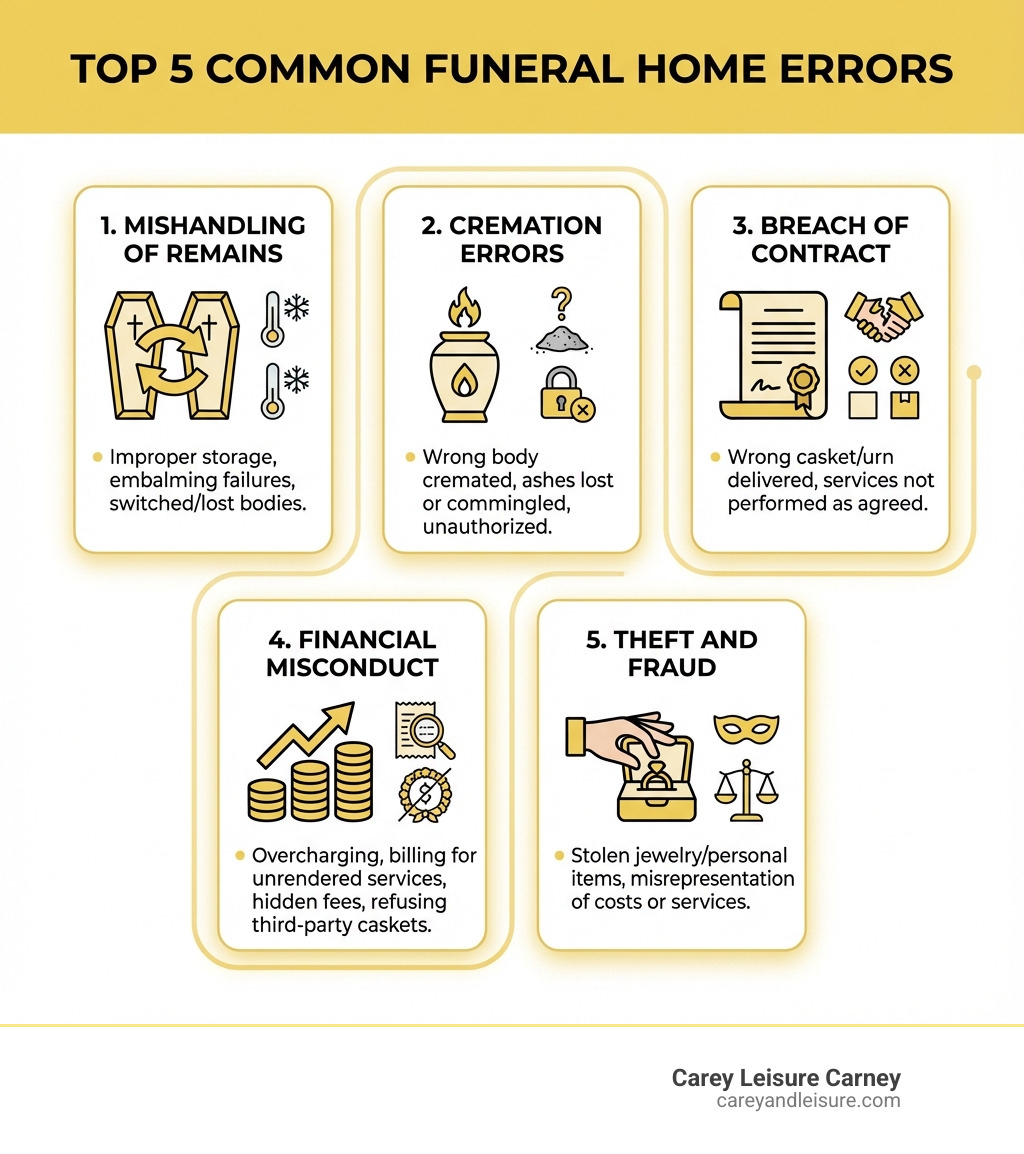
Reasons to sue a funeral home include breach of contract (failure to deliver promised services or goods), negligence (improper handling or storage of remains), fraud and misrepresentation (overcharging or billing for services not rendered), theft of personal items, cremation errors (mixing up or losing ashes), and intentional misconduct such as abuse of a corpse. You may also have grounds to sue for emotional distress if the funeral home’s actions caused severe psychological harm beyond normal grief.
Common Legal Grounds for Funeral Home Lawsuits:
| Legal Basis | Examples |
|---|---|
| Breach of Contract | Wrong casket delivered, services not performed as agreed, failure to follow specific burial instructions |
| Negligence | Improper embalming causing premature decomposition, mishandling of remains, inadequate storage |
| Fraud/Misrepresentation | Overcharging, billing for services not rendered, selling defective products |
| Intentional Torts | Theft of jewelry or personal items, unauthorized cremation, abuse or desecration of remains |
| Emotional Distress | Severe mental anguish caused by mishandling, losing, or switching bodies |
Losing a loved one is overwhelming enough without having to worry about whether a funeral home will treat their remains with dignity and respect. You trust these professionals during one of life’s most vulnerable moments—when you’re grieving, making quick decisions under emotional duress, and relying on their expertise to honor your loved one’s memory.
Unfortunately, that trust is sometimes betrayed. Funeral homes might fail to deliver the services they promised, mishandle remains, lose cremated ashes, or even commit fraud. These aren’t just service failures—they can cause devastating additional trauma to families already in pain.
The reality is stark: bodies have been switched, ashes have been mixed up, families have been grossly overcharged, and in the worst cases, remains have been stolen or abused. When a funeral home’s negligence or misconduct compounds your grief, the law recognizes your right to seek justice.
Whether the harm was accidental or intentional, you have legal options. Understanding the reasons to sue a funeral home is the first step toward holding these businesses accountable and recovering compensation for the additional suffering they’ve caused.
I’m Thomas W. Carey, a board-certified civil trial attorney who has spent decades representing families who’ve suffered harm due to professional negligence. Throughout my career, I’ve seen how funeral home misconduct can devastate already grieving families, and I’ve helped clients understand the reasons to sue a funeral home and pursue the justice they deserve.
Understanding the Legal Grounds for a Lawsuit
When a funeral home fails to uphold its professional and ethical duties, it can be an incredibly painful and infuriating experience for grieving families. These failures aren’t just moral wrongs; they often constitute legal violations that can form the basis of a lawsuit. Understanding the legal theories behind these claims is crucial for anyone considering legal action. We believe in seeking justice for funeral, cemetery & cremation malpractice.

Generally, legal claims against funeral homes fall into categories such as breach of contract, negligence, and intentional torts. Each of these represents a different way a funeral home can fail in its duties, leading to civil liability and accountability for the harm caused.
Breach of Contract
At the heart of most funeral arrangements is a contract. This is a legally binding agreement outlining the specific services and goods the funeral home promises to provide, and what you, the consumer, agree to pay. When a funeral home fails to deliver on these agreed-upon terms, it can be a clear case of breach of contract.
For instance, if you paid for a specific casket but a different, cheaper one was used, or if a particular service—like a graveside ceremony—was promised but not performed, that’s a breach. The contract establishes the funeral home’s duty to you, and failing to fulfill those promises means they’ve broken that duty. The Federal Trade Commission (FTC) emphasizes that consumers have the right to buy only the goods and services they want, and if a funeral home has deceived you about its services or costs, it could certainly be a breach.
Negligence
Negligence occurs when a funeral home fails to exercise the reasonable care expected of a professional in their field, resulting in harm. Funeral homes have a specific “duty of care” to handle human remains with dignity and respect, provide accurate billing, and deliver services as promised. This duty is usually established through the contract for services.
A breach of this duty can manifest in various ways, such as failure to properly preserve remains, leading to premature decomposition, or using unlicensed personnel for sensitive procedures. These actions demonstrate a lack of professionalism and unreasonable conduct. When a funeral home’s actions (or inactions) fall below this standard of care, and that failure directly causes harm, it constitutes negligence. We have extensive experience proving funeral home negligence in Florida.
Intentional Torts
Unlike negligence, which involves accidental harm due to a lack of care, intentional torts involve deliberate misconduct. These are actions taken knowingly and willfully by the funeral home or its staff that cause harm.
Common examples of intentional torts in the funeral industry include fraud, misrepresentation, theft, and in the most egregious cases, abuse of a corpse. Fraud might involve a funeral home overcharging for services or billing for items never rendered. Misrepresentation could mean deceiving you about the necessity of certain services or the quality of merchandise. Theft is a direct criminal act, such as stealing jewelry or personal items left with the deceased. Abuse of a corpse is an unthinkable and deeply disturbing act, but unfortunately, it does occur. In cases of intentional misconduct like theft or abuse, authorities should be alerted to initiate criminal charges in addition to filing a civil lawsuit.
Top Reasons to Sue a Funeral Home: From Negligence to Fraud
Grieving families place immense trust in funeral homes during their most vulnerable moments. When that trust is violated through negligence, fraud, or intentional misconduct, the emotional toll can be immense. These failures are often irreversible and can compound the already profound pain of loss. Understanding the specific funeral home negligence signs can help families identify when something has gone wrong.

Here, we dig into some of the most common and distressing reasons to sue a funeral home:
Mishandling of Remains
The proper handling and care of a deceased loved one’s remains are paramount. When funeral homes fail in this fundamental duty, the consequences are devastating.
- Improper Storage: Remains must be stored appropriately to prevent decomposition. Failure to do so, such as waiting too long to refrigerate a body, can lead to rapid deterioration.
- Failure to Embalm: If embalming was contracted for, but not performed correctly or at all, it can result in premature decay, making an open-casket viewing impossible and causing severe distress.
- Premature Decomposition: This can occur due to improper embalming or inadequate storage, leading to a loved one appearing undignified or neglected during services.
- Lost or Switched Bodies: Imagine the horror of being presented with the wrong body at a wake or finding your loved one’s remains were lost or mixed up with another individual’s. This is an egregious error that causes profound emotional trauma.
- Lack of Dignity: This encompasses a range of disrespectful actions, from dropping a body during transport to preparing remains in an undignified or unsanitary manner.
Cremation and Burial Errors
The final disposition of a loved one’s remains is a sacred act, and errors in this process are often irreversible and deeply traumatic.
- Cremating the Wrong Body: This is one of the most severe errors, involving the destruction of remains contrary to the family’s wishes, often due to a mix-up.
- Losing Ashes: The loss of cremated remains means the family can never truly have their loved one’s physical presence back, causing immense and lasting grief.
- Commingling Ashes: This happens when the ashes of multiple individuals are mixed together, denying families the distinct remains of their loved one.
- Burial in the Wrong Plot: Cemetery negligence can lead to a loved one being buried in an incorrect plot, or even multiple remains being buried in the same plot without consent.
- Unauthorized Cremation: Cremation without proper family consent is a profound violation and an irreversible act that can lead to significant legal action.
Financial Misconduct as one of the key reasons to sue a funeral home
Grieving families are particularly vulnerable to financial exploitation. Funeral homes have a legal and ethical responsibility to provide accurate and fair billing, but unfortunately, misconduct in this area is a common reason to sue a funeral home.
- Overcharging: Charging more than the agreed-upon price or inflating costs for services.
- Billing for services not rendered: This can include charging for embalming when it wasn’t performed, or for a specific type of casket that was never used.
- Price gouging: Taking advantage of a family’s emotional state to charge exorbitant prices for goods or services.
- Hidden fees: Adding charges that were not disclosed upfront or were obscured in the contract.
- Refusing to accept third-party caskets: The FTC’s Funeral Rule explicitly states that funeral homes cannot refuse to handle a casket or urn you buy elsewhere, nor can they charge a fee to do so. Violating this rule is a form of financial misconduct and a deceptive practice.
How to Prove Your Case Against a Funeral Home
Successfully pursuing a lawsuit against a funeral home requires more than just knowing the reasons to sue a funeral home; it demands concrete proof. Building a strong case involves meticulous evidence gathering and demonstrating that the funeral home’s actions meet specific legal requirements. We understand the intricacies of proving funeral home negligence and can guide you through this complex process.
The Four Essential Elements of Negligence
To prove negligence against a funeral home in Florida, or any other party, you generally need to establish four key elements:
- Duty of Care: You must show that the funeral home owed a legal duty to you and your loved one. This duty is typically established by the signed contract for services and/or goods, which obligates them to handle remains respectfully and provide services as agreed.
- Breach of Duty: Next, you must demonstrate that the funeral home “breached” this duty by failing to act with reasonable care or by violating the terms of the contract. For example, failure to properly preserve remains or using unlicensed personnel could qualify as a breach.
- Causation: You need to prove that the funeral home’s breach of duty directly caused the harm or damages you suffered. There must be a clear link between their actions (or inactions) and your negative experience.
- Damages: Finally, you must show that you suffered actual harm or loss as a result of the funeral home’s negligence. This can include financial losses, emotional distress, or other legally recognized injuries.
Steps to Build a Strong Case
If you suspect funeral home negligence or misconduct, taking proactive steps to gather evidence is vital for building a strong case.
- Document Everything: Keep all receipts, contracts, and communication with the funeral home, including emails, letters, and notes from phone calls. Take photographs of any physical evidence, such as damaged remains, incorrect services, or substandard conditions. This thorough documentation is crucial in challenging the funeral home’s negligence or misconduct.
- Contracts and Receipts: These are your primary proof of what was agreed upon and what was paid. Review them carefully for discrepancies.
- Photographic Evidence: If there’s any physical evidence of mishandling or damage, take clear, dated photographs.
- Witness Statements: If other family members, friends, or even third-party vendors witnessed the negligence or misconduct, collect their contact information and statements describing what they observed.
- Expert Opinions: In some cases, an expert opinion from a mortician, embalming specialist, or another funeral industry professional can be critical. They can testify about industry standards and how the funeral home’s actions deviated from them.
Acting quickly is also important. While Florida’s specific statute of limitations for funeral home negligence can vary depending on the exact nature of the claim, it’s generally best to consult with an attorney as soon as possible to ensure you don’t miss any critical deadlines.
Recovering Damages and Holding Homes Accountable
When a funeral home’s actions cause additional grief and suffering, families have the right to seek justice and compensation. This isn’t just about financial recovery; it’s also about holding negligent or fraudulent businesses accountable and finding some measure of emotional justice. We are dedicated to helping families understand their options for funeral home negligence lawsuit damage claims.
Who Has the Right to Sue?
It can be confusing to figure out who has the legal right to file a lawsuit against a funeral home for negligence. In Florida, the legal standing to sue typically falls to those most directly affected by the loss and the funeral home’s misconduct.
- Surviving Spouse: The deceased’s husband or wife is usually the primary party with the right to sue.
- Children: Surviving children of the deceased also generally have legal standing.
- Parents of the Deceased: If the deceased was a minor or had no surviving spouse or children, their parents may have the right to file a claim.
- Estate Representative: In Florida, the personal representative of the deceased’s estate is the primary party who files a wrongful death lawsuit. This representative is often designated in the deceased’s will or appointed by the court.
- Heirs in a Will: Any heir mentioned in the decedent’s will can also sue for damages following funeral home negligence.
- Dependent Parties: In some cases, any blood relative or adoptive sibling who was partly or wholly dependent on the deceased for support or services may also be eligible to recover damages.
Types of Compensation You Can Seek
The types of damages that can be recovered in a funeral home negligence case aim to compensate the family for the various harms they’ve endured. These can fall into several categories:
- Economic Damages: These cover quantifiable financial losses. Examples include:
- Refunds for services not rendered or goods not delivered.
- Overpayment for services or products.
- Costs associated with re-burial or re-cremation.
- Medical or funeral expenses directly related to the funeral home’s negligence.
- Lost property, such as stolen personal items or jewelry.
- Non-Economic Damages: These address the intangible harms, primarily emotional suffering. They can include:
- Pain and suffering.
- Mental anguish and emotional distress.
- Loss of companionship, comfort, and guidance.
- Disruption to family life.
- Punitive Damages: In cases of extreme misconduct, fraud, or intentional wrongdoing, punitive damages may be awarded. These are not meant to compensate the victim but to punish the funeral home for its egregious actions and deter similar behavior in the future.
We strive to help our clients recover all applicable types of compensation for their suffering.
Emotional Distress: A Valid Reason to Sue a Funeral Home
One of the most significant and often profound harms caused by funeral home negligence is emotional distress. While normal grief is an expected part of losing a loved one, the severe mental anguish caused by a funeral home’s misconduct goes far beyond this.
You can sue a funeral home for emotional distress if their actions or negligence directly cause severe emotional harm or mental anguish. This means the distress must be substantial and beyond what a reasonable person could be expected to endure. Examples include the trauma of finding a loved one’s body was severely mishandled, or the shock of receiving the wrong ashes.
To prove emotional distress, we need to establish that the funeral home’s actions were the direct cause of your significant psychological impact. Documenting emotional harm through therapy records, journal entries, or witness testimonies can be crucial. In cases of intentional misconduct, such as abuse of a corpse, a claim for intentional infliction of emotional distress may be appropriate, requiring proof of “extreme and outrageous conduct” that caused severe emotional suffering.
Frequently Asked Questions about Funeral Home Lawsuits
Here are some common questions we encounter when families consider legal action against a funeral home.
What are my rights under the FTC’s Funeral Rule?
The FTC’s Funeral Rule is a federal regulation designed to protect consumers when making funeral arrangements. It applies anytime you seek information from a funeral provider, whether for pre-need or at-need arrangements. The rule ensures transparency and allows you to make informed decisions without undue pressure.
Under the Funeral Rule, you have several important rights:
- Right to an Itemized Price List: When you visit a funeral home, you have the right to get an itemized price list (General Price List or GPL) when you start talking about funeral arrangements and prices. This list is yours to keep and must detail all goods and services offered with their individual prices. You also have the right to get price information over the phone.
- Right to Choose: You have the right to buy only the goods and services that you want, instead of being required to buy a “package” that includes items you don’t need or desire.
- Right to Use Third-Party Goods: Funeral homes cannot refuse to handle a casket or urn that you bought elsewhere, nor can they charge you a fee for using it. They also cannot require you to be present when it’s delivered.
- Right to a Written Statement: Before you pay, you have the right to receive a written statement listing the price for each good or service you chose, the total cost, and any cash advances.
- No Mandatory Embalming: No state law requires routine embalming for every death. While some states require it or refrigeration if the body isn’t buried or cremated within a certain time, refrigeration is often an acceptable alternative.
The FTC conducts undercover inspections every year to ensure funeral homes comply with these rules.
What is the statute of limitations for suing a funeral home in Florida?
In Florida, the statute of limitations, or the time limit for filing a lawsuit, can vary depending on the specific legal grounds of your claim. For general negligence claims, Florida typically allows four years from the date the negligence occurred. However, for claims involving wrongful death, the statute of limitations is generally two years from the date of death. Given the complexities of determining the exact nature of the claim and the varying deadlines, it is crucial to act quickly. Consulting with an attorney as soon as you suspect negligence or misconduct is the best way to protect your right to file a claim and ensure all applicable deadlines are met.
Are there alternatives to filing a lawsuit?
Yes, while lawsuits are a powerful tool for seeking justice, they are not the only option. For some disputes with funeral homes, alternative dispute resolution (ADR) methods can provide a quicker and less confrontational path to resolution:
- Mediation: In mediation, a neutral third party (the mediator) helps you and the funeral home communicate and negotiate to reach a mutually agreeable settlement. The mediator does not make decisions but facilitates discussion.
- Arbitration: Arbitration is a more formal process where a neutral third party (the arbitrator) hears arguments and evidence from both sides and then makes a binding decision. This decision is often legally enforceable, similar to a court judgment, but the process is usually less formal than a trial.
These alternatives can be faster and potentially less expensive than a full lawsuit. However, they may not be appropriate for all cases, especially those involving severe misconduct, significant damages, or when you are seeking punitive measures. An experienced attorney can advise you on the best course of action for your specific situation.
Seeking Justice After a Funeral Home’s Failure
Losing a loved one is a profoundly personal and challenging experience. When that grief is compounded by the misconduct or negligence of a funeral home, it creates an unbearable burden. Understanding the reasons to sue a funeral home is the first step toward reclaiming dignity for your loved one and seeking accountability for the harm caused.
You have rights, and funeral homes have clear legal and ethical responsibilities. When they fail in these duties, whether through mishandling remains, financial fraud, or other egregious acts, we believe they must be held accountable.
At Carey Leisure Carney, we understand the emotional delicacy and legal complexities involved in these cases. Our board-certified attorneys, with over a century of combined experience, are committed to providing personalized service and direct attorney access to families in Clearwater, Largo, New Port Richey, Spring Hill, St. Petersburg, Trinity, and Wesley Chapel, Florida. We are here to help you steer this difficult time and pursue the justice you deserve.
If you suspect funeral home negligence or misconduct, don’t hesitate to reach out. Contact us today for a free consultation and let us help you explore your legal options and ensure your loved one receives the respect they deserve.