

From Sidewalk to Settlement: Navigating Your Pedestrian Injury Claim
Understanding Your Rights After a Pedestrian Accident
A pedestrian injury claim is a legal process that allows injured pedestrians to seek compensation from at-fault drivers for medical bills, lost wages, pain and suffering, and other damages. Here’s what you need to know:
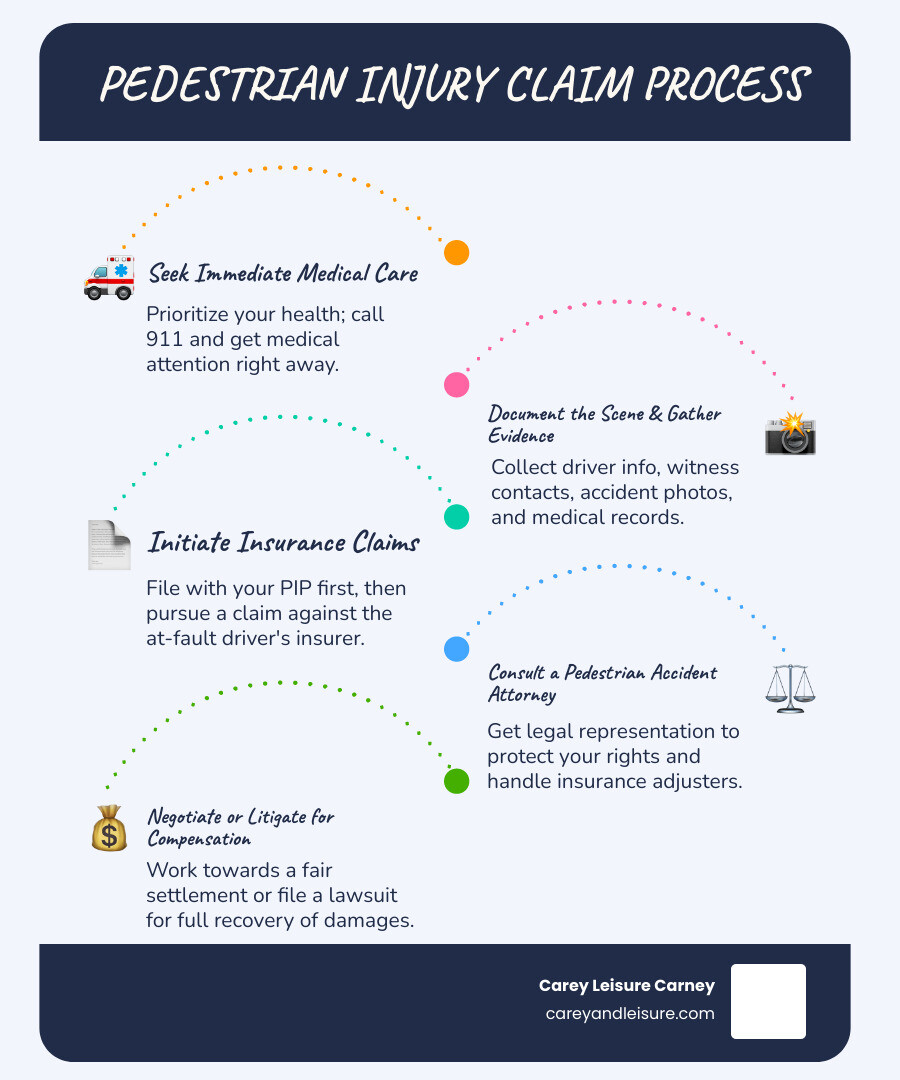
Key Steps in the Pedestrian Injury Claim Process:
- Seek immediate medical attention and call 911 to document the accident
- Gather evidence including driver information, witness contacts, and scene photos
- File a claim with your Personal Injury Protection (PIP) insurance first, then the at-fault driver’s insurer
- Avoid giving recorded statements to insurance adjusters without legal representation
- Consult a pedestrian accident attorney within Florida’s two-year statute of limitations
- Negotiate or litigate to recover full compensation for your injuries and losses
When a vehicle strikes a pedestrian, the consequences can be devastating. Pedestrians have no structural protections—no airbags, no seatbelts, no crumple zones—making them among the most vulnerable road users. In Clearwater and throughout Pinellas County, pedestrian accidents occur with alarming frequency along busy corridors like US Highway 19 and Gulf to Bay Boulevard, often resulting in serious injuries like traumatic brain damage, spinal cord trauma, broken bones, and internal injuries.
The path from accident scene to fair settlement involves multiple steps: immediate medical care, evidence preservation, insurance negotiations, and often legal action. Florida’s modified comparative negligence law means you can still recover damages even if you share partial fault—as long as you’re not more than 50% responsible. Insurance companies frequently try to devalue claims by disputing treatment necessity, blaming the victim, or pressuring quick settlements that fail to cover future medical costs.
Understanding your legal rights and the claim process is essential to protecting your financial recovery. Whether the driver was distracted, speeding, failed to yield at a crosswalk, or drove under the influence, you deserve full compensation for the harm caused by their negligence.
As Thomas W. Carey, I’ve guided thousands of injury victims through the pedestrian injury claim process across Florida since 1988, securing multi-million-dollar results for those harmed by negligent drivers. My board-certified trial experience and personal advocacy—rooted in losing my wife to a drunk driver—drives my commitment to helping pedestrian accident victims recover what they’re owed.
Key pedestrian injury claim vocabulary:
Primary Causes and High-Risk Areas for Pedestrians in Florida
Florida is beautiful, but it consistently ranks as one of the most dangerous states for people on foot. When we look at why these accidents happen, it’s rarely a “mystery.” Most of the time, it comes down to human error and a lack of attention.

According to NHTSA Pedestrian Safety Data, pedestrian fatalities have reached 30-year highs nationally, and Florida is often at the epicenter of this trend. In our local communities like Clearwater and St. Petersburg, we see the same dangerous behaviors repeating:
- Distracted Driving: This is the “silent epidemic.” Whether it’s texting, checking GPS, or scrolling through social media, a driver looking at a phone for five seconds at 45 mph has traveled the length of a football field essentially blindfolded.
- Speeding: Physics is a cruel mistress. A pedestrian hit at 20 mph has a 90% chance of survival. At 40 mph, that survival rate drops to 50%. In residential areas of Largo or New Port Richey, speeding turns a “close call” into a tragedy.
- Failure to Yield: Drivers making right turns on red often look left for oncoming traffic and never look right to see the pedestrian entering the crosswalk.
- Driving Under the Influence: Alcohol and drugs impair judgment and reaction time. It’s a factor in a massive percentage of fatal pedestrian crashes.
- Drowsy Driving: Research shows that being awake for 18 hours impairs a person’s body to the same extent as a 0.08 blood alcohol level. Fatigued drivers simply cannot react in time when a person steps into the road.
Vulnerable Pedestrian Demographics in Pinellas County
While anyone can be a victim, certain groups face higher risks in our area:
| At-Risk Group | Why They Are Vulnerable |
|---|---|
| Seniors (65+) | Slower walking speeds and increased physical fragility make accidents more likely and injuries more severe. |
| Children | Their small size makes them harder to see, and they may not yet understand traffic patterns or “right of way.” |
| Evening Walkers | Between 6 p.m. and midnight, visibility drops significantly, especially in areas with poor street lighting. |
| Intoxicated Pedestrians | Just as DUI is dangerous, walking while impaired can lead to poor decision-making, like jaywalking across Highway 19. |
Dangerous Intersections and Roadways in Clearwater
In our neck of the woods, some roads are notorious for a pedestrian injury claim. If you’re walking near these areas, you need to be on high alert:
- US Highway 19: Often called one of the deadliest roads in America, its high speeds and wide spans make it a nightmare for pedestrians.
- Gulf to Bay Boulevard: The heavy tourist traffic heading toward Clearwater Beach creates a chaotic environment.
- Clearwater Beach Traffic: Between the roundabouts and distracted tourists looking for parking, the beach area is a hotspot for low-speed but high-trauma “knockdown” accidents.
Florida has launched the Target Zero initiative to eliminate traffic fatalities, but until the infrastructure catches up to the population growth, we must remain vigilant.
Immediate Steps to Take After Being Hit by a Car
If you’ve just been hit, you’re likely in shock. Your adrenaline is pumping, and you might not even feel the full extent of your injuries yet. However, the actions you take in the first 30 minutes can make or break your pedestrian injury claim.
- Call 911 Immediately: You need the police and paramedics on the scene. The police will create an official crash report, which is the cornerstone of your legal case.
- Seek Medical Attention: Even if you think you’re “fine,” go to the ER or an urgent care in Clearwater or Trinity. Internal bleeding and concussions don’t always show symptoms immediately.
- Gather Driver Information: Get the driver’s name, phone number, insurance company, and policy number. If it’s a hit-and-run, try to get the plate number or even just the color and make of the car.
- Identify Witnesses: Bystanders often leave once they see help has arrived. Grab their names and phone numbers quickly. Their unbiased testimony is gold.
- Document the Scene: If you are physically able, take photos of the car, where you landed, the crosswalk signals, and any skid marks.
Gathering Evidence to Support Your Case
Evidence disappears fast. Skid marks wash away in Florida rain, and bruises heal. You need a “dossier” of proof to ensure your pedestrian injury claim is successful.
| Essential Evidence Type | Why It Matters |
|---|---|
| Scene Photos/Video | Proves the weather, road conditions, and vehicle positions. |
| Medical Records | Connects your injuries directly to the accident (crucial for “causation”). |
| Police Report | Contains the officer’s initial assessment of fault and any citations issued. |
| Damaged Clothing/Gear | Torn clothes or a smashed phone can show the force of the impact. |
| CCTV/Dashcam | Many businesses along Gulf to Bay have security cameras that may have captured the hit. |
Why You Should Avoid Speaking to Insurance Adjusters
Within a day or two, you’ll likely get a call from the driver’s insurance company. They might sound friendly—they aren’t. They are trained professionals whose job is to save the company money.
- The Recorded Statement Trap: They will ask to record you. Say no. They are looking for you to say “I’m okay” or “I didn’t see them coming,” which they will use to devalue your claim later.
- The Lowball Offer: They might offer you a few thousand dollars right away. This is almost always a fraction of what your case is worth, especially if you need future surgery or physical therapy.
- Admitting Fault: Even a polite “I’m sorry” can be twisted into an admission of guilt.
How Fault and Negligence Impact Your Pedestrian Injury Claim
Florida’s legal landscape for pedestrians changed significantly in 2023. Understanding how “negligence” works is vital. In a legal sense, negligence is a failure to use “reasonable care.” A driver has a duty of care to watch for pedestrians; if they breach that duty and hit you, they are negligent.
Understanding Florida’s Modified Comparative Negligence
Florida follows the Florida Modified Comparative Negligence Statute. This is a “shared fault” system with a catch.
- The 50% Bar: If you are found to be more than 50% at fault for the accident (for example, you sprinted into the middle of Highway 19 at night while wearing dark clothes), you are legally barred from recovering any damages from the driver.
- Proportional Recovery: If you are 20% at fault (maybe you were jaywalking) and the driver is 80% at fault (they were speeding), you can still recover 80% of your total damages.
This makes the “fault battle” the most important part of your pedestrian injury claim. The insurance company will try to push your fault percentage as high as possible to avoid paying.
Negligence Per Se in Pedestrian Accidents
Sometimes, negligence is “automatic.” This is called negligence per se. If a driver violates a safety statute—like Florida Statute 316.130, which governs pedestrian rights—and that violation causes your injury, the court may find them negligent as a matter of law. Examples include:
- Running a red light.
- Failing to yield to a pedestrian in a marked crosswalk.
- Passing a vehicle that is stopped for a pedestrian.
Comparative Negligence vs. Contributory Negligence
Some states use “contributory negligence,” where if you are even 1% at fault, you get nothing. Thankfully, Florida isn’t that harsh. However, our new “modified” system is stricter than the old “pure” system. Under the old rules, even a pedestrian who was 90% at fault could recover 10%. Now, you must prove the driver was at least 50% responsible to see a dime.
Recoverable Damages and Insurance Company Tactics
When we talk about “damages,” we’re talking about the money required to make you “whole” again. In a pedestrian injury claim, these are split into two main categories:
- Economic Damages (The “Receipt” Damages):
- Medical Expenses: Every ambulance ride, ER visit, surgery, and bottle of Advil.
- Lost Wages: Money you lost because you couldn’t work.
- Lost Earning Capacity: If your injuries prevent you from ever returning to your career in St. Petersburg or Clearwater.
- Non-Economic Damages (The “Human” Damages):
- Pain and Suffering: The physical agony and mental anguish of the accident.
- Loss of Consortium: The impact the injury has on your relationship with your spouse.
- Disfigurement: Compensation for permanent scarring or loss of limb.
Calculating the Value of Your Pedestrian Injury Claim
How much is your case worth? There’s no “calculator” that gives an exact number, but we look at:
- Severity: A traumatic brain injury is worth more than a broken toe.
- Recovery Time: Did you miss two weeks of work or two years?
- Permanency: Will you have a limp for the rest of your life?
- Impact: Can you no longer play with your grandkids or enjoy the beach?
Common Tactics Used to Devalue Your Claim
Insurance companies have a “playbook” to keep their money:
- Disputing Treatment: They’ll claim you didn’t need that MRI or that you’re “over-treating.”
- Blaming the Victim: They’ll scour your social media to see if you posted a photo of yourself smiling, claiming “you don’t look injured.”
- Delaying Processing: They hope you’ll get desperate for money and accept a tiny settlement just to pay your rent.
The Legal Process: Filing Your Claim in Florida
The pedestrian injury claim process in Florida is unique because of our “No-Fault” insurance laws.
- Personal Injury Protection (PIP): If you own a car in Florida, your own PIP insurance covers the first $10,000 of your medical bills, even if you were walking. If you don’t own a car, you may be covered by a resident relative’s policy.
- Third-Party Claim: Once your injuries exceed a certain threshold (permanent injury, significant scarring, or death), you can step outside the no-fault system and sue the driver’s insurance for your full damages.
- Uninsured Motorist (UM) Coverage: If the driver who hit you has no insurance (which happens a lot in Florida), your own UM coverage can step in to pay your bills.
How a Pedestrian Accident Attorney Can Help
You wouldn’t perform surgery on yourself, and you shouldn’t litigate a pedestrian injury claim alone. A board-certified attorney at Carey Leisure Carney provides:
- Accident Reconstruction: We hire experts to prove exactly how the car hit you.
- Expert Witnesses: We use medical experts to explain your future needs to a jury.
- Aggressive Negotiation: We know the insurance company’s tricks and how to counter them.
Time Limits for Filing a Claim in Florida
Time is not on your side. Under the Florida Statute of Limitations, you generally have two years from the date of the accident to file a lawsuit for negligence. If you miss this deadline, your right to recover compensation is gone forever. If the accident resulted in a wrongful death, the timeline is also two years.
Frequently Asked Questions about Pedestrian Accidents
Can I still file a claim if I was jaywalking?
Yes! In Florida, drivers have a “heightened duty of care” to avoid hitting people. Even if you crossed where you shouldn’t have, if the driver was speeding or distracted, they still share the blame. Your settlement might be reduced, but it isn’t eliminated—unless you are more than 50% at fault.
What if the driver who hit me fled the scene?
This is a hit-and-run. We work with local law enforcement in Clearwater and Largo to try and track them down. If they aren’t found, we can often secure compensation through your own Uninsured Motorist (UM) coverage.
Who pays my medical bills if I don’t own a car?
If you don’t have PIP and don’t live with a relative who has it, the at-fault driver’s PIP coverage may be required to pay your initial bills. After that, we pursue their bodily injury liability coverage.
Conclusion
Navigating a pedestrian injury claim is complex, especially when you’re trying to heal from traumatic injuries. At Carey Leisure Carney, we believe you shouldn’t be just another case number. With over 100 years of combined experience and board-certified expertise, we provide the personalized, aggressive representation you need to take on the insurance giants.
We serve clients across the Tampa Bay area, including Clearwater, Largo, New Port Richey, Spring Hill, St. Petersburg, Trinity, and Wesley Chapel. When you call us, you get direct access to an attorney who will fight for every penny you deserve.