

Florida Pedestrian Laws: Top 3 Essential Rights
Florida’s Roads: A Shared Responsibility for Safety
Florida pedestrian laws create a framework where both walkers and drivers share responsibility for preventing accidents on the state’s busy streets. Understanding these rules isn’t just about avoiding tickets – it’s about staying alive in one of America’s most dangerous states for pedestrians.
Key Florida Pedestrian Laws:
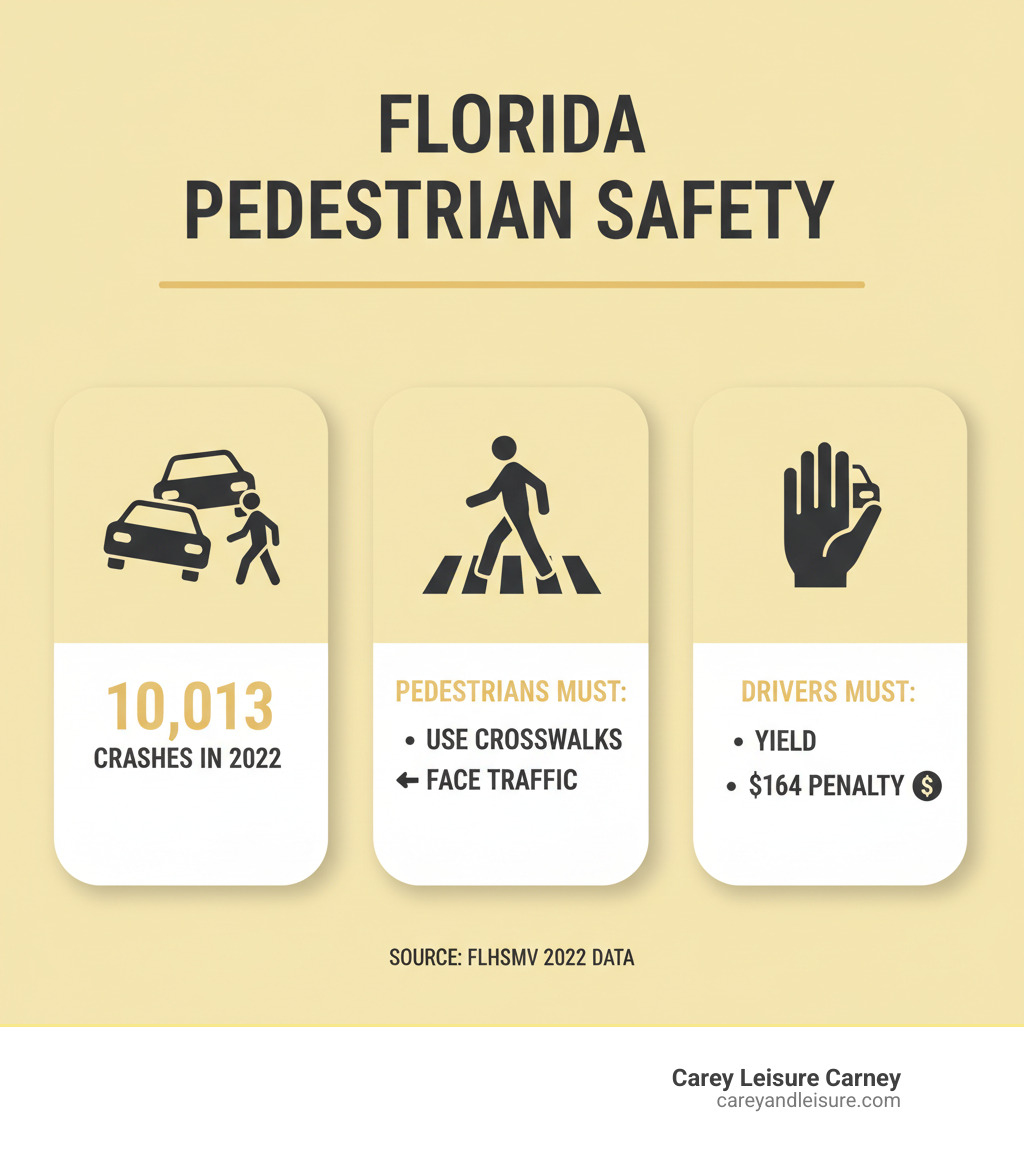
- Pedestrians must use sidewalks when available, or walk facing traffic on the left shoulder
- Drivers must yield to pedestrians in crosswalks (both marked and unmarked)
- Both parties must exercise “due care” to avoid accidents
- Crosswalk violations result in $164 fines and 3 points on driver’s license
- Pedestrians must yield to vehicles when crossing outside designated crosswalks
Florida’s pedestrian safety statistics paint a sobering picture. In 2022 alone, the state recorded 10,013 pedestrian-related crashes with 765 fatalities. Florida consistently ranks among the most dangerous states for pedestrians, with cities like Orlando, Tampa, Jacksonville, and Miami leading the nation in pedestrian accidents.
The state’s rapid growth, car-centric road design, and year-round tourism create unique challenges. Many streets were built with little consideration for pedestrian use, leaving walkers vulnerable on roads designed primarily for vehicles.
As Thomas W. Carey, founding partner of Carey Leisure Carney and board-certified civil trial lawyer since 1988, I’ve handled thousands of pedestrian accident cases across Florida and understand how Florida pedestrian laws protect vulnerable road users. My experience representing injured pedestrians has shown me that knowledge of these laws can mean the difference between life and death on our state’s roads.
Pedestrian Duties: Following the Rules of the Road on Foot
Walking in Florida comes with real responsibilities. While you might think pedestrians always have the right of way, that’s actually a dangerous myth that gets people hurt. Florida pedestrian laws spell out clear duties for anyone traveling on foot – rules that could save your life.
Think of it this way: just because you’re not behind the wheel doesn’t mean traffic laws don’t apply to you. Florida Statute 316.130 makes this crystal clear, outlining exactly what pedestrians must do to stay safe and legal.
When sidewalks exist, you must use them. This isn’t just a suggestion – it’s the law. I know it seems obvious, but you’d be surprised how often people choose to walk in the road when there’s a perfectly good sidewalk available. Whether you’re strolling through Clearwater or Largo, that sidewalk is there for your protection.
No sidewalk? Walk on the left side of the road, facing traffic. This rule trips up a lot of people. You want to see what’s coming toward you, not have cars sneaking up from behind. Walking with your back to traffic is like playing Russian roulette – you can’t dodge what you can’t see coming.
Traffic signals apply to you too. Those “WALK” and “DON’T WALK” signals aren’t decorations. When the light says don’t walk, it means don’t walk – even if the coast looks clear. Traffic signals exist because they can see the bigger picture of traffic flow that you might miss.
Here’s where that “pedestrians always have the right of way” myth really falls apart. You must yield to vehicles when crossing outside of crosswalks. If you dart across the street mid-block, cars don’t have to slam on their brakes for you. In fact, you’re breaking the law.
The term “jaywalking” might not appear in Florida pedestrian laws, but what it describes absolutely does. Between intersections with traffic signals, you generally can’t cross wherever you please. Even at intersections, you need to cross at right angles – no cutting diagonally across unless signs specifically say it’s okay.
Breaking these rules isn’t just about getting a ticket. It’s about staying alive on some of the most dangerous roads in America. For more insight into how Florida’s traffic laws work, check out our Florida Law overview.
Understanding Crosswalks: Marked vs. Unmarked
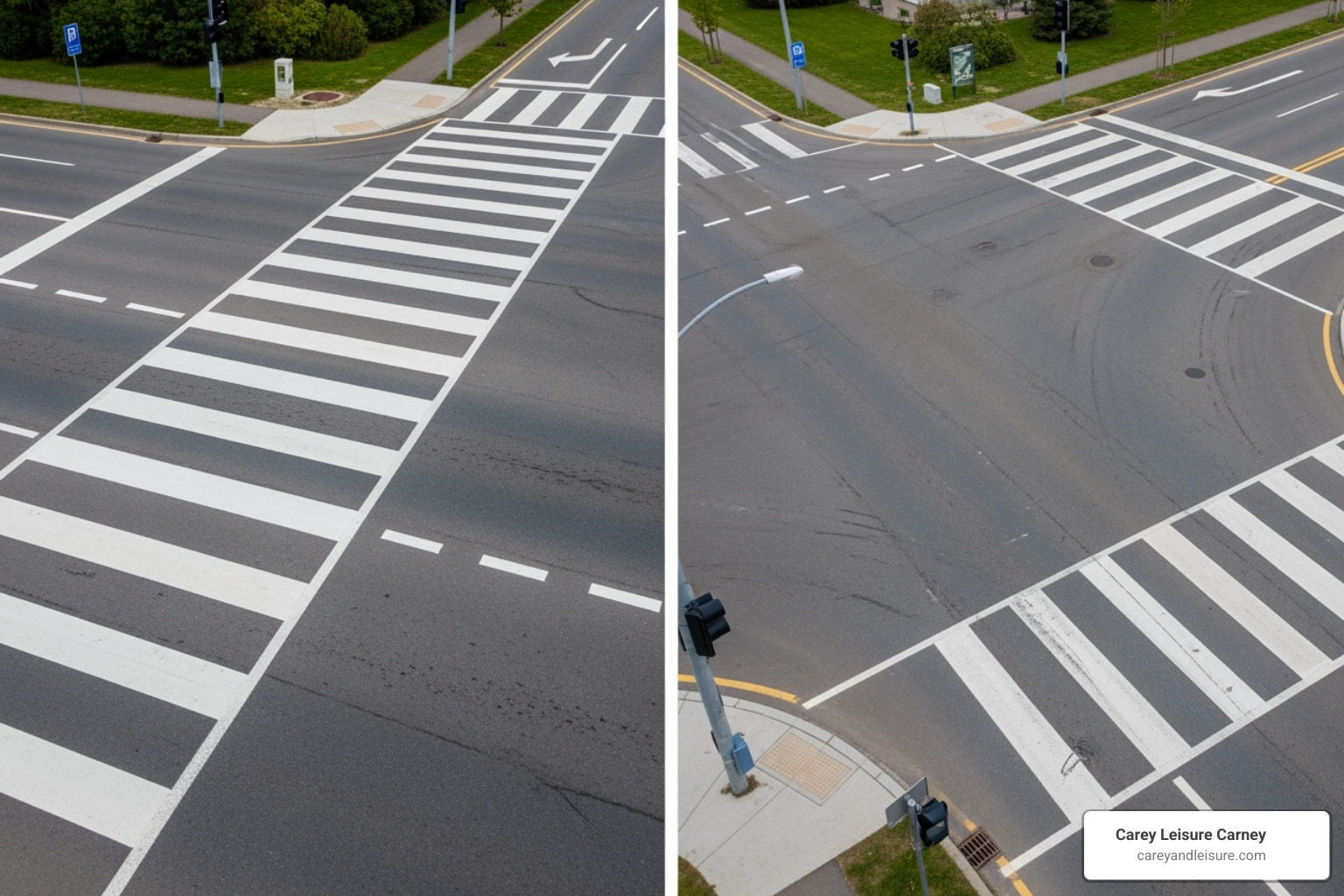
Here’s something that surprises most people: crosswalks exist even when you can’t see them. Florida recognizes two types of crosswalks, and understanding both could keep you out of the hospital.
Marked crosswalks are the easy ones – those white painted lines you see at intersections and mid-block locations. But unmarked crosswalks are trickier. At any intersection where sidewalks meet, there’s an invisible crosswalk connecting them, even without paint. It’s like an imaginary line drawn from sidewalk to sidewalk.
Both types give you the same legal protection. Drivers must yield to pedestrians in both marked and unmarked crosswalks. The law doesn’t care whether you can see the lines or not – if you’re crossing at an intersection where sidewalks connect, you’re in a crosswalk.
But here’s the catch: you still can’t just step into traffic expecting cars to screech to a halt. You need to make sure drivers can actually stop safely before you enter their path. Right-of-way doesn’t make you invincible.
Drivers who don’t yield face real consequences – a $164 fine and three points on their license. That’s Florida’s way of saying pedestrian safety matters. When you’re driving through St. Petersburg or New Port Richey and see someone in a crosswalk, you must stop. No exceptions.
At intersections, things get more complex. Even with a green light, drivers must yield to pedestrians already in crosswalks. Making a right turn on red? You better come to a complete stop and make sure no one’s crossing before you go.
Specific Situations: Bridges, Parking Lots, and Impaired Walking
Some situations in Florida create extra dangers that Florida pedestrian laws specifically address.
Bridges present unique hazards. You can’t walk on a drawbridge once it starts opening – seems obvious, but the law spells it out anyway. More importantly, you can’t walk on highways or their ramps. I don’t care how much of a shortcut it seems like – interstates are for cars, not pedestrians. The only exception is for maintenance workers doing their jobs.
Parking lots are accident magnets. About 9% of pedestrian crashes happen in these seemingly safe spaces. The biggest danger? Backing vehicles. Drivers reversing out of spaces often can’t see you, especially if you’re short or a child.
Your best defense is staying visible. Walk in front of parked cars, not between them. Use designated walkways when they exist. And always assume that backing car doesn’t see you – because they probably don’t.
Walking while drunk is a deadly gamble. About 30% of pedestrians killed in 2022 were legally intoxicated. Alcohol doesn’t just impair drivers – it makes pedestrians stumble into traffic, misjudge distances, and make terrible decisions.
If you’ve been out enjoying Clearwater Beach’s nightlife or downtown St. Petersburg’s bar scene, call an Uber. Your life is worth more than the fare. The CDC data on impaired pedestrians shows just how dangerous this combination can be.
Walking impaired isn’t just risky – it can also affect your legal rights if you’re hit by a car. Florida’s comparative negligence laws mean your own intoxication could reduce any compensation you might receive.
Driver Obligations: The Legal Duty to Protect Pedestrians
When you’re behind the wheel in Florida, you carry a significant responsibility for pedestrian safety. The law doesn’t just suggest you be careful – it demands it. Florida pedestrian laws place a clear legal burden on drivers to protect vulnerable road users through what’s called the “due care” principle.
This principle means you must always stay alert and take every reasonable step to avoid hitting a pedestrian. It’s not enough to simply follow traffic signals or speed limits. You need to drive defensively, anticipating that pedestrians might appear unexpectedly.
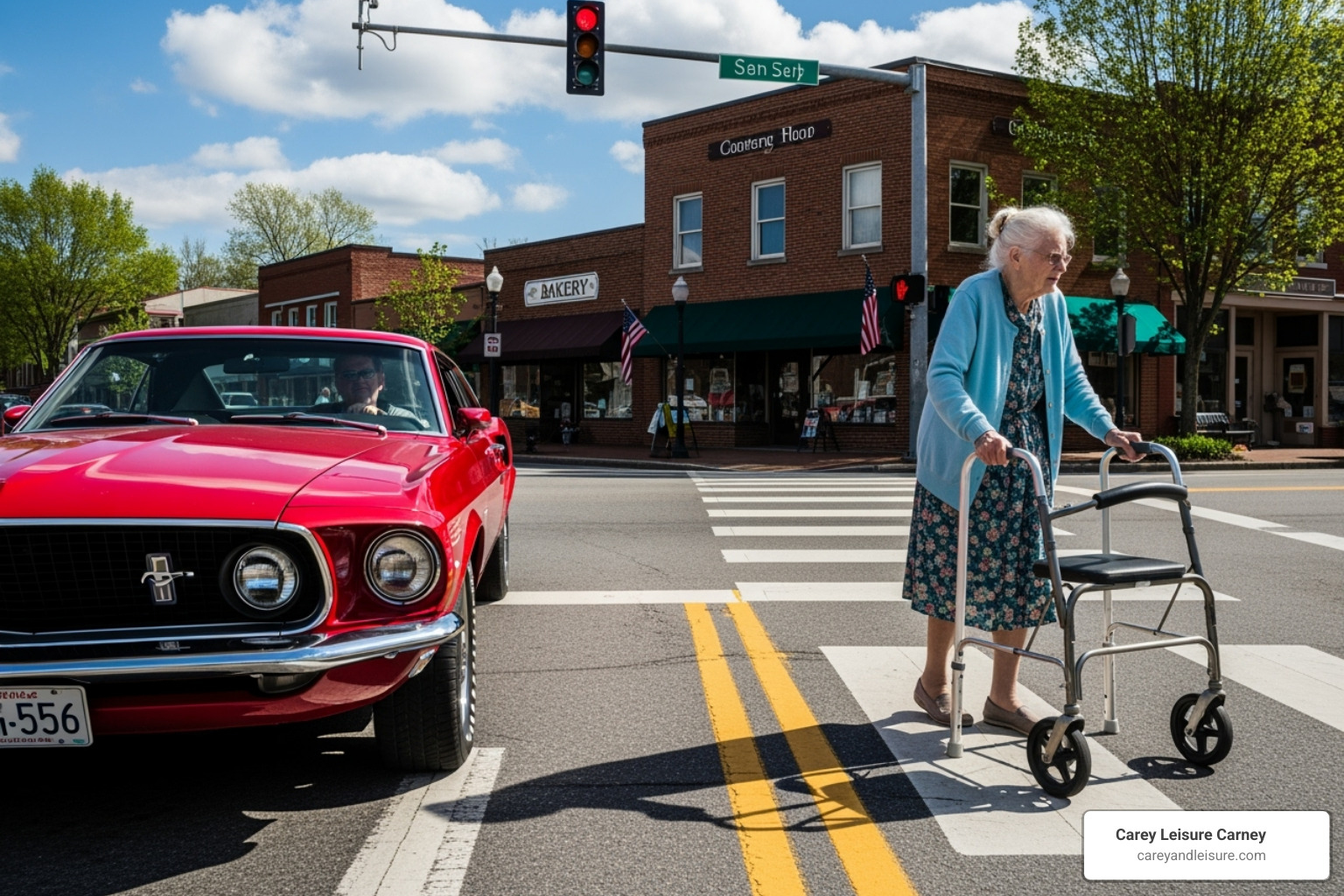
Due care goes beyond basic driving rules. When you see children playing near the road, an elderly person with a walker, or anyone who seems confused or impaired, you must exercise extra caution. This might mean slowing down in residential areas, giving a gentle horn warning, or stopping even when you technically have the right of way.
The yielding requirements are crystal clear. You must yield to pedestrians in crosswalks at intersections, whether you’re facing a green light or making a right turn on red. This applies to both marked crosswalks with painted lines and unmarked crosswalks where sidewalks would naturally connect across an intersection.
If there’s a marked crosswalk in the middle of a block, you must yield there too. The key phrase in the law is that you must stop when a pedestrian is in the crosswalk “or approaching so closely from the opposite half of the roadway as to be in danger.”
When you must stop, you must stay stopped. Don’t creep forward impatiently or try to squeeze past. Wait until the pedestrian has completely crossed your lane and is far enough away to be safe.
The penalties for failing to yield reflect how seriously Florida takes pedestrian safety. You’ll face a minimum $164 fine and three points on your license – consequences that can add up quickly if you’re not careful.
Here’s a rule that saves lives but many drivers don’t know: never pass a vehicle that’s stopped at a crosswalk. That stopped car is likely waiting for a pedestrian you can’t see. Passing puts you directly in the path of someone trying to cross safely. This violation can result in serious accidents and severe legal consequences.
For the complete legal details on these requirements, you can review Florida Statute 316.130.
Protecting Vulnerable Pedestrians
Some pedestrians need extra protection, and Florida pedestrian laws recognize this reality by requiring heightened caution from drivers in certain situations.
Children require your utmost attention. They’re unpredictable, often darting into streets without looking. Their small size makes them harder to spot, especially when backing up or navigating parking lots. When driving through neighborhoods, near schools, or anywhere kids might be present, slow down and stay hyper-alert.
Mobility-impaired individuals deserve patience and space. Someone using a wheelchair, walker, or crutches needs more time to cross safely. You must come to a complete stop and wait, giving them the space and time they need without rushing them.
The White Cane Law provides special protection for visually impaired pedestrians. When you see someone crossing with a guide dog or carrying a white cane (sometimes with a red tip), you must stop completely and take every precaution to avoid injury. This isn’t just good manners – it’s the law.
The same protection extends to anyone with a service animal. These individuals rely on their training and their animal’s guidance, so your patience and caution become even more critical.
Increased driver caution in these situations isn’t optional. Failing to exercise this higher standard of care can result in both legal liability and the devastating knowledge that you could have prevented someone’s injury.
Understanding Florida Pedestrian Laws on Visibility and Nighttime Driving
Darkness changes everything when it comes to pedestrian safety. Most hit-and-run fatalities in Florida happen at night or during low-light conditions, making visibility a life-or-death issue for both drivers and pedestrians.
When daylight saving time ends and evenings get darker earlier, the danger increases dramatically. Both you as a driver and pedestrians on the road need to adapt your behavior to these challenging conditions.
As a driver, you must reduce your speed in low-light conditions. This gives you more time to spot and react to pedestrians who might be difficult to see. Keep your headlights clean and properly aimed, and don’t hesitate to use high beams when appropriate – just remember to dim them when approaching other vehicles or when you spot pedestrians.
Your vigilance must increase after dark. Look for pedestrians everywhere, not just in crosswalks. Pay extra attention when turning, backing up, or driving through residential areas where people might be walking dogs or jogging.
Pedestrians also have responsibilities for making themselves visible. They should wear bright or reflective clothing, carry flashlights, and never assume you can see them. The smart pedestrian makes eye contact with drivers before crossing, even in marked crosswalks.
Using flashlights serves a dual purpose – helping pedestrians see where they’re going and making them visible to drivers like you. Reflective clothing, shoes, and accessories can mean the difference between being seen and being hit.
These visibility guidelines aren’t just suggestions – they’re part of exercising the “due care” that Florida pedestrian laws require from everyone sharing our roads. When we all do our part to see and be seen, our streets become safer for everyone.
After a Pedestrian Accident: Understanding Fault and Your Legal Rights
When a pedestrian accident happens, the aftermath can feel overwhelming. Whether you were walking or driving, your world suddenly shifts from a normal day to dealing with injuries, insurance companies, and legal questions. Understanding how fault works and what rights you have under Florida pedestrian laws can make all the difference in your recovery.
The reality is that pedestrian accidents rarely have simple explanations. Most occur due to a combination of factors that unfold in just seconds. Distracted driving remains one of the biggest culprits – drivers checking phones, adjusting music, or simply not paying attention to the road ahead. Speeding makes everything worse, reducing reaction time and turning what might have been a minor incident into a tragedy.
Failure to yield violations happen constantly in Florida, especially at busy intersections where drivers rush through yellow lights or make hurried right turns without checking for pedestrians. We also see accidents caused by impaired driving, where alcohol or drugs cloud a driver’s judgment at the worst possible moment.
But drivers aren’t always solely to blame. Sometimes pedestrians contribute to accidents through distracted walking – texting while crossing streets or wearing headphones that block out traffic sounds. Crossing outside designated crosswalks, what people commonly call “jaywalking,” also plays a role in many accidents.
Determining fault in these situations requires careful investigation. It’s not always as clear-cut as you might think. Law enforcement officers will examine the scene, interview witnesses, and review traffic signals and signage. They’ll consider who had the right-of-way according to Florida pedestrian laws, whether traffic signals were obeyed, and if both parties exercised proper care.
Visibility conditions matter too. Was it dark? Raining? Were there obstructions blocking someone’s view? These details can significantly impact how fault is assigned. Our team at Carey Leisure Carney has investigated countless pedestrian accidents, and we know how to uncover the facts that matter most. For insights into this complex process, you can read our guide on How to tell who is at fault in a car accident.
Florida follows a comparative negligence rule, which means fault can be shared between parties. If you’re injured as a pedestrian but found to be partially at fault – say, for crossing slightly outside a crosswalk – your compensation gets reduced by your percentage of fault. This isn’t necessarily unfair, but it does make the stakes much higher when determining exactly what happened.
Here’s the critical part: Florida’s 51% bar to recovery rule means that if you’re found more than half at fault for the accident, you can’t recover any damages at all. This makes having experienced legal representation essential, not optional. The difference between being found 49% at fault versus 51% at fault could mean the difference between receiving compensation for your injuries and walking away with nothing.
What to Do If You’re an Injured Pedestrian
The moments and days following a pedestrian accident are crucial for both your health and any potential legal claim. Your actions during this time can significantly impact your recovery and your ability to receive fair compensation.
Seek medical care immediately, even if you feel okay. Adrenaline can mask serious injuries, and some conditions like concussions or internal bleeding don’t always show symptoms right away. Getting prompt medical attention also creates important documentation of your injuries.
Call the police to report the accident. The responding officers will create an official accident report that becomes vital evidence. This report provides an objective third-party account of what happened and often includes the officer’s assessment of fault.
If you’re physically able and it’s safe to do so, document everything. Take photos of the accident scene, including vehicle damage, your injuries, road conditions, traffic signals, and any relevant signage. Get the contact information of any witnesses – their testimony can be invaluable if your case goes to court.
Avoid admitting fault or apologizing at the scene. It’s natural to say “I’m sorry” when something traumatic happens, but these statements can be twisted and used against you later. Stick to factual information when speaking with police and avoid speculating about what caused the accident.
Be cautious about what you say to insurance adjusters. While you need to report the accident, insurance companies are looking for ways to minimize their payouts. It’s often best to have an attorney handle these communications to protect your interests.
For a comprehensive guide on handling these critical first steps, check out our detailed resource on Steps to take after being a pedestrian accident victim.
Florida’s statute of limitations gives you only two years from the date of your accident to file a personal injury lawsuit. This might seem like plenty of time, but building a strong case takes months of investigation, medical treatment, and legal preparation. The sooner you contact an experienced attorney, the better we can protect your rights and gather the evidence needed for your case.
At Carey Leisure Carney, we understand that every pedestrian accident is unique, and we’re here to guide you through this difficult time with the personalized attention you deserve.
Frequently Asked Questions About Florida Pedestrian Laws
Over my decades of practicing personal injury law in Florida, I’ve noticed the same questions come up again and again. Let me share some clarity on the most common misconceptions about Florida pedestrian laws that I encounter in my practice.
Do pedestrians always have the right of way in Florida?
This is probably the biggest myth I hear, and it’s a dangerous one. The truth is more nuanced than most people realize.
While drivers do have significant legal duties to protect pedestrians, the idea that pedestrians “always” have the right-of-way simply isn’t accurate under Florida pedestrian laws. Both pedestrians and drivers share what we call a “duty of care” – a legal responsibility to act reasonably to prevent accidents.
When Pedestrians Must Yield: There are several situations where pedestrians must give way to vehicles. If you’re crossing a roadway outside of a marked crosswalk or an unmarked crosswalk at an intersection, you must yield to all vehicles. You also can’t suddenly dart from a curb into the path of a car that’s too close to stop safely. If there’s a pedestrian tunnel or overpass available, you’re expected to use it rather than crossing at street level.
Florida Statute 316.130(10) spells out these specific situations clearly. The law recognizes that while pedestrians are vulnerable, they also have responsibilities to act predictably and safely. Understanding this shared responsibility can literally save your life.
What is the difference between a marked and an unmarked crosswalk?
This question comes up frequently in my consultations, especially after accidents at intersections without painted lines.
The main difference is visual, but both types of crosswalks generally carry the same legal weight. Marked crosswalks are the familiar white stripes painted on the road surface – they’re obvious and unmistakable. Unmarked crosswalks are the invisible extensions of sidewalks across intersections, even when there are no painted lines.
Legal Equivalence: Here’s what’s important – for the purposes of Florida pedestrian laws, drivers must yield to pedestrians in both marked and unmarked crosswalks at intersections. The Florida Pedestrian Law Enforcement Guide makes this clear: crosswalks are legally presumed to exist at all intersection legs unless signs specifically prohibit crossing.
However, I always advise my clients that unmarked crosswalks can be more dangerous precisely because they’re less obvious to drivers. Just because you have the legal right-of-way doesn’t mean every driver will recognize it. Extra caution is always wise.
Can I get a ticket for “jaywalking” in Florida?
“Jaywalking” is one of those terms everyone uses, but it doesn’t actually appear in Florida pedestrian laws. That said, you absolutely can get cited for crossing the street improperly.
The violations that people commonly call “jaywalking” include crossing between signalized intersections where you’re required to use marked crosswalks, crossing against traffic signals like ignoring “DON’T WALK” signs, and darting into traffic where drivers can’t reasonably stop for you. You can also be ticketed for crossing diagonally through intersections unless it’s specifically allowed by traffic control devices.
Pedestrian Duty to Yield: Even when you’re crossing legally outside a marked crosswalk – say, at an intersection with an unmarked crosswalk – you still have a duty to yield to vehicles. If you disrupt traffic flow or create a dangerous situation, you could face a noncriminal traffic infraction under Chapter 318 of Florida Statutes.
The bottom line? While there’s no specific “jaywalking” law, there are plenty of ways to get a ticket for unsafe crossing behavior. More importantly, following these rules keeps you safe on Florida’s busy roads.
Conclusion: Walk Safely and Know Your Rights in the Sunshine State
Navigating Florida’s roads safely requires understanding that Florida pedestrian laws create a partnership between walkers and drivers. Throughout this guide, we’ve explored how this shared responsibility works in practice – from pedestrians using crosswalks properly and facing traffic when sidewalks aren’t available, to drivers yielding at crosswalks and exercising extra care around vulnerable road users.
The reality is sobering. With over 10,000 pedestrian crashes and 765 fatalities in 2022 alone, Florida’s roads demand respect and knowledge from everyone who uses them. These aren’t just statistics – they represent families changed forever by preventable tragedies.

Understanding your rights isn’t just about avoiding tickets or citations. It’s about protecting yourself and others on roads that weren’t always designed with pedestrians in mind. Whether you’re walking in downtown Clearwater or driving through Spring Hill, knowing these laws can literally be the difference between life and death.
When accidents do happen, the aftermath brings difficult questions. Who was at fault? How does Florida’s comparative negligence rule affect your case? What about medical bills, lost wages, and long-term recovery costs? These concerns pile up quickly, adding stress when you should be focusing on healing.
At Carey Leisure Carney, we’ve spent decades helping pedestrian accident victims steer these challenging waters. Our Board-Certified attorneys represent the top 2% of lawyers in Florida, bringing over 100 years of combined experience to every case. We believe in direct attorney access and personalized service because we understand that behind every case is a person whose life has been turned upside down.
We serve families throughout Clearwater, Largo, New Port Richey, St. Petersburg, Spring Hill, Trinity, and Wesley Chapel. Our expertise in Florida pedestrian laws means we know how to build strong cases, deal with insurance companies, and fight for the compensation our clients deserve.
Don’t face this alone. Insurance companies have teams of lawyers working to minimize what they pay you. You deserve the same level of professional advocacy. Contact a Pedestrian Accident Attorney for a free consultation with our team today. Let us handle the legal complexities while you focus on what matters most – your recovery and your family’s future.