
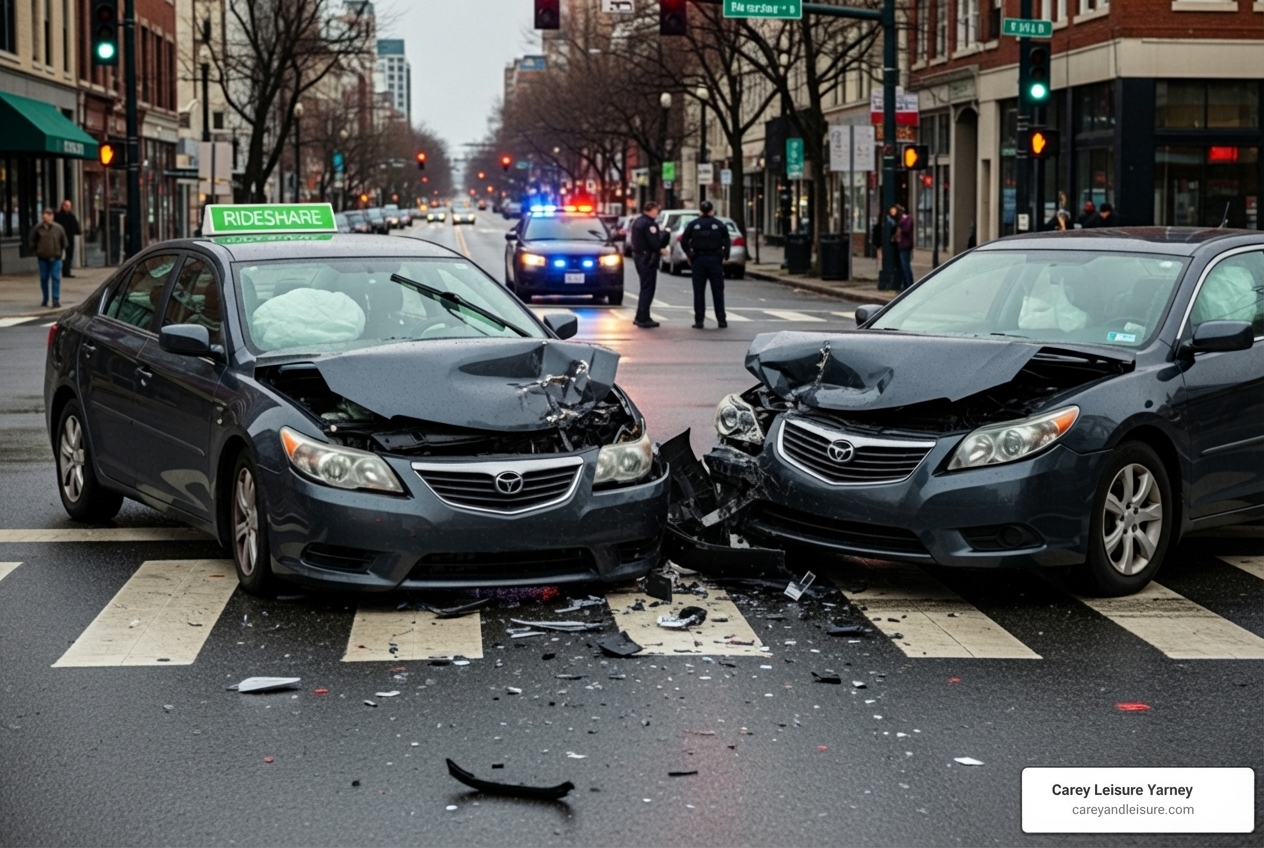
Your Legal Journey: What to Do After a Rideshare Accident
Understanding Rideshare Accident Lawsuits in Florida
A Rideshare accident lawsuit involves legal action taken after an injury occurs in or involving an Uber or Lyft vehicle. Here’s what you need to know:
Key Legal Options:
- File an insurance claim with the rideshare company’s insurer (up to $1 million coverage when driver has passenger)
- Sue the at-fault driver directly for damages exceeding insurance limits
- Pursue a lawsuit against Uber/Lyft in cases of negligent hiring or supervision
- Use your own UM/UIM coverage if the driver is uninsured or flees
Critical First Steps:
- Seek medical attention within 14 days (Florida PIP requirement)
- Screenshot your ride details from the app before leaving the scene
- Call 911 and obtain a police report
- Gather driver information, photos, and witness contacts
- Report the accident through the rideshare app
Rideshare services have created a legal maze when accidents happen. Since 2011, they’ve been linked to a 3% rise in fatal accidents. The confusion comes from drivers being independent contractors, which creates complex insurance layers that depend on the driver’s app status at the time of the crash.
Florida’s House Bill 221 sets minimum insurance levels, but determining who pays depends on the driver’s status at the moment of impact. Without understanding these complexities, many victims accept lowball settlements far below their claim’s full value.
As a board-certified civil trial lawyer with over 35 years of experience in Florida, I have guided thousands of injury victims through these unique challenges. My firm understands the technology, insurance layers, and corporate tactics involved in rideshare accident cases, setting them apart from traditional car accidents.
Easy Rideshare accident lawsuit glossary:
First 48 Hours: Critical Steps to Protect Your Claim
The moments after a rideshare accident are chaotic, but your actions in the first 48 hours are critical to protecting your legal claim. While your safety is the priority, these steps can significantly impact the outcome of a potential Rideshare accident lawsuit.
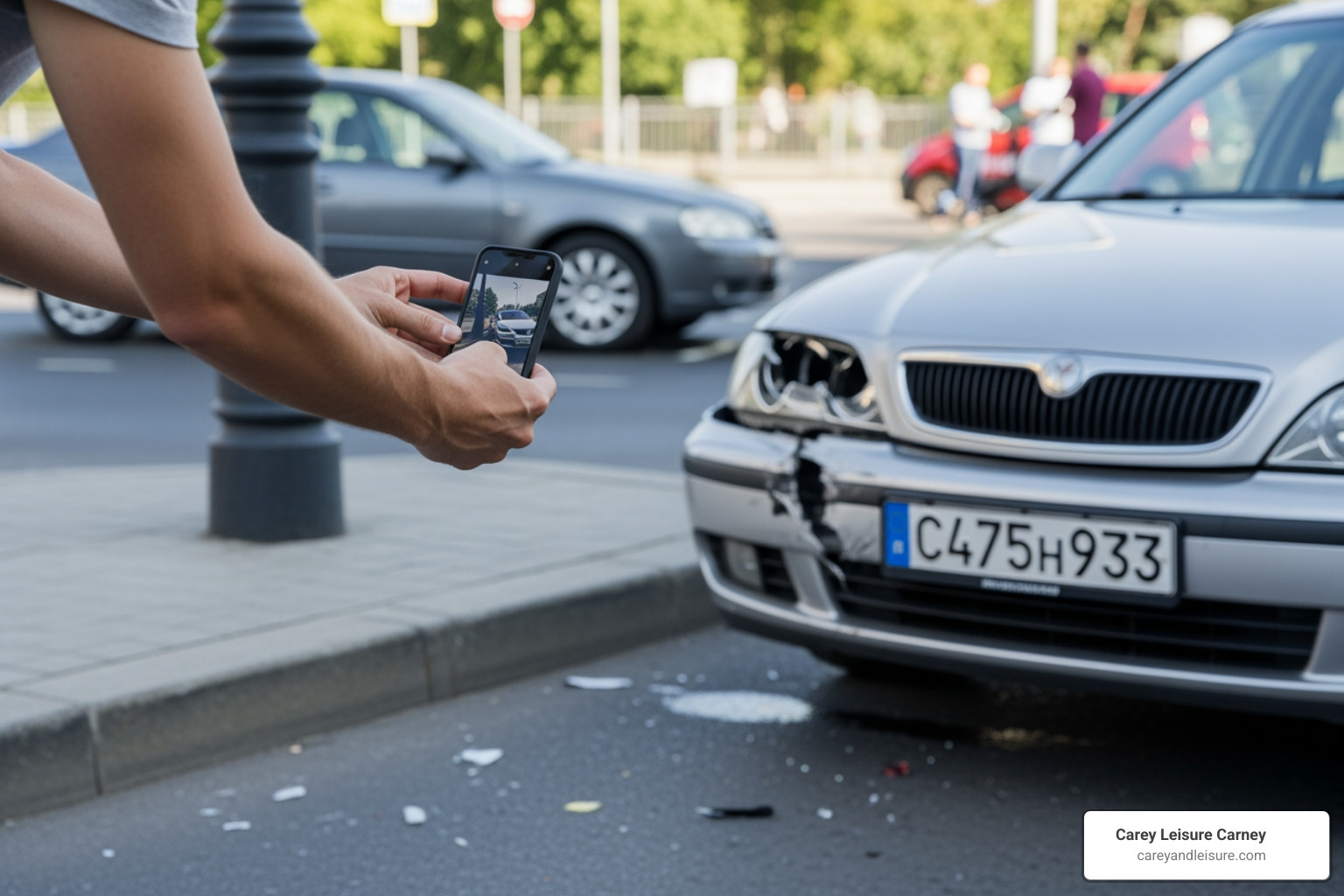
First, prioritize safety and move away from traffic if possible. Then, seek medical attention. Adrenaline can mask pain, and some injuries may not appear for days. A prompt medical evaluation creates an official record linking your injuries to the accident. For more guidance, see what to do after a car accident Florida.
Immediately call 911 to get an official police report, which documents key details and serves as vital evidence in any future Rideshare accident lawsuit.
Next, gather as much evidence as you can. This includes contact and insurance information for all drivers, witness contacts, and photos of the scene, damage, and injuries. Crucially, screenshot your ride status in the Uber or Lyft app. This digital proof of the driver’s status directly impacts which insurance policy applies. For more on evidence, read our guide on documenting evidence in personal injury claims.
Finally, report the accident through the rideshare app. However, be cautious about giving recorded statements to any insurance adjusters without first consulting an attorney, as anything you say can be used to minimize your payout.
What Information to Collect at the Scene
Collecting thorough information immediately after a rideshare accident is paramount. Here’s a checklist of essential details to gather:
- Driver’s name and contact info: Get the full name, phone number, and address of the rideshare driver and any other drivers involved.
- Driver’s personal insurance details: Request their personal auto insurance company name and policy number.
- License plate and vehicle information: Note the make, model, year, and license plate number for all vehicles involved.
- Photos and videos: Take extensive photos and videos of the accident scene, including:
- Damage to all vehicles involved.
- Any visible injuries you or others sustained.
- Road conditions, traffic signs, and signals.
- Skid marks or debris on the road.
- The overall environment where the accident occurred.
- Names and numbers of witnesses: Obtain contact information from anyone who saw the accident. Their unbiased accounts can be invaluable.
- Screenshot of your ride status in the Uber or Lyft app: This is critical! Capture the screen showing the driver’s name, vehicle, your trip details, and especially the driver’s status (e.g., “on trip,” “en route,” “online”). This proves the driver’s activity at the moment of impact and dictates which insurance policy applies.
Why Seeking Immediate Medical Care is Crucial
Seeking immediate medical attention after a rideshare accident is crucial, even if you feel fine. Adrenaline can mask pain, and serious latent injuries may not appear for days or weeks. This is common in auto accidents.
Delaying treatment can undermine your claim. Insurers may argue your injuries weren’t serious or caused by the crash. Prompt medical care creates a vital record linking your injuries to the accident, which is essential evidence for a Rideshare accident lawsuit.
In Florida, you have 14 days to seek initial medical treatment to qualify for Personal Injury Protection (PIP) benefits. PIP covers 80% of your medical bills up to $10,000, regardless of fault. Missing this deadline means losing these benefits. Learn more about what is PIP insurance Florida.
Common injuries from car accidents can range from whiplash to more severe conditions like types of car accident injuries, spinal cord injuries, or traumatic brain injuries. All require proper medical diagnosis and treatment. Your medical records will form the backbone of your claim for damages.
Navigating the Maze of Liability and Insurance Coverage
The main complexity in a Rideshare accident lawsuit is determining liability and which insurance policy applies. This confusion is due to the driver’s independent contractor status and the layered insurance policies of Uber and Lyft.
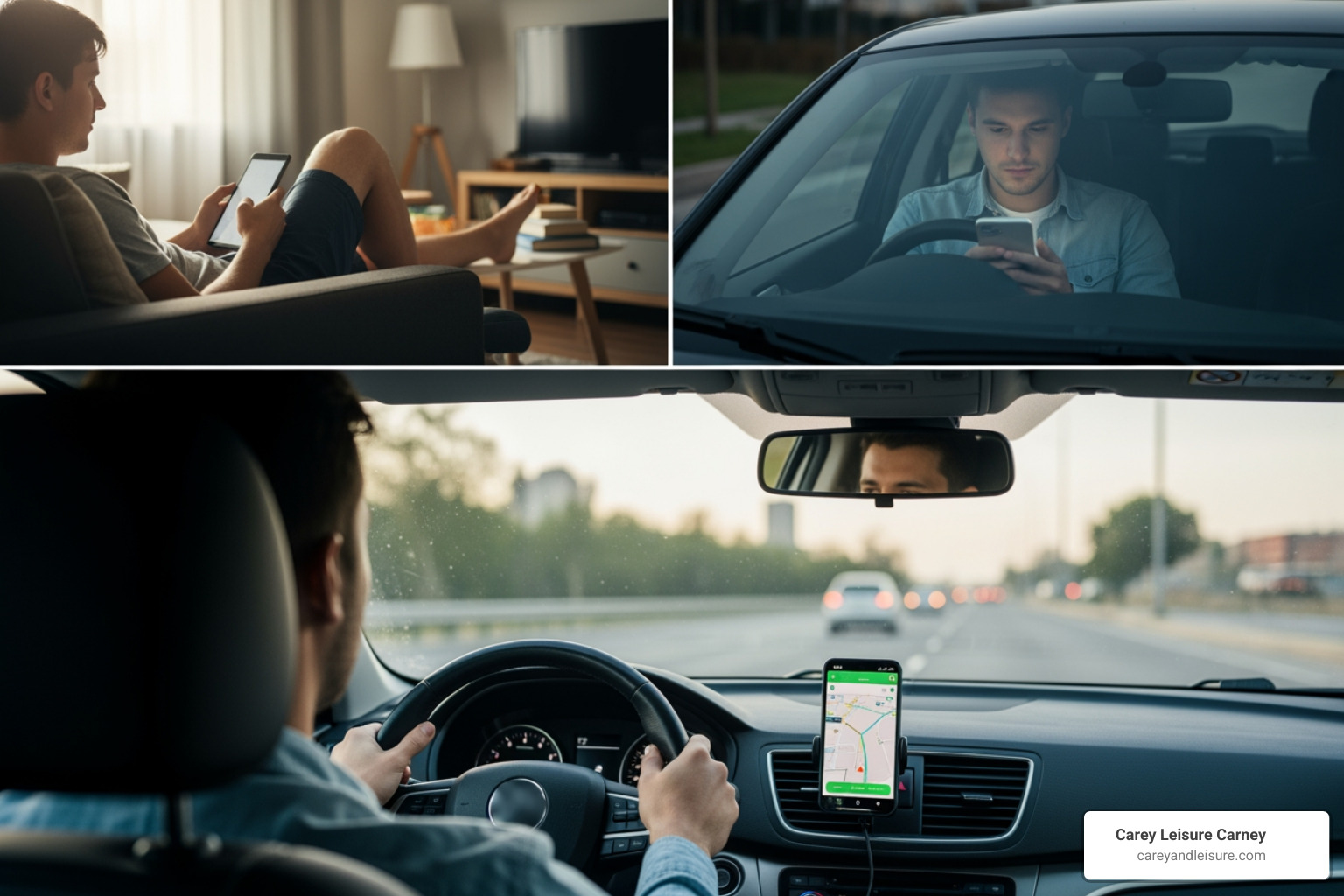
Because rideshare drivers are independent contractors, suing Uber or Lyft directly for an employee’s actions (vicarious liability) is difficult. However, we can still pursue claims against them for negligent hiring or supervision if they failed to vet their drivers or ignored dangerous conduct.
Another common scenario involves multiple at-fault parties. If another driver hit your rideshare, but your rideshare driver was also distracted, both could share fault. Florida follows the rule of comparative negligence, meaning your compensation can be reduced by your percentage of fault. As a passenger, however, it’s unlikely you would be found at fault.
Florida’s House Bill 221 mandates minimum insurance levels and background checks for ridesharing services. This law dictates the baseline coverage Uber and Lyft must provide, which varies by the driver’s activity status.
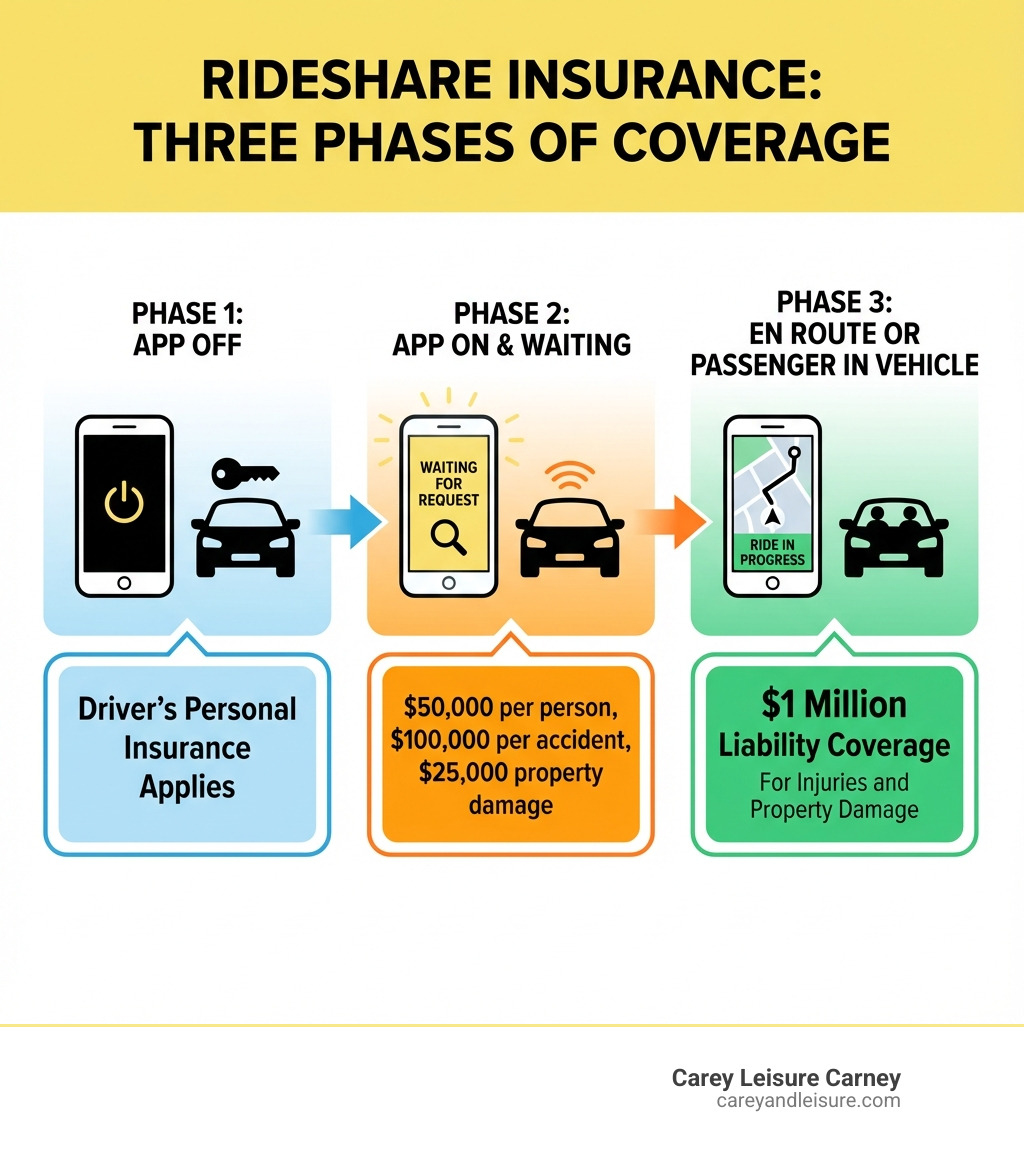
How Rideshare Insurance Works: A Breakdown by Driver Status
The insurance coverage in a rideshare accident shifts dramatically based on the driver’s exact status at the moment of impact. Understanding these phases is key to a successful Rideshare accident lawsuit.
Here’s a breakdown of how it works in Florida:
| Status | Primary Coverage | Typical Limits (Florida) |
|---|---|---|
| App Off | Driver’s Personal Policy | Varies, but Florida minimums are $10,000 PIP, $10,000 PDL. Bodily Injury Liability (BIL) often optional unless specific conditions met. |
| Online & Waiting | Rideshare Limited Liability | $50,000 for bodily injury or death per person, $100,000 for bodily injury or death per accident, $25,000 for property damage. |
| En Route to Pickup | Rideshare Full Liability | $1,000,000 for bodily injury, property damage, and wrongful death. |
| Transporting Passenger | Rideshare Full Liability | $1,000,000 for bodily injury, property damage, and wrongful death. |
Information based on Florida’s House Bill 221 and latest coverage details for Uber and Lyft.
The difference in coverage between a driver being “online and waiting” versus “en route” is substantial—a jump from $50,000 per person to $1,000,000 in liability. This is why screenshotting the app at the scene is so vital. That screenshot could be the evidence that open ups a much higher insurance payout.
What If the At-Fault Driver is Uninsured or Flees?
If the at-fault driver is uninsured or flees in a hit-and-run, you still have options for compensation.
When the at-fault driver is uninsured, underinsured, or disappears after a hit and run death or injury, your best option is often Uninsured/Underinsured Motorist (UM/UIM) coverage.
Rideshare companies like Uber and Lyft often provide UM/UIM coverage for passengers during active trips. This policy is designed to apply when the at-fault driver’s insurance is inadequate or missing.
Your own personal auto insurance may also include UM/UIM coverage, which we highly recommend. This provides a safety net for your expenses when other options are exhausted. Understanding uninsured vs underinsured motorist coverage explained is key.
We can help you steer these complex scenarios, identifying all potential sources of recovery to ensure you don’t bear the financial burden of an accident caused by someone else’s negligence.
The Path to Justice: Your Rideshare Accident Lawsuit
After a rideshare accident, you can file an insurance claim or initiate a Rideshare accident lawsuit. A lawsuit becomes necessary when:
- Insurance offers are too low: Insurers often make lowball offers, hoping you’ll accept before understanding your claim’s full value.
- Liability is disputed: If the insurance companies disagree on who is at fault, a lawsuit may be needed to determine responsibility.
- Injuries are severe: Catastrophic injuries often exceed insurance policy limits, requiring a lawsuit to seek full compensation.
- Negotiations fail: If negotiations don’t result in a fair settlement, litigation is the next logical step.
In Florida, the statute of limitations for most personal injury claims is two years from the accident date. However, exceptions exist, so acting quickly and consulting an attorney is crucial. We can help you understand why you need a personal injury lawyer to steer these timelines.
Key Steps in a Rideshare Accident Lawsuit
Once we determine a Rideshare accident lawsuit is the best path, we begin a structured legal process to secure justice for you. The general steps include:
- Investigation and evidence gathering: Our team conducts a thorough investigation, collecting police reports, medical records, witness statements, and all available app data (GPS logs, timestamps, driver activity).
- Filing the complaint: We file a formal complaint with the appropriate Florida court (e.g., in Clearwater, Largo, New Port Richey, Spring Hill, St. Petersburg, Trinity, or Wesley Chapel). This document outlines the facts, the legal basis for your claim, and the damages you seek.
- Findy phase: Both sides exchange information through written questions (interrogatories), document requests, and depositions. During the litigation process depositions, witnesses provide sworn testimony, allowing us to build a comprehensive case.
- Negotiation and mediation: We continuously negotiate with the defendant’s legal team. Often, cases are resolved through mediation, a facilitated process to reach a settlement.
- Trial: If a fair settlement cannot be reached, our board-certified attorneys are fully prepared to take your case to trial and advocate for the compensation you deserve. For an overview, see the litigation process.
The Impact of Arbitration Clauses on Your Rideshare Accident Lawsuit
A challenging aspect of a Rideshare accident lawsuit is the arbitration clause. When you sign up for Uber or Lyft, you agree to terms of service that often include clauses mandating private arbitration for disputes, which means you waive your right to a jury trial.
This has a significant impact. The McGinty case showed how an Uber Eats arbitration clause blocked a lawsuit against Uber, as noted in an external overview of arbitration ruling. Agreeing to these terms may force you into private arbitration.
While arbitration can be faster, it’s often less transparent and may not favor the victim. The enforceability of these clauses can sometimes be challenged. Our legal experts can review your situation, assess the clause’s enforceability, and advise on the best course of action to protect your right to a fair resolution.
Understanding Your Compensation: Damages and Settlement Factors
Securing fair compensation in a rideshare accident is about more than covering immediate medical bills. A successful Rideshare accident lawsuit recovers a wide range of damages to make you whole again. Your case’s value is unique, and we assess what is my personal injury case worth by considering every aspect of your suffering.
Damages fall into two main categories: economic and non-economic. In some cases involving extreme recklessness, such as a drunk driving accident, punitive damages may also be awarded. For more on this, see our information on Drunk Driving Punitive Damages.
What Damages Can Be Recovered?
Here’s a breakdown of the types of damages you may be able to recover in a Rideshare accident lawsuit in Florida:
- Medical bills (past and future): This includes all medical care related to your injuries, from ER visits and surgery to physical therapy and future treatments.
- Lost wages (past and future): Compensation for income you’ve lost and will lose if you cannot work at full capacity.
- Loss of earning capacity: Damages for a permanent reduction in your ability to earn a living due to your injuries.
- Property damage: The cost to repair or replace your vehicle or other personal property damaged in the crash.
- Pain and suffering: Compensation for the physical pain and emotional distress caused by your injuries. Understanding compensation for pain and suffering in Florida what you need to know is crucial.
- Emotional distress: Compensation for the psychological impact of an accident, such as anxiety, depression, or PTSD.
- Loss of enjoyment of life: Damages for the inability to participate in hobbies and activities you once enjoyed.
Factors That Influence Your Settlement Amount
Several factors will significantly influence the potential settlement amount in your Rideshare accident lawsuit:
- Severity of injuries: This is the most impactful factor. Minor injuries may settle for $1,000 – $5,000, while severe injuries (TBI, spinal damage) can exceed $100,000. The average passenger settlement is around $29,700, per car accident settlement data from Forbes. Herniated disc cases average $65,000-$110,000, and whiplash cases range from $6,000-$25,000.
- Total medical expenses: The cumulative cost of your past and future medical treatment directly impacts your economic damages.
- Clarity of fault: Cases where fault is clearly established tend to result in larger and quicker settlements.
- Available insurance coverage: The limits of the applicable insurance policies (driver’s, rideshare company’s, or your own UM/UIM) set the maximum recoverable amount. Uber provides up to $1 million in liability coverage during active trips.
- Quality of legal representation: Working with an experienced attorney can nearly double settlement offers. Our board-certified attorneys have over 100 years of combined experience, giving us a significant edge in negotiations and at trial.
- Role of app data and technology as evidence: GPS data, timestamps, and other app records can provide irrefutable evidence to establish the driver’s status, speed, and movements.
Frequently Asked Questions about Rideshare Accident Lawsuits
We understand that after a rideshare accident, you’ll have many questions. Here are some of the most common ones we hear:
Can I sue Uber or Lyft directly?
This is a complex question. Because drivers are independent contractors, suing Uber or Lyft directly for a driver’s negligence is difficult. The companies argue they are technology platforms, not employers.
However, you may be able to sue the company directly in some cases:
- Negligent hiring, supervision, or retention: If we can prove the company failed to conduct adequate background checks, ignored a driver’s dangerous history, or kept a driver with a pattern of misconduct, you may have a direct claim.
- When their $1 million policy applies: When the driver is en route or transporting a passenger, Uber and Lyft’s $1 million liability policy applies. While this is an insurance claim, it means substantial corporate insurance funds are available.
Most lawsuits target the at-fault driver and their insurance. We can help you steer these nuances to build the strongest legal strategy. Learn more about personal injury lawsuits.
How much is my rideshare accident case worth?
Every Rideshare accident lawsuit is unique, so there’s no single average settlement. Minor injuries might settle for $1,000-$5,000, while severe cases can exceed $100,000.
The value of your case depends on factors like:
- Severity and nature of your injuries: Serious injuries like spinal cord damage or TBI command higher compensation.
- Medical expenses: The total cost of your past and future medical treatment.
- Lost income: How much money you lost from work and expect to lose in the future.
- Pain and suffering: The extent of your physical pain and emotional distress.
- Impact on daily life: How the injuries affect your daily tasks and responsibilities.
- Available insurance coverage: The limits of the policies involved.
- Clarity of fault: How clearly the other party was at fault.
For example, herniated disc settlements average $65,000-$110,000, while whiplash cases range from $6,000-$25,000. You can review personal injury settlement examples for a general idea, but your case will be evaluated on its specific facts. Our attorneys can provide a personalized assessment.
Do I need a lawyer if my injuries were minor?
Even for seemingly minor injuries, we strongly advise consulting a personal injury attorney. Here’s why:
- Latent injuries: Many serious injuries don’t appear immediately. What seems minor now could become a chronic condition.
- Dealing with insurance adjusters: Insurers are skilled negotiators who may try to minimize or deny your claim. An attorney protects you from these tactics.
- Maximizing recovery: An experienced lawyer understands all damages you’re entitled to, including non-economic damages like pain and suffering, ensuring you receive full compensation.
- Property damage claims: An attorney can also handle your property damage claim to ensure a fair outcome.
The complexities of rideshare claims make them difficult to handle alone. Studies show that working with an experienced car accident attorney can nearly double settlement offers. We provide personalized service and direct attorney access so you’re never alone. For more insights, see hiring a law firm what you need to know.
Conclusion: Secure the Justice You Deserve
Navigating a Rideshare accident lawsuit in Florida is complex. From the crash aftermath to insurance layers and arbitration clauses, each step requires expert legal guidance. The stakes are high when you’re facing medical bills, lost wages, and the emotional toll of an injury.
This guide has outlined the critical steps involved. Acting quickly to get medical care, gather evidence, and consult a legal professional are your best defenses against the tactics of rideshare companies and their insurers.
At Carey Leisure Carney, we bring over 100 years of combined experience, with board-certified attorneys recognized as being in the top 2% of Florida lawyers. We offer direct attorney access and personalized service, ensuring your needs are at the forefront of your legal journey. We serve clients across Clearwater, Largo, New Port Richey, Spring Hill, St. Petersburg, Trinity, and Wesley Chapel, Florida.
If you or a loved one has been injured in a rideshare accident, don’t face the legal maze alone. Let us be your advocates, fighting to secure the justice and compensation you deserve.
Contact a specialized rideshare accident attorney today for a free consultation.