Expert Guidance: Navigating Fatal Accident Claims with Legal Support
Understanding Fatal Accident Claims: Wrongful Death vs. Survival Actions
When a fatal collision occurs, Florida law provides two separate legal mechanisms to seek financial recovery: a wrongful death claim and a survival action. While both stem from the same tragedy, they serve distinct legal purposes and compensate different losses.
A wrongful death claim focuses on the loss suffered by the surviving family members. Its goal is to provide financial compensation for the emotional and monetary support the deceased person would have provided had they lived. On the other hand, a survival action is brought on behalf of the victim’s estate to recover damages that the deceased person suffered from the moment of the crash until their death.
| Feature | Wrongful Death Claim | Survival Action |
|---|---|---|
| Primary Purpose | Compensate surviving family members | Recover damages sustained by the deceased before death |
| Brought By | Personal Representative (for beneficiaries) | Personal Representative (for the estate) |
| Types of Damages | Loss of companion, emotional distress, lost financial support | Pre-death medical bills, pre-death pain and suffering, lost wages |
| Distribution | Directly to surviving statutory relatives | To the estate (subject to estate debts and distribution terms) |
Understanding the distinction between these claims is essential when seeking fatal accident claims. To dive deeper into the local legal framework, check out our wrongful death attorney Florida complete guide.
How Fatal Accident Legal Help Determines Eligibility and Standing
Not just anyone can file a wrongful death lawsuit. Florida law strictly mandates who has the legal standing to bring a suit and who may receive compensation.
Under state law, a personal injury lawsuit resulting in death must be filed by the personal representative named in the deceased person’s will or appointed by the probate court. This personal representative files the lawsuit on behalf of both the estate and all eligible surviving relatives (statutory survivors).
Statutory priority for recovering damages generally applies in this order:
- Surviving Spouse: Holds the primary right to recover for loss of companionship, protection, and mental pain and suffering.
- Minor Children: Children under 18 (and under certain circumstances, adult children) can recover for lost parental companionship, instruction, and guidance.
- Surviving Parents: If a minor child passes away, parents can recover for emotional pain and suffering. Parents of adult children may also recover if there are no other surviving spouses or descendants.
- Dependent Relatives: Any blood relative or adoptive sibling who was partly or wholly dependent on the deceased for support or services.
Determining legal standing requires careful review of estate documents and state statutes. Learn more about relative priority in our guide on claiming justice your guide to dependency claims under the faa or consult with qualified lawyers for wrongful death.
Financial Compensation and Recoverable Damages for Families
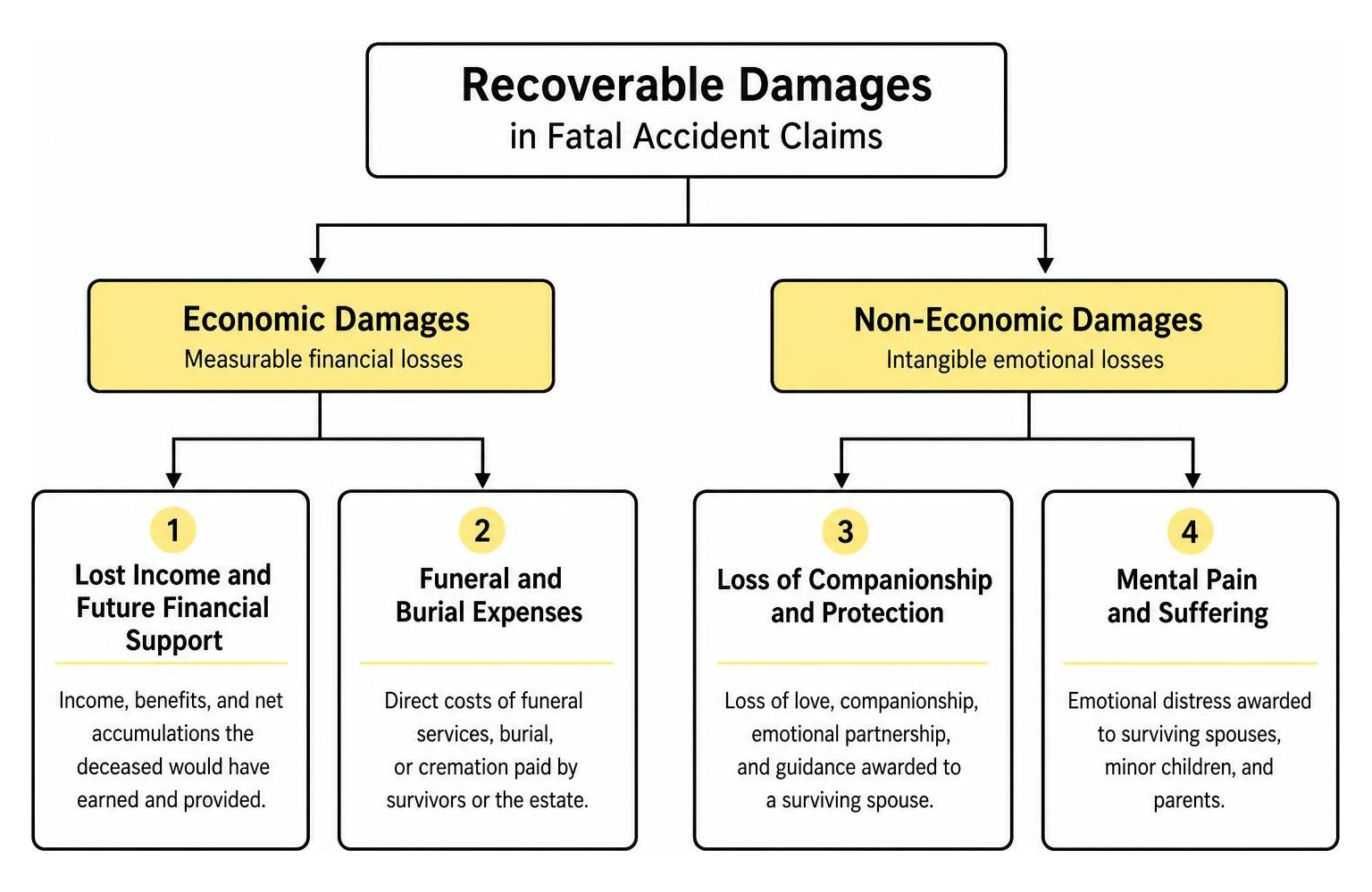
When families seek fatal accident legal help, one of their first concerns is understanding what losses can be financially recovered. Florida civil justice allows for both economic and non-economic damages to make the family whole as much as legally possible.
Recoverable damages typically include:
- Lost Income and Future Financial Support: Calculation of the income, benefits, and net accumulations the deceased person reasonably would have earned and provided over their expected lifetime.
- Funeral and Burial Expenses: Direct costs associated with funeral services, burial, or cremation paid by survivors or the estate.
- Loss of Companionship and Protection: Non-economic damages awarded to a surviving spouse for the loss of love, companionship, and emotional partnership.
- Mental Pain and Suffering: Emotional distress damages awarded to surviving spouses, minor children, and parents.
- Punitive Damages: In cases involving extreme negligence, gross recklessness, or intentional harm (such as severe drunk driving), punitive damages may be awarded to punish the at-fault driver.
Detailed guidance on recovering these expenses can be found in our articles on beyond grief understanding your right to claim funeral costs and more and the abcs of fatal accident compensation claims.
Critical Deadlines and Statutes of Limitations for Wrongful Death Lawsuits
Time is one of the most critical factors in any fatal collision case. Under Florida Statutes § 95.11, the statute of limitations for filing a wrongful death lawsuit is generally two years from the date of death.
If a family fails to file a lawsuit within this strict timeframe, they risk forfeiting their legal right to hold the negligent party accountable and secure financial compensation.
There are narrow tolling provisions (exceptions that pause the countdown), such as:
- Cases where the identity of the at-fault party was fraudulently concealed.
- Pending criminal charges or proceedings against the driver in specific statutory contexts.
Because establishing tolling exceptions is legally complex, waiting is never advisable. Read our comprehensive guide on how deadlines affect your claim: the clock is running a guide to accident statute of limitations.
Navigating Complex Fatal Accidents: Hit-and-Run, Uninsured Drivers, and Criminal Charges

Fatal crashes become significantly more complex when the at-fault driver flees the scene, lacks liability insurance, or faces criminal prosecution for their actions.
When dealing with a hit and run death or crashes involving drunk driving, families must pursue multiple legal avenues simultaneously. Learn about these complex legal scenarios through our analysis of drunk drivers head on collisions and wrongful death your legal options.
How Uninsured Motorist Coverage Protects Families
Uninsured motorist (UM) insurance is designed specifically for situations where an at-fault driver either has no insurance, insufficient insurance limits, or flees the scene of a fatal accident.
Key aspects of UM coverage include:
- First-Party Protection: Your claim is filed directly with your loved one’s or your family’s auto insurance company rather than relying on a negligent party’s policy.
- Hit-and-Run Coverage: In hit-and-run cases where the fleeing driver cannot be identified, UM policy limits step in to pay for economic and non-economic losses.
- Policy Stacking: In Florida, policyholders often have stacked UM coverage, which multiplies policy limits across multiple vehicles owned in the household to provide higher overall protection.
To understand how our firm assists with uninsured driver claims, read fatal car accident lawyer how we can help you.
How Criminal Proceedings Impact Your Civil Case
When a fatal collision involves illegal actions like driving under the influence or reckless driving, state prosecutors may bring criminal charges such as vehicular homicide or DUI manslaughter.
It is critical to understand the distinction between criminal and civil court proceedings:
- Burden of Proof: Criminal court requires proof “beyond a reasonable doubt,” whereas civil claims operate on a “preponderance of the evidence” standard (meaning it is more likely than not that the defendant was negligent).
- Negligence Per Se: A criminal conviction or guilty plea can serve as conclusive evidence of negligence in your civil lawsuit, making liability much easier to establish.
- Independent Case Pace: Civil claims proceed independently of criminal trials. While criminal cases punish the offender with jail time or fines, civil suits focus entirely on financial restitution for surviving family members.
Explore the impact of drunk driving on legal claims in tragedy on the road understanding drunk drivings fatal toll.
How Professional Fatal Accident Legal Help Secures Crucial Evidence
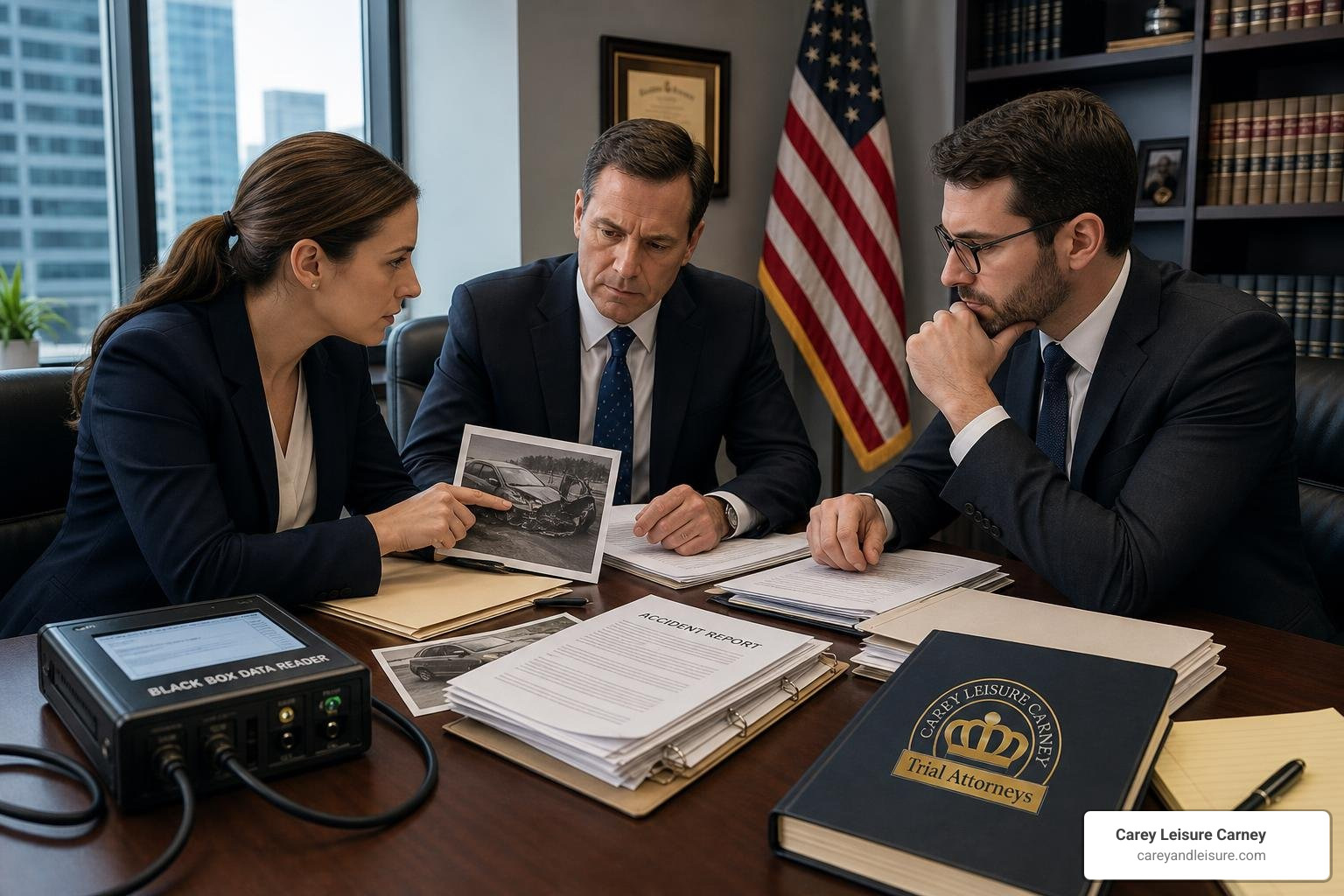
Proving negligence after a fatal collision requires swift and comprehensive investigation. While grieving families are focused on honoring their lost loved one, evidence at the crash site can fade or be destroyed rapidly.
When you secure fatal accident legal help, our legal team takes immediate action to protect critical evidence by issuing formal spoliation letters to preserve physical data before it is wiped or altered.
Key evidence gathered includes:
- Black Box (EDR) Data: Modern vehicles record pre-crash speed, braking patterns, steering input, and seatbelt usage.
- Surveillance and Traffic Camera Footage: Nearby business video feeds or municipal traffic cameras capturing the crash.
- Accident Reconstruction Reports: Specialized engineering experts rebuild the dynamics of the crash.
- Witness Testimony: Timely interviews with bystanders before memories fade.
Learn where and how crash records are collected in our guide on uncovering the truth where to find fatality reports and see the investigation steps detailed in claiming compensation a step by step guide to fatal accident claims.
Common Causes of Fatal Collisions and Essential Investigation Steps
Fatal collisions stem from various unsafe driving behaviors. Pinpointing the exact cause allows attorneys to establish full fault and pursue maximum recovery.
Common causes include:
- Distracted driving (texting or using mobile devices).
- Excessive speeding and aggressive driving.
- Driving under the influence of drugs or alcohol.
- Failing to yield at busy intersections.
Detailed crash analysis is highlighted in the silent epidemic unpacking fatal traffic accidents and the grim reality a guide to fatal accidents and their aftermath.
Why Seeking Immediate Fatal Accident Legal Help Matters for Your Rights
Insurance adjusters often contact grieving families shortly after a fatal collision. Their primary goal is to settle claims quickly for as little money as possible before families fully understand their long-term rights and loss.
Securing experienced trial counsel immediately protects your rights in several key ways:
- Shielding You from Insurers: Your attorney handles all communication with insurance companies so you are not pressured into recorded statements or lowball settlements.
- Calculating Full Lifetime Value: Attorneys work with economic experts to project lost future support accurately.
- No Upfront Costs: Personal injury firms handle fatal collision cases on a contingency fee basis—you pay nothing out of pocket unless money is successfully recovered for your family.
If you are looking for local representation across Pinellas, Pasco, or Hernando counties, consider reviewing resources for accidental death lawyers near me or connect directly with a wrongful death lawyer st petersburg fl. Carey Leisure Carney also serves families from offices in Clearwater, Largo, New Port Richey, Spring Hill, Trinity, and Wesley Chapel.
Frequently Asked Questions About Fatal Accident Claims
What is the main difference between a wrongful death claim and a survival action?
A wrongful death claim compensates the surviving family members for their personal loss, such as lost financial support, emotional distress, and loss of companionship. A survival action recovers damages that the victim personally suffered prior to passing away—such as pre-death medical expenses and pain and suffering—which are then paid into the deceased’s estate.
Can I receive compensation if the driver who caused the crash was uninsured?
Yes. If the at-fault driver has no liability coverage or flees the scene in a hit-and-run, you can often recover compensation through Uninsured Motorist (UM) insurance on your loved one’s policy or your own household policy. An attorney can help identify all available insurance coverage.
How long do families have to file a fatal accident lawsuit?
In Florida, the standard statute of limitations for filing a wrongful death lawsuit is two years from the exact date of death. Because investigating these cases takes time, it is vital to speak with an attorney as soon as possible to avoid missing legal deadlines.
Conclusion: Protecting Your Rights with Experienced Legal Representation
Navigating the loss of a loved one after a fatal traffic collision is extraordinarily heavy. You should not have to carry the legal burden alone while trying to heal your family.
At Carey Leisure Carney, our board-certified trial attorneys bring over 100 years of combined experience to every case we handle. We provide direct attorney access, personal attention, and relentless advocacy to ensure surviving heirs receive full financial justice.
When you need compassionate, effective guidance, reach out to our team for a free, no-obligation case review by visiting our wrongful death attorney guidance page today.