The ABCs of Fatal Accident Compensation Claims
What Is a Fatal Accident Compensation Claim? A Plain-English Answer
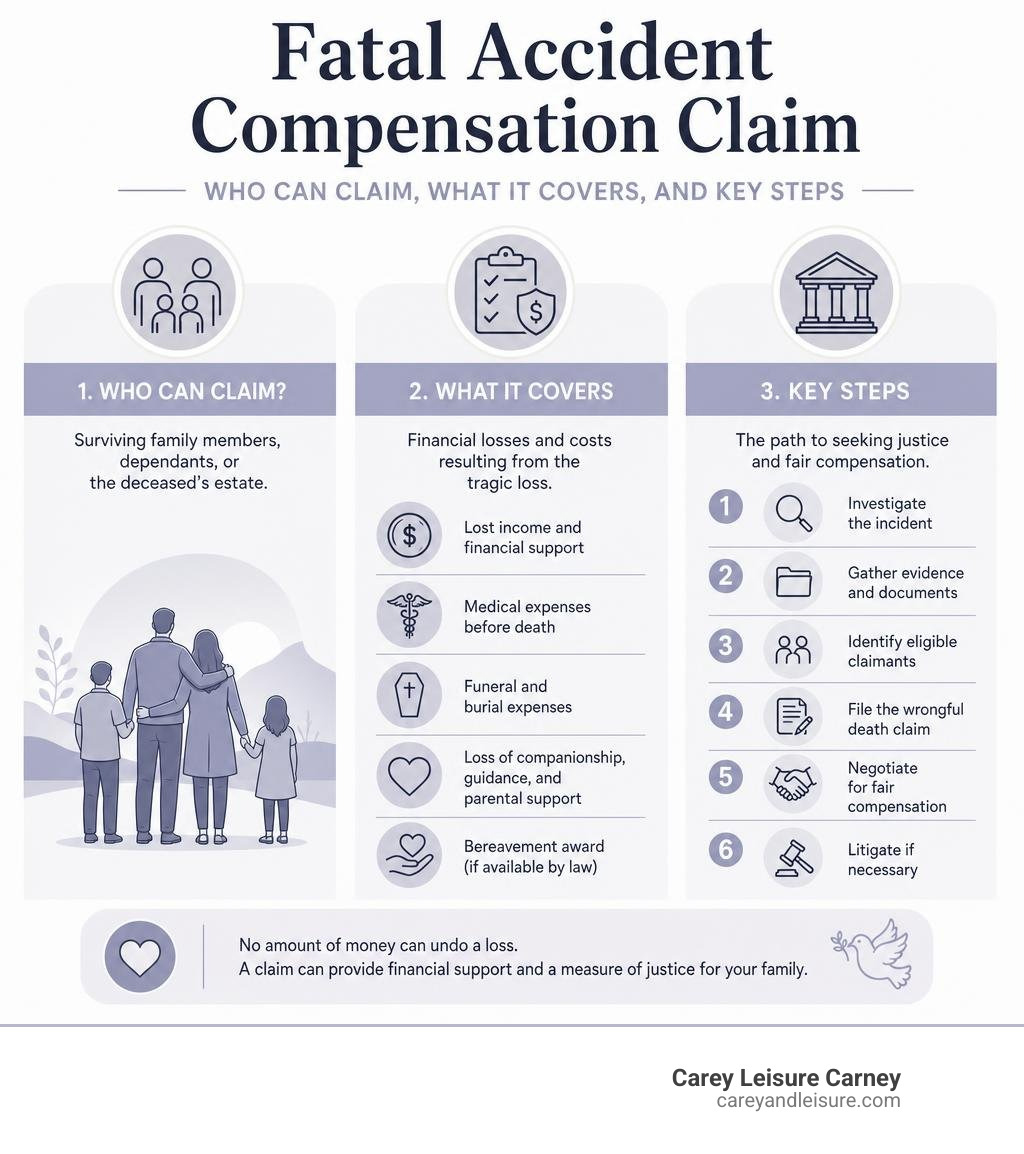
A fatal accident compensation claim is a legal action brought by surviving family members or dependants after a loved one dies due to someone else’s negligence, wrongful act, or breach of duty.
Here is what that means in plain terms:
- Who died: A person whose death was caused by another party’s careless or unlawful conduct
- Who claims: Close family members, dependants, or the deceased’s estate
- What they claim: Financial losses, funeral costs, and in some cases a fixed bereavement award
- The legal basis (in Florida and most U.S. states): A wrongful death action requiring proof of duty of care, breach of that duty, and causation
- The goal: Financial support for those left behind, and a measure of justice for the family
No amount of money can undo the loss of a loved one. But a successful claim can ease the financial burden that often follows — covering lost income, funeral expenses, and other costs that pile up quickly after a tragedy.
I’m Thomas W. Carey, founding partner of Carey Leisure Carney and a board-certified civil trial lawyer with over four decades of experience handling what is a fatal accident compensation claim on behalf of Florida families — including my own personal experience losing my wife, Joni, to a drunk driver. That experience drives everything I do for the clients we represent here in Clearwater and across the Tampa Bay area.
Quick what is a fatal accident compensation claim definitions:
Who Can Make a Fatal Accident Compensation Claim?
When a preventable tragedy occurs, the law outlines specific rules regarding who is legally entitled to file a claim. Because we serve families across Florida—including Clearwater, Largo, St. Petersburg, New Port Richey, Spring Hill, Trinity, and Wesley Chapel—we primarily look at these rules through the lens of the Florida Wrongful Death Act (Florida Statute 768.19).
In Florida, a wrongful death lawsuit must be filed by the personal representative (also known as the executor) of the deceased’s estate. This personal representative files the claim on behalf of the estate itself and all surviving dependants.
Eligible survivors who can recover compensation under Florida law include:
- The surviving spouse
- Minor children (and adult children if there is no surviving spouse)
- Parents of the deceased
- Any blood relatives or adoptive siblings who were partly or wholly dependent on the deceased for support or services
If you are looking at how these claims operate internationally, such as in the United Kingdom, the rules are governed by different statutes like the Fatal Accidents Act 1976. For a detailed comparison of international definitions of eligible dependants, you can read Understanding Fatal Accident Claims (2026) – UKLegalGuides.com . However, if the accident occurred here in the Sunshine State, Florida’s specific statutory definitions will strictly dictate who can recover.
What Types of Compensation Are Available in a Fatal Accident Claim?
If you are wondering what is my personal injury case worth? after a devastating loss, it helps to understand that damages are generally split into two main categories: economic damages and non-economic damages.
Economic Damages (Calculable Financial Losses)
These are the tangible, concrete financial losses that the family has incurred or will incur in the future due to the death:
- Loss of Support and Services: The financial value of the support, income, and physical services (like childcare, home maintenance, and household chores) the deceased would have provided.
- Lost Wages and Earning Capacity: The income the deceased would have reasonably earned over their expected working lifetime.
- Medical and Funeral Expenses: Any medical bills accrued between the time of the injury and the time of death, as well as all reasonable funeral and burial costs.
Non-Economic Damages (Intangible Emotional Losses)
These damages address the devastating emotional impact of the loss, which are often the most significant components of a claim:
- Loss of Companionship, Guidance, and Protection: Awarded to the surviving spouse and children to compensate for the permanent loss of the relationship.
- Mental Pain and Suffering: The emotional anguish experienced by the survivors since the date of the injury.
For a comprehensive breakdown of how these damages are structured, check out our wrongful death attorney Florida complete guide.
What Is the Bereavement Award and Who Is Eligible to Receive It?
In some jurisdictions outside the United States, such as the UK, the law provides a fixed statutory sum known as a bereavement award (currently set at £15,120 in England and Wales) to specific close relatives. You can learn more about how these statutory caps function abroad by visiting Fatal Accident Compensation Payouts (2026): Who Can Claim and How Much? .
However, in Florida, there is no fixed statutory cap on emotional damages or pain and suffering for survivors in a standard wrongful death claim. Instead, the value of the emotional loss is determined on a case-by-case basis. Factors that influence this include:
- The depth and nature of the relationship between the survivor and the deceased.
- The age of the surviving children (minor children under 25 are generally entitled to higher non-economic damages for the loss of parental guidance).
- The circumstances surrounding the accident.
Rather than relying on a small, predetermined flat fee, Florida law allows a jury or insurance negotiators to evaluate the true, unique emotional impact the death has had on your household.
What Is a Dependency Claim and How Is It Calculated?
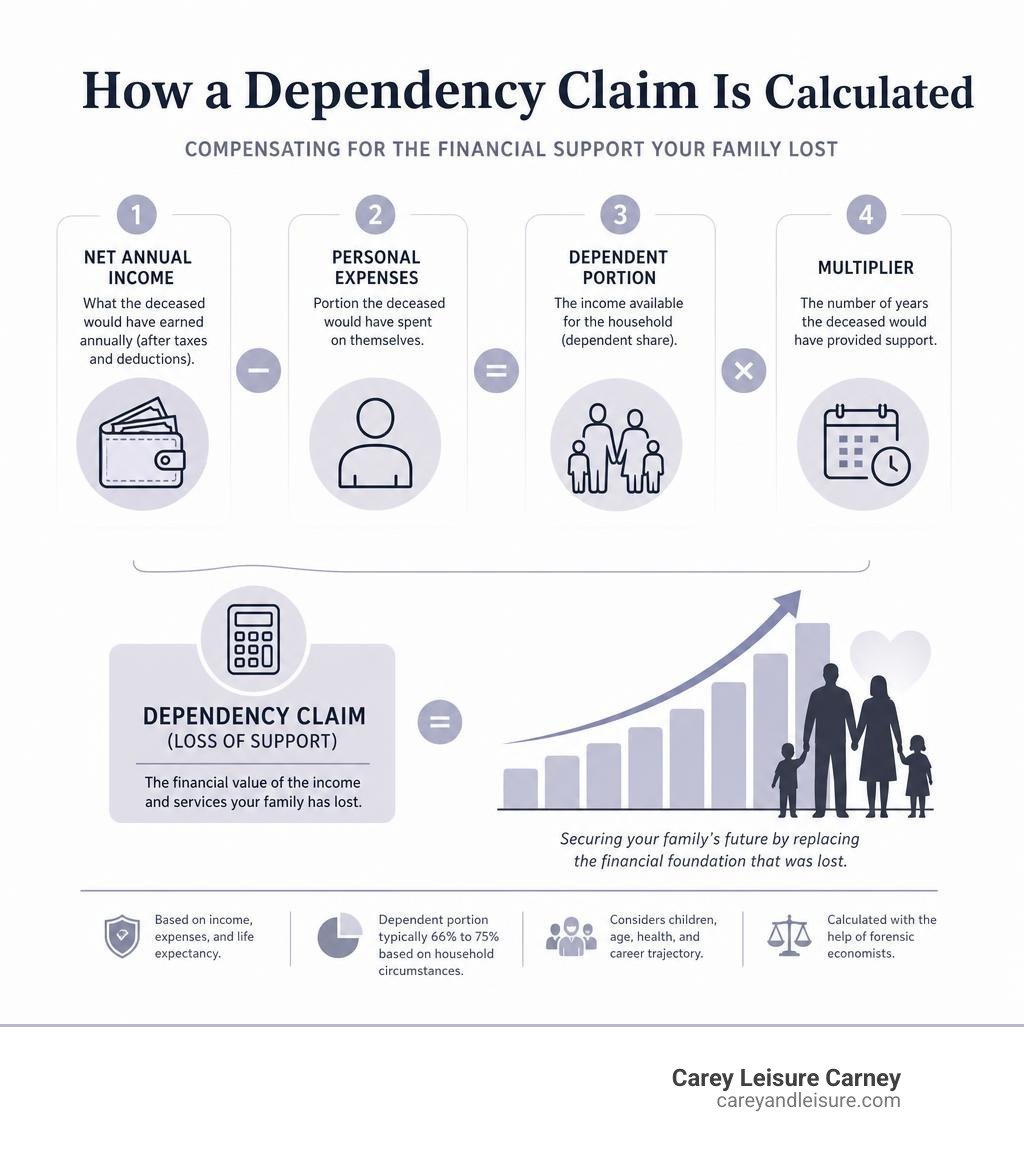
A dependency claim focuses on replacing the financial lifeline that the deceased provided to their household. If your family lost its primary earner, calculating this loss is a highly detailed process that often requires the help of forensic economists.
When calculating a dependency claim, we look at several core factors:
- The Multiplicand (The Net Income): We calculate the deceased’s net annual income, factoring in their age, health, job stability, and career trajectory.
- The Apportionment Principle: We deduct the portion of the income that the deceased would have spent solely on themselves (such as personal travel, clothing, or hobbies). The remaining percentage (typically 66% to 75% depending on whether there are children in the home) is considered the dependent portion.
- The Multiplier: This represents the number of years the deceased would have reasonably continued to work and provide for the family.
These calculations are highly scrutinized by insurance defense lawyers. For example, when working with an experienced Clearwater car accident lawyer from our team, we will compile tax returns, employment records, and expert economic testimony to build an undisputed projection of these lifetime losses.
What Is the Time Limit for Making a Fatal Accident Claim?
Time is of the essence when pursuing compensation after accident situations, especially when those accidents are fatal.
In Florida, the statute of limitations for a wrongful death claim is generally two years from the date of the person’s death.
Failing to file a lawsuit within this strict two-year window almost always means losing your legal right to pursue compensation permanently. While two years might sound like a long time, building a robust wrongful death case requires immediate action:
- Preserving physical evidence from the crash scene or workplace.
- Securing electronic data, such as commercial truck black boxes or workplace security footage.
- Locating and interviewing key witnesses before their memories fade.
Whether you need to speak with a New Port Richey car accident lawyer, a Spring Hill car accident lawyer, or our team at Carey Leisure Carney, contacting an attorney immediately is the best way to ensure critical deadlines are met.
Do Families Need to Go to Court for a Fatal Accident Claim?
One of the most common anxieties families share with us is the fear of enduring a long, stressful court trial while they are still actively grieving.
The reassuring news is that the vast majority of fatal accident claims are settled out of court through negotiations or mediation. Insurance companies are often eager to avoid the unpredictable nature and high costs of a jury trial, especially when liability is clear.
However, a settlement is only possible if the insurance company respects your legal team. If an insurer refuses to offer a fair settlement that covers your family’s long-term financial needs, we must be prepared to take the case to court. Having a board-certified civil trial attorney on your side sends a clear message to the insurance company that we are fully prepared to present your case to a jury if they fail to treat you fairly.
What Evidence Is Needed to Support a Fatal Accident Compensation Claim?
To successfully resolve a claim, your legal team must prove three essential elements: duty of care, breach of duty, and causation. This requires a comprehensive collection of evidence.
To help us build your case, we gather and analyze:
- Official Accident Reports: This includes police crash reports, workplace incident logs, or federal safety investigation reports. If you were involved in a motor vehicle collision, you can learn more about reporting requirements from Involved in a Crash? – Florida Highway Safety and Motor Vehicles .
- Medical Documentation: Any medical records, paramedic logs, and autopsy reports showing the exact cause of death and linking it directly to the accident.
- Financial Records: Tax returns, pay stubs, employment contracts, and utility bills to prove the financial loss suffered by the dependants.
- Physical and Digital Evidence: Dashcam footage, CCTV recordings, photos of the scene, and black box data from the vehicles involved.
- Witness Statements: Written or recorded accounts from people who saw the incident occur.
For more details on navigating the immediate aftermath of a tragic incident, read our guide on the grim reality: a guide to fatal accidents and their aftermath.
How Do Fatal Accident Claims Differ When the Death Results from a Criminal Injury?
If your loved one’s death was caused by a criminal act—such as a drunk driving collision, a violent assault, or manslaughter—the civil claim for compensation proceeds independently of any criminal prosecution.
Here is how the two systems interact:
- Different Burden of Proof: In a criminal case, the prosecutor must prove the defendant’s guilt “beyond a reasonable doubt.” In a civil wrongful death claim, we only need to prove liability on a “preponderance of the evidence” (meaning it is more likely than not that the defendant’s negligence caused the death). This means you can still win a civil compensation claim even if the defendant is acquitted in criminal court.
- Punitive Damages: If the wrongdoer’s conduct was exceptionally reckless, intentional, or malicious (such as driving under the influence), Florida law allows us to pursue punitive damages. These are additional financial penalties designed to punish the offender and deter others from similar behavior.
If you are looking for representation in local areas like St. Petersburg, consulting with specialized wrongful death lawyers who understand both the civil and criminal implications of these cases is highly recommended.
What Steps Should Families Take After a Fatal Accident to Pursue Compensation?
If you have recently lost a family member in a tragic accident, taking these practical steps can protect your legal rights while you focus on your family:
- Report the Incident: Ensure the accident is officially reported to the police (for auto accidents) or the appropriate regulatory body, such as OSHA (for workplace fatalities). For workplace-specific guidance, read Fatal Accident Claims Arising from Workplace Injuries (2026) – UKLegalGuides.com .
- Preserve All Documentation: Keep copies of the death certificate, funeral home invoices, medical bills, and any correspondence from insurance companies.
- Avoid Speaking to the Insurance Adjusters: Insurance companies representing the at-fault party may reach out quickly to offer a lowball settlement. Do not sign any documents or give recorded statements without an attorney present.
- Establish the Estate: Work with a legal professional to have a personal representative appointed so the civil claim can be formally initiated.
- Consult an Experienced Wrongful Death Attorney: Reach out to a firm that specializes in fatality car accident resulting in death cases to review your options.
Why Choose Carey Leisure Carney?
At Carey Leisure Carney, we know that learning what is a fatal accident compensation claim is likely the last thing you wanted to do. You are dealing with an unimaginable loss, and the legal system can feel cold and overwhelming.
We do things differently. Our firm is built on personal, compassionate service:
- Board-Certified Expertise: Our attorneys are Board-Certified in Civil Trial Law—a distinction held by less than 2% of Florida lawyers.
- Over 100 Years of Combined Experience: We have successfully navigated complex wrongful death and auto accident claims for decades.
- Direct Attorney Access: You won’t be passed off to assistants or case managers. You will have direct access to your attorney throughout the entire process.
- Personal Understanding: Because our founding partner has walked in your shoes, we treat every family we represent with the deep empathy, respect, and dedication they deserve.
If you are ready to discuss your options with a compassionate auto accident attorney/fatal accident attorney, we are here to listen.
Please visit our wrongful death attorney pillar page to schedule a free, confidential, and no-obligation case evaluation, or contact us directly at our Clearwater office.