Don’t Click Yet: The Truth Behind Highway Accident Claims on Social Media
How to Spot Fake Highway Crash Posts Before You Click
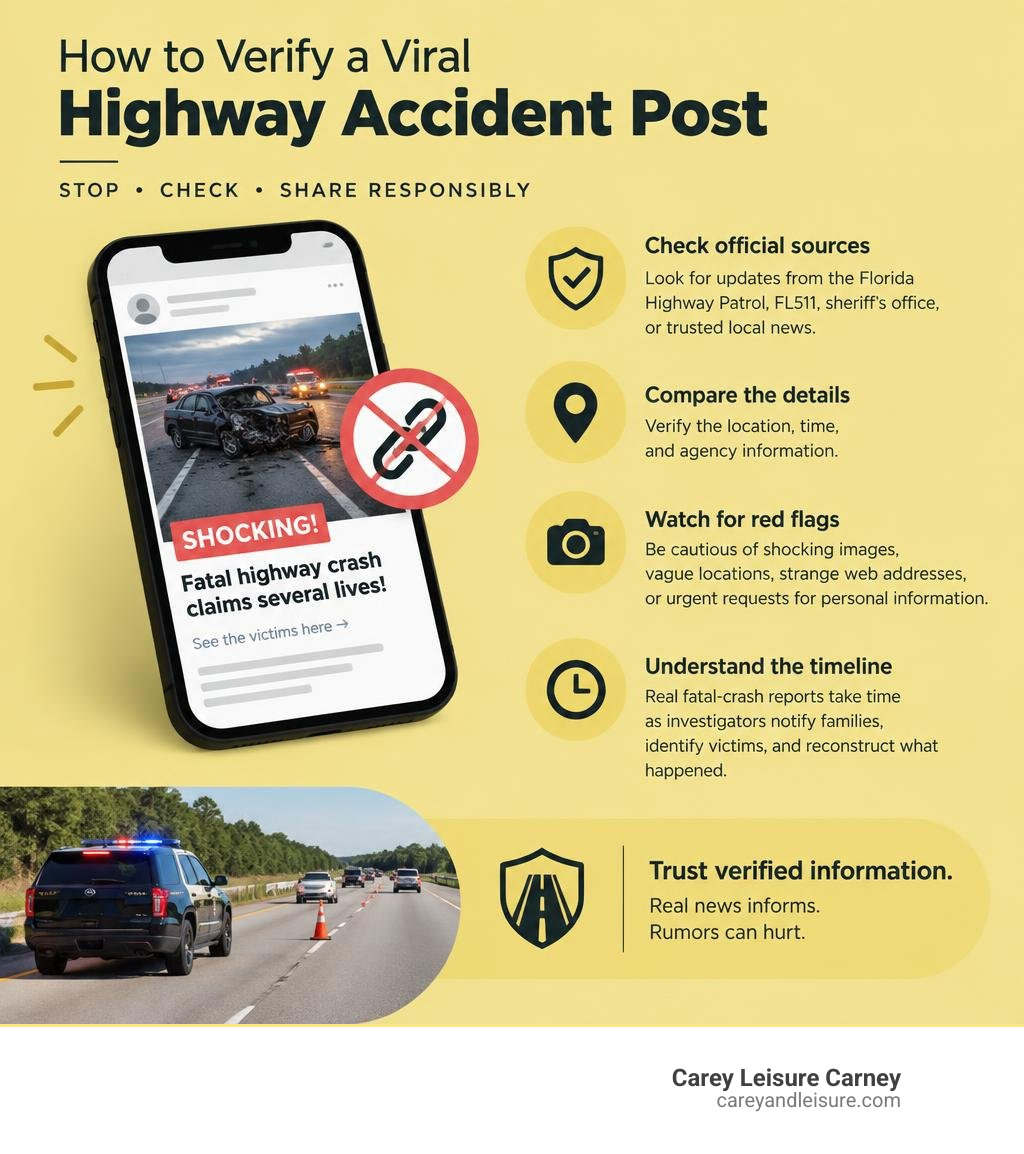
When a post claims a fatal traffic accident on the highway claims several lives, pause before sharing, commenting, or opening its link. Check the report through a verified Florida Highway Patrol, FL511, sheriff’s office, or established local-news account; then compare the crash location, time, and agency details. Be wary of posts that use shocking images, vague locations, strange web addresses, or urgent requests to “see the victims” or enter personal information.
Real fatal-crash reporting usually develops over time because investigators must notify families, identify victims, document the vehicles involved, and reconstruct what happened. A genuine report may describe lane closures and responding agencies, but it should not pressure you to click a suspicious link.
I am Thomas W. Carey, a board-certified civil trial lawyer who has handled and overseen thousands of Florida injury matters, including cases involving catastrophic highway collisions and wrongful death. When a fatal traffic accident on the highway claims several lives, families deserve verified information, preserved evidence, and clear guidance rather than social-media rumors.
Know your fatal traffic accident on the highway claims several lives terms:
- fatal accident investigation
- fatal accident claims
- The Grim Reality: A Guide to Fatal Accidents and Their Aftermath
How Viral Clickbait Exploits When a Fatal Traffic Accident on the Highway Claims Several Lives
Social media algorithms thrive on urgency and raw emotion. When bad actors craft sensational posts claiming that a horrific wreck occurred in your neighborhood, they exploit our natural instinct to protect friends and loved ones. These posts often mimic genuine breaking news alerts, designed to trigger immediate panic and rapid sharing across community groups.

Behind these alarming posts lies a calculated cyber threat. Fraudsters capitalize on fear to direct readers toward malicious destinations. Understanding the architecture of these scams helps keep your personal data secure while preventing the spread of harmful misinformation.
Why a Fake Post Says a Fatal Traffic Accident on the Highway Claims Several Lives
Scammers understand that highway collisions evoke deep emotional reactions. By claiming a crash just occurred on local corridors like US-19 in Clearwater or Little Road in New Port Richey, bad actors guarantee clicks from concerned residents.
These schemes typically operate through:
- Hijacked Social Media Accounts: Compromised profiles of real people post into community buy-and-sell groups or neighborhood pages to appear trustworthy.
- Cloned News Outlets: Fraudulent domains mirror the visual layout of well-known Florida news stations to deceive readers into thinking the story is legitimate.
- Locked Comments: Post creators frequently disable comments to stop vigilant neighbors from warning others that the story is fabricated.
- Emotionally Manipulative Language: Captions emphasize graphic details or urge viewers to “identify the bodies” before authorities make public statements.
Red Flags of Highway Crash Hoaxes and Phishing Links
Spotting a fake crash post comes down to looking closely at the details. Scammers rely on rushed readers who do not inspect URLs or question the absence of official statements.
| Feature | Viral Scam Post | Verified Highway Crash Report |
|---|---|---|
| URL / Link Source | Strange, unfamiliar domain or disguised link | Official news outlet, FL511, or law enforcement site |
| Location Details | Generic descriptions (e.g., “the highway nearby”) | Specific mile markers, cross streets, and exit numbers |
| Comments Section | Disabled or heavily curated by a single poster | Open public discussion and updates from verified reporters |
| Call to Action | “Log in to view video” or “Share before it’s deleted” | Neutral request to avoid the area or seek detour routes |
| Agency Involvement | No mention of responding agencies | Quotes and reports from Florida Highway Patrol or local police |
If clicking a link prompts you to re-enter your Facebook, Google, or banking credentials, close the browser immediately. This tactic, known as credential harvesting, gives cybercriminals access to your personal accounts to propagate further scams.
The Reality Behind Serious Highway Collisions in Florida
While fake news posts generate unnecessary panic, catastrophic collisions on major thoroughfares remain a severe reality across Florida. In 2024, there were 39,254 deaths from motor vehicle crashes in the United States, translating to a national fatality rate of 11.5 deaths per 100,000 people and 1.19 deaths per 100 million vehicle miles traveled.
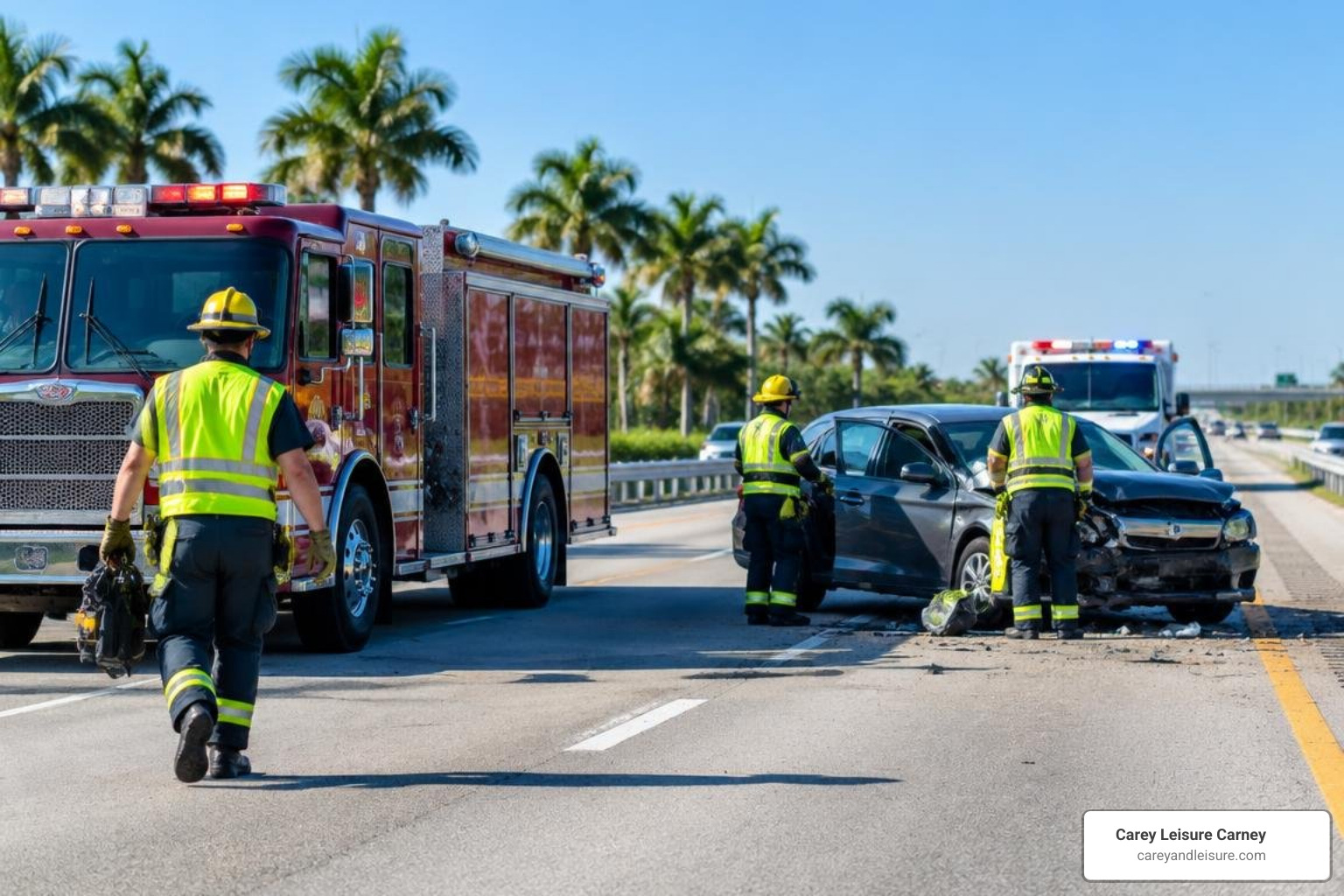
High-speed corridors throughout Pinellas, Pasco, and Hernando Counties see multi-vehicle impacts, rollovers, and hazardous pileups regularly. Understanding how these tragedies happen requires examining vehicle dynamics, human error, and thorough post-crash investigations. You can read more about unraveling the truth in fatal accident investigations to see how real evidence is gathered.
What Really Happens When a Fatal Traffic Accident on the Highway Claims Several Lives
A catastrophic wreck on a major thoroughfare unfolds in seconds but leaves devastation that lasts a lifetime. Whether caused by commercial semitrucks, distracted driving, or severe lane departures, high speeds amplify collision forces dramatically. Nationwide, speeding was a contributing factor in 29% of motor vehicle crash deaths in 2024.
Real multi-vehicle collisions frequently involve:
- Chain-Reaction Pileups: When traffic suddenly halts, following vehicles traveling at high speeds fail to stop in time, triggering sequential rear-end impacts.
- Median Crossovers: A heavy commercial rig or passenger car losing control and crossing a median creates an unavoidable head-on hazard for opposing lanes.
- Commercial Carrier Mass Disparities: An 80,000-pound semitruck striking a standard passenger car results in severe structural intrusion into passenger cabins.
- Secondary Crashes and Debris Fields: Scattered cargo and disabled vehicles in travel lanes pose immediate danger to incoming drivers who have limited reaction time.
Major incidents, such as when a fatal crash on I-95 claims multiple lives, require comprehensive shutdowns of entire highway sections lasting several hours while emergency teams conduct rescue operations.
Investigating Multi-Vehicle Highway Pileups and Liability
Real crash scenes involve rigorous forensic documentation rather than instant online conclusions. Responding agencies like the Florida Highway Patrol deploy Traffic Homicide Investigators (THI) to systematically piece together how a wreck occurred.
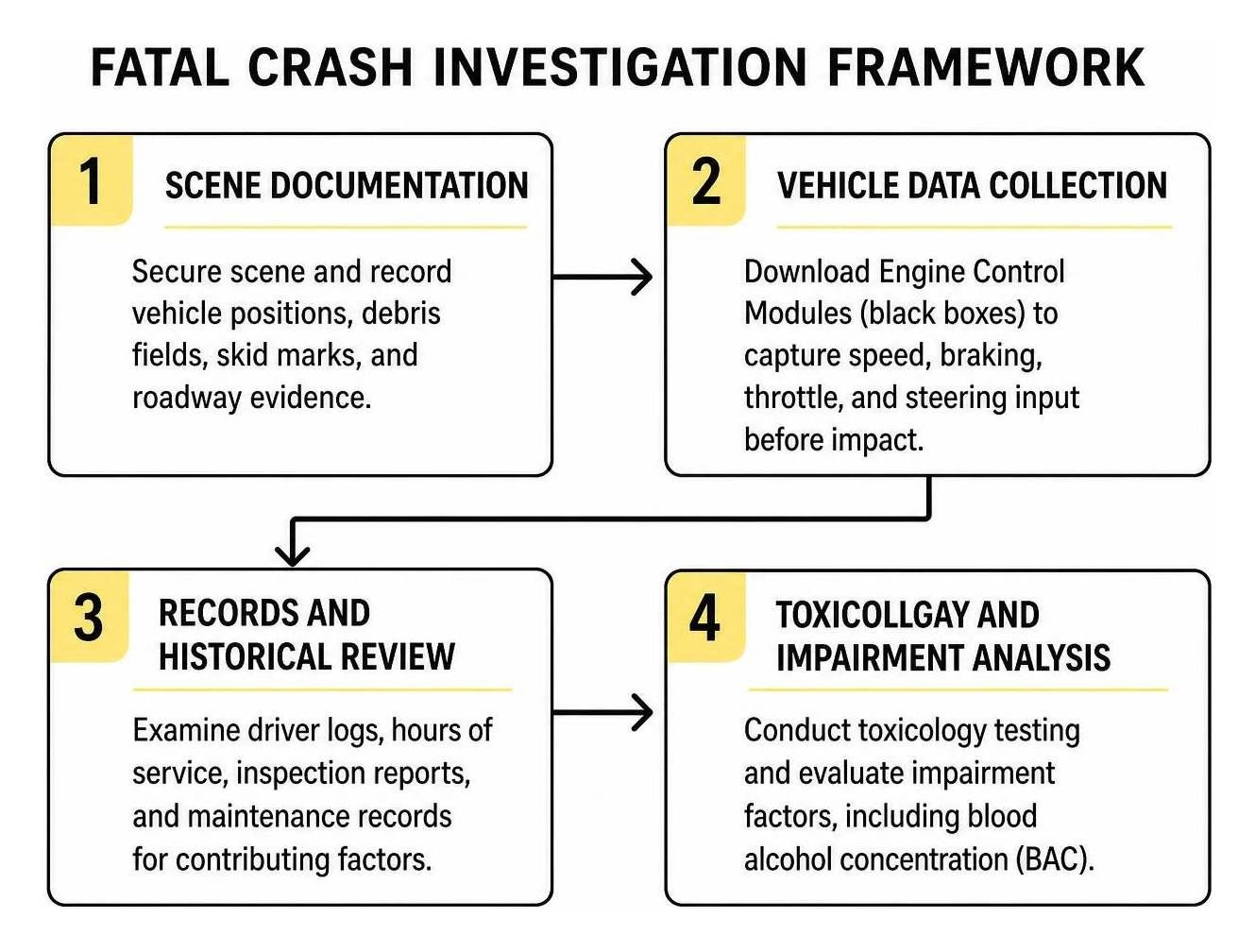
Official investigations analyze multiple physical factors:
- Engine Control Modules (Black Boxes): Recording pre-impact vehicle speed, braking status, throttle position, and steering input.
- Physical Roadway Evidence: Measuring skid marks, yaw marks, fluid trails, gouges in the asphalt, and final resting positions.
- Electronic Logs and Maintenance Records: Reviewing commercial driver hours of service (HOS) logs, inspection reports, and brake maintenance histories.
- Toxicology and Impairment Screenings: Evaluating blood alcohol concentration (BAC). In fatal crashes involving passenger vehicle drivers in 2024, an estimated 31% had a BAC of 0.08% or higher.
When an incident occurs—such as when a Clearwater man was seriously injured after an SUV rolled over on US-19—investigators must reconstruct the chain of events. Understanding how to tell who is at fault in a car accident requires assessing driver behavior, roadway conditions, and mechanical factors through objective science.
How to Verify Legitimate Crash News and Official Florida Road Reports
When you see reports of a terrible highway accident in your area, you can easily verify whether the event is real using public records and direct agency channels rather than clicking suspicious links.
Staying informed should never compromise your digital security. You can learn the best ways to stay informed on recent fatal crashes by relying on official, state-managed public safety platforms.
Trusted Sources for Florida Highway Traffic and Crash Alerts
Florida provides multiple public portals that update traffic disruptions, road closures, and active emergency dispatches in real time:
- FL511 (Florida Department of Transportation): Delivers real-time camera feeds, lane closures, construction zones, and crash alerts across all Florida interstates and state roads.
- Florida Highway Patrol Live Traffic Crash and Road Condition Report: An open-access dashboard listing active incidents, dispatch times, exact highway locations, and response statuses by county.
- Local County Sheriff Dispatch Feeds: Law enforcement offices in Pinellas, Pasco, and Hernando counties regularly post verified emergency notices and detour routes on their official websites.
- Established Local News Outlets: Professional journalists verify information with public information officers (PIOs) before publishing names or crash sequences.
If you suspect an active incident near your commute, checking a trusted source for tracking local car crashes in your area today gives you accurate, live road conditions without exposure to malware.
Steps for Families Seeking Legitimate Accident Information
When a genuine collision occurs, finding accurate information about loved ones is vital. When tragic events make the news—such as when a New Port Richey man dies after a five-vehicle crash on Little Road—official notifications follow a strict protocol to respect families.
If you are concerned a loved one was involved in a severe highway crash:
- Contact the Responding Highway Patrol Troop or Local Police Department: Request information through their public records or dispatch division.
- Contact Regional Trauma Centers: Area hospitals have dedicated patient-information liaisons to confirm admissions following major roadway accidents.
- Connect with the District Medical Examiner’s Office: In fatal incidents, official identification and formal next-of-kin notifications are handled directly by the medical examiner or law enforcement chaplains, never via social media.
Legal Recourse and Wrongful Death Claims for Highway Crash Victims
The sudden loss of a family member in a highway crash brings immense grief, emotional trauma, and unexpected financial burdens. When negligence, reckless driving, or commercial carrier violations cause a fatal wreck, Florida law allows surviving family members to pursue justice.
Navigating these claims requires understanding the protections available to surviving dependents. For a comprehensive overview of your rights, consult our Florida wrongful death attorney guide to learn how state statutes safeguard grieving families.
Establishing Fault and Navigating Insurance Claims
Highway crashes often involve complex liability across multiple parties. This is especially true when commercial motor vehicles, ride-share companies, or government road-maintenance contractors are involved.
Key elements of navigating highway accident claims include:
- Identifying All Liable Parties: Determining whether fault lies with an individual reckless driver, a commercial trucking company, a vehicle parts manufacturer, or an employer.
- Uncovering Commercial Insurance Coverage: Commercial trucks and corporate fleets carry higher liability policy limits than standard passenger vehicles.
- Evaluating the role of insurance companies in a car accident: Insurance adjusters often attempt to minimize payouts or shift comparative fault to victims to protect their corporate profits.
- Addressing Seat Belt and Restraint Use: Nationally, among passenger vehicle occupants fatally injured in 2024, only 46% were restrained. Insurers often examine seat belt defense arguments, making clear legal advocacy essential.
Protecting Your Rights After a Fatal Interstate Crash
Securing evidence immediately after a serious highway collision is crucial. Physical skid marks wash away, vehicle computers get overwritten, and commercial carriers move quickly to safeguard their own interests.
Families seeking justice should keep several considerations in mind:
- Statute of Limitations: Florida sets strict statutory deadlines for filing wrongful death and personal injury actions. Delaying can permanently bar your family from seeking financial recovery.
- Preservation of Critical Evidence: Sending formal legal spoliation letters to trucking firms and insurers prevents them from destroying or altering black box data and dashcam footage.
- Securing Specialized Representation: Whether you need a dedicated wrongful death lawyer in Spring Hill, FL or an experienced wrongful death lawyer in New Port Richey, FL, having seasoned local trial counsel ensures your rights are fiercely defended.
- Recoverable Damages: Eligible survivors can seek compensation for lost future earnings, medical and funeral expenses, mental pain and suffering, and loss of parental companionship.
Frequently Asked Questions About Fatal Highway Crashes and Scams
How do scammers use fake fatal accident posts on Facebook and social media?
Scammers use compromised accounts to publish shocking stories with urgent headlines in local community groups. When users click the link, they are taken to cloned websites designed to steal passwords, install malicious browser extensions, or harvest private personal data.
Where can I find official records for a recent fatal highway crash in Florida?
Official crash records, traffic updates, and homicide investigation reports can be accessed through the Florida Highway Patrol Live Traffic Crash Feed, the Florida Department of Highway Safety and Motor Vehicles (FLHSMV), FL511, or the local county sheriff’s office dispatch records in Clearwater, St. Petersburg, New Port Richey, and surrounding areas.
Who can file a wrongful death claim after a fatal highway crash in Florida?
Under the Florida Wrongful Death Act, the claim must be filed by the personal representative of the deceased person’s estate. The action is brought on behalf of surviving statutory beneficiaries, which typically include the surviving spouse, minor children, dependent adult children, and dependent parents.
Conclusion
Encountering a shocking post claiming a devastating highway wreck has occurred can be alarming. By recognizing the warning signs of online scams and relying on verified reporting from official Florida agencies, you protect yourself and your loved ones from digital deception.
When real tragedies occur on our roads, families need dedicated, experienced advocates by their side. At Carey Leisure Carney, our board-certified civil trial attorneys have over 100 combined years of experience representing accident victims and their families. With offices in Clearwater, St. Petersburg, New Port Richey, Spring Hill, Trinity, Largo, and Wesley Chapel, we provide direct attorney access and compassionate support to help you through the most challenging times.
If your family has been affected by a catastrophic highway collision, contact an experienced Florida wrongful death attorney at Carey Leisure Carney today for a free, confidential consultation.