How a DUI Accident Victim Attorney Can Help After a Crash
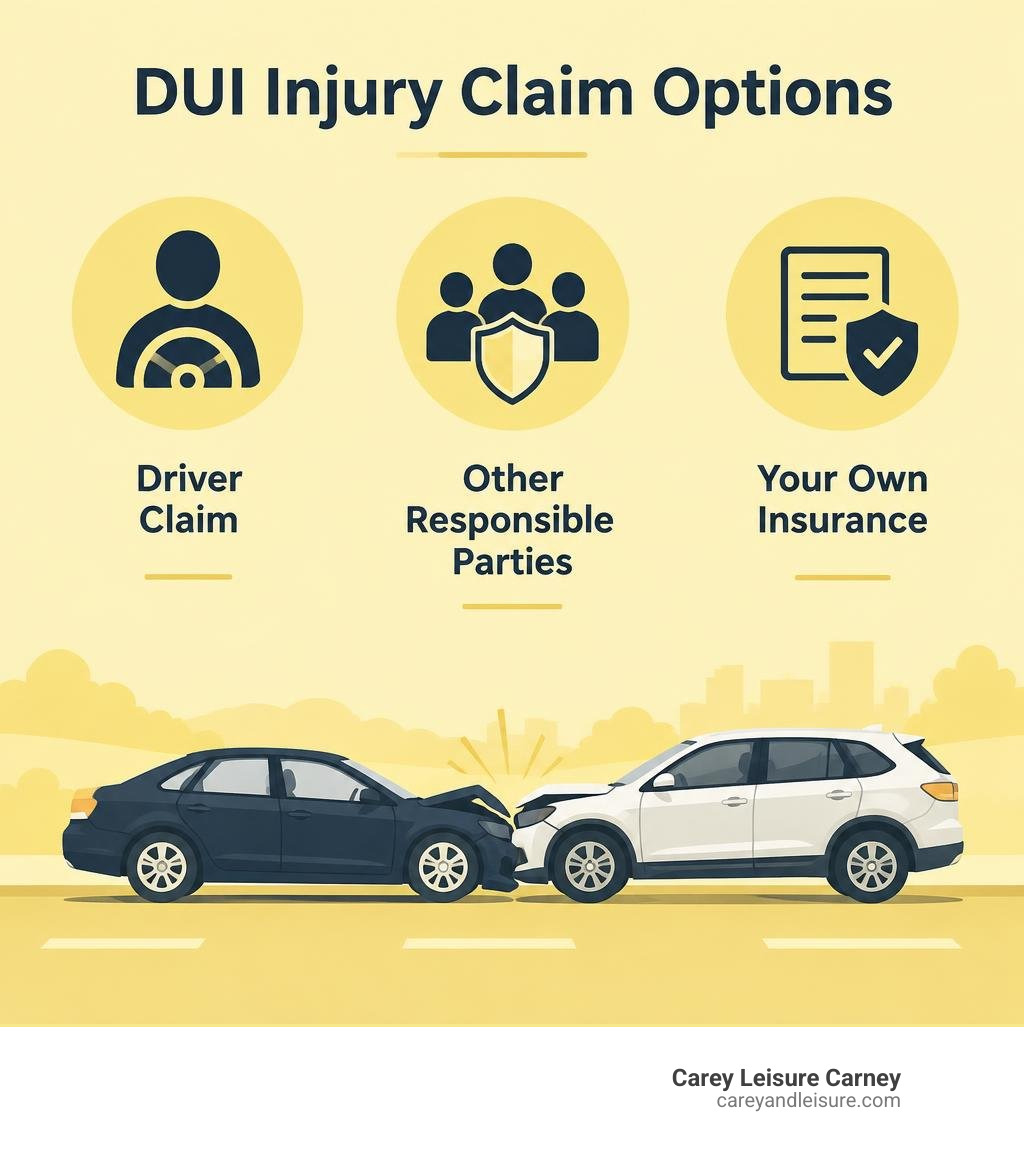
A dui accident victim attorney can help you seek compensation from the impaired driver, identify other parties who may be responsible, and review coverage under your own auto policy. Get medical care, keep the crash report and bills, and avoid accepting a settlement before you know the full cost of your injuries.
In Florida, your personal injury protection (PIP) coverage may pay some early expenses. If your injuries are serious or the driver has too little insurance, you may have other options.
I’m Thomas W. Carey, founding partner of Carey Leisure Carney and a board-certified civil trial lawyer with decades of experience handling injury claims. My work as a dui accident victim attorney is personal, too: my wife, Joni, was killed by a drunk driver early in our marriage.
Basic dui accident victim attorney terms:
Direct Claims Against the Impaired Driver and Insurance Challenges

When an impaired driver crashes into you, fault usually seems obvious. The police arrest the driver, conduct field sobriety tests, and record a high blood alcohol concentration (BAC). In most auto collision cases, establishing liability is the hardest hurdle. In drunk driving crashes, however, liability is rarely the main argument. Instead, disputes focus on how much compensation the insurance company must pay.
Insurance carriers know when their insured driver made an inexcusable choice. Because the risk of facing a jury is dangerous for them, adjusters often reach out quickly. They might express deep sympathy, offer to pay your immediate hospital bills, and slide a check across the table.
This is an early settlement trap. Insurers know that victims are vulnerable right after a crash. By offering a fast payout before you know the full extent of your physical therapy needs, future surgeries, or lost earnings, they hope you will sign a release of all liability. Once you sign that release, you forfeit your right to seek additional compensation, even if your injuries require lifelong care. Understanding what to do if you were hit by a drunk driver is critical to protecting your financial recovery.
Another challenge arises when insurance carriers attempt to deny coverage altogether. Some adjusters argue that driving under the influence constitutes an “intentional act,” which is often excluded under standard auto policies. In civil practice, courts reject this reasoning. While deciding to drink and drive is an intentional decision, crashing into another vehicle is categorized under civil negligence or gross negligence. When an insurance company wrongfully threatens a coverage denial, it can open the door to bad-faith insurance claims.
How a DUI Accident Victim Attorney Proves Liability and Gross Negligence
Even when an arrest occurs at the scene, winning a civil personal injury claim requires distinct proof. A criminal conviction punishes the driver, but it does not automatically deposit a settlement check into your bank account. As explained in this guide on Legal Options After You’re Injured by a Drunk Driver, civil claims require independent discovery to establish the full scope of damages and negligence.
We build civil cases by securing crucial evidence before it disappears:
- Toxicology and Chemical Test Results: Breathalyzer data, blood draw lab reports, and urine analyses gathered by law enforcement.
- Police Dashcam and Bodycam Footage: Visual evidence showing the driver stumbling, slurring words, or failing standardized field sobriety tests.
- Crash Reconstruction Data: Event data recorders (“black boxes”) that log vehicle speed, braking attempts, and steering inputs prior to impact.
- Eyewitness Testimony: Statements from other motorists or pedestrians who saw erratic driving prior to the crash.
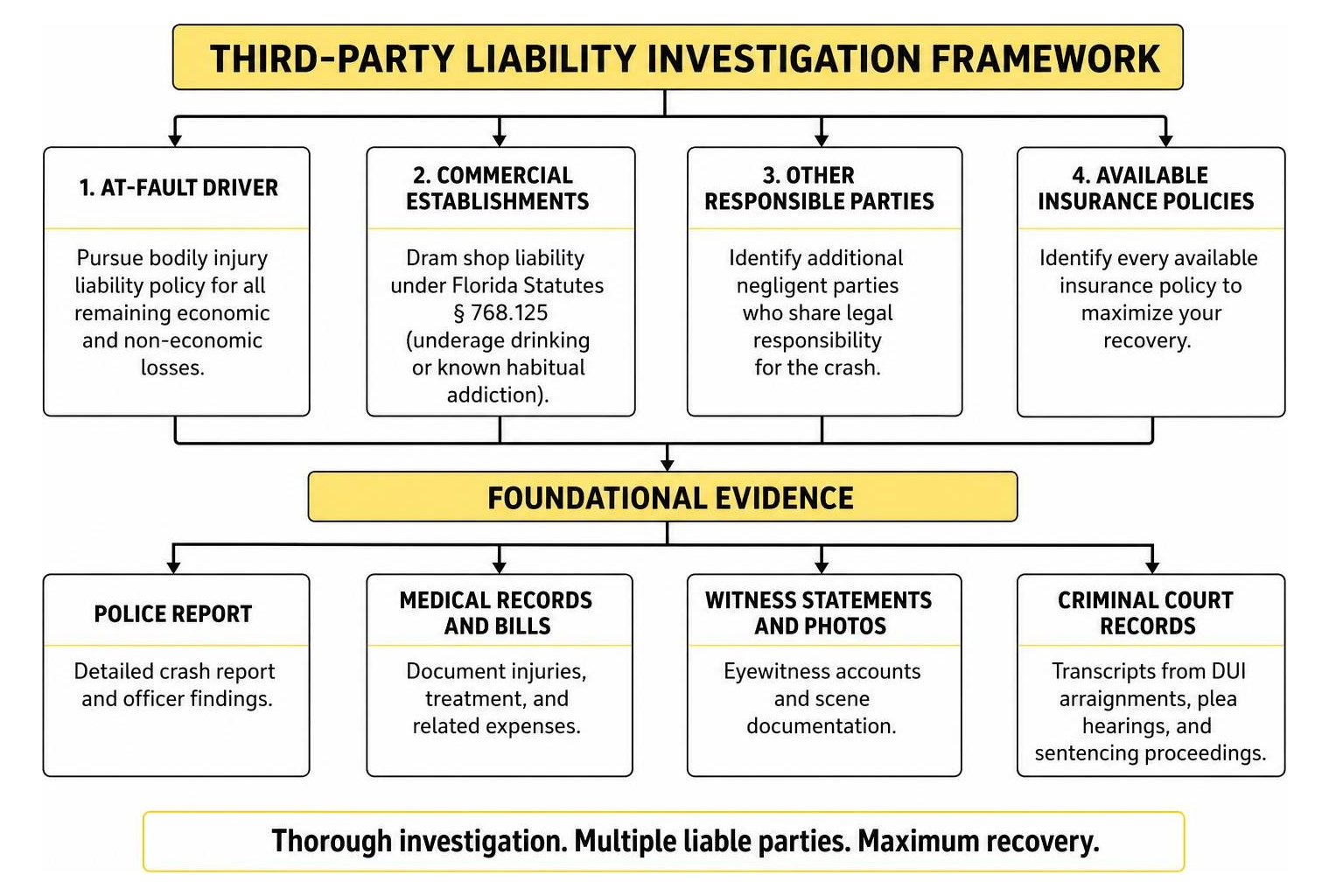
- Criminal Court Records: Transcripts from DUI arraignments, plea hearings, and sentencing proceedings.
Criminal restitution ordered by a judge in a DUI prosecution is helpful, but it rarely covers extensive medical care or pain and suffering. A civil claim bridges that gap, demanding accountability through the civil court system.
Navigating Florida PIP and Bodily Injury Coverage Limits
Florida operates under a no-fault insurance system. Under these rules, your initial medical bills and lost wages are processed through your own Personal Injury Protection (PIP) coverage, regardless of who caused the crash. PIP covers up to $10,000 in medical and disability benefits, provided you seek medical care within 14 days of the accident.
Because catastrophic drunk driving collisions easily exceed PIP limits, victims must step outside the no-fault system. To pursue a direct bodily injury liability claim against the at-fault driver, your injuries must meet Florida’s permanent injury threshold:
- Significant and permanent loss of an important bodily function
- Permanent injury within a reasonable degree of medical probability
- Significant and permanent scarring or disfigurement
- Death
Once this threshold is met, you can pursue the at-fault driver’s bodily injury liability policy for all remaining economic and non-economic losses.
Pursuing Third-Party Liability Beyond the At-Fault Driver
Drunk drivers frequently carry only state-mandated minimum liability coverage, and many carry no bodily injury insurance at all. When injuries are severe, a single minimum policy is nowhere near enough. A thorough investigation must examine whether third parties share legal responsibility for the crash. Following our drunk driving accident claims guide, we identify every available insurance policy to maximize your recovery.
Working With a DUI Accident Victim Attorney to Uncover Third-Party Liability
Commercial establishments that sell or serve alcohol can sometimes be held liable under dram shop statutes. Under Florida law (Florida Statutes § 768.125), a bar, restaurant, or social host is generally not liable for injury caused by an intoxicated patron, with two exceptions:
- Underage Drinking: Anyone who willfully and unlawfully sells or furnishes alcohol to a person who is not of lawful drinking age.
- Known Habitual Addiction: Anyone who knowingly serves alcohol to a person who is habitually addicted to beverage alcohol.
Proving that an establishment knowingly served a habitually addicted patron requires detailed discovery, such as bar tab receipts, surveillance video, witness statements from bartenders, and prior incident reports. Reviewing our dram shop injury attorney ultimate guide helps clarify how commercial vendor liability functions in complex civil litigation.
Employer Liability and Negligent Vehicle Entrustment
Third-party liability is not limited to bars. Other parties can share legal responsibility depending on the circumstances of the crash:
- Respondeat Superior (Employer Liability): If an employee causes a drunk driving crash while acting within the scope of their employment, the employer can be held vicariously liable. Examples include a sales representative driving home after entertaining clients at a multi-drink business lunch, or an on-duty delivery driver. This doctrine applies even if the worker was operating their personal vehicle for work purposes.
- Negligent Entrustment: A vehicle owner who hands their keys to someone they know is intoxicated, or who has a known pattern of driving under the influence, can be sued directly for negligently entrusting their vehicle.
- Workers’ Compensation Claims: If you were hit by a drunk driver while performing your own job duties (such as driving a company vehicle, running work errands, or working in a road construction zone), you can file for workers’ compensation benefits through your employer while simultaneously pursuing a third-party lawsuit against the drunk driver.
First-Party Insurance Coverage Options When the At-Fault Driver Is Underinsured

When an impaired driver has no bodily injury insurance or their policy limits are exhausted, your own auto insurance policy becomes your safety net. Filing a claim against your own insurer does not mean you caused the crash; it simply activates coverages you have purchased.
Key first-party coverages include:
- Uninsured/Underinsured Motorist (UM/UIM) Coverage: This is the most crucial coverage you can purchase. UM/UIM steps into the shoes of the at-fault driver, paying for your medical expenses, lost earning capacity, pain, and suffering when the drunk driver lacks adequate insurance.
- Medical Payments (MedPay): An optional coverage that pays medical bills for you and your passengers up to policy limits, often covering PIP copays and deductibles.
- Collision Coverage: Pays for the repair or total-loss replacement value of your vehicle, regardless of driver fault.
In severe crashes involving head-on collisions and wrongful death, stacking multiple UM policies across household vehicles can provide the necessary financial lifeline for a family.
First-Party Insurance Coverages vs Third-Party Liability Claims
| Coverage Feature | First-Party Claims (PIP, UM/UIM, MedPay) | Third-Party Claims (At-Fault Driver, Dram Shop, Employer) |
|---|---|---|
| Who Pays | Your own insurance carrier | The at-fault driver or third-party insurer |
| Fault Requirement | PIP/MedPay: No fault required UM/UIM: Must prove other driver caused crash | Must prove negligence or gross negligence |
| Damage Recovery | Limited to policy limits and specific coverages (PIP pays 80% medical) | Full economic, non-economic, and punitive damages |
| Recovery Speed | Fast for immediate medical bills (PIP/MedPay) | Longer due to investigation, discovery, and negotiations |
Calculating Damages: Economic, Non-Economic, and Punitive Awards
Personal injury damages fall into three categories: economic, non-economic, and punitive.
Economic Damages (Special Damages)
These represent tangible, out-of-pocket financial losses resulting from the collision:
- Past, current, and future medical expenses (hospital stays, surgeries, physical therapy, prescription medications)
- In-home nursing care and medical equipment
- Lost wages and lost future earning capacity
- Property damage and vehicle replacement costs
Non-Economic Damages (General Damages)
These address the subjective, human toll of the crash:
- Physical pain and chronic discomfort
- Emotional distress, anxiety, depression, and PTSD
- Loss of capacity for the enjoyment of life
- Permanent disfigurement or physical impairment
- Loss of consortium (damage to marital and family relationships)
Punitive Damages
Unlike standard compensatory damages, punitive damages are designed to punish the wrongdoer and deter others from engaging in reckless conduct. Standard auto accident claims rarely qualify for punitive damages because ordinary negligence (like misjudging a turn or following too closely) does not show reckless indifference.
Drunk driving cases are different. Intentionally getting behind the wheel with a high BAC is widely recognized by courts as gross misconduct. Pursuing drunk driving punitive damages requires filing a formal motion with the court, supported by evidence demonstrating gross negligence. In cases involving fatal drunk driving collisions, punitive damages hold reckless drivers accountable for devastating loss.
Why You Need a DUI Accident Victim Attorney for Complex Claims
DUI injury claims involve simultaneous civil and criminal proceedings, multiple insurance carriers, subrogation liens, and high evidentiary standards. Having board-certified trial attorneys handling your case ensures you are not pushed around by insurance companies that handle claims every day.
We handle critical case tasks on your behalf:
- Subpoenaing toxicology reports, 911 dispatch audio, and establishment receipts before evidence is destroyed.
- Managing communication with aggressive insurance adjusters to prevent recorded statements that harm your case.
- Identifying and stacking all available insurance policies (PIP, bodily injury, UM/UIM, commercial liability, umbrella policies).
- Calculating future medical and economic losses with medical life-care planners and economists.
- Resolving health insurance and hospital subrogation liens so you keep the compensation you are awarded.
Whether you need guidance from an accident lawyer in Florida or are ready to protect your claim by securing your injury lawyer, experienced legal advocacy levels the playing field.
Frequently Asked Questions About Drunk Driving Accident Injury Claims
Can an auto insurer deny coverage by claiming drunk driving is an intentional act?
Insurers sometimes argue that because drinking and driving is a deliberate choice, the collision was an intentional act excluded from coverage. Courts routinely reject this defense. The act of drinking is voluntary, but causing a crash is considered negligence or gross negligence. If an insurance carrier improperly denies coverage under this pretense, it may be subject to a bad-faith insurance lawsuit for failing to protect its insured and settle legitimate claims.
What happens if the drunk driver who hit me is completely uninsured?
If the at-fault driver has no insurance, you can pursue compensation through your own Uninsured Motorist (UM) coverage. You can also file a lawsuit against the driver personally, although collecting a judgment directly depends on their personal assets. An attorney will also investigate potential third-party liability, such as a negligent vehicle owner or an employer who permitted the driver to operate a vehicle for work.
When are punitive damages awarded in a drunk driving crash case?
Punitive damages are awarded when a plaintiff demonstrates that the defendant’s behavior amounted to intentional misconduct or gross negligence. In drunk driving collisions, evidence such as an exceptionally high blood alcohol level, a prior history of DUI convictions, or fleeing the scene helps substantiate a claim for punitive damages. Under Florida law, you must obtain court approval by showing a reasonable evidentiary basis before you can formally add a punitive damages claim to your civil complaint.
Conclusion
A drunk driving crash alters lives in seconds, leaving victims and families to deal with physical pain, emotional trauma, and mounting financial pressures. You do not have to handle the recovery process alone. At Carey Leisure Carney, our board-certified personal injury attorneys provide direct attorney access and over a century of combined legal experience to victims across Clearwater, Largo, St. Petersburg, New Port Richey, Spring Hill, Trinity, and Wesley Chapel. We fight for full compensation from all liable parties. To understand your rights and the statutes governing alcohol-related crashes, learn more about Florida alcohol laws and victim rights or reach out to our team today for a free consultation.