

Compensation After Accident: Maximize Your 2025 Claim
Why Understanding Your Rights to Compensation After Accident Is Critical
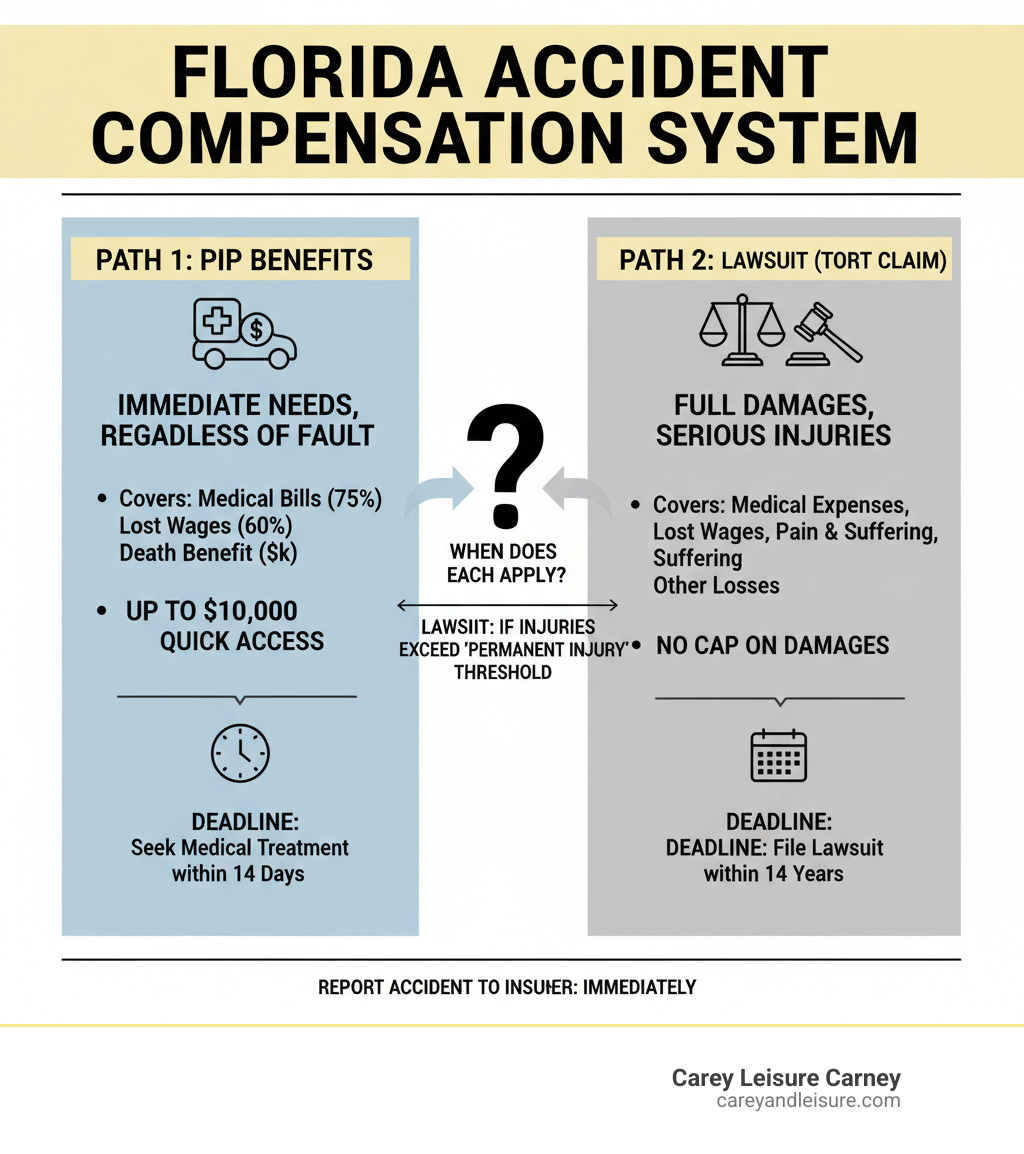
Compensation after accident follows two main paths in Florida. Knowing which applies to your situation is crucial for getting the money you deserve for medical bills, lost wages, and pain and suffering. Understanding your options helps you take the right steps quickly.
Here are the primary ways to get compensation after an accident in Florida:
- Personal Injury Protection (PIP) Claims – Your own insurance pays up to $10,000 regardless of who caused the crash.
- Lawsuit Against At-Fault Driver – You can sue for full damages if your injuries are serious enough.
- Uninsured Motorist Claims – Your own coverage protects you when the other driver has no insurance.
Key deadlines you must know:
- Seek medical treatment within 14 days to keep PIP benefits.
- File a lawsuit within 2 years of the accident date.
- Report the accident to insurance companies immediately.
The compensation process can feel overwhelming. Insurance companies may offer quick settlements that seem appealing but rarely cover your full losses. Understanding what you’re entitled to makes the difference between getting by and getting the compensation that truly covers your needs.
As Thomas W. Carey, a board-certified civil trial lawyer who has guided over 40,000 injury cases across Florida, I’ve seen how knowledge about compensation after accident claims transforms outcomes. My experience securing multi-million-dollar results shows that accident victims who understand their rights from the start are far more likely to receive fair compensation.
Understanding Your Immediate Rights: Florida’s No-Fault System and PIP Benefits
Florida’s “no-fault” system is designed to get you help faster after a car accident. Regardless of who caused the crash, your own insurance company provides immediate coverage through Personal Injury Protection (PIP). This system exists because determining fault can take months, but your medical bills won’t wait.
Every driver in Florida must carry PIP insurance. This mandatory coverage creates a safety net for everyone on the road. For a complete breakdown, our guide on What is PIP Insurance Florida? has more details.
A critical deadline trips up many accident victims: you have exactly 14 days from the accident to seek medical treatment. If you miss this deadline, you could lose your PIP benefits entirely. This rule ensures people get prompt medical care and helps verify that injuries are accident-related.
So what does PIP cover for your compensation after accident?
- 80% of your medical expenses, including ER visits, X-rays, and physical therapy.
- 60% of your lost wages if your injuries keep you from working.
- $5,000 in death benefits in the case of a fatal accident.
The standard PIP coverage limit is $10,000. A single ER visit can cost thousands, so serious injuries can exhaust this amount quickly. This is why PIP is just the starting point for compensation after accident; it covers immediate needs while you explore other options for full recovery.
When you file a PIP claim, you’ll work directly with your own insurance company, which is faster than waiting for the at-fault driver’s insurer to accept responsibility. For official details on Florida’s insurance rules, see the information at More on Florida insurance requirements. Understanding these rules helps protect your benefits.
Pursuing Full Compensation After an Accident: Filing a Lawsuit
When the $10,000 PIP limit isn’t enough to cover your losses, Florida law allows you to pursue compensation after accident through a lawsuit against the at-fault driver.

To file a lawsuit, your injuries must meet the serious injury threshold, meaning you’ve suffered a permanent injury, significant scarring, or permanent loss of a bodily function. If so, you can pursue full compensation. While PIP is a band-aid, a lawsuit seeks to make you whole again. When we pursue Personal Injury Claims, we hold the negligent party accountable for all damages.
Damages fall into three categories: economic, non-economic, and (rarely) punitive.
Economic Damages (Special Damages)
These are your tangible, calculable financial losses. They include:
- Past and future medical expenses: All costs from the ambulance ride to future surgeries and therapy.
- Lost income and earning capacity: Compensation for missed paychecks and any reduction in your future ability to earn.
- Property damage: The cost to repair or replace your vehicle, including its Compensation for Diminished Car Value After Accident in Florida.
- Out-of-pocket costs: Expenses like rental cars, medical equipment, and even household help if you can no longer perform daily tasks.
Non-Economic Damages (General Damages)
These intangible losses compensate for the impact on your quality of life.
- Compensation for Pain and Suffering in Florida: Covers physical pain and emotional distress like anxiety or PTSD.
- Loss of enjoyment of life: For hobbies and activities you can no longer do.
- Permanent disability, scarring, and disfigurement: Compensation for fundamental, long-term changes to your life and appearance.
Good news: Florida generally has no cap on compensatory damages (economic and non-economic) in personal injury cases, recognizing that severe injuries deserve substantial compensation.
Punitive Damages
Punitive damages are rare and intended to punish the at-fault party for gross negligence or intentional misconduct, such as drunk driving. The Legal definition of damages explains their purpose is to punish wrongdoers. While there’s a high burden of proof and statutory caps in Florida, the possibility can encourage better settlement offers. Most cases, however, focus on securing full economic and non-economic damages.
The Essential Steps in the Accident Compensation Claims Process
The moments after an accident are chaotic, but having a clear plan protects your rights and maximizes your compensation after accident. Following these essential steps can make or break your claim:
- Ensure safety and call 911 immediately.
- Gather information and evidence at the scene.
- Seek medical attention within Florida’s 14-day window.
- Notify your insurance company to start your PIP claim.
- Consult a personal injury lawyer before speaking to other insurers.
- Follow all medical advice and keep detailed records.
What to Do Immediately After the Crash
The first few minutes are critical.
- Prioritize Safety and Call 911: Check for injuries and move vehicles if safe. Always call 911 to get a police report and medical attention. Adrenaline can mask serious injuries.
- Exchange Information: Get the other driver’s name, contact info, and insurance details. Be polite but stick to the facts.
- Document Everything: Use your phone to take photos and videos of the scene, vehicle damage, skid marks, and your injuries.
- Talk to Witnesses: Get contact information from any witnesses. Their unbiased account is invaluable.
- Never Admit Fault: Avoid saying “I’m sorry” or anything that could be used against you. Let the investigation determine fault.
For a complete checklist, see our guide: What to Do After a Car Accident.
What Is the Process for Getting Compensation After an Accident?
After the immediate aftermath, the claims process begins.
- Start Your PIP Claim: Notify your own insurer immediately. This is how Florida’s no-fault system works.
- Meet Critical Deadlines: You must get medical treatment within 14 days to keep your PIP benefits. You also have a two-year statute of limitations to file a personal injury lawsuit. Acting quickly is vital as evidence disappears and memories fade.
- File the Claim: If your injuries are severe, you’ll pursue a claim against the at-fault driver’s insurer. This involves complex paperwork and negotiations, which an attorney can manage while you recover.
Gathering Critical Evidence for Your Claim
A strong claim is built on solid evidence. Insurance companies require proof for everything.
- Police Report: Provides an official, objective account of the accident.
- Medical Records: Documents the full extent of your injuries, treatment, and recovery, proving their connection to the accident.
- Proof of Lost Wages: Employment records confirm income lost due to your injuries.
- Photos and Videos: Visual evidence from the scene and of your injuries tells a powerful story.
- Witness Statements: Independent accounts that can resolve disputes about fault.
- Expert Reports: Specialists like accident reconstructionists or medical experts can provide crucial testimony in complex cases.
Understanding the different Types of Car Accident Injuries helps ensure you document all effects. Building this evidence foundation is key to demanding fair compensation after accident.
Key Factors That Influence Your Settlement Amount
Every case is unique, but the amount of compensation after accident you can expect depends on several key factors.

- Injury Severity: This is the most significant factor. A spinal cord injury will result in a much higher settlement than a minor sprain.
- Total Economic Losses: The sum of your medical bills, lost wages, and future care costs forms the foundation of your claim’s value.
- Strength of Evidence: Clear proof, like a police report and witness statements, strengthens your case and leads to better offers.
- Insurance Policy Limits: The at-fault driver’s coverage can cap your recovery, making your own Uninsured Motorist coverage critical.
- Comparative Negligence: Your compensation can be reduced if you are found partially at fault.
How Florida’s Comparative Fault Rule Affects Your Claim
Florida’s “modified comparative negligence” rule can dramatically impact your compensation after accident. If you are found partially at fault, your settlement is reduced by your percentage of fault. For example, if you have $100,000 in damages but are found 20% at fault, you can only recover $80,000.
Crucially, the 51% bar to recovery means if you are found 51% or more responsible, you are barred from collecting anything from the other driver. Insurance companies aggressively use this rule to blame victims. We work to gather evidence immediately to prove the other driver was primarily responsible.
Dealing with Uninsured or Underinsured Drivers
With nearly one in four Florida drivers being uninsured, getting compensation after accident can be challenging. Your own Uninsured/Underinsured Motorist (UM/UIM) coverage is your lifeline. This optional coverage pays for your damages when the at-fault driver has no insurance (UM) or not enough insurance (UIM). In some cases, policy stacking allows you to combine UM/UIM limits from multiple vehicles, increasing your available coverage.
The Role of a Lawyer in Maximizing Your Settlement
Insurance companies are businesses focused on minimizing payouts. As our guide on Why You Need a Personal Injury Lawyer explains, professional legal help levels the playing field. An experienced lawyer will:
- Calculate all damages, including future medical costs and lost earning potential.
- Hire experts (medical, vocational, accident reconstruction) to build a strong case.
- Negotiate effectively with insurance adjusters who are trained to lowball you.
- Fight unfair claim denials and, if necessary, file bad faith claims.
- Take your case to court if a fair settlement cannot be reached. Our trial-ready approach often encourages better offers.
Frequently Asked Questions about Accident Compensation in Florida
Here are answers to the most common questions we hear from clients seeking compensation after accident in Florida.
How is pain and suffering calculated in Florida?
There is no exact formula for calculating pain and suffering. Attorneys and insurers typically use two methods:
- The Multiplier Method: Your total economic damages (medical bills, lost wages) are multiplied by a number, usually between 1.5 and 5. The multiplier depends on the severity and permanence of your injuries.
- The Per Diem Method: A daily dollar amount is assigned for each day you suffer from the accident until you reach maximum recovery.
A jury uses its discretion to determine a fair amount based on the severity of your injuries, the impact on your life, and your emotional distress. We present powerful evidence to help them understand the full extent of your suffering.
How long do I have to file a car accident claim in Florida?
This deadline is critical. In Florida, you generally have two years from the accident date to file a personal injury lawsuit. This is known as the statute of limitations.
While two years seems long, it passes quickly. Evidence can be lost and memories fade, so it is vital to act quickly to preserve your rights. There are very limited exceptions to this rule. Contacting an attorney early is the best way to build a strong case for your compensation after accident.
What if the insurance company denies my claim?
A claim denial is not the end of the road. Insurers often deny valid claims for reasons like liability disputes, claims of pre-existing conditions, or late reporting.
- Review the Denial: The first step is to carefully review the insurer’s reason for denial.
- Appeal the Decision: We can appeal by gathering more evidence and presenting legal arguments to counter the denial.
- File a Bad Faith Claim: If an insurer denies a valid claim without proper justification, we can file a separate lawsuit against them for acting in bad faith.
Challenging an unfair denial is complex, but it is often necessary to get the compensation after accident you deserve.
Conclusion
Navigating the process for compensation after accident in Florida involves two main paths: immediate PIP benefits and a lawsuit for serious injuries. To protect your claim, remember these key takeaways:
- Act Fast: Seek medical care within 14 days to protect your PIP benefits.
- Know Your Deadline: You have two years to file a personal injury lawsuit.
- Document Everything: Evidence from day one is crucial for your settlement.
Insurance companies have teams of lawyers working to minimize your payout. At Carey Leisure Carney, our Board-Certified attorneys—representing the top 2% in Florida—have over 100 years of combined experience fighting for accident victims. We know how to counter their tactics and build a case for the maximum compensation you deserve.
When you work with us, you get direct access to your attorney. We take the time to understand how the accident has affected your life because compensation after accident is about more than just bills—it’s about getting your life back. Don’t face the insurance companies alone. Level the playing field.
Contact our experienced personal injury attorneys today for a free consultation.