

Claiming Justice: Your Guide to Dependency Claims Under the FAA
When Someone You Depended On Dies: Understanding Your Legal Rights
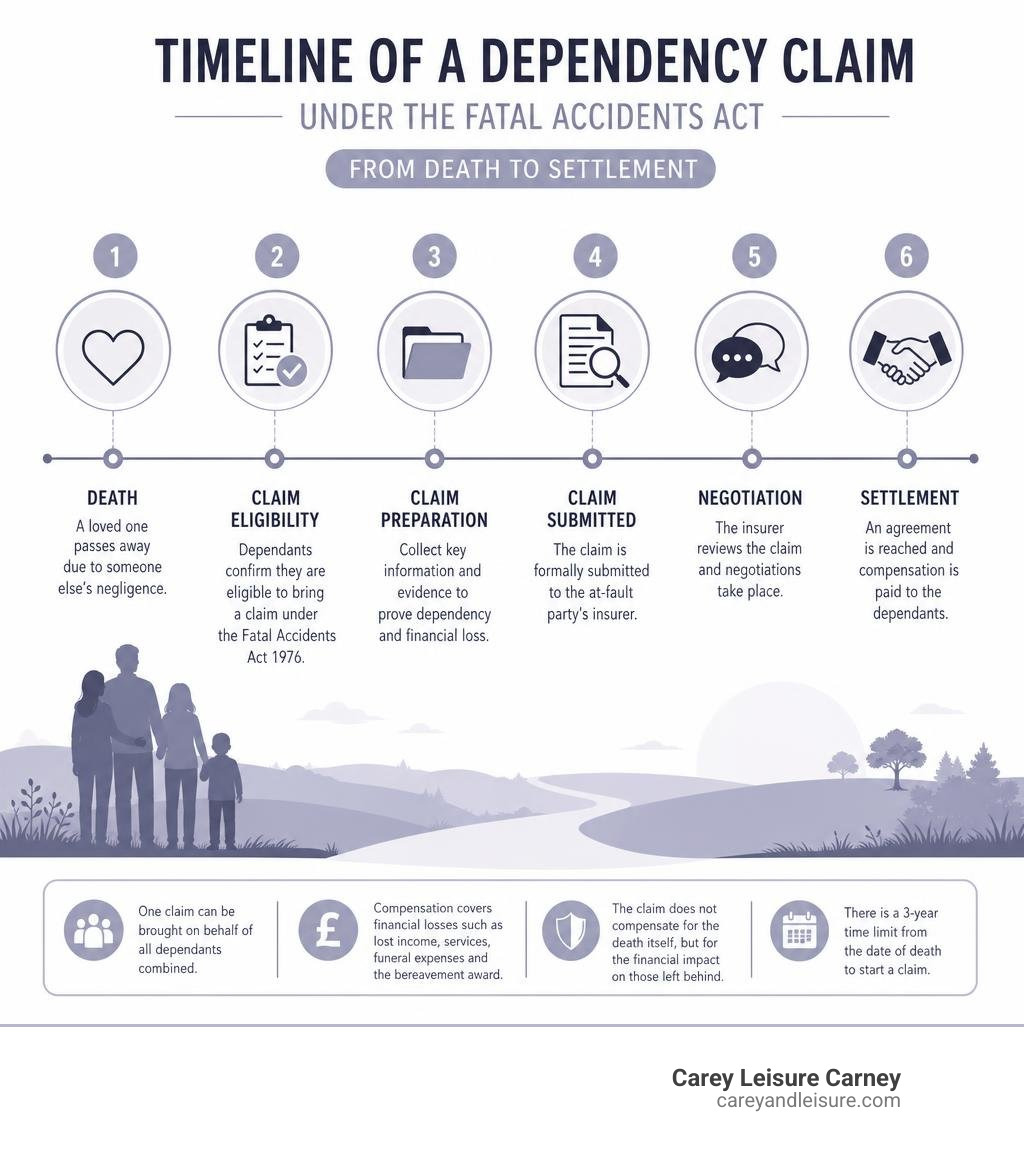
A dependency claim fatal accidents act provision gives surviving family members the legal right to seek compensation when a loved one is killed due to someone else’s negligence. If you’ve just lost a family member and are wondering whether you have a claim, here’s the short answer:
Who can make a dependency claim?
- Spouses and civil partners
- Cohabiting partners (living together for at least 2 years before the death)
- Children (including stepchildren treated as children of the family)
- Parents
- Other close relatives who can show financial dependency
What can be claimed?
- Lost financial support (income the deceased would have provided)
- Loss of services (childcare, household tasks, DIY, caregiving)
- A fixed bereavement award of £15,120 (for qualifying claimants)
- Funeral expenses
Key rule: Only one claim can be brought on behalf of all dependants combined.
The claim does not compensate for the death itself — it compensates the people left behind for the real financial losses they now face.
Losing someone is devastating enough. Facing financial hardship on top of that grief — because that person was also the one paying the bills, raising the children, or keeping the household running — makes an already impossible situation even harder. The Fatal Accidents Act 1976 exists specifically for this situation. It gives dependants a legal route to recover what they’ve lost. But navigating that route without guidance is rarely straightforward.
I’m Thomas W. Carey, founding partner of Carey Leisure Carney and a board-certified civil trial lawyer with decades of experience handling wrongful death and dependency claim fatal accidents act matters across Florida. Having personally lost my wife to a drunk driver, I understand this area of law not just professionally, but deeply personally.
Glossary for dependency claim fatal accidents act:
The Legal Framework: What is a Dependency Claim Fatal Accidents Act Provision?
When a fatal accident occurs due to negligence, the legal aftermath operates under two primary, distinct statutory frameworks: the Law Reform (Miscellaneous Provisions) Act 1934 and the Fatal Accidents Act 1976. Understanding the difference between these two is critical for any family seeking justice.
Essentially, the Law Reform (Miscellaneous Provisions) Act 1934 allows the deceased’s estate to bring a claim for losses suffered by the deceased themselves before they passed away. This includes compensation for pain, suffering, loss of amenity, and any financial losses (like medical bills or lost wages) incurred between the date of the accident and the date of death.
Conversely, a dependency claim fatal accidents act action is brought specifically for the benefit of the living people who relied on the deceased. It does not look backward at the deceased’s pain; instead, it looks forward at the financial void left in the lives of the survivors.
To successfully recover compensation, claimants must satisfy the elements of negligence:
- Duty of Care: Establishing that the defendant owed the deceased a duty to keep them safe (such as a motorist’s duty to other road users, or an employer’s duty to workers).
- Breach: Showing that the defendant failed to meet the standard of a reasonable person.
- Causation: Proving that this breach directly caused the fatal accident.
- Actionability: Proving that if the deceased had survived, they would have been legally entitled to maintain an action and recover damages themselves. This fundamental rule is established under Establishing liability under the FAA.
For a complete look at the underlying legislation, you can review the full Fatal Accidents Act 1976 Statute.
Establishing Eligibility for a Dependency Claim Fatal Accidents Act Action
The law does not allow just anyone to claim dependency. The Fatal Accidents Act 1976 contains a strictly defined, closed list of eligible dependants. Under Fatal Accidents Act 1976 Section 1, the classes of people who may qualify include:
- The surviving spouse or civil partner (including former spouses or civil partners).
- Any person who was living with the deceased as husband, wife, or civil partner for at least two years immediately prior to the death.
- Any parent or other ascendant of the deceased, or anyone treated by the deceased as a parent.
- Any child or other descendant of the deceased, or any person treated by the deceased as a child of the family (such as stepchildren).
- Siblings, aunts, uncles, and their respective children.
To successfully secure damages, simply being on this list is not enough. An eligible relative must also prove a “reasonable expectation of pecuniary advantage” — meaning they must show a realistic, substantial chance that they would have received financial support or practical services from the deceased had the death not occurred.
Calculating Damages in a Dependency Claim Fatal Accidents Act Claim
Calculating dependency damages is a highly technical exercise. The courts utilize a structured method to project what the deceased would have earned and contributed to their household over their remaining working life. Under Fatal Accidents Act 1976 Section 3, the calculation relies on two primary components: the multiplicand and the multiplier.
- The Multiplicand: This is the annual value of the dependency. It represents the net annual financial support or value of services that the deceased would have provided to their dependants.
- The Multiplier: This is the figure by which the multiplicand is multiplied to reflect the number of years the dependency would have lasted. Multipliers are calculated using the actuarial Ogden Tables, which take into account life expectancy, retirement age, and economic factors.
Historically, multipliers were calculated from the date of the deceased’s death. However, the landmark Supreme Court ruling in Knauer v Ministry of Justice changed this approach. Today, past losses (from the date of death to the date of the trial or settlement) are calculated separately as a fixed sum. The multiplier is then applied only to future losses starting from the date of the trial, ensuring a fairer, more accurate assessment of the true financial loss.
Types of Losses and How They Are Calculated
When pursuing a dependency claim fatal accidents act case, we break down the compensation into distinct “heads of loss” to ensure every angle of the family’s deprivation is covered.

1. Financial Dependency
This is the loss of cold, hard cash that would have flowed into the household. It is based on the deceased’s net earnings, pension contributions, and other income.
Rather than demanding that grieving families produce grocery receipts from years prior to prove exactly how much the deceased spent on themselves, the courts apply standard, conventional percentage deductions to the joint household income:
- Couples with no dependent children: The court assumes a conventional deduction of 33% (one-third) of the deceased’s net income for their personal spending. The surviving partner’s financial dependency is therefore calculated at 66% (two-thirds) of the deceased’s income.
- Families with dependent children: The conventional deduction for personal spending is reduced to 25% (one-quarter), leaving a 75% (three-quarters) financial dependency for the surviving family.
For example, if a deceased parent earned £40,000 net annually and left behind a spouse and two children, the court would apply a 25% deduction for the deceased’s personal maintenance. The annual financial dependency (multiplicand) for the family would be £30,000.
2. Loss of Services Dependency
A household is run on more than just paychecks. The practical services the deceased performed are often incredibly expensive to replace. We can claim for the loss of services such as:
- Childcare and parenting (driving kids to school, homework help, cooking).
- Housework, laundry, and cleaning.
- DIY home maintenance, gardening, and vehicle repairs.
The value of these services is typically quantified using the commercial cost of hiring professional replacements (e.g., professional nannies, gardeners, or handymen) or by assessing the earnings a surviving relative had to give up to take over these chores.
3. The Bereavement Award
This is a statutory, flat-rate award designed to acknowledge the profound grief of losing a close family member. Under the Damages for Bereavement (Variation of Sum) (England and Wales) Order 2020, the bereavement award is fixed at £15,120 for deaths occurring on or after May 1, 2020.
Only a very narrow class of people can claim this award:
- The surviving spouse or civil partner.
- Cohabiting partners of more than two years.
- The parents of an unmarried minor child.
If more than one person qualifies (for example, both parents of a deceased child), the £15,120 is split equally between them.
4. Funeral Expenses
Reasonable funeral costs, including the cost of a headstone, are fully recoverable under the Act, provided they are paid for by the dependants or the estate.
Statutory Protections: Disregard of Benefits
A vital element of the Fatal Accidents Act 1976 (specifically Section 4) is that any benefits accruing to the dependants as a result of the death are completely disregarded. This means that life insurance payouts, pensions, and inherited property cannot be deducted by the defense to reduce the value of your dependency claim. The law ensures that prudent financial planning by the deceased does not let the negligent party off the hook.
For more information on structuring these claims, see our guide on Fatal Accident Claims.
Key Differences: UK Fatal Accidents Act vs. Florida Wrongful Death Law
Because Carey Leisure Carney is a premier personal injury firm serving Florida, we frequently assist clients who are comparing legal frameworks or dealing with tragic accidents that cross international boundaries. It is highly valuable to understand how the UK’s Fatal Accidents Act 1976 contrasts with the Florida Wrongful Death Act (Fla. Stat. §§ 768.16-768.26).
| Feature | UK Fatal Accidents Act 1976 | Florida Wrongful Death Act |
|---|---|---|
| Who Files the Lawsuit? | The executor/administrator of the estate, or any dependant directly if no action is taken within 6 months. | Only the Personal Representative of the estate can file the lawsuit. |
| Who Recovers Damages? | Strictly defined dependants who can prove financial/service reliance. | Survivors (spouse, children, parents, and dependent blood relatives). |
| Bereavement / Pain & Suffering | A fixed, statutory flat-rate award of £15,120 (highly restricted eligibility). | No arbitrary cap on mental pain and suffering damages for close survivors (except in specific medical malpractice scenarios). |
| Remarriage Impact | s.3(3) explicitly mandates that a widow’s remarriage or prospects of remarriage must be disregarded. | Remarriage of a surviving spouse is admissible and can impact future loss of support/companionship claims. |
| Statute of Limitations | Generally 3 years from the date of death or date of knowledge. | Generally 2 years from the date of death. |
In Florida, the law is designed to consolidate all claims into one action managed by the Personal Representative. While the UK relies heavily on rigid, conventional percentages (like the 33% or 25% rules) to calculate financial loss, Florida courts look broadly at the actual value of lost support and services, alongside highly significant jury awards for emotional pain and suffering.
To explore the Florida system in depth, read our Wrongful Death Attorney Florida Complete Guide and our resource on dealing with a Fatality Car Accident Resulting in Death.
Local Legal Support in Florida
If your family has suffered a fatal loss in Florida, navigating the probate court to appoint a Personal Representative while simultaneously fighting insurance companies is an overwhelming burden.
At Carey Leisure Carney, we provide compassionate, aggressive representation across our local Florida communities. Our board-certified attorneys can help you coordinate your civil claim and secure the maximum recovery possible in:
- Wrongful Death Lawyer Largo FL
- Wrongful Death Lawyer St. Petersburg FL
- Clearwater
- New Port Richey
- Spring Hill
- Trinity
- Wesley Chapel
Frequently Asked Questions About Dependency Claims
Who can claim a bereavement award and how much is it?
The bereavement award is a fixed statutory lump sum of £15,120 (for deaths occurring after May 1, 2020). It can only be claimed by a surviving spouse, civil partner, a cohabiting partner of over two years, or the parents of an unmarried deceased minor. If both parents claim, the award is split equally (£7,560 each).
How does contributory negligence affect a dependency claim?
Under Section 5 of the Fatal Accidents Act 1976 (and under comparative fault rules in Florida), if the deceased was partially at fault for the accident that caused their death, the dependency damages will be reduced by that same percentage. For example, if a jury or court determines the deceased was 30% responsible for a fatal car crash, the total compensation awarded to the dependants will be reduced by 30%.
What is the limitation period for filing a claim?
Under UK law, the limitation period for a fatal accident claim is three years from either the date of death or the “date of knowledge” of the negligence. In Florida, the statute of limitations is stricter: you generally have only two years from the date of death to file a wrongful death lawsuit. Failing to file within these windows will permanently bar your family from seeking recovery.
Conclusion
A dependency claim fatal accidents act action is a vital shield against financial ruin for families who have lost their primary breadwinner or caregiver. Whether you are navigating the structured calculations of the UK statute or dealing with a tragic loss right here in Florida, you do not have to carry this heavy burden alone.
At Carey Leisure Carney, we treat our clients like family because we know exactly what it feels like to sit in your chair. With over 100 years of combined experience and board-certified trial specialists (an honor held by only the top 2% of attorneys in Florida), we provide direct attorney access and personalized, unwavering support. We operate on a No Win, No Fee basis, meaning you pay nothing unless we secure justice for you.
If you are ready to discuss your options, contact our Personal Injury Attorney / Wrongful Death Attorney team today for a free, confidential consultation.