
A Complete Guide to Florida Wrongful Death Claims
What Florida Wrongful Death Law Means for Your Family
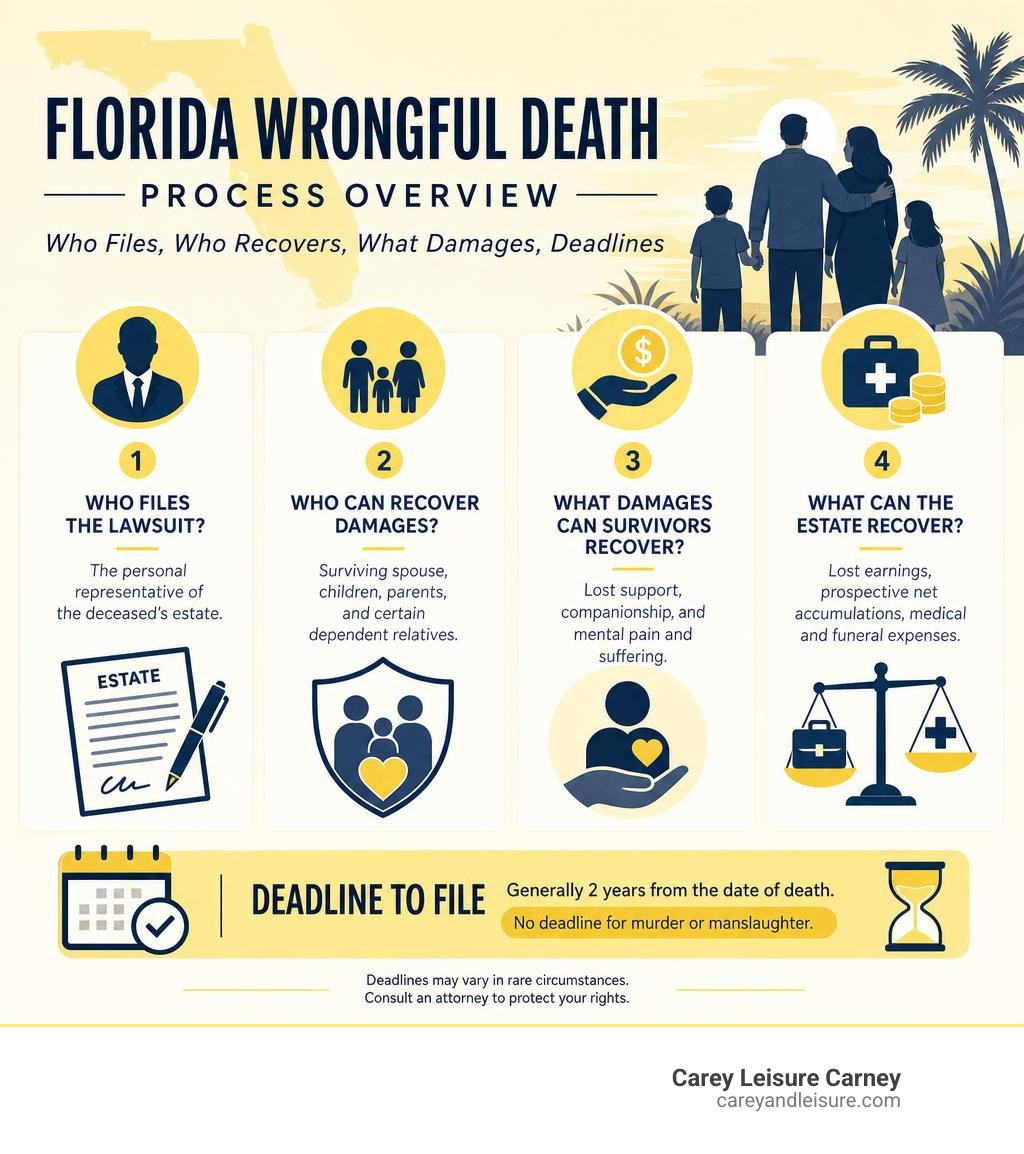
Florida wrongful death law gives families the right to seek civil compensation when a loved one is killed due to someone else’s negligence, recklessness, or intentional misconduct. Here is a quick overview of how it works:
| Key Question | Quick Answer |
|---|---|
| What qualifies as wrongful death? | Death caused by negligence, intentional acts, medical malpractice, defective products, or breach of contract |
| Who files the lawsuit? | The personal representative of the deceased’s estate |
| Who can recover damages? | Surviving spouse, children, parents, and certain dependent relatives |
| What can survivors recover? | Lost support, companionship, and mental pain and suffering |
| What can the estate recover? | Lost earnings, prospective net accumulations, medical and funeral expenses |
| Filing deadline? | Generally 2 years from the date of death (no deadline for murder or manslaughter) |
Losing a family member is devastating enough on its own. When that loss is caused by someone else’s wrongdoing, the grief is compounded by anger, confusion, and financial pressure. Florida law provides a path forward — but the rules are complex, the deadlines are strict, and the legal process can feel overwhelming when you are already at your lowest.
This guide walks you through everything you need to know about bringing a wrongful death claim in Florida — from who can file, to what damages are available, to the special limitations that apply in medical malpractice cases.
I am Thomas W. Carey, founding partner of Carey Leisure Carney and a board-certified civil trial lawyer who has handled thousands of Florida wrongful death and personal injury matters since 1988, including cases born from the most painful circumstances imaginable. My goal here is to give you clear, honest answers so you know exactly where you stand.
Basic florida wrongful death terms:
Legal Framework for a Florida Wrongful Death Action
Navigating the aftermath of a fatal accident requires a firm grasp of state statutes. The core rules governing these claims are codified in the Florida Wrongful Death Act (Florida Statutes §§ 768.16–768.26). This legal framework exists to shift the financial burdens caused by a premature death from the innocent surviving family members onto the negligent party who caused the harm.
When an injured person dies as a result of a wrongful act, Florida law handles the situation differently than a standard personal injury claim. Under Florida law, an existing personal injury lawsuit does not survive the victim’s death if the injury itself caused the death. Instead, the pending action abates, and the claim must be converted into a single, unified civil action governed by Florida Statute 768.20 Parties. For a deep dive into how these claims unfold, explore our Florida Wrongful Death Attorney Complete Guide.
Statutory Definition of Florida Wrongful Death Claims
Under Fla. Stat. § 768.19, a wrongful death action arises whenever the death of a person is caused by the wrongful act, negligence, default, or breach of contract or warranty of another party. This broad legal definition encompasses a wide range of tragic incidents throughout Clearwater, St. Petersburg, Largo, and surrounding Tampa Bay communities, including:
- Motor vehicle collisions, trucking crashes, and fatal motorcycle accidents.
- Pedestrian and bicycle accidents caused by reckless or distracted drivers.
- Medical malpractice, surgical errors, or medication mistakes.
- Dangerous property conditions leading to fatal slips, trips, or swimming pool drownings.
- Defective household products, automotive components, or dangerous machinery.
- Intentional acts of violent crime, assault, murder, or manslaughter.
If the deceased person (legally referred to as the decedent) would have had the right to file a personal injury lawsuit had they survived, their estate retains the right to bring a claim. Working with experienced Lawyers for Wrongful Death ensures that the foundational elements of liability, causation, and breach of duty are thoroughly proven.
Role of Personal Representative in Estate Litigation
One of the most distinct aspects of florida wrongful death litigation is who brings the case to court. Unlike many states where individual family members can file separate lawsuits, Florida requires one consolidated lawsuit filed by a single individual: the decedent’s Personal Representative.
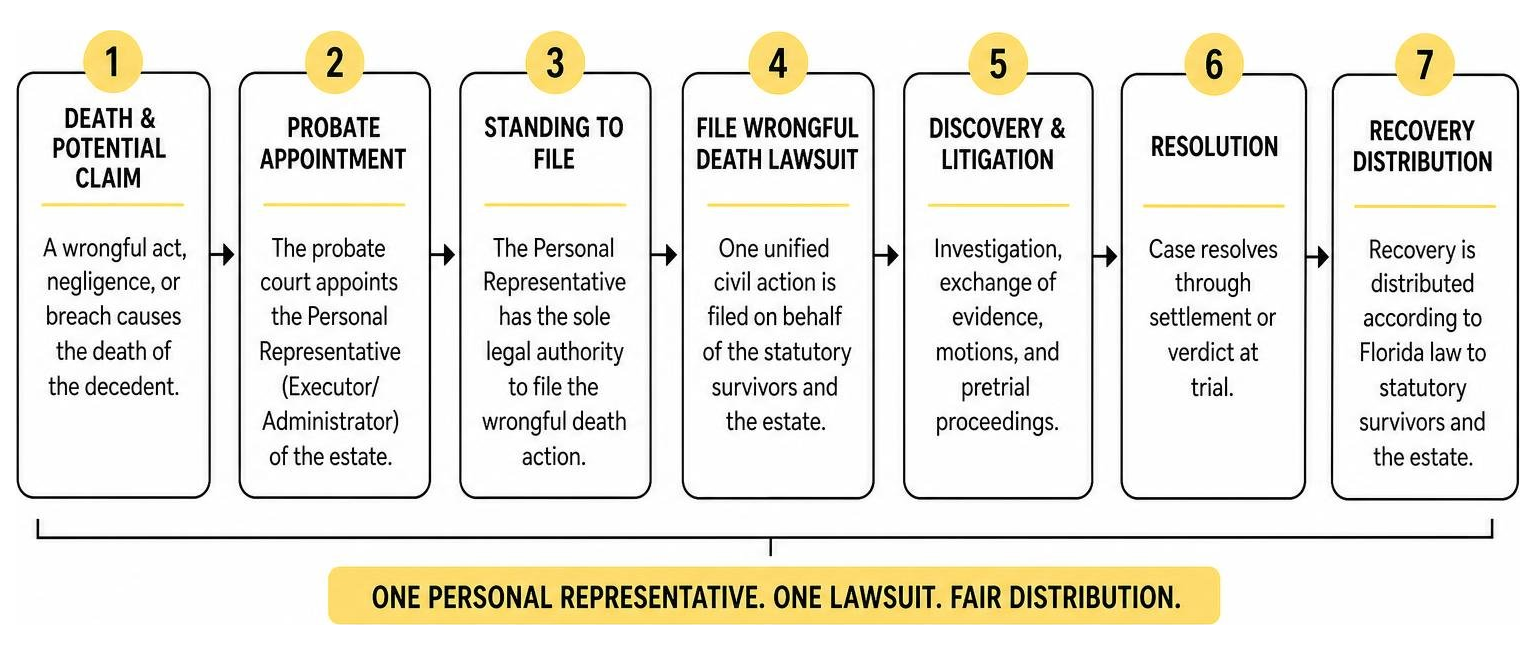
The Personal Representative (often called the executor or administrator of the estate) is formalised through the probate court. If the decedent left a valid will, it usually names this representative; if no will exists, the probate court appoints an eligible relative or administrator. The Personal Representative acts as a legal fiduciary, carrying the sole legal standing to initiate the lawsuit on behalf of two distinct groups:
- The Statutory Survivors: Eligible family members who suffered direct loss.
- The Estate: The financial entity representing the deceased person’s remaining legal rights.
This unified lawsuit structure prevents multiple family members from filing competing actions in court, ensuring all potential recovery is calculated, litigated, and distributed fairly through one organized proceeding.
Survivor Eligibility and Compensation Distribution
Florida law explicitly dictates who is considered a statutory survivor and what specific compensation each person may claim. Under Fla. Stat. § 768.18, eligible survivors include:
- The surviving spouse.
- Minor children (defined under Florida wrongful death law as children under the age of 25, regardless of marital status).
- Adult children (ages 25 and older), when there is no surviving spouse.
- Parents of a deceased minor child, or parents of a deceased adult child if there are no other statutory survivors.
- Blood relatives or adoptive siblings who were dependent on the decedent for support or services.
Survivor Damages Versus Estate Damages
Compensation in a florida wrongful death case is strictly bifurcated into survivor damages and estate damages. Understanding these distinct statutory classifications is critical when projecting total financial values under Chapter 768 Section 21 – 2025 Florida Statutes and filing Fatal Accident Claims.
| Damage Category | Recoverable Items | Eligible Claimants |
|---|---|---|
| Survivor Damages | Value of lost support and services (past & future reduced to present value) | All statutory survivors (spouse, children, dependent relatives) |
| Loss of companionship, protection, and mental pain and suffering | Surviving spouse | |
| Lost parental companionship, instruction, guidance, and mental suffering | Minor children (and all children if no surviving spouse exists) | |
| Mental pain and suffering for loss of child | Parents of minor children (or parents of adult children if no other survivors) | |
| Direct reimbursement for paid medical or funeral expenses | The specific survivor who paid the bills | |
| Estate Damages | Loss of earnings from date of injury to date of death | The Estate |
| Prospective net accumulations (lost future savings/investments) | The Estate (if surviving spouse or lineal descendants exist) | |
| Unpaid medical charges and funeral expenses charged against estate | The Estate |
For family members seeking further detail on how financial damages are structured, read The ABCs of Fatal Accident Compensation Claims.
It is worth noting a unique rule in Florida statutory law: if both spouses die within 30 days of each other as a result of the same wrongful act, Florida treats each spouse as having predeceased the other when determining the recovery rights of surviving minor children. Furthermore, Florida law explicitly allows evidence of a surviving spouse’s remarriage to be introduced during trial when evaluating future emotional and financial losses.
Distribution of Settlements and Probate Creditor Claims
When a settlement or jury verdict is reached, the distribution of funds follows strict probate guidelines designed to protect surviving family members.
One of the greatest protections under the Florida Wrongful Death Act is that funds awarded directly to statutory survivors for non-economic losses (such as mental pain and suffering or loss of companionship) belong solely to those individual survivors. These awards are legally protected and cannot be seized by probate creditors to pay off the decedent’s outstanding credit cards, personal loans, or medical debts.
Conversely, any monies awarded directly to the decedent’s estate — such as net accumulations, lost wages before death, or estate-reimbursed medical expenses — become probate assets. Consequently, estate recoveries are subject to valid, timely claims submitted by medical providers and probate creditors in compliance with Florida probate law.
Statutory Filing Deadlines and Comparative Negligence
Time is critical following a fatal accident. In addition to securing physical evidence and preserving testimony, families must remain vigilant regarding legal deadlines and statutory rules governing comparative fault.

Statute of Limitations in a Florida Wrongful Death Lawsuit
Under Fla. Stat. § 95.11(4)(d), the standard statute of limitations for filing a florida wrongful death lawsuit is two years from the date of the decedent’s death. Missing this strict statutory deadline almost always results in a permanent loss of the legal right to seek financial recovery.
There are, however, critical statutory exceptions to this rule:
- Murder or Manslaughter: If the death resulted from murder or manslaughter, there is no statute of limitations. A wrongful death suit may be brought at any time, even if the perpetrator was never arrested, charged, or criminally convicted.
- Tolling Provisions: Deadlines may be paused or extended in rare circumstances involving fraud, intentional concealment, or active identity concealment by the wrongdoer.
Because building a compelling civil claim requires thorough investigation, consulting a lawyer as early as possible ensures crucial evidence is preserved. Review the Wrongful Death Claims in Florida Legal Guide for additional insights on timing considerations.
Impact of Modified Comparative Negligence
In March 2023, Florida updated its negligence framework by adopting a modified comparative fault standard under Fla. Stat. § 768.81. This rule directly impacts wrongful death actions arising from traffic collisions, premises accidents, or personal injury incidents occurring in Spring Hill, Trinity, Wesley Chapel, and across the state.
Under Florida’s modified comparative fault rule:
- Proportional Reduction: If the decedent was partially at fault for the incident (for instance, speed contributed to a fatal crash caused by an oncoming driver turning left), the total financial damages awarded to the survivors and estate are reduced by the exact percentage of fault assigned to the decedent.
- The 51% Fault Bar: If the decedent is determined to be more than 50% at fault for the crash or injury, the estate and surviving family members are completely barred from recovering any financial compensation from the defendant in ordinary negligence cases.
Insurance companies frequently exploit this law, attempting to blame the deceased victim who can no longer speak for themselves. Countering these tactics requires prompt reconstruction of the event using crash investigators, accident reconstruction engineers, and eyewitness testimony.
Medical Malpractice Restrictions and the Free Death Gap
While Florida’s wrongful death framework provides robust recovery rights in most accident claims, medical negligence cases are governed by far more restrictive rules.
Understanding the Free Death Gap
Under Fla. Stat. § 768.21(8), Florida law carves out an explicit exception for wrongful death claims resulting from medical malpractice. Specifically, subsection (8) dictates that:
- Adult children (ages 25 and older) cannot recover mental pain and suffering damages if their parent dies due to medical negligence.
- Parents of an adult child (ages 25 and older) cannot recover mental pain and suffering damages if their adult child dies due to medical negligence.
This statutory restriction creates what attorneys and policy advocates call the “Free Death” gap. If an unmarried adult over the age of 25 with no minor children dies as a result of medical malpractice, no statutory survivor exists under Florida law who is legally eligible to claim non-economic pain and suffering damages. Because economic losses in such cases may be minimal, negligent medical providers and hospitals often escape significant civil liability altogether.
Understanding these nuances is essential before pursuing medical negligence claims. Learn more about navigating complex injury actions in our Best Wrongful Death Attorney Guide.
Special Pre-Suit Investigation Requirements
In addition to damage restrictions, medical malpractice wrongful death actions must comply with strict statutory pre-suit procedures set forth in Florida Statutes Chapter 766. Before a lawsuit can even be filed in court, the Personal Representative must:
- Conduct an extensive preliminary investigation to gather all hospital and medical records.
- Obtain a verified written medical expert opinion affidavit from a qualified physician confirming that medical negligence occurred and caused the death.
- Serve a formal Notice of Intent to Initiate Litigation on all potential medical defendants.
- Participate in a mandatory 90-day pre-suit discovery and settlement evaluation period.
These extensive requirements make early legal review imperative when medical error is suspected.
Frequently Asked Questions About Florida Wrongful Death Claims
Who is eligible to file a wrongful death lawsuit in Florida?
In Florida, individual family members do not file separate lawsuits. Under Fla. Stat. § 768.20, only the decedent’s designated Personal Representative has legal standing to file the wrongful death action. The Personal Representative brings one unified lawsuit on behalf of all statutory survivors (surviving spouse, minor children, dependent adult children, parents, and dependent blood relatives) as well as the decedent’s estate.
What is the deadline to file a wrongful death lawsuit in Florida?
The general statute of limitations for a florida wrongful death lawsuit is two years from the exact date of death pursuant to Fla. Stat. § 95.11(4)(d). However, if the death was caused by murder or manslaughter, there is no statute of limitations deadline at all. If the claim involves a government entity, sovereign immunity notice periods may impose additional early deadlines.
Can adult children recover pain and suffering in medical malpractice claims?
No. Under Florida Statute § 768.21(8), adult children who are 25 years of age or older are legally prohibited from recovering damages for mental pain and suffering or lost parental companionship if their parent’s death was caused by medical negligence. Adult children can only recover non-economic damages in medical malpractice cases if there is no surviving spouse and the child was under age 25 at the time of death.
Conclusion
Losing a loved one due to someone else’s negligence alters your family’s life forever. While no financial settlement can ever replace a cherished family member, pursuing a civil claim under florida wrongful death law provides vital financial security, covers overwhelming medical and funeral costs, and holds accountable parties responsible for their actions.
Because Florida enforces complex procedural steps, tight statutory deadlines, and nuanced comparative fault rules, having dedicated legal support makes all the difference. At Carey Leisure Carney, our board-certified civil trial attorneys represent less than the top 2% of Florida lawyers. With over 100 years of combined legal experience serving families across Clearwater, St. Petersburg, Largo, New Port Richey, Spring Hill, Trinity, and Wesley Chapel, we provide direct attorney access and personalized, compassionate guidance every step of the way.
If you have lost a loved one in a fatal crash, slip and fall, or negligent incident, contact us today to discuss your rights. You can also visit our page to Contact a Clearwater Pedestrian Accident Attorney to learn more about how we fight for grieving families.