
Pedestrian Accident Fault: The Role of Experts in Your Case
When a Pedestrian Gets Hit: Who Is Actually at Fault?
Pedestrian accident fault is rarely as simple as “the driver is always to blame.” Here’s a quick breakdown of how fault typically works:
- Driver at fault: Speeding, distracted driving, failing to yield, or running a red light
- Pedestrian at fault: Jaywalking, crossing against a signal, darting into traffic, or walking while distracted
- Shared fault: Both parties acted carelessly – very common in real cases
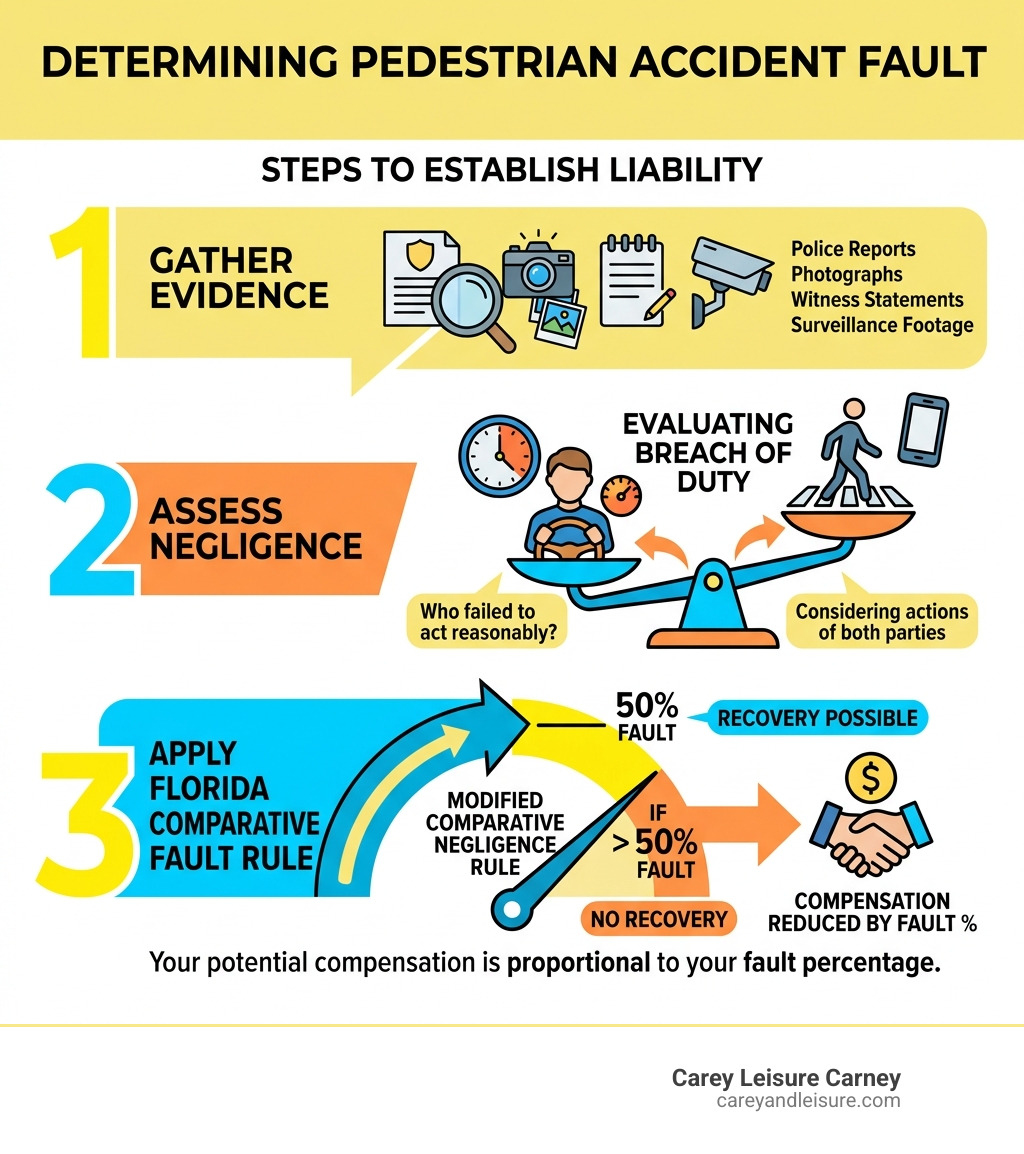
- Florida rule: Under modified comparative negligence, you can still recover damages if you are 50% or less at fault – but your compensation is reduced by your percentage of fault
So even if you made a mistake, you may still have a valid claim.
Every year, thousands of pedestrians across Florida are seriously hurt in collisions with vehicles. Nationally, around 76,000 pedestrians are injured annually, and over 6,000 lose their lives, according to the National Highway Traffic Safety Administration. The Tampa Bay area – including Clearwater – is one of the most dangerous regions in the country for people on foot.
What makes these cases legally complex is that both the driver and the pedestrian have a legal duty to act reasonably. When something goes wrong, figuring out who breached that duty – and by how much – can determine whether you walk away with full compensation, partial compensation, or nothing at all.
That’s where experts come in.
Accident reconstructionists, medical professionals, and experienced personal injury attorneys all play a critical role in untangling what really happened and who bears responsibility. Understanding how pedestrian accident fault is determined can mean the difference between a fair settlement and a denied claim.
I’m Thomas W. Carey, founding partner of Carey Leisure Carney and a board-certified civil trial lawyer with over 35 years of experience handling complex personal injury cases – including pedestrian accident fault disputes – across Clearwater, Pinellas County, and throughout Florida. In this guide, I’ll walk you through exactly how fault is established, how Florida law affects your recovery, and what steps give your case the strongest possible foundation.
Pedestrian accident fault terms made easy:
Understanding Pedestrian Accident Fault in Florida
When we talk about pedestrian accident fault in Florida, we are looking at a specific set of rules defined by Florida Statutes. Many people assume that pedestrians always have the “right-of-way.” While Florida law offers significant protection to those on foot, it isn’t an absolute shield. Both drivers and pedestrians owe a “duty of care” to others on the road.
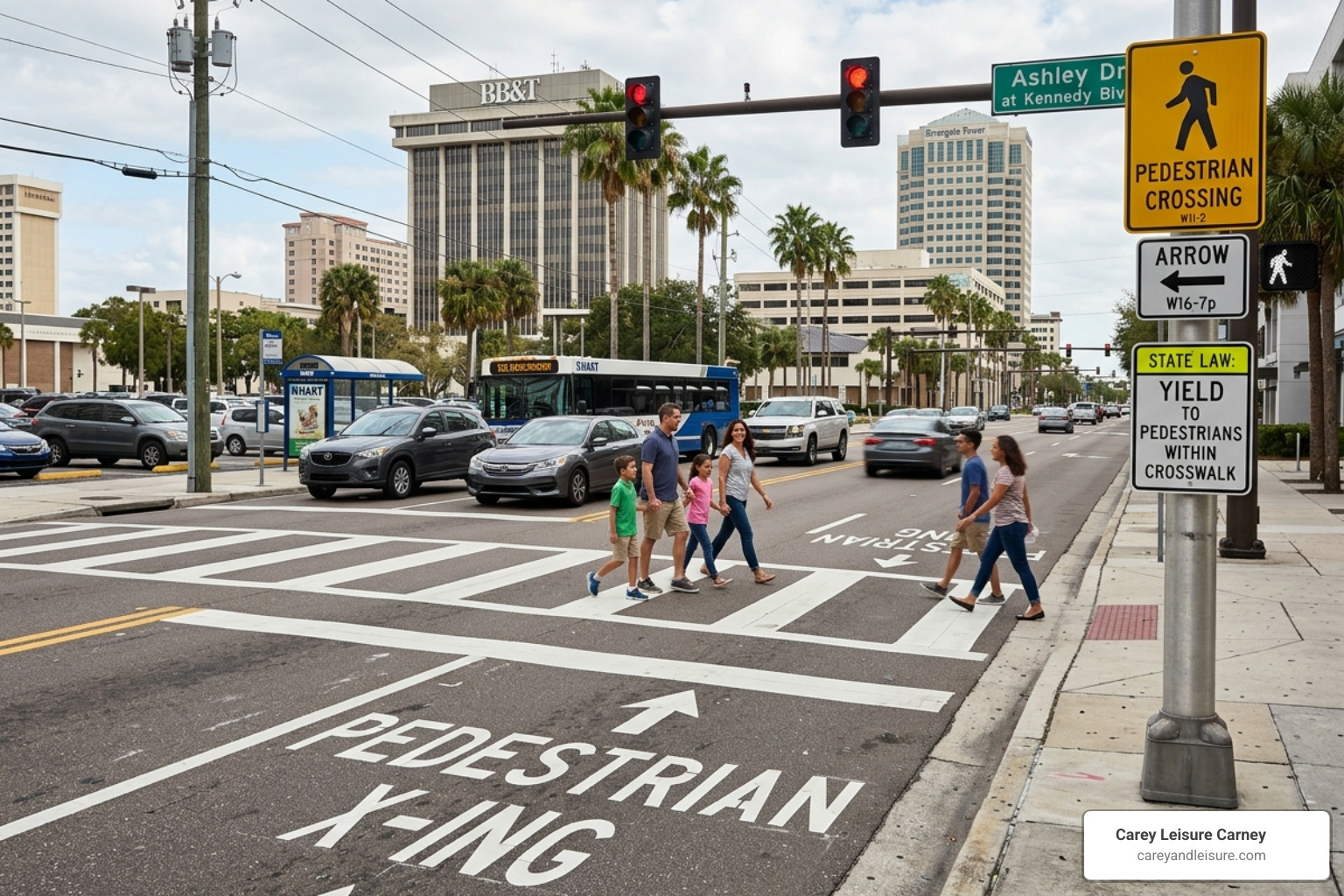
In cities like Clearwater and St. Petersburg, traffic is heavy, and the interaction between cars and walkers is constant. Under Florida law, drivers must exercise “due care” to avoid colliding with any pedestrian. This is especially true when children or obviously confused or incapacitated persons are involved. However, pedestrians also have responsibilities, such as following traffic control signals and using crosswalks when available.
To understand how liability is divided, we look at who failed in their duty. If a driver was texting and didn’t see you in a marked crosswalk, they have clearly breached their duty. But if you stepped out from behind a parked car in the middle of a block without looking, a jury might find that you also breached your duty. Navigating these rules requires a deep dive into our Florida Pedestrian Laws Complete Guide.
Driver Negligence and Pedestrian Accident Fault
Driver negligence is the most common cause of these accidents. In our decades of experience in Largo and New Port Richey, we’ve seen that most drivers simply aren’t looking for pedestrians. Common forms of negligence include:
- Speeding: This reduces the driver’s reaction time and increases the severity of the impact. An extra 10 mph can be the difference between a few bruises and a fatality.
- Distracted Driving: Whether it’s a phone, a GPS, or a sandwich, anything that takes a driver’s eyes off the road is a recipe for disaster.
- Failure to Yield: Drivers often “roll” through right turns on red without checking for pedestrians crossing from the right.
- Driving Under the Influence: Alcohol and drugs impair judgment, coordination, and reaction speed.
- Inattentional Blindness: This is a fascinating (and terrifying) psychological phenomenon where a driver “looks” at a pedestrian but their brain doesn’t “see” them because they are focused on looking for other cars.
When a driver is negligent, they are often primarily responsible for the pedestrian accident fault. You can learn more about your legal standing in these scenarios by reading Navigating The Aftermath Pedestrian Accident Attorneys Explain Your Rights.
When a Pedestrian Shares Pedestrian Accident Fault
It’s a tough pill to swallow, but sometimes the pedestrian is partially or even fully at fault. Insurance companies love to point the finger at the victim to save money. Common scenarios where a pedestrian might share fault include:
- Jaywalking: Crossing the street outside of a marked or unmarked crosswalk between two signalized intersections.
- Darting into Traffic: Stepping into the road so suddenly that a driver, even one following all laws, cannot reasonably stop in time.
- Distracted Walking: We’ve all seen it – someone staring at their phone, wearing noise-canceling headphones, walking right into the path of a vehicle.
- Crossing Against Signals: Entering the crosswalk when the “Don’t Walk” sign is flashing or the light is green for cross-traffic.
- Nighttime Visibility: Walking at night in dark clothing in poorly lit areas of Spring Hill or Trinity can make it nearly impossible for a driver to see you until it’s too late. Statistics show that roughly 72% of pedestrian fatalities occur after dark.
How Experts and Evidence Determine Liability
Proving pedestrian accident fault isn’t just about your word against the driver’s. It’s about building a mountain of evidence that makes the truth undeniable. In the immediate aftermath, we look at police reports, witness statements, and any available surveillance footage from nearby businesses in Wesley Chapel or Clearwater.
However, the “big guns” in these cases are the experts. We often employ:
- Forensic Experts: To analyze blood patterns or clothing fibers.
- Vehicle Data Recorder (Black Box) Technicians: To see exactly how fast the car was going and when the brakes were applied.
- Medical Experts: To explain how the injuries occurred and what they say about the angle and speed of the impact.
If you’ve been hit, there are specific Steps To Take After Being A Pedestrian Accident Victim to preserve this evidence.
| Type of Evidence | What It Proves | Why It Matters |
|---|---|---|
| Police Report | Officer’s initial assessment | Often the “baseline” for insurance companies |
| Surveillance Video | Real-time visual of the crash | Eliminates “he said/she said” disputes |
| Skid Marks | Braking distance and speed | Shows if the driver was speeding or didn’t brake |
| Cell Phone Records | Driver usage at time of impact | Proves distracted driving |
| Witness Testimony | Independent accounts | Provides context and corroboration |
The Role of Accident Reconstruction in Pedestrian Accident Fault
Accident reconstruction is a specialized field of engineering. These experts use the laws of physics to “reverse engineer” the crash. They look at the final resting positions of the pedestrian and the car, the damage to the vehicle, and the “throw distance” (how far the pedestrian was tossed).
By analyzing sightlines, they can determine if a driver should have seen the pedestrian. They might conduct a “sightline study” at the same time of day and in similar lighting conditions to prove that the driver’s claim of “they came out of nowhere” is physically impossible. This level of detail is vital when moving From Sidewalk To Settlement Navigating Your Pedestrian Injury Claim.
Recovering Damages Under Florida’s Comparative Negligence Laws
Florida recently moved to a modified comparative negligence system. This is a huge change that every resident of Pinellas and Pasco County needs to understand.
Previously, Florida was a “pure” comparative negligence state, meaning you could be 99% at fault and still recover 1% of your damages. That is no longer the case.
Under the new 50 percent bar, if you are found to be more than 50% at fault for the accident, you are barred from recovering any damages from the other party. If you are 50% or less at fault, you can still recover, but your check will be smaller. For example, if your total damages (medical bills, lost wages, pain and suffering) are $100,000, but you are found 30% at fault for jaywalking, you will receive $70,000.
This makes the fight over every percentage point of pedestrian accident fault incredibly high-stakes. Our goal as your attorneys is to use expert testimony to keep your fault percentage as low as possible. You can read more about the nuances of a Florida Pedestrian Accident claim on our site.
Insurance Systems and Pedestrian Claims
Florida is a “no-fault” state, which sounds confusing when we are discussing fault. This primarily refers to Personal Injury Protection (PIP).
- PIP Benefits: If you own a car in Florida, your own PIP insurance usually covers the first $10,000 of your medical bills and lost wages, even if you were 100% at fault for being hit while walking.
- Third-Party Liability: To get compensation beyond that $10,000 (for things like “pain and suffering” or bills exceeding PIP), you must prove the driver was at fault. This is where the driver’s bodily injury liability coverage comes in.
- Uninsured Motorist (UM) Coverage: If the driver who hit you has no insurance (which is common in Florida) or flees the scene, your own UM coverage can step in to pay your claim.
Understanding these layers is a key part of our Pedestrian Accident Attorney Ultimate Guide.
Frequently Asked Questions about Pedestrian Accident Fault
Can I recover damages if I was jaywalking in Clearwater?
Yes, you potentially can. Jaywalking does not automatically strip you of your right to compensation. While jaywalking might mean you share some of the pedestrian accident fault, the driver still has a duty to avoid hitting you if they reasonably can. If the driver was speeding or looking at their phone, their negligence might be considered greater than yours. We often help clients in this situation by hiring experts to prove the driver had plenty of time to stop. Check out our guide on Beyond The Crosswalk When To Hire A Niche Pedestrian Accident Attorney.
What happens if both the driver and I share fault?
As mentioned, Florida uses the 50% rule. If the jury decides you were 25% at fault and the driver was 75% at fault, your total award is simply reduced by 25%. However, if the split is 51/49 against you, you receive nothing. This is why having an attorney who knows how to present evidence to a jury is so critical.
When should I contact a Clearwater pedestrian accident attorney?
Immediately. The statute of limitations for personal injury in Florida is now two years from the date of the accident (it was recently shortened from four). More importantly, evidence disappears quickly. Skid marks wash away in the Florida rain, and surveillance footage is often erased after 48 to 72 hours. To protect your claim, Dont Walk Away Secure Your Pedestrian Accident Lawyer Near You as soon as you are medically stable.
Conclusion
Determining pedestrian accident fault is a high-stakes game of physics, law, and investigation. In the Tampa Bay area, where the roads are busy and the stakes are life-altering, you cannot afford to leave your recovery to chance.
At Carey Leisure Carney, we bring over a century of combined experience to the table. We aren’t just lawyers; we are board-certified specialists who understand the “detective work” required to win. When you call us, you get direct access to an attorney who will walk you through every step of the process—from the initial investigation to the final settlement or jury verdict.
We serve clients across Clearwater, Largo, New Port Richey, Spring Hill, St. Petersburg, Trinity, and Wesley Chapel. If you or a loved one has been injured, don’t let the insurance companies dictate your future. Secure your expert legal representation today and let us fight for the justice you deserve.