

Pain and Suffering After a Car Accident: Your Guide to Fair Compensation
What is Pain and Suffering in a Florida Car Accident?
Compensation for pain and suffering after a car accident is money you can recover for the physical and emotional harm caused by your injuries — on top of your medical bills and lost wages.
Here’s a quick overview of how it works:
| Question | Quick Answer |
|---|---|
| What is it? | Money for physical pain, emotional distress, and reduced quality of life |
| How is it calculated? | Multiplier method (1.5x–5x medical bills) or per diem method (daily rate × days suffering) |
| Average range | ~$15,000–$30,000, but can reach $300,000+ for serious injuries |
| Is it taxable? | Generally no |
| Do you need a lawyer? | Yes — especially for serious injuries |
After a crash, your medical bills have a number on them. Your pain does not. That’s what makes these claims so hard — and so easy for insurance companies to undervalue.
Pain and suffering covers a wide range of real harm: the throbbing in your back every morning, the anxiety you feel getting behind the wheel, the sleep you’ve lost, and the hobbies you can no longer enjoy. None of it shows up in a receipt. But all of it counts.
Insurance adjusters know this. They often start with a low offer, betting you don’t know what your claim is really worth.
This guide will show you exactly how pain and suffering is calculated, what evidence you need, and how to protect your right to fair compensation in Florida.
I’m Thomas W. Carey, founding partner of Carey Leisure Carney and a board-certified civil trial lawyer with over 35 years handling personal injury cases across Florida — including countless claims for compensation for pain and suffering after a car accident. After personally experiencing the devastation a negligent driver can cause, I’ve dedicated my career to making sure injured people understand their rights and receive what they truly deserve.
Learn more about compensation for pain and suffering after a car accident:
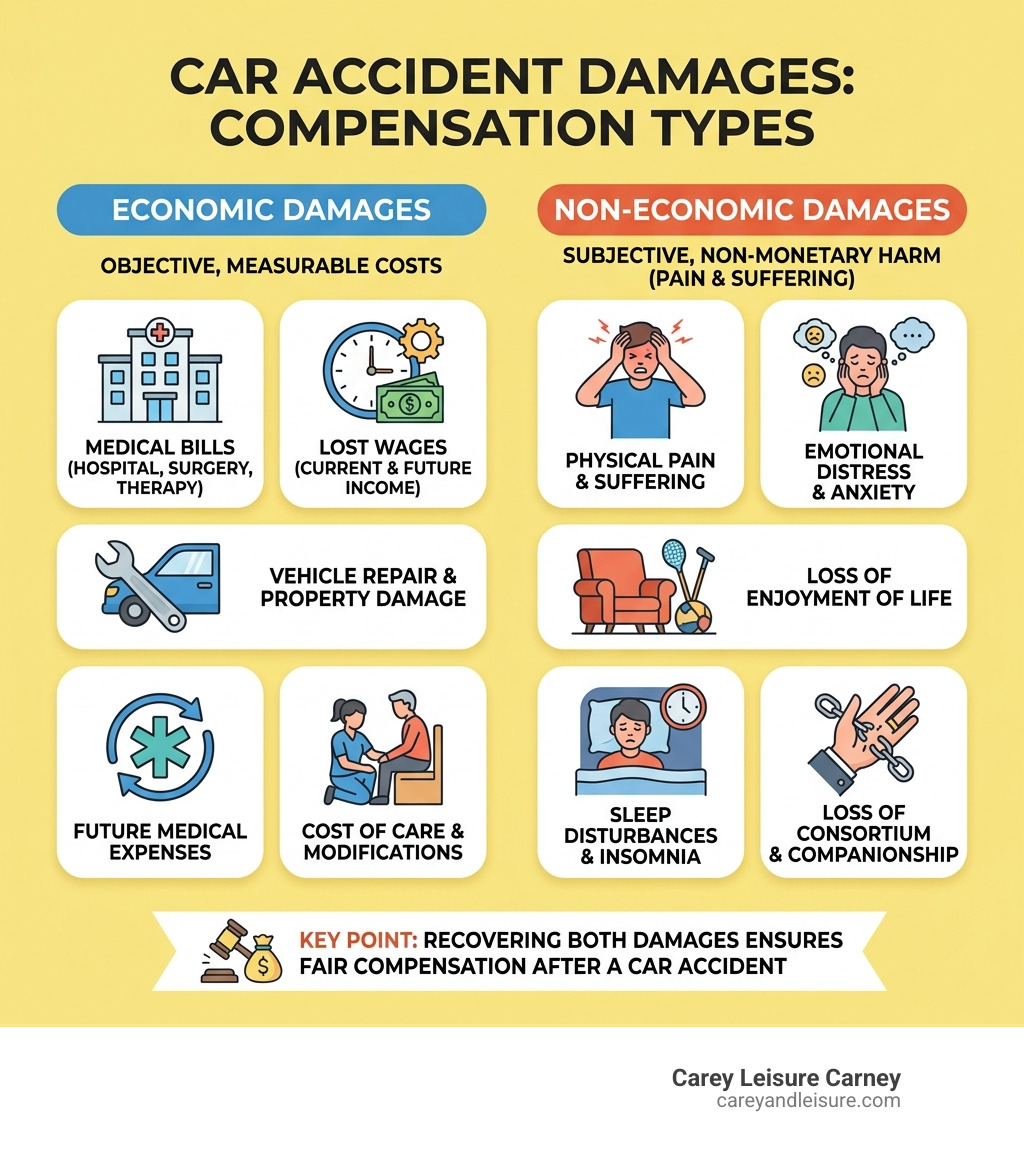
When we talk about compensation for pain and suffering after a car accident, we are referring to “non-economic damages.” Unlike a hospital bill or a car repair estimate, these damages don’t have a fixed price tag. They represent the human cost of the accident.
In Florida, pain and suffering is generally split into two categories:
Physical Pain and Suffering
This is the actual physical discomfort you feel because of your injuries. It includes the immediate pain of the crash, the discomfort of surgeries, and the ongoing ache of chronic conditions. Whether it’s navigating back pain compensation after a car accident a comprehensive guide or dealing with the sharp stabs of nerve damage, this category covers the “hurt” factor.
Mental and Emotional Pain and Suffering
The impact of a crash isn’t just skin deep. Many of our clients in Clearwater and St. Petersburg suffer from significant emotional distress. This includes:
- Anxiety and PTSD: Feeling terrified when a car merges near you or having flashbacks to the sound of crunching metal.
- Depression: Feeling a loss of hope because you can no longer work or take care of your family. You can read more about psychological trauma payouts understanding compensation for depression after an accident to see how these are valued.
- Loss of Enjoyment of Life: If you loved weekend fishing in New Port Richey but can no longer stand on a boat due to a spinal injury, that is a compensable loss.
- Loss of Consortium: This refers to the impact the injury has on your relationship with your spouse, including loss of companionship and intimacy.
According to Car Accident Pain and Suffering Damages, these damages are subjective and vary wildly from person to person. Two people could have the exact same broken arm, but one might be a professional pianist whose entire life is upended, while the other is a retired office worker. Their pain and suffering awards should reflect those different realities.
How to Calculate Compensation for Pain and Suffering After a Car Accident
Insurance companies don’t just pull a number out of a hat (though it sometimes feels that way). They usually use one of two primary methods to start the negotiation. However, we often find that their software, like the infamous “Colossus,” fails to account for the unique human elements of a case.
Here is how the two most common methods compare:
| Feature | Multiplier Method | Per Diem Method |
|---|---|---|
| Logic | Multiplies economic losses by a factor of 1.5 to 5 | Assigns a daily dollar value for your suffering |
| Best For | Serious, long-term, or permanent injuries | Short-term recoveries with a clear end date |
| Calculation | (Medical Bills + Lost Wages) × Multiplier | Daily Rate × Number of Days to Recover |
| Flexibility | Highly dependent on the “multiplier” chosen | Often based on your actual daily earnings |
To get a better idea of what your specific situation might be worth, check out our guide on what is my personal injury case worth. You can also find more technical details on How to Calculate Car Accident Pain And Suffering.
Using the Multiplier Method for Compensation for Pain and Suffering After a Car Accident
The multiplier method is the most common way to calculate compensation for pain and suffering after a car accident. We take your “special damages” (medical bills and lost wages) and multiply them by a number between 1.5 and 5.
- 1.5 Multiplier: Usually applied to minor injuries, like soft tissue strains or “whiplash,” where you recover fully within a few weeks.
- 3 Multiplier: Often used for broken bones or injuries requiring surgery.
- 5 Multiplier: Reserved for catastrophic injuries, such as traumatic brain injuries, paralysis, or permanent scarring.
For example, if you have $20,000 in medical bills and $10,000 in lost wages, your economic damages are $30,000. If your injury is severe enough to warrant a multiplier of 3, your pain and suffering would be valued at $90,000, bringing your total claim to $120,000.
Applying the Per Diem Method for Compensation for Pain and Suffering After a Car Accident
“Per diem” is Latin for “by the day.” This method assigns a specific dollar amount to every day you live with pain. A common way to determine the daily rate is to use your actual daily earnings. The logic is that living with the pain of an injury is at least as much “work” as your actual job.
If you earn $200 a day and it takes you 100 days to reach Maximum Medical Improvement (MMI), your per diem calculation would be $20,000. This method is often easier to explain to a jury in places like Wesley Chapel or Largo because it feels grounded in reality.
Essential Evidence to Maximize Your Settlement
In our 100+ years of combined experience, we’ve learned that the insurance company isn’t going to take your word for it. They need proof. Because pain is invisible, we have to make it visible through documentation.
To maximize your compensation for pain and suffering after a car accident, we help you gather:
- Medical Records and Doctor Notes: These are the foundation. If you tell your doctor, “My back hurts so much I can’t sleep,” and they write it down, that is evidence.
- Prescription Records: Taking heavy-duty painkillers or anti-anxiety meds proves the severity of your physical and mental distress.
- Mental Health Records: Bills from psychologists or counselors are vital for proving emotional anguish.
- Witness Statements: We often talk to your neighbors in Trinity or coworkers in Spring Hill. If they can testify that you used to be the life of the party but now rarely leave the house, that carries a lot of weight.
- Photos and Videos: Pictures of your injuries immediately after the crash, or video of you struggling to perform daily tasks, provide a powerful visual for the adjuster.
For a deeper dive into proving specific types of injuries, see from concussion to compensation navigating mild traumatic brain injury settlements.
How to Document Your Pain Effectively
One of the best things you can do for your case is to keep a “Pain Journal.” We recommend our clients do this daily. Here is how to make it effective:
- Use a 1-10 Scale: Be consistent. If a 10 is “emergency room pain,” where are you today?
- Note Activity Restrictions: Don’t just say “it hurts.” Say, “I couldn’t pick up my toddler today,” or “I had to stop halfway through grocery shopping because of a muscle spasm.”
- Record Emotional Setbacks: Did you have a panic attack while driving? Did you feel a surge of frustration because you couldn’t get dressed without help? Write it down.
- Mention Medication Side Effects: If your meds make you drowsy, nauseated, or unable to focus, that is part of your suffering.
Navigating Florida’s No-Fault Laws and Limitations
Florida is a “no-fault” state, which adds a layer of complexity to getting compensation for pain and suffering after a car accident.
Every driver in Florida is required to carry Personal Injury Protection (PIP). This insurance pays 80% of your medical bills and 60% of your lost wages, up to a $10,000 limit, regardless of who caused the crash. Crucially, PIP does not pay for pain and suffering.
To step outside of the no-fault system and sue the at-fault driver for pain and suffering, you must meet the “permanent injury threshold” under Florida Statute 627.737. This means your injury must involve:
- Significant and permanent loss of an important bodily function.
- Permanent injury within a reasonable degree of medical probability.
- Significant and permanent scarring or disfigurement.
- Death.
We specialize in helping clients prove they meet this threshold. You can find more details on compensation for pain and suffering in florida what you need to know.
Can I Get Compensation for Pain and Suffering After a Minor Car Accident?
Yes, it is possible, but it is much harder. Even a “minor” fender bender can cause lasting whiplash or chronic headaches. However, without a permanent injury diagnosis, you may be limited to what your PIP covers. This is why it is vital to see a doctor immediately. What feels like a minor ache today could be a herniated disc that plagues you for years.
If you are in Florida, you should also be aware of car accident compensation florida and how our state’s specific laws impact your recovery.
Frequently Asked Questions About Pain and Suffering
What is the average settlement for pain and suffering in car accidents?
There is no “true” average because every case is so different. However, statistics show that many pain and suffering settlements fall between $15,000 and $30,000. For catastrophic cases involving permanent disability, that number can easily climb into the hundreds of thousands or even millions. You can see some of our past results at personal injury settlement examples.
Is pain and suffering compensation taxable?
Generally, no. The IRS considers settlements for physical injuries and the emotional distress that flows from those injuries to be non-taxable. However, if you receive “punitive damages” (money meant to punish the other driver for extreme recklessness), those are taxable. Always consult with a tax professional regarding your specific settlement.
How long does it typically take to receive a settlement for pain and suffering?
Most car accident cases settle within 6 to 9 months after you have finished your medical treatment. We usually advise against settling too early. If you settle while you are still in pain, you might not realize the full extent of your future suffering, and once you sign that release, you can’t go back for more.
For more tips on speeding up the process without sacrificing value, read how to get the most compensation from a car accident settlement in florida.
Conclusion
At Carey Leisure Carney, we know that compensation for pain and suffering after a car accident is about more than just money—it’s about justice. It’s about acknowledging that your life has changed and ensuring you have the resources to move forward.
As a firm with Board-Certified attorneys (a distinction held by only the top 2% of lawyers in Florida), we bring a level of expertise that insurance companies respect. We offer direct attorney access, meaning you won’t be passed off to a paralegal. Whether you are in Clearwater, St. Petersburg, or New Port Richey, we are here to provide the personalized service you deserve.
If you’ve been injured, don’t let an insurance company tell you what your pain is worth. Let us fight for you. Contact a personal injury attorney at Carey Leisure Carney today for a free consultation.