
A Guide to Torts Law and Premises Liability
Understanding Torts Law After an Injury
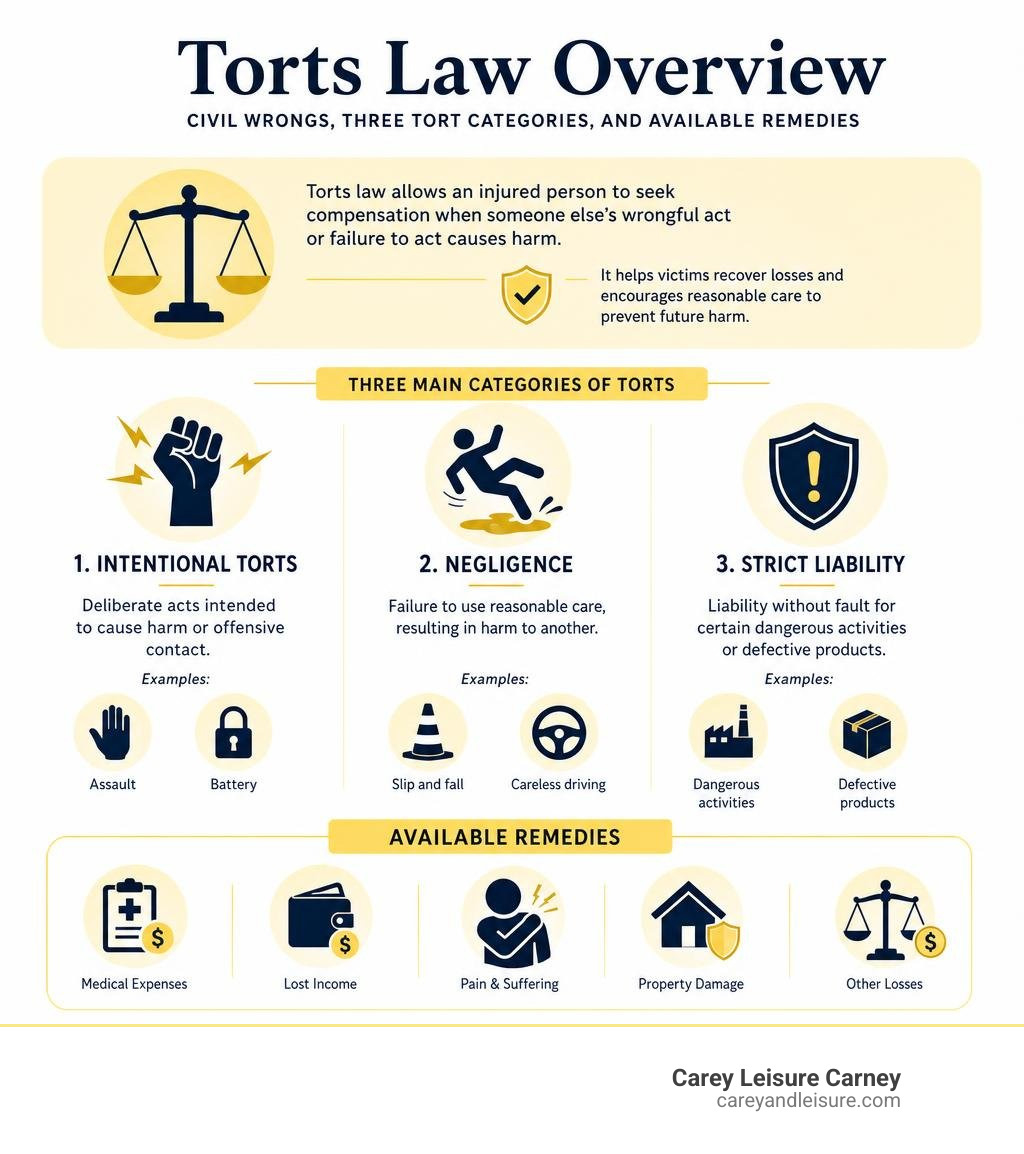
Torts law is the area of civil law that lets an injured person seek a legal remedy when someone else’s wrongful act or failure to act causes harm. In simple terms, it covers personal injuries and losses caused by intentional conduct, carelessness, or certain dangerous activities and defective products.
The basic goal is to help an injured person recover losses such as medical bills, lost income, and pain and suffering. Torts law also encourages people, businesses, and property owners to act with reasonable care so preventable injuries are less likely to happen.
| Key point | Quick answer |
|---|---|
| What is a tort? | A civil wrong that causes a legal injury or harm. |
| What does torts law do? | It provides a way for injured people to seek compensation and holds wrongdoers accountable. |
| Main types of torts | Intentional torts, negligence, and strict liability. |
| Common example | A slip and fall caused by an unsafe condition on someone else’s property may involve premises liability and negligence. |
For someone dealing with an accident or the loss of a loved one, these rules can feel distant from the immediate problems of treatment, bills, work, and grief. This guide explains the basic ideas behind torts law and premises liability in clear terms, including when a property owner or another party may have a duty to prevent harm.
I am Thomas W. Carey, founding partner of Carey Leisure Carney and a board-certified civil trial lawyer who has handled or overseen roughly 40,000 Florida injury matters since 1988. My work in torts law includes motor-vehicle crashes, medical malpractice, premises liability, wrongful death, and other claims involving serious injuries caused by negligence.
Fundamentals of Torts Law and System Distinctions
At its heart, torts law is concerned with civil wrongs—acts or omissions that invade a legally protected right and result in harm to another person. Unlike criminal prosecutions, which are brought by government authorities on behalf of the public, tort claims are private lawsuits initiated by the injured party (the plaintiff) against the party responsible for the injury (the defendant).
The framework governing tort cases in Florida and across the United States relies heavily on traditional common law precedent developed by court decisions over decades, alongside specific state statutory rules. Legal scholars and courts frequently look to authoritative legal standards, such as the Restatement of Torts compiled by the American Law Institute, to guide how duty, standard of care, and legal liability are defined. Understanding these foundations is a critical first step when reviewing Lawsuit Basics and evaluating an injury claim. As detailed by the tort | Legal Information Institute, a tort exists whenever a legal right has been violated and the legal system provides a civil monetary or injunctive remedy.
It is important to note the legal distinction between an “injury” and “harm.” In the legal sense, an injury refers to the invasion or violation of a legally recognized right (such as your right to physical integrity or property safety), whereas harm refers to the actual tangible loss or detriment suffered (such as physical pain, emotional trauma, or financial losses).
Essential Aims and Foundations of Torts Law
Why do we have a civil tort system in the first place? Torts law serves three fundamental aims that keep our communities safer and fairly structured:
- Compensation for Victims: The foremost objective of tort law is to make the injured party “whole” again, as far as money can do so. While money cannot undo a permanent injury or bring back a loved one, financial compensation relieves the crushing economic burdens of medical bills and lost earnings.
- Loss Allocation and Corrective Justice: Accidents carry real costs. Tort law determines who should bear those costs—the innocent victim who suffered the injury, or the wrongdoer whose careless or deliberate conduct brought it about. Corrective justice principles hold that fairness requires the responsible party to repair the damage they caused.
- Deterrence of Harmful Conduct: By imposing monetary liability on individuals, businesses, and property managers who act recklessly or fail to maintain safe conditions, tort law encourages proactive safety measures. As discussed in philosophical perspectives on civil justice like Theories of the Common Law of Torts (Stanford Encyclopedia of Philosophy), civil liability acts as a powerful deterrent against socially harmful behavior.
Distinguishing Civil Torts from Criminal and Contract Law
People often confuse civil torts with criminal charges or breach of contract claims, but they operate under distinct legal principles.
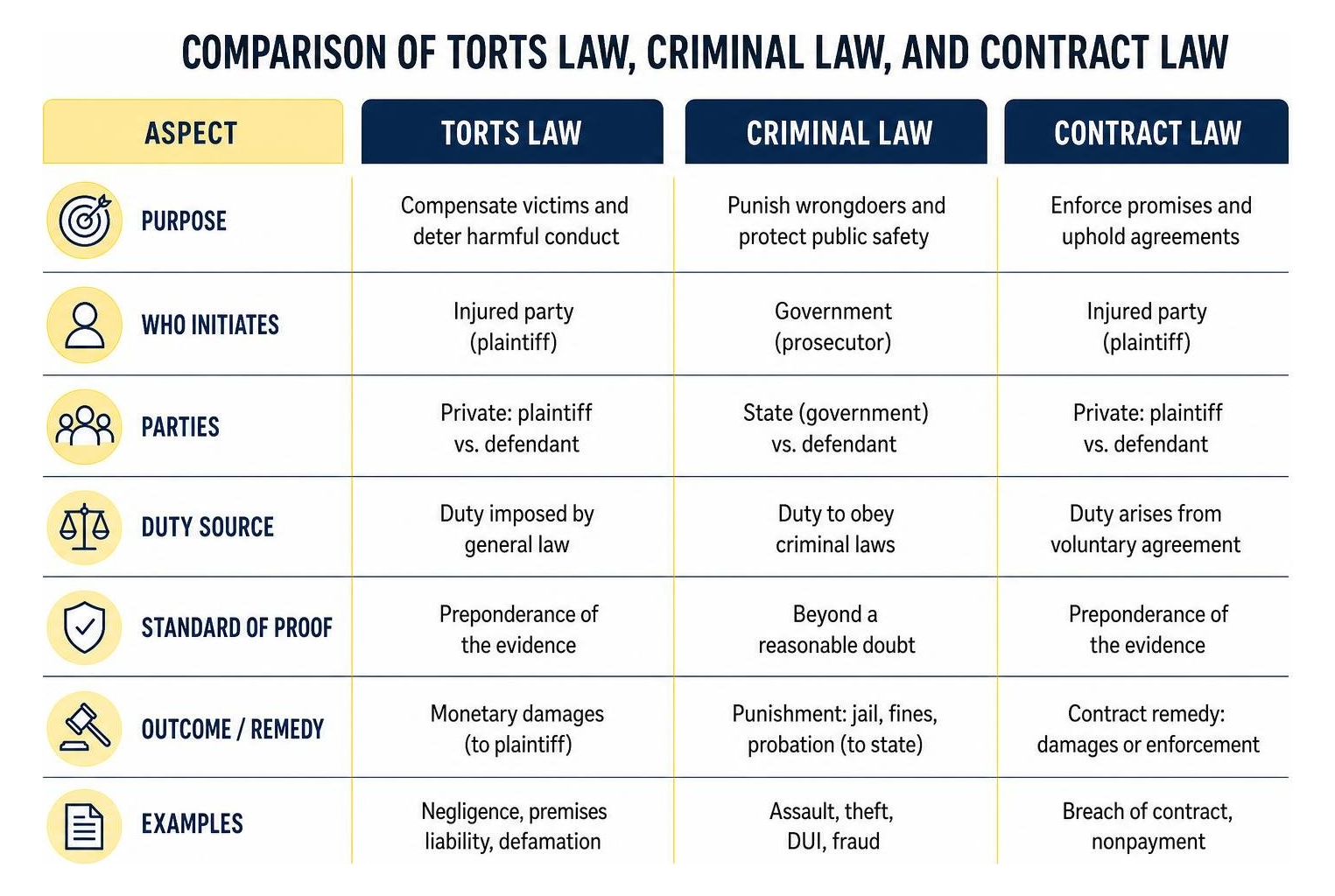
- Torts Law vs. Criminal Law: Criminal law addresses public wrongs committed against society as a whole. Criminal cases are prosecuted by government state attorneys, and penalties focus on punishment through incarceration, fines paid to the state, or probation. A tort, by contrast, is a private civil wrong where the injured individual files suit to recover financial compensation directly from the wrongdoer. Notably, a single action—such as an assault and battery—can trigger both a criminal prosecution by the state and a civil tort lawsuit by the victim.
- Burden of Proof Differences: In criminal trials, the state must prove the defendant’s guilt “beyond a reasonable doubt”—the highest evidentiary standard in law. In civil tort actions, the standard of proof is much lower: the plaintiff must establish liability by a “preponderance of the evidence.” This means showing that it is more likely than not (greater than a 50% probability) that the defendant’s actions caused the harm.
- Torts Law vs. Contract Law: Contractual obligations arise from voluntary agreements entered into by specific parties who agree to bound terms. Tort duties, on the other hand, are involuntary obligations imposed by general law upon everyone in society. You do not need to sign a contract with a retail store owner or a passing motorist for them to owe you a legal duty to avoid causing you harm.
Major Categories of Torts and Legal Liability Standards
To succeed in a civil claim, an injured party must identify the proper category of tort liability that applies to their situation. In legal practice, torts are divided into three major categories based on the defendant’s degree of fault and mental state: intentional torts, negligence torts, and strict liability torts. Understanding the precise legal line between these categories is essential, particularly when evaluating the Difference Between Intentional Misconduct and Gross Negligence.
Intentional Torts, Transferred Intent, and Consent Defenses
Intentional torts occur when a person acts deliberately with the desire to bring about a specific harmful consequence or with substantial certainty that such harm will result. Common examples of intentional torts include:
- Battery: The intentional, harmful, or offensive physical contact with another person without their consent. Interestingly, the victim does not even need to be aware of the contact at the moment it happens (such as a surgery performed on the wrong limb while under anesthesia) for a battery to occur, because battery protects physical bodily integrity.
- Assault: Acting intentionally to create a reasonable apprehension or fear of immediate harmful or offensive contact. Assault protects mental peace of mind, whereas battery protects physical safety.
- False Imprisonment: Intentionally detaining or restraining someone against their will without legal justification within bounded limits.
- Intentional Infliction of Emotional Distress (IIED): Extreme and outrageous conduct deliberately or recklessly calculated to cause severe emotional distress to another person.
The Doctrine of Transferred Intent
What happens if someone intends to harm one person but accidentally harms another instead? Under the legal doctrine of transferred intent, the law transfers the actor’s original intent to the unintended victim. For example, if a person throws a rock intending to hit Person A, but Person A ducks and the rock hits Person B, the law satisfies the intent element for Person B’s battery claim against the thrower. Transferred intent applies specifically to battery, assault, false imprisonment, trespass to land, and trespass to chattels.
The Role of Consent as a Defense
In intentional tort claims, consent acts as a complete defense. If a person voluntarily consents to an act, they cannot later sue for harm resulting from that act. Consent can be express (spoken or written words) or implied through conduct. For example, individuals participating in contact sports implicitly consent to physical contacts inherent to the rules of the game. However, consent has legal limits: it does not extend to acts that exceed the reasonable scope of the activity (such as an intentional physical attack occurring long after the whistle has blown).
Strict Liability and High-Risk Activities
Unlike negligence or intentional torts, strict liability imposes legal responsibility without requiring any proof of fault, carelessness, or bad intent. Under strict liability, if a harm occurs during certain qualifying activities, the defendant is automatically legally liable simply because the activity took place and caused injury.
Strict liability typically applies in three major contexts:
- Abnormally Dangerous (Ultrahazardous) Activities: Conducting inherently dangerous activities that involve a grave risk of serious harm that cannot be eliminated even with the utmost reasonable care—such as commercial crop dusting, storing explosives, or public pyrotechnic displays.
- Dangerous or Wild Animals: Keeping wild animals or domestic animals known to possess dangerous tendencies.
- Commercial Products Liability: Commercial sellers and manufacturers are strictly liable when they sell a product that contains a manufacturing defect, design defect, or inadequate safety warning that makes the product unreasonably dangerous and injures a consumer.
The underlying rationale behind strict liability is economic risk allocation: commercial entities and actors engaged in high-risk ventures are in the best position to bear, insure against, and distribute the costs of potential injuries to the public.
Negligence, Premises Liability, and Duty of Care

While intentional acts and strict liability represent important areas of law, negligence is by far the most commonly litigated area of tort law in the civil justice system. Negligence focuses on unintentional harm caused by a failure to observe the standard of reasonable care required under the circumstances.
A critical application of negligence principles occurs in premises liability claims. Property owners and commercial businesses owe legal duties to individuals who enter their land or premises. Whether you are walking through a grocery store in St. Petersburg, visiting a resort in Clearwater, or visiting a business in Wesley Chapel, property owners must take reasonable measures to maintain safe conditions.
Under Florida law, a property owner’s legal duty depends significantly on the visitor’s legal status:
- Invitees: Business customers or public visitors invited onto the property for the owner’s financial benefit. Property owners owe invitees the highest duty of care: they must actively inspect the premises, fix dangerous conditions, and post clear safety warnings for known hazards.
- Licensees: Social guests entering with permission. Property owners must warn social guests of non-obvious, dangerous conditions they are aware of.
- Trespassers: Persons entering without permission. Property owners generally owe no duty to make the premises safe for adult trespassers, though they cannot set intentional traps or inflict willful harm.
When an injured person shares partial fault for an accident, Florida applies a modified comparative fault standard under The 2025 Florida Statutes – Online Sunshine. Understanding how fault is apportioned is vital, as outlined in our overview of Comparative Negligence.
Four Core Elements of Negligence Claims
To successfully establish a civil negligence claim, an injured plaintiff must prove four distinct legal elements by a preponderance of the evidence:
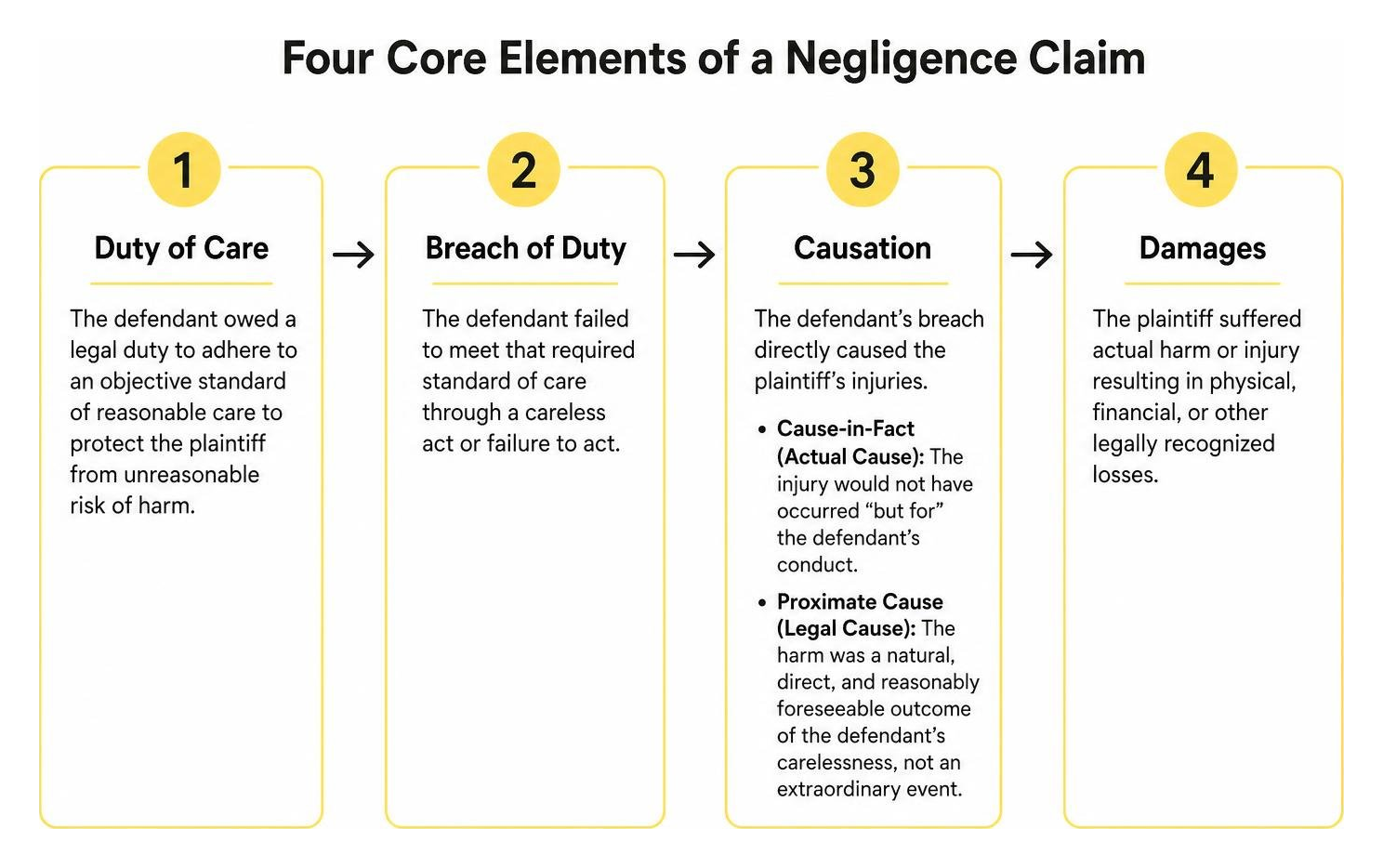
- Duty of Care: The defendant owed a legal duty to adhere to an objective standard of reasonable care to protect the plaintiff from unreasonable risk of harm.
- Breach of Duty: The defendant failed to meet that required standard of care through a careless act or failure to act.
- Causation: The defendant’s breach directly caused the plaintiff’s injuries. Causation requires proving two distinct links:
- Cause-in-Fact (Actual Cause): Proving the injury would not have occurred “but for” the defendant’s conduct.
- Proximate Cause (Legal Cause): Proving that the harm was a natural, direct, and reasonably foreseeable outcome of the defendant’s carelessness, rather than an extraordinary event.
- Actual Damages: The plaintiff suffered legally cognizable harm or actual loss (such as physical injury, medical expenses, or financial damages). Without actual injury or loss, negligence alone does not create a civil lawsuit.
When conduct falls far below any reasonable standard of safety, it may cross the threshold into higher levels of legal culpability. For a detailed exploration of extreme carelessness, refer to our Gross Negligence Law Complete Guide.
The Palsgraf Principle and Foreseeable Duty Limits
No discussion of tort law is complete without examining the famous landmark case Palsgraf v. Long Island Railroad Co. (1928), which defined the legal limits of duty and proximate cause in American injury law.
In Palsgraf, a railway passenger was running to board a moving train. Railroad guards reached out to lift him aboard, accidentally causing the passenger to drop a package wrapped in newspaper. Unbeknownst to anyone, the package contained hidden fireworks. The package fell onto the tracks and exploded. The shockwave knocked over heavy coin-operated weighing scales located at the far end of the platform, striking and injuring Mrs. Helen Palsgraf.
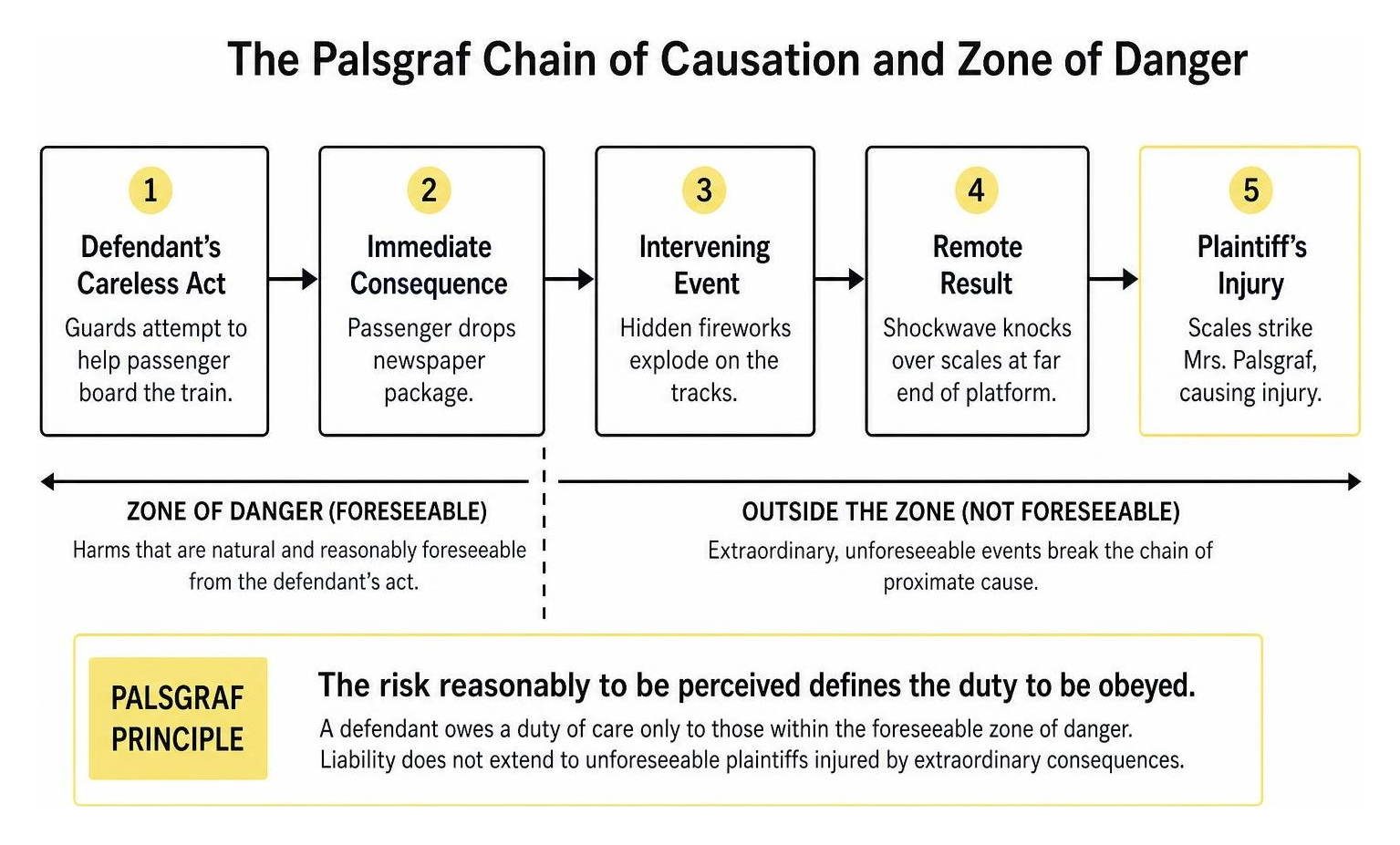
Writing for the court, Chief Judge Benjamin Cardozo established what is now known as the Palsgraf Principle:
“The risk reasonably to be perceived defines the duty to be obeyed.”
Cardozo ruled that a defendant owes a legal duty of care only to foreseeable plaintiffs located within the foreseeable “zone of danger.” Because the railway guards could not reasonably foresee that assisting a passenger with a newspaper package would explode and tip over heavy scales across the platform, they owed no legal duty to Mrs. Palsgraf regarding that unforeseeable sequence of events. The Palsgraf ruling reinforces that tort liability requires both careless conduct and a direct, foreseeable connection between that conduct and the victim.
Remedies, Damages, and Civil System Reforms
When liability is established in a civil tort claim, the legal system provides monetary and equitable remedies to address the victim’s losses.
Compensatory vs Punitive Damages Awards
Civil court damages fall into two primary classifications: compensatory damages and punitive damages.
Compensatory Damages
Compensatory damages are explicitly designed to restore the injured party to the financial position they would have occupied had the tort not occurred. Compensatory awards are split into two categories:
- Economic Damages: Measurable financial losses backed by objective documentation, including past and future medical bills, emergency care, physical therapy, lost wages, diminished earning capacity, and property repair costs.
- Non-Economic Damages: Subjective, non-monetary losses representing human suffering, including physical pain and suffering, emotional distress, mental anguish, loss of enjoyment of life, permanent scarring, and loss of consortium (damage to marital relationships).
Punitive Damages
Unlike compensatory awards, punitive damages are not intended to compensate the victim. Instead, punitive damages are awarded in rare cases specifically to punish defendants who engage in gross negligence, intentional misconduct, or severe malice, and to deter similar reckless behavior across society.
Criticisms and Economic Reforms in Torts Law
The U.S. tort system undergoes continuous debate regarding efficiency, litigation overhead, and overall economic impact. Economic research highlights several notable facts regarding civil tort costs:
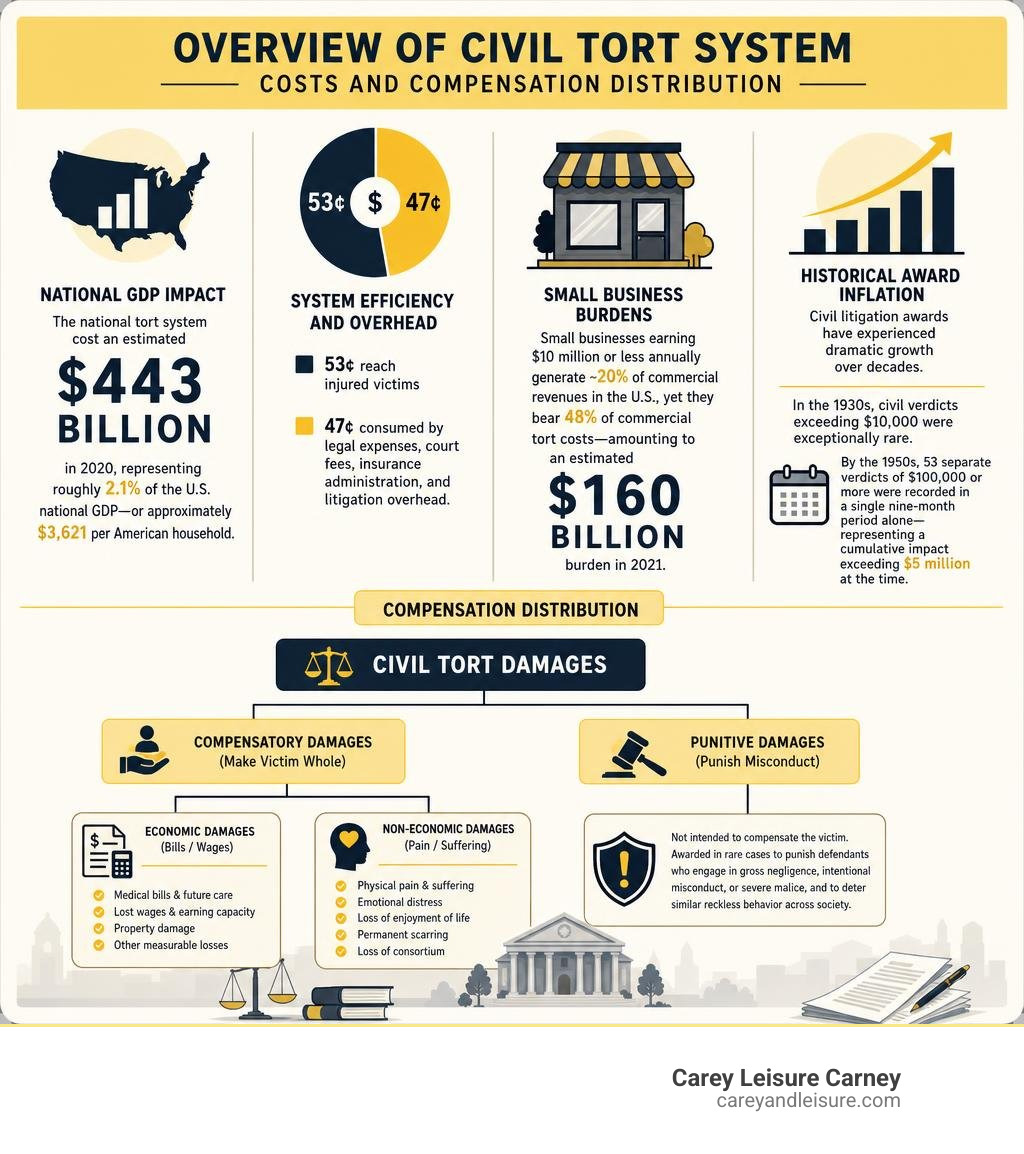
- National GDP Impact: Studies reveal that the national tort system cost an estimated $443 billion in 2020, representing roughly 2.1% of the U.S. national Gross Domestic Product (GDP)—or approximately $3,621 per American household.
- System Efficiency and Overhead: Of every dollar flowing through the U.S. tort system, only 53 cents directly reach injured victims. The remaining 47 percent is consumed by legal expenses, court fees, insurance administration, and litigation overhead costs.
- Small Business Burdens: Small businesses earning $10 million or less annually generate approximately 20 percent of commercial revenues in the U.S., yet they bear 48 percent of commercial tort costs—amounting to an estimated $160 billion burden in 2021.
- Historical Award Inflation: Civil litigation awards have experienced dramatic growth over decades. In the 1930s, civil verdicts exceeding $10,000 were exceptionally rare. By the 1950s, 53 separate verdicts of $100,000 or more were recorded in a single nine-month period alone—representing a cumulative impact exceeding $5 million at the time.
These macroeconomic metrics have fueled ongoing civil justice discussions regarding statutory damage caps, class action litigation procedures, and streamlined dispute mechanisms for complex mass tort claims.
Frequently Asked Questions About Torts Law
What is the primary difference between intentional torts and negligence?
The fundamental distinction lies in the defendant’s mental state and intent. An intentional tort requires that the defendant acted deliberately with the desire to cause harm or knew with substantial certainty that harm would occur (such as striking someone during an argument).
By contrast, negligence involves no intention to injure anyone. Instead, negligence arises when a person acts carelessly or fails to exercise the reasonable level of caution that a prudent person would use under similar circumstances (such as running a red light or failing to clean a liquid spill in a supermarket aisle).
How does the Palsgraf ruling define duty of care in personal injury cases?
The Palsgraf ruling established the foreseeable plaintiff rule. Under this landmark doctrine, a defendant does not owe a legal duty of care to the entire world; they owe a duty only to individuals within the reasonably foreseeable “zone of danger” created by their conduct.
If an injury occurs to an unexpected plaintiff through an extraordinary, unforeseeable sequence of events, courts will find that no legal duty was breached, limiting legal liability to foreseeable risks.
What damages can an injured party recover in a premises liability lawsuit?
If you are injured on commercial or private property due to an unsafe condition (such as a structural defect, broken staircase, or slippery floor), you can recover full compensatory damages under Florida premises liability law. These damages typically include:
- Reimbursement for all past, present, and future medical care and rehabilitation.
- Full compensation for lost wages and loss of future earning capacity.
- Non-economic compensation for physical pain, suffering, emotional distress, and loss of quality of life.
- Property replacement costs for personal items damaged during the incident.
Conclusion
Understanding torts law empowers individuals and families to protect their rights after an unexpected injury or loss. Whether dealing with a slip and fall, a serious vehicle collision, or another unsafe condition on commercial property, civil tort rules provide a structured pathway to hold negligent parties accountable and recover fair financial compensation.
Navigating complex insurance negotiations, legal duty requirements, and comparative fault rules can be overwhelming while recovering from harm. Having experienced trial attorneys on your side ensures your rights are protected every step of the way.
At Carey Leisure Carney, our board-certified personal injury trial attorneys bring over 100 years of combined experience helping injured victims throughout Clearwater, Largo, New Port Richey, Spring Hill, St. Petersburg, Trinity, and Wesley Chapel. We provide direct attorney access and personalized, compassionate service to every client. If you or a loved one has suffered an injury due to property negligence or careless conduct, contact us today for a free consultation or explore our specialized Premises Liability Services to learn how we can help you heal and secure full financial recovery.