Premises Liability vs Negligence and What It Means for Your Claim
Understanding Premises Liability vs Negligence: The Core Legal Differences
When evaluating tort claims, people often ask how property injuries differ from general personal injuries. At its core, the distinction in premises liability vs negligence is a matter of category. General negligence serves as the broad umbrella covering any scenario where a person fails to exercise reasonable care and causes harm to someone else. Premises liability is a specialized branch under that umbrella where the harm directly relates to a physical defect or unsafe condition on real property.
For a clearer perspective on this distinction, reviewing how premises liability vs negligence what is the difference shows that standard negligence evaluates human behavior in isolation, whereas premises liability links human responsibility directly to the ownership, possession, or control of land or buildings.
| Feature | General Negligence | Premises Liability |
|---|---|---|
| Primary Focus | Affirmative conduct or reckless actions of an individual | Unsafe physical condition, design defect, or maintenance failure on real estate |
| Origin of Legal Duty | General duty to avoid harming others through foreseeable actions | Possession, control, or legal ownership of the property |
| Role of Injured Party Status | Visitor classification does not apply | Visitor classification (invitee, licensee, trespasser) sets the duty of care |
| Notice Requirement | Typically not required; focuses directly on the careless act | Essential; plaintiff must prove actual or constructive notice of the hazard |
| Typical Defenses | Comparative fault, absence of proximate causation | Open and obvious doctrine, lack of notice, comparative fault |
When analyzing whether is premises liability the same as negligence? – professional negligence – united states or distinct from it, courts look at whether the injury arose from an active behavior or a stationary physical defect.
Origin of Duty: Human Conduct vs Property Conditions
In a standard negligence lawsuit, such as a traffic collision, the duty of care arises naturally from everyday human interaction. Every driver has an inherent legal obligation to operate their vehicle safely.
In contrast, premises liability roots its duty in the physical environment. A property owner, commercial business, or residential tenant assumes a legal duty because they manage or control physical space. Their obligation is to maintain a reasonably safe environment for those who enter. The duty is not tied to active movement, but rather to the ongoing inspection, upkeep, and warning measures necessary to keep real estate secure.
Active Malfeasance vs Passive Nonfeasance in Tort Law
Another fundamental legal distinction revolves around malfeasance versus nonfeasance:
- Active Malfeasance (General Negligence): Involves an affirmative act of wrongdoing or careless conduct. If an employee swings a heavy ladder through an aisle and strikes a customer, that is an active negligent activity (malfeasance).
- Passive Nonfeasance (Premises Liability): Involves an omission or failure to act. If a commercial cooler leaks onto the tile floor and management fails to clean it up or post a warning sign, that is passive nonfeasance.
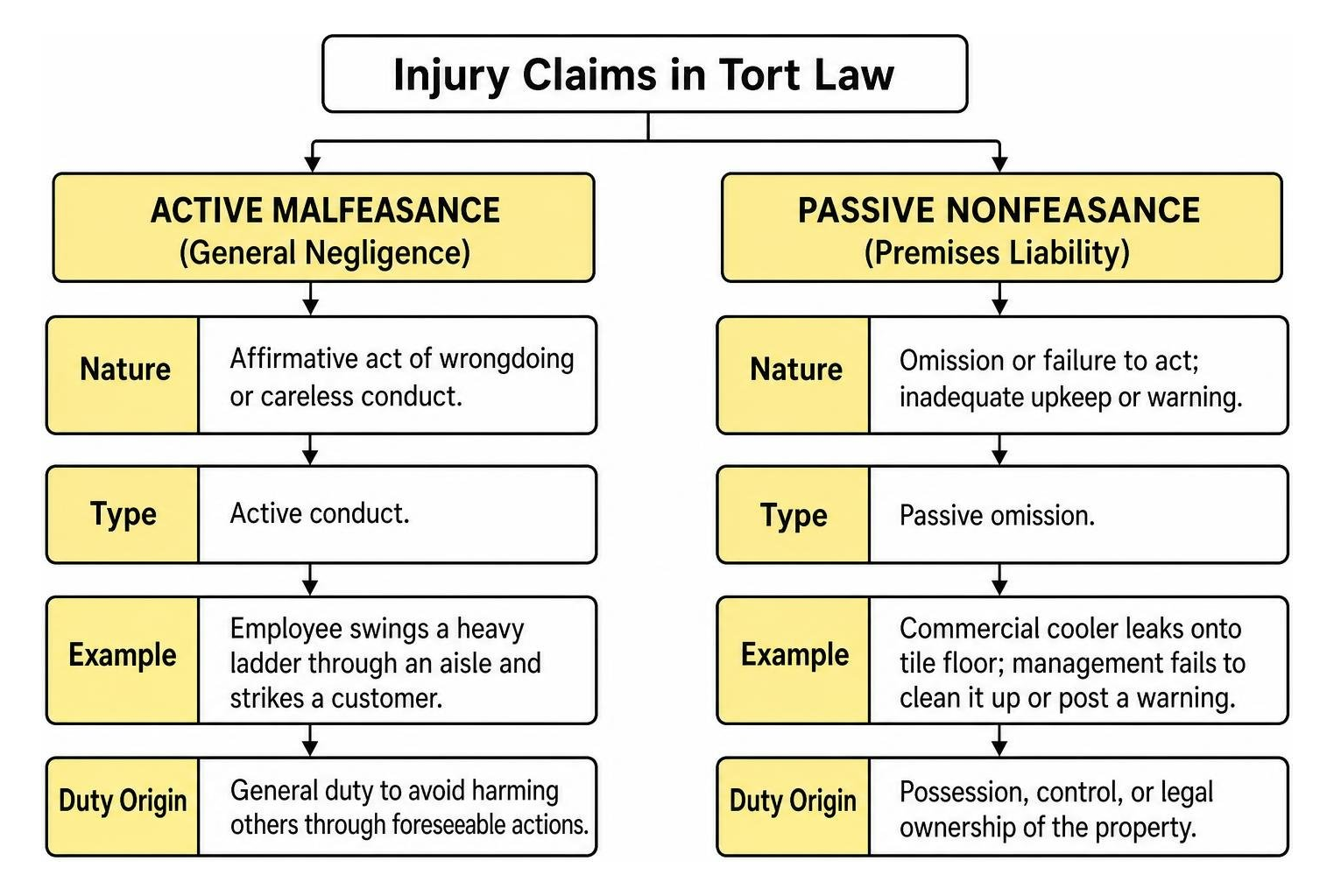
Understanding this separation prevents strategic errors when filing a lawsuit, as explained in this guide on premises liability vs. negligence: what’s the difference?. Pleading an active conduct claim when the real issue is a static property hazard can complicate how duty and notice are argued in court.
The Four Elements of Proof: General Negligence vs Property Claims
Every personal injury claim based on negligence requires the plaintiff to establish four core elements:
- Duty: The defendant owed a legal obligation of care to the plaintiff.
- Breach: The defendant failed to uphold that standard of care.
- Causation: The defendant’s breach directly and proximately caused the injury.
- Damages: The plaintiff sustained real, measurable losses (medical bills, lost income, pain and suffering).
While these four pillars remain universal, premises liability places extra evidentiary requirements on breach and causation. Falls account for over 8 million hospital emergency room visits annually, representing the leading cause of such visits at 21.3 percent. Furthermore, premises liability claims make up approximately 17 percent of all personal injury trials nationwide. Meeting the burden of proof requires demonstrating precisely how the property condition led to the harm.
Premises Liability vs Negligence Elements: Proving Breach and Causation
To prove a breach in a premises liability case, an injured party must show more than just the occurrence of an injury. You must prove that a hazardous condition existed, that the condition created an unreasonable risk of harm, and that the person controlling the property failed to remedy it or provide adequate warnings.
Causation also requires demonstrating a direct physical link: the broken step, inadequate lighting, or slippery residue caused the fall, rather than unrelated personal factors. Helpful resources like premises liability vs. negligence: what’s the difference? – legalclarity outline how these proof standards function during litigation.
The Critical Role of Actual vs Constructive Notice
In general negligence, “notice” rarely dictates whether a party is at fault. If a driver runs a red light, you do not have to prove they had advance warning that they were about to be careless.
In premises liability cases involving business properties, proving that the property owner had notice of the hazard is often the cornerstone of the entire claim:
- Actual Notice: The property owner or their staff created the hazard, saw it firsthand, or received a direct report about it prior to the incident (for instance, an employee walking past an open spill or a manager receiving a written complaint about a broken handrail).
- Constructive Notice: The hazard existed for a sufficient length of time that a business owner exercising ordinary, reasonable care should have discovered and corrected it.
Constructive notice is frequently established through circumstantial evidence. Evidence such as dark, wilted produce on a floor, track marks through a dried liquid, or maintenance logs revealing that a high-traffic area was ignored for hours helps establish that the hazard was present long enough for management to resolve it.
Visitor Classifications and Owner Responsibilities Under Florida Law

Florida premises liability law does not treat every visitor the same way. The legal obligation a landowner owes depends heavily on why the person entered the property. Understanding these classifications is critical when assessing liability.
Invitees, Licensees, and Trespassers Explained
Florida recognizes three main classifications for visitors:
Public and Business Invitees:
- Definition: People invited onto the property for business purposes (shoppers at a retail store, patrons at a restaurant) or members of the public visiting land held open for public use (parks, public libraries).
- Duty Owed: Property owners owe invitees the highest duty of care. The owner must maintain the premises in a reasonably safe condition, routinely inspect the property to discover hidden hazards, and either fix dangerous conditions or post clear, visible warnings.
Licensees:
- Invited (Social Guests): Friends and family invited over for social gatherings. Owners must keep the property reasonably safe and warn guests of known, concealed hazards that the guest is unlikely to discover on their own.
- Uninvited Licensees: Persons who enter the property solely for their own convenience or purpose without an invitation (such as a door-to-door solicitor). The owner must refrain from willful or wanton harm and warn of known, concealed dangers once the person’s presence is known.
Trespassers:
- Undiscovered Trespassers: Individuals entering without permission or legal right. Owners generally owe no duty other than to refrain from intentional, willful, or wanton injury (such as setting intentional traps).
- Discovered Trespassers: Once an owner notices a trespasser on the land, they must avoid reckless harm and warn of dangerous, hidden artificial conditions known to the owner.
Attractive Nuisance Doctrine for Child Trespassers
Children lack the adult judgment necessary to appreciate dangerous physical conditions. Under the attractive nuisance doctrine, property owners owe a heightened duty of care to young children, even if they enter the land without permission.
If a property features a dangerous, artificial condition that is foreseeable to attract curious children—such as an unfenced swimming pool, an open construction site, or unsecured machinery—the property owner must take proactive measures to secure the area. Failing to install proper barriers or child-resistant latches can make a property owner liable if a child wanders onto the grounds and gets hurt.
Legal Defenses: Open and Obvious Hazards and Comparative Fault
Defendants and their insurance carriers use several defenses to challenge both general negligence and premises liability claims. For a detailed reference on common defenses, the premises liability & negligence handbook — credocket offers insights into how defense strategies vary based on the specific facts of an incident.
Premises Liability vs Negligence Defenses: Comparative Fault Rules
Under Florida’s modified comparative fault system, an injured party’s financial recovery is reduced by their own percentage of fault. If a claimant is found to be 20 percent responsible for not watching their step and their total damages equal $100,000, their recovery is adjusted to $80,000.
Under current Florida law, if a claimant’s personal share of fault exceeds 50 percent, they are barred from recovering any compensation from the defendant. This makes preserving solid evidence immediately after an accident essential to counter claims of personal carelessness.
The Open and Obvious Doctrine as a Defense Strategy
A common defense in premises liability lawsuits is the open and obvious doctrine. Property owners often argue that a hazard was so clear, conspicuous, and visible that any reasonable person would have noticed and avoided it.
However, an obvious hazard does not give landowners an automatic pass. An owner can still be held liable if they should have anticipated that an invitee could become distracted (such as a shopper looking at elevated retail displays) or if the visitor had no safe alternative route to reach their destination.
Frequently Asked Questions About Premises Liability and Negligence
Is premises liability considered a type of negligence?
Yes. Premises liability is a specialized subset of negligence law. Both actions require establishing duty, breach, causation, and damages. The key difference is that premises liability applies specifically to injuries caused by physical, unsafe conditions on real property rather than immediate, careless human actions.
How does constructive notice affect a slip and fall claim?
Constructive notice allows an injured person to prove a business owner was negligent even if no employee admitted to seeing the spill. By showing the hazard existed for a substantial period—through security footage, witness testimony, or physical signs of age like footprints or grime—you prove the business failed in its duty of regular inspection.
Can a tenant be held liable instead of the property owner?
Yes. In premises liability, legal responsibility centers on who holds physical possession and control of the space. While a commercial landlord may manage common parking lots or exterior stairwells, an individual commercial tenant or residential renter is typically responsible for maintaining the interior areas under their direct operational control.
Conclusion: Protecting Your Rights After an Injury
Understanding the legal landscape between general carelessness and property maintenance failures protects your ability to seek compensation. If you suffer an injury due to an unsafe condition on someone else’s land, prompt action is critical:
- Document the scene immediately with photographs and video before the hazard is cleaned or repaired.
- Report the incident to the property manager and request a copy of the official incident report.
- Collect contact information from any eyewitnesses who observed the condition or the fall.
- Seek immediate medical evaluation to create a clear record linking your injuries to the event.
At Carey Leisure Carney, our board-certified personal injury trial attorneys bring over 100 years of combined experience to every case we handle. We provide direct attorney access and personalized guidance to clients throughout Clearwater, Largo, New Port Richey, Spring Hill, St. Petersburg, Trinity, and Wesley Chapel, Florida.
If you or a loved one was injured by an unsafe property hazard, contact our dedicated Clearwater premises liability lawyers today for a free consultation to review your claim and safeguard your legal rights.