

Keep On Trucking: How an Interstate Trucker Lawyer Saves Your Job
How an Interstate Trucker Lawyer Can Protect Your CDL and Career
If you drive commercially in Florida, do not simply pay a traffic citation before understanding the CDL consequences. An interstate trucker lawyer can review the charge, the roadside inspection, and the evidence; explain the risk to your license; and pursue options that may reduce, amend, or contest the allegation.
A commercial ticket can affect far more than a fine. A conviction may be reported across state lines, harm your driving record, raise concerns for your employer, and create problems with federal safety rules enforced by the Federal Motor Carrier Safety Administration (FMCSA). Serious offenses, including reckless driving, major speeding violations, DUI, and logbook falsification, can lead to CDL disqualification.
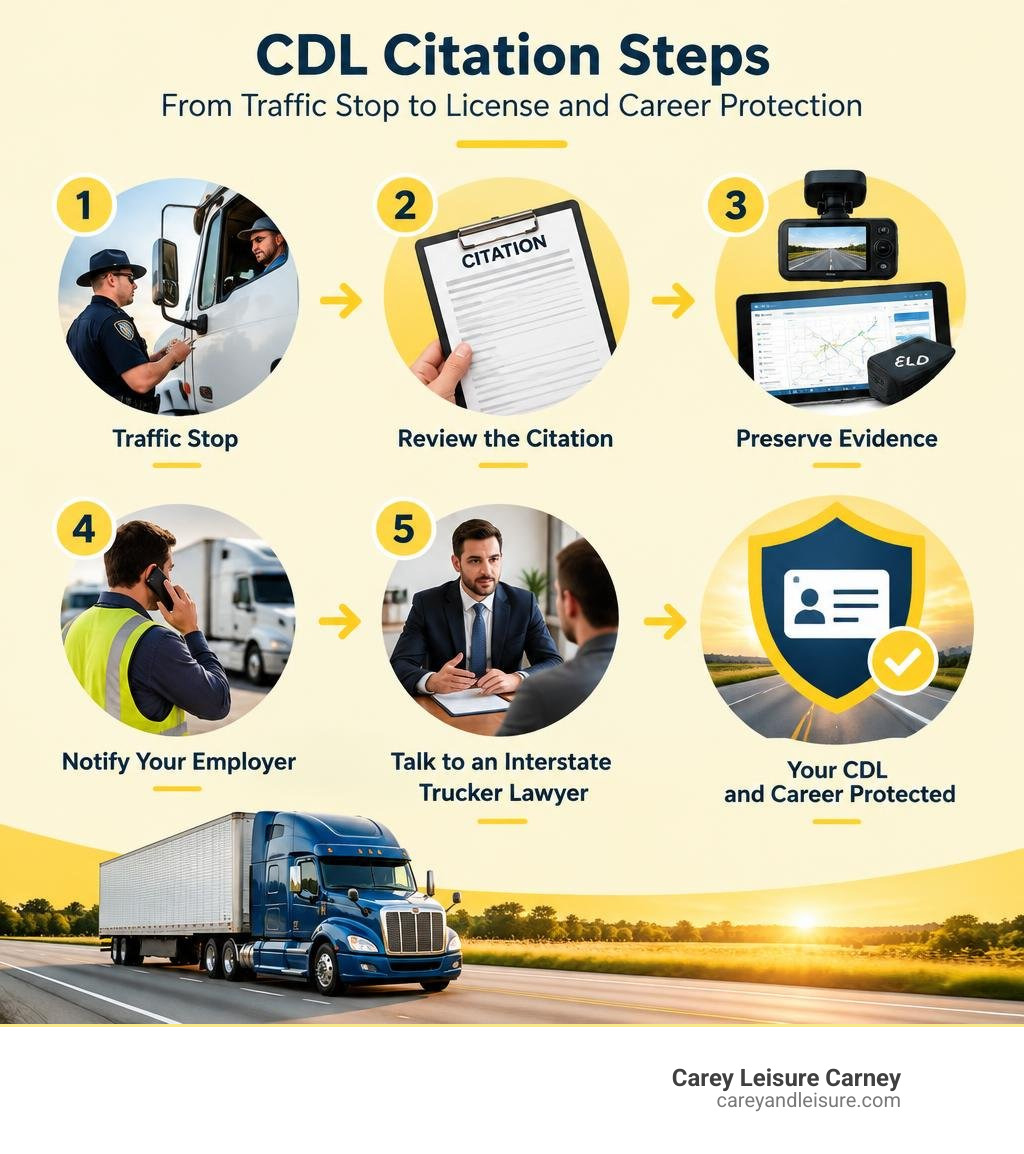
The best first steps are simple:
- Stay calm and professional during the stop.
- Read the citation carefully and save all related paperwork.
- Preserve dashcam footage, inspection reports, and electronic logging device (ELD) data.
- Notify your employer as required by company policy.
- Speak with a lawyer experienced in commercial-driver and trucking matters before entering a plea or paying the ticket.
I am Thomas W. Carey, a board-certified civil trial lawyer and founding partner of Carey Leisure Carney, with decades of experience handling serious Florida truck-crash and motor-vehicle cases. While an interstate trucker lawyer focuses on CDL defense, my work involving trucking evidence, safety issues, and collision claims informs the high stakes drivers and injured people face after a commercial-vehicle incident.
Interstate trucker lawyer word roundup:
For a broader understanding of the federal framework, the Federal Motor Carrier Safety Administration provides background on the agency that enforces many of the rules affecting commercial drivers.
The High Cost of Traffic Citations for Commercial Drivers
Commercial motor vehicle (CMV) operators navigate strict federal safety thresholds every mile on the highway. For everyday motorists, a minor speeding ticket means points and an annoying fine. For commercial drivers hauling freight along the Interstate 4 corridor or Interstate 275 through Clearwater and St. Petersburg, a single moving violation can jeopardize your professional career.
Federal law establishes clear lines between serious traffic violations and major disqualifying offenses. Securing specialized commercial driver legal defense helps drivers challenge unjustified citations before they lead to mandatory disqualification periods.
| Violation Category | Examples of Offenses | Mandatory Federal Penalties |
|---|---|---|
| Serious Traffic Violations | Speeding 15+ mph over limit, reckless driving, improper lane changes, following too closely, texting while driving | 60-day disqualification for 2 violations in 3 years; 120-day disqualification for 3 violations in 3 years |
| Major Disqualifying Offenses | Operating with BAC $\ge$ 0.04%, refusal of chemical testing, leaving the scene of an accident, felony involving CMV | 1-year disqualification (first offense); 3-year disqualification if hauling HAZMAT; lifetime ban for second offense |
| Out-of-Service Order Violations | Operating during mandatory driver rest periods, severe mechanical defect orders | 180-day to 1-year disqualification (first offense); 2 to 5-year disqualification for subsequent offenses |
| Railroad-Highway Crossing | Failing to slow, stop, or ensure clearance at rail crossings | 60-day disqualification (first offense); 120-day (second); 1-year (third within 3 years) |
Why Simply Paying a Traffic Ticket Threatens Your Career
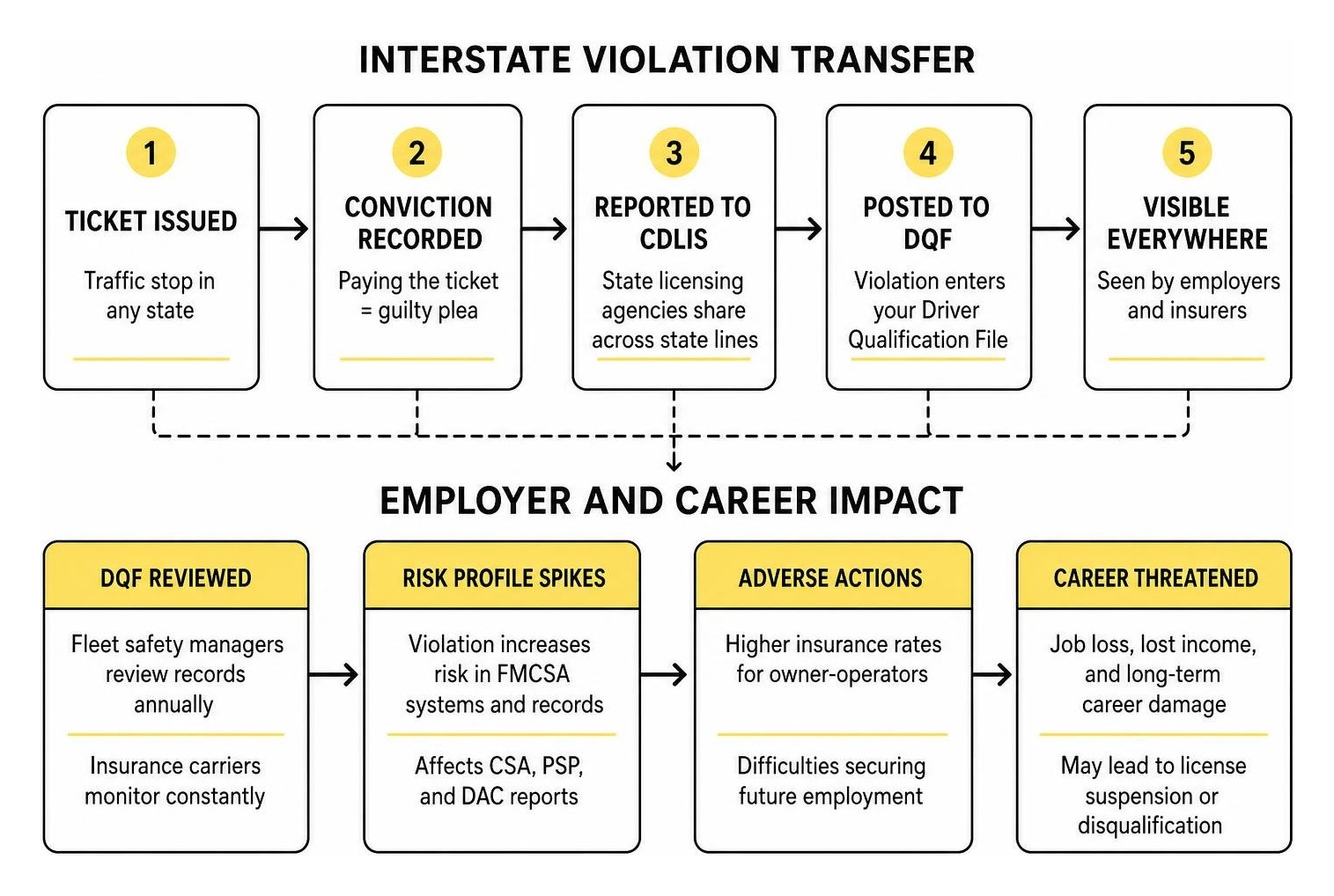
Many drivers think mailing in a check or paying a citation online resolves the matter quickly so they can get back to their route. In the commercial driving realm, paying a ticket constitutes an automatic guilty plea.
Under the Commercial Driver’s License Information System (CDLIS), state licensing agencies communicate across state lines. A conviction entered in any jurisdiction transmits to your home licensing state. Once posted, the violation lands directly in your Driver Qualification File (DQF). Fleet safety managers review these records annually, and commercial insurance carriers monitor them constantly. A sudden jump in risk profile often leads to immediate termination, sky-high insurance rates for owner-operators, and significant difficulties securing future employment.
How an Interstate Trucker Lawyer Protects Your CSA Score and DAC Report
The FMCSA tracks safety through the Compliance, Safety, Accountability (CSA) system. Roadside inspections, mechanical defects, and traffic citations feed directly into the Safety Measurement System (SMS), influencing a carrier’s Behavior Analysis and Safety Improvement Categories (BASIC) percentiles.
Violations on roadside inspection reports also impact a driver’s Pre-Employment Screening Program (PSP) record and private employment history databases, such as Drive-A-Check (DAC) reports. Dedicated transportation counsel can challenge erroneous inspection data using the FMCSA DataQs system. When citations are dismissed, amended to non-moving violations, or won at trial, attorneys submit official court dispositions through DataQs to remove or reduce the associated safety points. For more on the federal safety program behind these records, see the Compliance, Safety, Accountability overview.
Why You Need an Experienced Interstate Trucker Lawyer on Your Side
Commercial transportation is governed by Title 49 of the Code of Federal Regulations (49 CFR). General practice attorneys who handle basic municipal traffic tickets rarely understand the complex web of federal safety mandates, electronic logging device (ELD) data, and hours-of-service (HOS) exceptions that apply to interstate freight.

Having access to comprehensive commercial truck legal support ensures your defense addresses both the underlying citation and its administrative ripple effects across state lines.
CDL Defense vs. Standard Traffic Court Representation
Defending a commercial driver differs fundamentally from standard municipal traffic defense because of federal anti-masking regulations under 49 CFR § 384.226. In regular traffic court, judges routinely allow drivers to take a defensive driving course to dismiss a ticket or withhold adjudication so points never appear on their record.
Federal law strictly forbids courts from masking, deferring, or using diversion programs to hide CDL traffic convictions. An attorney defending a commercial driver must focus on substantive defenses, such as:
- Demonstrating calibration flaws in speed-measuring radar and laser devices.
- Auditing state weight-enforcement scale certifications for axle overload citations.
- Verifying whether an oversized load permit was properly interpreted by enforcement officers.
- Challenging the legal basis of a roadside stop or improper inspection protocol.
- Negotiating charge amendments to non-moving, non-safety equipment infractions that do not impact CDLIS or CSA records.
Complex Accident Defense and Carrier Liability Exposure
When a traffic citation stems from a serious motor vehicle collision, the legal stakes escalate significantly. A traffic conviction can be used as evidence of negligence in subsequent personal injury or wrongful death lawsuits.
Carriers and drivers operating across Hillsborough, Pinellas, and Pasco counties face immediate exposure following highway collisions. Commercial claims demand thorough accident reconstruction, immediate preservation of electronic control module (ECM) black box data, and in-depth understanding of complex trucking liability claims. At Carey Leisure Carney, our board-certified trial attorneys bring more than 100 years of combined courtroom experience to evaluating catastrophic collision evidence, preserving vital records, and analyzing liability across every layer of a transportation claim. For background on the federal rules that shape these cases, see the Code of Federal Regulations entry.
What to Do When Pulled Over: A Driver’s Step-by-Step Action Plan

The moments following the activation of law enforcement emergency lights often decide the fate of your commercial driving record. Maintaining composure and executing a methodical roadside protocol protects your safety, your license, and your legal defense options.
Immediate Actions at the Traffic Stop
- Safely Position Your Rig: Signal early, pull completely onto the shoulder or into an inspection bay, turn on hazard lights, set the parking brake, and keep your hands visible on the steering wheel.
- Maintain Professional Demeanor: Treat the officer with professional courtesy. Roadside interactions are frequently recorded via dashcam and bodycam systems, and combative behavior eliminates any chance of roadside discretion.
- Avoid Unintended Admissions: Never volunteer statements like “I thought the limit was 65” or “I am behind on my delivery window.” State facts clearly without admitting fault or speculating on speed, weight, or mechanical issues.
- Preserve Critical Digital Evidence: Immediately save your forward-facing and cab-facing dashcam footage to avoid automatic file overwrites. Take a clean snapshot or data download of your ELD duty status and hours-of-service records.
- Photograph the Scene: If safe to do so after the inspection, capture clear photos of roadway signage, construction zone markings, weather conditions, scale display readouts, or vehicle positioning.
- Review Paperwork for Inaccuracies: Examine the roadside inspection sheet (Form MCS-63) and any uniform traffic citation before departing. Note incorrect highway mile markers, misstated vehicle identification details, or flawed statutory references.
- Comply with Employer Notification Rules: Federal and state regulations require commercial drivers to notify their employing motor carrier of any traffic conviction within 30 days, though most company internal safety policies mandate reporting citations within 24 hours.
What to Look for When Hiring an Interstate Trucker Lawyer
When choosing an attorney to defend your commercial driving record or manage collision liability, look for specific qualifications that align with commercial transportation law:
- Transparent Pricing Structures: Look for clear flat-fee representations on standard traffic citations, eliminating unexpected hourly billing surprises.
- Extensive Courtroom and Trial Track Record: Confirm whether the firm regularly tries cases before juries or simply negotiates plea deals. Experience in handling catastrophic cases provides the trial readiness required when stakes are high.
- Direct Attorney Access: Choose a firm where you can speak directly with your legal counsel rather than being routed indefinitely through administrative call centers.
- Board Certification: In Florida, board-certified civil trial attorneys represent the top 2% of practitioners, demonstrating peer-reviewed skill and ethical standards.
- Clear Multi-Jurisdictional Strategy: Ensure your legal team understands how an outcome in one jurisdiction impacts your home state licensing requirements, DAC reporting, and carrier qualification status.
For complex collision claims and serious highway accident representation, selecting top-tier Florida truck litigation counsel ensures your rights are protected by experienced trial attorneys. For more on the licensing system that connects these records across states, see the Commercial Driver’s License Information System overview.
Frequently Asked Questions About Commercial Trucking Citations
How long do CDL violations stay on my commercial driving record?
Moving violations and safety convictions generally remain on a state Motor Vehicle Record (MVR) for a minimum of three years, though certain major offenses and alcohol-related suspensions can remain for five to ten years or indefinitely depending on state administrative rules. Under federal guidelines, FMCSA crash and roadside inspection records remain visible on a carrier’s public Safety Measurement System data for 24 months and stay on a driver’s Pre-Employment Screening Program (PSP) record for three to five years.
Can I attend traffic school to dismiss a ticket from my CDL?
No. Under federal anti-masking regulations outlined in 49 CFR § 384.226, courts, prosecutors, and state licensing agencies are expressly prohibited from masking, deferring, or using diversionary driving school programs to keep a commercial driver’s moving violation from appearing on their CDLIS record. To protect your CDL, an attorney must seek a full dismissal of the charges or negotiate an amendment to a non-moving equipment infraction that does not trigger federal reporting or driver disqualification points.
What happens if I receive a citation while driving my personal vehicle?
Violations committed in your personal vehicle can directly disqualify your commercial driving privileges. If you are convicted of major offenses—such as driving under the influence of alcohol or drugs, leaving the scene of an accident, or using a motor vehicle in the commission of a felony—in your personal passenger car, you face a mandatory one-year CDL disqualification for a first offense. Accumulating multiple serious speeding or reckless driving citations in your personal car within a three-year window can also trigger federal CDL disqualification periods. For more on the federal rules that govern these penalties, see the Federal Motor Carrier Safety Administration entry.
Conclusion
Your commercial driver’s license represents your financial security, your career, and countless hours behind the wheel. When an unexpected traffic stop, mechanical citation, or serious highway accident threatens your driving record, ignoring the problem or simply paying the fine is never a safe strategy. Proactive, knowledgeable legal defense protects your qualification status, keeps your safety metrics intact, and preserves your professional standing.
At Carey Leisure Carney, our board-certified trial attorneys bring more than a century of combined legal experience to personal injury and commercial vehicle accident cases throughout Clearwater, Largo, New Port Richey, Spring Hill, St. Petersburg, Trinity, and Wesley Chapel, Florida. If you or a loved one has been involved in a serious commercial vehicle crash, reach out to our experienced Florida commercial truck accident lawyers for a free, personalized consultation to ensure your rights and livelihood remain protected. For additional context on the federal agency overseeing commercial vehicle safety, see the Federal Motor Carrier Safety Administration page.