
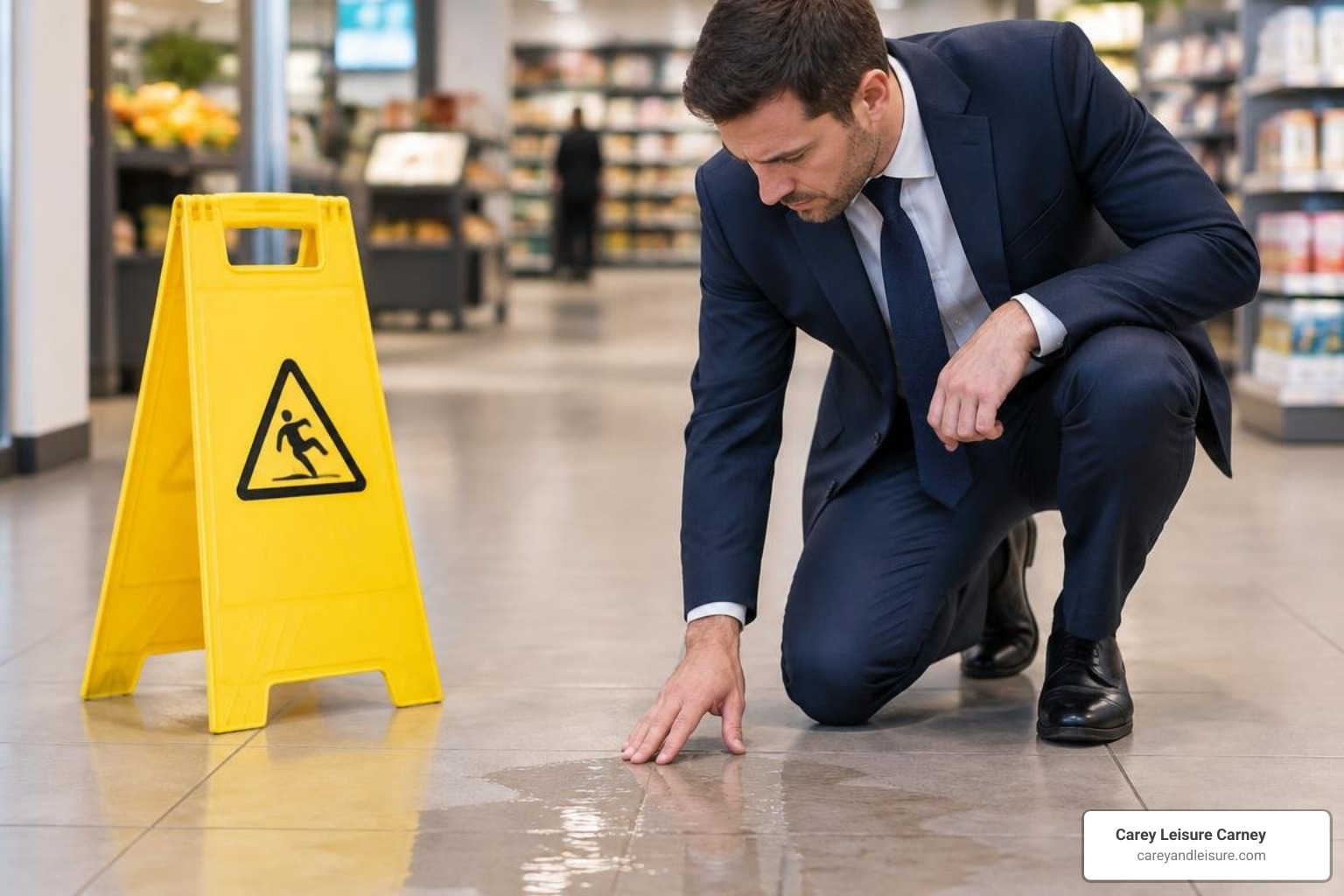
Why Injured Floridians Need a Slip and Fall Attorney Immediately
Why You Need a Slip and Fall Attorney in Florida Quickly
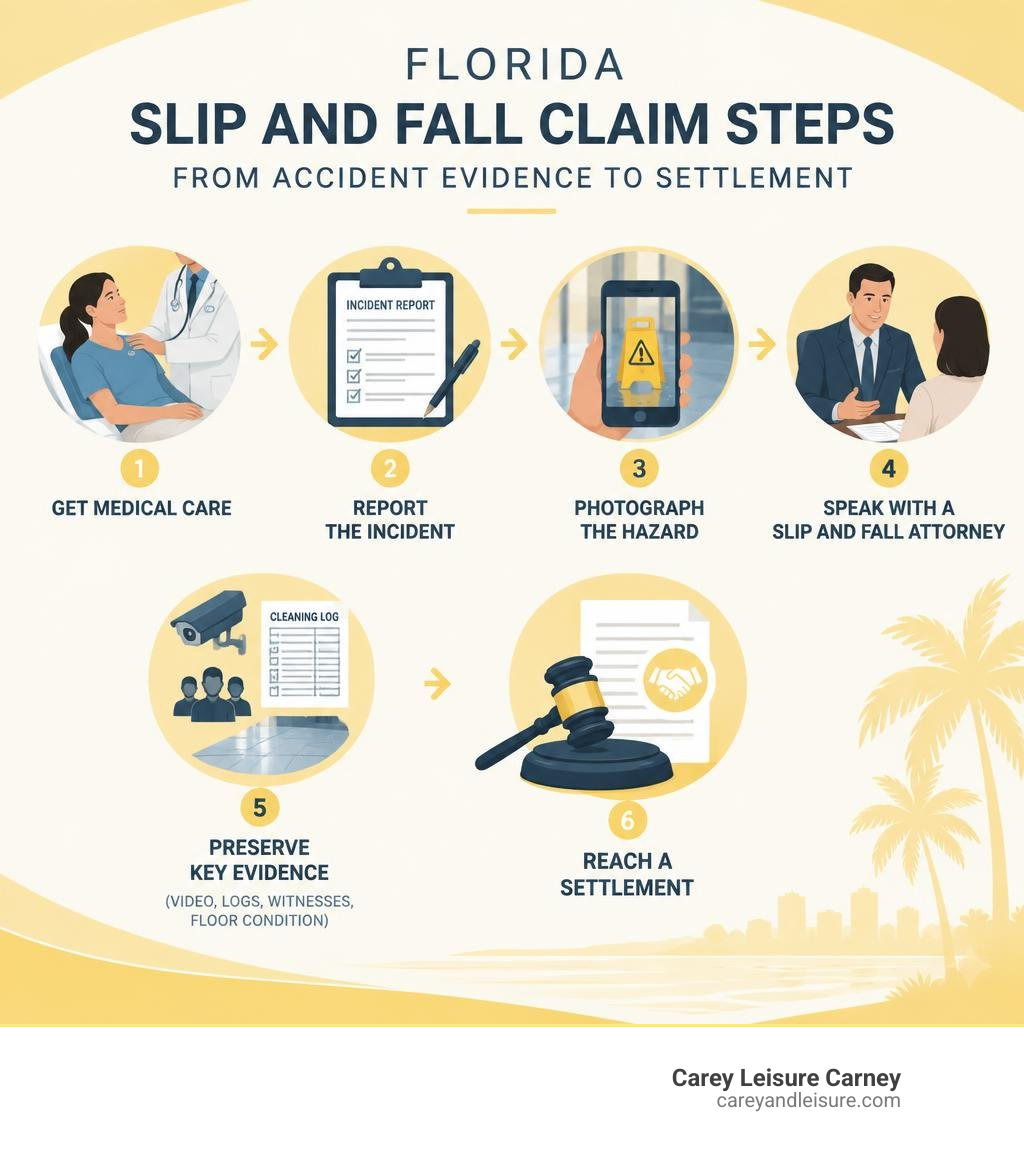
After a fall on someone else’s property, get medical care, report the incident, photograph the hazard, and speak with a slip and fall attorney Florida residents can trust as soon as possible. Evidence such as surveillance video, cleaning logs, witness names, and the condition of the floor can disappear quickly.
Florida premises liability law may allow an injured person to seek payment for medical bills, lost income, pain and suffering, and other losses when a property owner or business failed to address a dangerous condition. But insurers often argue that the hazard was obvious, the owner lacked notice, or the injured person caused the fall. Acting early helps preserve the facts needed to answer those claims.
I am Thomas W. Carey, a founding partner at Carey Leisure Carney and a board-certified civil trial lawyer who has handled and overseen injury matters across Florida since 1988. As a slip and fall attorney Florida victims can consult, I help injured people understand their options before critical evidence and legal deadlines are lost. For a broader overview of how these cases work, see the premises liability framework that governs property owner duties.
Understanding Florida Premises Liability and Slip and Fall Laws
Every year, slip and fall accidents account for over one million emergency room visits nationwide, with Florida consistently ranking among the top states for these incidents. Whether you were shopping at a supermarket, dining out, or walking through a hotel lobby, Florida property owners are legally required to maintain reasonably safe conditions for their guests.
When an owner fails to meet this obligation, the underlying legal doctrine is known as premises liability. Under this framework, the duty of care owed by a property owner depends on your legal status at the time of the incident:
- Invitees: Customers and patrons invited onto commercial premises for business purposes. Property owners owe invitees the highest duty of care—they must actively inspect the property, repair hazards, and clearly warn of any known dangers.
- Licensees: Social guests entering private property for non-commercial reasons. Owners must maintain safe conditions and warn guests of hidden dangers they know about.
- Trespassers: Individuals entering a property without permission. While owners generally owe no duty to maintain safe grounds for adult trespassers, they cannot intentionally create concealed traps to harm them.
If you suffered injuries due to an unaddressed hazard on a commercial or private property, understanding premises liability is the first step toward securing the financial recovery you deserve.
Florida Transitory Foreign Substance Statute 768.0755
When a slip and fall occurs in a commercial establishment due to a temporary condition—such as a puddle of spilled water, leaking refrigeration fluid, or dropped food in a grocery aisle—the case is governed by Florida Statute § 768.0755.
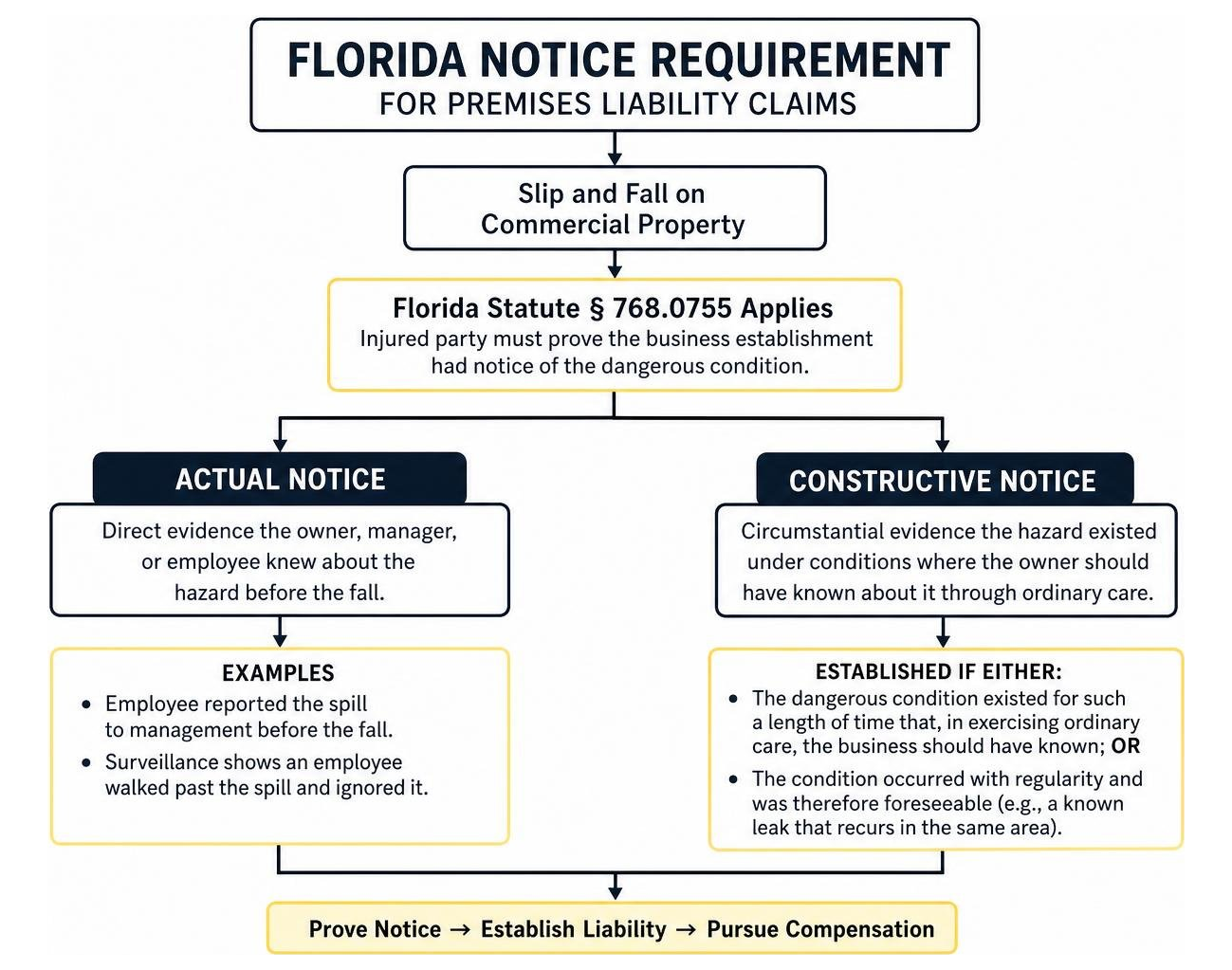
Under this law, the injured party bears the burden of proving that the business establishment had actual or constructive knowledge of the dangerous condition and should have taken reasonable action to remedy it. This statutory burden makes commercial slip and fall claims in Florida uniquely complex compared to many other states.
Proving Actual vs. Constructive Notice Under Florida Law
To establish liability under Florida Statute § 768.0755, we must demonstrate that the property owner had notice of the hazard before your injury occurred:
- Actual Notice: Direct evidence showing the property owner, manager, or an employee knew about the spill or hazard. Examples include an employee reporting the puddle to management before your fall or surveillance showing an employee walking past the spill and ignoring it.
- Constructive Notice: Circumstantial evidence proving the hazard existed under conditions where the owner should have known about it through ordinary care. Under Florida law, this is demonstrated if:
- The dangerous condition existed for such a length of time that, in exercising ordinary care, the business establishment should have known of the condition; or
- The condition occurred with regularity and was therefore foreseeable (e.g., a known roof leak that pools water in the same aisle every time it rains).
Demonstrating constructive notice requires thorough investigation, including subpoenaing electronic maintenance logs, shift sweep sheets, and security camera footage before it is routinely overwritten.
Critical Evidence and Steps to Take After a Florida Slip and Fall

What you do immediately following an accident on commercial or residential property directly affects your ability to recover compensation. Following the proper actions to take after an incident protects both your health and your legal rights:
- Report the Accident Immediately: Notify the property owner, store manager, or security personnel. Request an official incident report and ask for a copy or incident number before leaving.
- Document the Scene Thoroughly: Use your smartphone to take high-resolution photos and videos of the exact hazard, the surrounding floor conditions, lighting, and any lack of warning cones.
- Gather Witness Contact Details: Obtain names, phone numbers, and brief statements from anyone who witnessed your fall or noticed the hazard prior to the incident.
- Preserve Your Footwear and Clothing: Keep the shoes and clothes you were wearing in an unwashed, unaltered state. Insurance adjusters often try to claim worn-out soles caused the fall.
- Do Not Give Recorded Statements: Avoid giving detailed statements or signing insurance forms until you have consulted legal representation.
Seeking Immediate Medical Care and Documenting Injuries
Never downplay your injuries or delay medical evaluation. Slip and fall incidents frequently lead to serious physical trauma, including torn ligaments, spinal disc herniations, fractured bones, and traumatic brain injuries (TBIs). In Florida, medical treatment costs for slip and fall injuries average between $20,000 and $50,000 per incident.
Seeking an immediate medical evaluation establishes an official clinical link between the fall and your injuries. Gaps in medical treatment allow insurance companies to argue that your physical ailments were pre-existing or caused by an unrelated event.
Common Property Owner Defenses and Open and Obvious Hazards
Commercial property owners and their defense insurers utilize several standard defenses to avoid liability:
- The “Open and Obvious” Doctrine: The defense argues that the hazard was so clear and visible that any reasonable person should have seen and avoided it.
- Lack of Notice: Claiming the foreign substance fell onto the floor mere seconds before your accident, leaving no reasonable window of time for staff to discover and clean it.
- Comparative Fault: Suggesting that you were distracted by your mobile phone, rushing, or wearing improper footwear.
- Adequate Warning: Asserting that “Wet Floor” signs or barricades were visible and sufficient to warn pedestrians.
Florida Negligence Rules, Deadlines, and Financial Recovery
Navigating the financial recovery process requires a precise understanding of Florida’s legal system, statutory deadlines, and comparative fault standards.
Florida operates under a modified comparative negligence framework with a 51 percent bar. Under this rule:
- You can recover compensation if you are 50% or less at fault for your slip and fall accident.
- Your final financial award is reduced in direct proportion to your percentage of assigned fault.
- If you are found to be 51% or more at fault, you are completely barred from recovering any compensation from the property owner.
Data indicates that roughly 35% of slip and fall claims in Florida face reductions or denials based on comparative negligence arguments. Furthermore, under Florida Statute § 95.11, the statute of limitations for filing a personal injury lawsuit is two years from the date of the incident. Missing this statutory deadline results in a complete forfeiture of your right to seek damages in court.
Economic and Non-Economic Damages in Florida Claims
Injured victims may recover both tangible economic damages and subjective non-economic losses.
| Damage Category | Description | Common Examples |
|---|---|---|
| Economic Damages | Verifiable, out-of-pocket financial losses resulting directly from the injury | • Emergency room and hospital bills • Physical therapy and surgeries • Future estimated medical care • Lost wages (averaging $10,000 per claim) • Diminished future earning capacity |
| Non-Economic Damages | Intangible physical, mental, and emotional harm caused by the accident | • Physical pain and suffering • Emotional distress and mental anguish • Loss of enjoyment of life • Permanent physical impairment or scarring • Loss of consortium |
Florida Slip and Fall Settlement Timeline and Case Resolution
A typical Florida slip and fall case takes between 18 and 24 months to resolve from initial filing to final settlement or verdict. About 90% of premises liability claims settle out of court during negotiations or formal mediation.
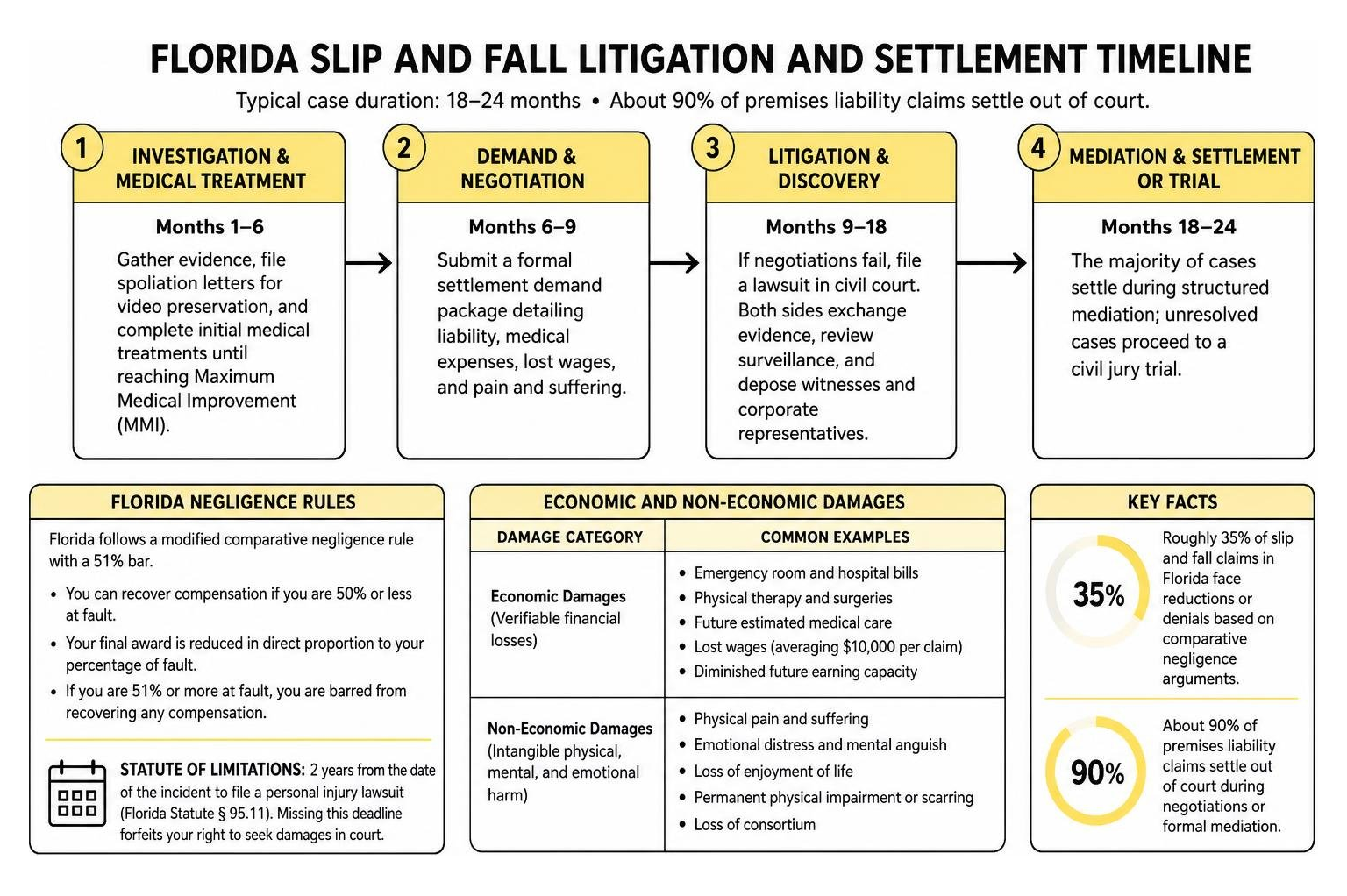
- Investigation & Medical Treatment (Months 1–6): Gathering evidence, filing formal spoliation letters for video preservation, and completing initial medical treatments until reaching Maximum Medical Improvement (MMI).
- Demand & Negotiation (Months 6–9): Submitting a formal settlement demand package detailing liability, medical expenses, lost wages, and pain and suffering.
- Litigation & Discovery (Months 9–18): If negotiations fail, filing a formal lawsuit in civil court. Both sides exchange evidence, review surveillance, and depose witnesses and corporate representatives.
- Mediation & Settlement or Trial (Months 18–24): The majority of cases settle during structured mediation; unresolved cases proceed to a civil jury trial.
Why Hiring a Slip and Fall Attorney Florida Victims Trust Matters
Florida sees over 50,000 slip and fall injury claims filed annually. According to statewide claim metrics, injured victims achieve an approximate 70% success rate when represented by an experienced attorney, compared to just 45% when attempting to negotiate directly with corporate insurers alone.
For deeper insights into navigating these complex claims, our slip-fall lawyer complete guide outlines how legal representation levels the playing field against major corporations.
When to Retain a Slip and Fall Attorney Florida for Severe Injuries
Hiring dedicated legal counsel is critical when dealing with:
- Catastrophic Injuries: Multiple fractures, spine damage, or head trauma requiring long-term care.
- Disputed Liability: Cases where commercial owners refuse to admit notice or claim you fabricated the accident.
- Multiple Liable Parties: Incidents involving third-party cleaning contractors, property management companies, and commercial building owners.
To learn more about preparing your case, read our guide on when to hire a slip and fall attorney and what to expect.
What to Look for in a Slip and Fall Attorney Florida Specialist
Choosing the right legal advocate makes all the difference in your case outcome. You should look for:
- Board Certification: Fewer than 2% of Florida attorneys are Board Certified in Civil Trial Law—a distinction reflecting extensive trial experience and recognized legal expertise.
- Direct Attorney Access: Ensure you work directly with your trial lawyer rather than being handed off to case managers.
- Local Community Experience: Familiarity with local courts and property management practices across Florida communities.
Review our resource on selecting the best attorneys for slip and falls or explore our best slip fall attorneys guide to evaluate representation standards.
We represent injured clients across our offices, providing local support as a:
- Slip-and-fall attorney in Clearwater, FL
- Slip-and-fall attorney in Largo, FL
- Slip-and-fall attorney in New Port Richey, FL
- Slip-and-fall attorney in Spring Hill, FL
- Slip-and-fall attorney in St. Petersburg, FL
- Slip-and-fall attorney in Trinity, FL
- Slip-and-fall attorney in Wesley Chapel, FL
Frequently Asked Questions About Florida Slip and Fall Claims
What is the average settlement for a slip and fall in Florida?
In Florida, slip and fall cases yield an average settlement between $30,000 and $40,000 for non-catastrophic injuries involving soft-tissue damage or minor fractures. However, severe cases involving surgical interventions, traumatic brain injuries, or permanent disability routinely exceed $1 million depending on available insurance coverage and liability strength.
Can I recover compensation if I was partially at fault for my fall in Florida?
Yes, provided you were 50% or less at fault for the accident. Under Florida’s modified comparative negligence standard, your compensation will be reduced by your percentage of fault. For example, if your total damages are $100,000 but you are found 20% at fault for being distracted, you will receive $80,000. If you are 51% or more at fault, you cannot recover damages.
How long do I have to file a slip and fall lawsuit in Florida?
Under Florida Statute § 95.11, the statute of limitations for filing a personal injury lawsuit from a slip and fall is two years from the date the incident occurred. Missing this legal deadline permanently bars your right to pursue compensation in court.
Conclusion
A slip and fall injury can leave you facing mounting medical expenses, missed paychecks, and painful physical rehabilitation. Corporate property owners and their insurers begin building their defense within hours of an incident—and you deserve strong, proven legal representation on your side.
At Carey Leisure Carney, our board-certified trial lawyers bring over 100 years of combined legal experience to every case. We provide direct attorney access, personal attention, and relentless courtroom advocacy to secure maximum compensation for your losses.
If you or a loved one has suffered an injury on commercial or private property, contact our dedicated St. Petersburg slip and fall attorney team today for a free, confidential case consultation. We are ready to help you hold negligent property owners accountable.