
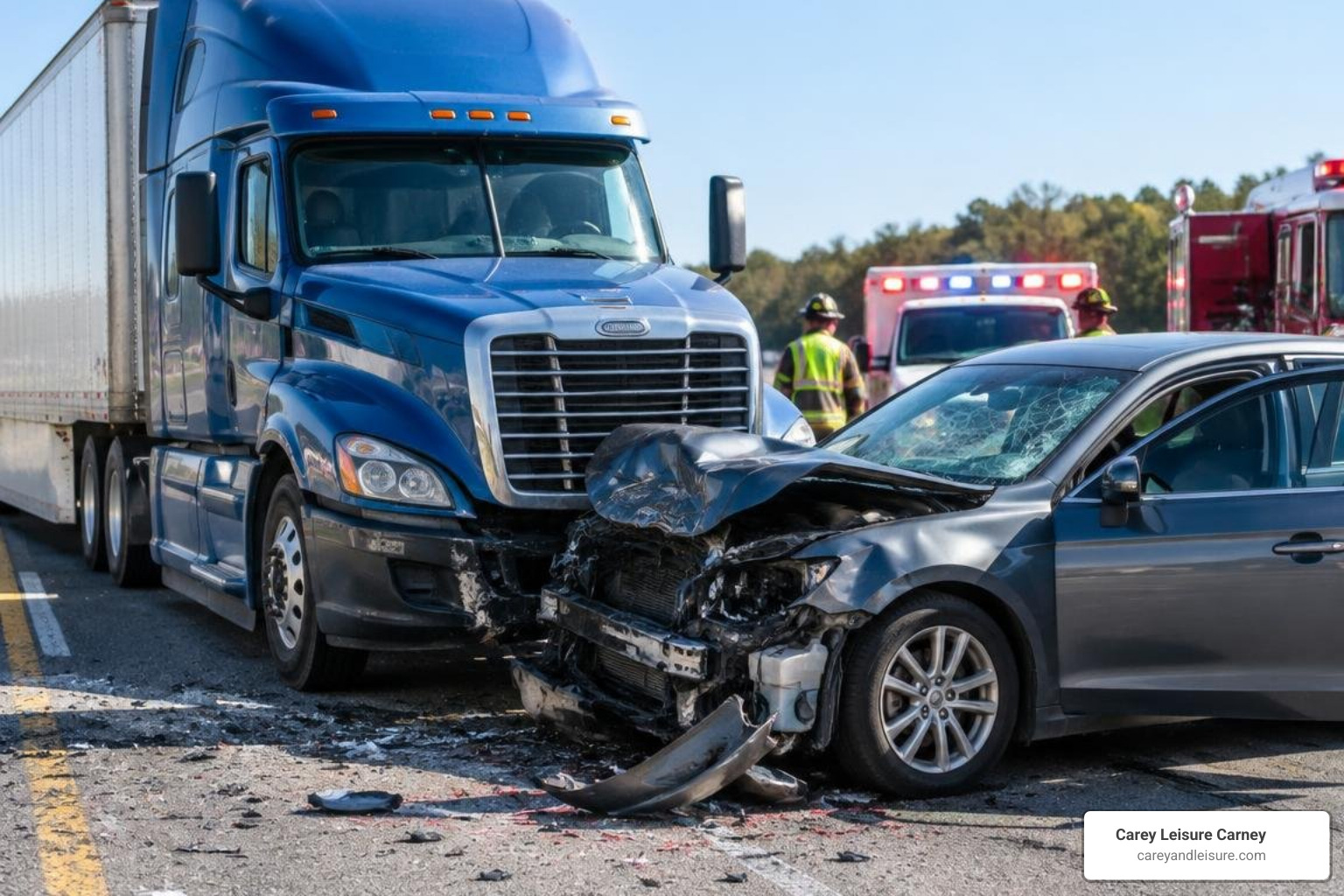
Why Big Rigs Demand an Experienced Eighteen Wheeler Accident Lawyer on Your Side
How an Eighteen Wheeler Accident Lawyer Can Protect Your Claim
After an eighteen-wheeler crash in Clearwater, Largo, New Port Richey, Spring Hill, St Petersburg, Trinity, or Wesley Chapel, get medical care, report the collision, and speak with a truck accident lawyer promptly. When choosing a lawyer, ask about their experience with trucking cases, how they preserve truck data and driver logs, and whether they investigate the driver, trucking company, and other possible parties before negotiating with an insurer.
Big-rig claims can involve serious injuries and evidence that is harder to obtain than in a car crash. Acting early gives your lawyer a better chance to secure that evidence and assess the full cost of your injuries.
I’m Thomas W. Carey, founder of Carey Leisure Carney and a board-certified civil trial lawyer whose firm handles truck crash claims across Florida. My decades of injury litigation shape how I approach the work of an eighteen wheeler accident lawyer: protect the evidence, identify who may be responsible, and understand what the injured person needs next.
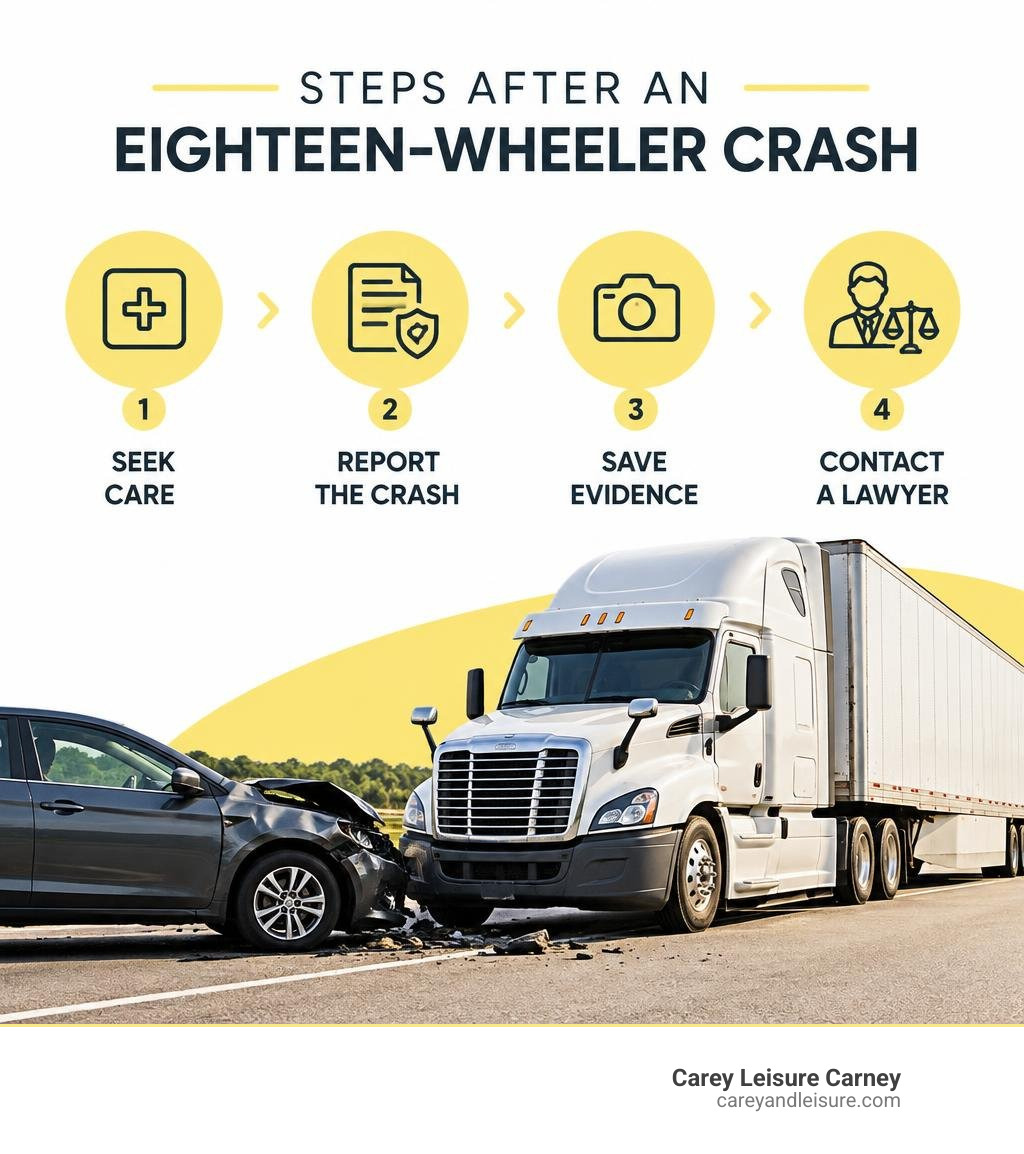
Simple guide to eighteen wheeler accident lawyer terms:
Understanding Big Rig Crashes: Commercial Trucks vs. Passenger Vehicles
When an 80,000-pound commercial tractor-trailer collides with a 4,000-pound passenger car, the physical outcome is entirely one-sided. Commercial collisions are governed by distinct mechanics, complex federal oversight, and massive insurance policies that make them fundamentally different from everyday fender benders.
Understanding the difference between truck accidents and car crashes starts with examining vehicle dynamics and regulatory standards:
| Feature | Standard Passenger Vehicle | Commercial Eighteen-Wheeler |
|---|---|---|
| Gross Vehicle Weight | 3,000 to 5,000 lbs | Up to 80,000 lbs (or more with permits) |
| Stopping Distance (65 mph) | Approx. 316 feet | Approx. 525 feet (nearly two football fields) |
| Regulatory Framework | Standard State Traffic Laws | FMCSA Title 49 CFR, DOT, and State Regulations |
| Primary Crash Risks | Cabin crush, airbag deployment | Underride collisions, jackknifing, cargo spills |
| Standard Insurance Coverage | $10,000 to $100,000 | $750,000 to $5,000,000+ commercial policies |
Federal safety data reveals the alarming scope of these wrecks: in 2021, large trucks accounted for 4,764 fatal crashes across the country—a 17% increase from the prior year—with over 500,000 total police-reported crashes recorded by the Federal Motor Carrier Safety Administration (FMCSA). Furthermore, roughly 60% of fatal big-rig collisions take place on rural routes where higher speeds and limited lighting increase severity. The sheer momentum generated by commercial rigs creates catastrophic underride risks, where a smaller car slides beneath the trailer, causing catastrophic trauma.
Common Causes of Commercial Truck Collisions
Commercial truck crashes rarely occur without underlying corporate or operator errors. A major factor is fatigue behind the wheel, which contributes to approximately 13% of all commercial vehicle collisions. When drivers face tight delivery deadlines, they often push past safe limits.
Common root causes include:
- Driver Fatigue and Hours-of-Service Violations: Exceeding maximum driving shifts without required rest breaks.
- Distracted Driving: Texting, operating dispatch monitors, or eating behind the wheel.
- Improper Cargo Loading: Unbalanced freight or unsecured loads that shift mid-transit and trigger rollovers.
- Mechanical and Brake Defects: Worn air brakes, bald tires, and failed steering assemblies that leave operators helpless in emergencies.
- Speeding for Road Conditions: Driving too fast during heavy Florida rainstorms, leading to hydroplaning and jackknifing.
Why You Need a Dedicated Eighteen Wheeler Accident Lawyer

Taking on a multi-million-dollar motor carrier requires a deep understanding of federal regulations, corporate discovery, and catastrophic injury litigation. Engaging an experienced licensed legal professional levels the playing field against aggressive corporate defense teams.
Securing strong representation is vital because studies demonstrate that hiring an attorney increases the likelihood of securing an injury settlement by up to 3.5 times compared to filing a claim alone. Discover why you need a pro to handle your big rig legal battle to protect your financial recovery against insurance adjusters who work around the clock to minimize payouts.
How an Eighteen Wheeler Accident Lawyer Proves Liability
Commercial truck claims rarely involve just a single negligent driver. Establishing legal fault requires navigating the legal maze of trucking company liability to identify all responsible corporate entities.
Under the legal doctrine of respondeat superior (vicarious liability), motor carriers are responsible for the negligent driving of their employees. Beyond vicarious liability, carriers can be sued for direct negligence, such as negligent hiring, failing to run background checks, or ignoring dangerous maintenance reports.
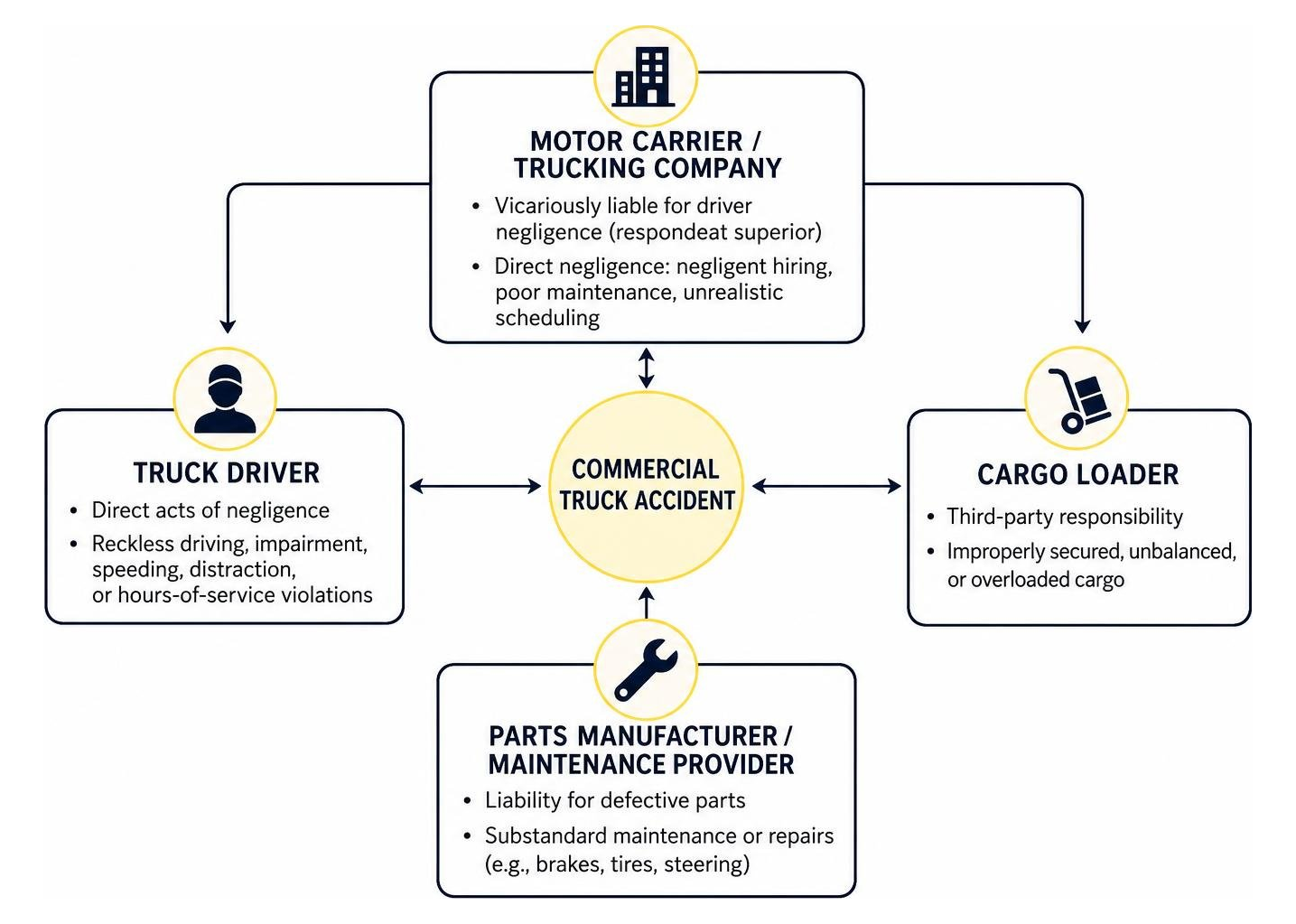
Potentially liable parties often include:
- The Truck Driver: For direct acts of reckless driving, impairment, speeding, or distraction.
- The Motor Carrier / Trucking Company: For enforcing unrealistic scheduling or neglecting vehicle inspections.
- Third-Party Cargo Loaders: For improperly securing or overloading freight.
- Maintenance and Repair Facilities: For substandard brake, tire, or engine repairs.
- Equipment Manufacturers: For defective truck components that failed on the roadway.
Critical Evidence in Commercial Truck Investigations
Unlike standard auto accidents, commercial cases hinge on proprietary digital data and regulatory filings. A focused investigation relies on issuing timely spoliation letters to preserve vital materials before they are legally destroyed or overwritten.
Essential evidence includes:
- Electronic Logging Device (ELD) Data: Proves whether the driver exceeded FMCSA Hours-of-Service rules.
- Engine Control Module (ECM / Black Box) Records: Records vehicle speed, braking inputs, throttle position, and steering angles leading up to impact.
- Driver Qualification Files (DQF): Contains commercial driver’s license records, pre-employment drug screening tests, and past safety violations.
- Pre-Trip and Post-Trip Inspection Reports (DVIR): Reveals whether the driver or fleet manager knowingly operated a malfunctioning rig.
- Accident Reconstruction and Expert Witness Testimony: Uses physics modeling and forensic data to prove how the crash unfolded.
Immediate Action Steps and Countering Insurer Defenses

The moments following a truck collision set the foundation for your legal claim. If you are physically able, take these steps at the scene:
- Call 911 Immediately: Ensure law enforcement and EMS respond so an official crash report is created.
- Seek Comprehensive Medical Care: Adrenaline often masks serious trauma like internal bleeding or spinal disc herniations.
- Document the Scene: Photograph the tractor, trailer markings, DOT registration numbers, skid marks, road conditions, and vehicle damage.
- Exchange Information: Collect the driver’s name, commercial driver’s license (CDL) number, carrier employer, and insurance policy details.
- Do Not Give Recorded Statements: Insurance adjusters frequently twist recorded answers to shift blame onto you.
Overcoming Trucking Company Defenses and Insurance Tactics
Trucking insurers deploy corporate rapid-response teams to the crash site within hours to build their defense. Common defense strategies include claiming you were in the truck driver’s “No-Zone” blind spot, alleging you cut off the rig, or arguing your injuries stemmed from pre-existing conditions.
Our legal team counters these tactics using digital ECM downloads, dashcam footage, and medical expert reviews. When navigating commercial vehicle accident settlements, having verified electronic evidence prevents insurers from minimizing the severity of the wreck.
Calculating Damages and Pursuing Full Financial Recovery
Due to the massive force generated by tractor-trailers, victims frequently suffer life-altering trauma, including traumatic brain injuries (TBI), spinal cord paralysis, complex fractures, and amputations. In 2020, the average settlement for a commercial truck accident lawsuit surpassed $1 million, with complex catastrophic cases frequently resolving for more than $5 million.
We pursue comprehensive recovery across two main categories of damages:
- Economic Damages: Past and future medical bills, surgical expenses, rehabilitation costs, home accessibility renovations, lost wages, and lost future earning capacity. Our team helps clients in managing medical bill options post crash to ensure outstanding hospital liens do not diminish their final settlement.
- Non-Economic Damages: Physical pain and suffering, mental anguish, permanent impairment, scarring and disfigurement, and loss of enjoyment of life.
- Punitive Damages: Awarded in rare cases where the motor carrier or driver acted with gross negligence or intentional misconduct, such as operating under the influence of illicit substances.
What to Expect When Hiring an Eighteen Wheeler Accident Lawyer
When you partner with our firm, we handle the entire legal burden while you focus on medical rehabilitation. We start by sending formal preservation demands to secure all black box data, dispatch logs, and maintenance records.
We represent clients on a contingency-fee basis, meaning you pay nothing upfront and owe zero legal fees unless we win your case. Review our breakdown of understanding truck accident lawyer costs to learn how contingency representation protects your family’s finances while allowing you to take on well-funded corporate defendants.
Frequently Asked Questions About Commercial Truck Crashes
How long do I have to file an eighteen-wheeler accident lawsuit in Clearwater, Florida?
Under Florida law, most personal injury lawsuits based on negligence must be filed within two years from the date of the crash. Wrongful death claims must also be filed within two years. Waiting to take action risks the loss of vital black box data and surveillance footage, so it is critical to consult legal counsel right away.
Who can be held liable in a multi-vehicle truck collision?
Liability can fall on multiple parties, including the commercial truck driver, the motor carrier, third-party logistics brokers, cargo loading companies, and maintenance contractors. Florida’s comparative fault rules allow damages to be apportioned among all parties responsible for causing the crash.
Why are eighteen-wheeler settlements typically larger than regular car crash settlements?
Truck accident claims involve higher settlement amounts because federal regulations require motor carriers to carry substantial commercial liability policies (typically starting at $750,000 to $5,000,000 or more). Additionally, the catastrophic physical injuries caused by commercial rigs result in far higher medical bills, extensive rehabilitation needs, and significant lost lifetime earnings.
Conclusion
Commercial eighteen-wheeler crashes leave behind overwhelming physical, emotional, and financial burdens. Motor carriers and their insurance companies act immediately to protect their bottom line, and you deserve a dedicated legal team that fights just as hard for you.
At Carey Leisure Carney, our Board-Certified trial attorneys bring over 100 years of combined legal experience to personal injury litigation across Clearwater, Largo, New Port Richey, Spring Hill, St Petersburg, Trinity, and Wesley Chapel, Florida. We provide direct attorney access and personalized guidance every step of the way. Contact our firm today for dedicated truck accident representation and let us fight for the full financial compensation you deserve.