
Healing Without the Headache: Understanding Your Medical Bill Options Post-Truck Crash
When a Truck Crash Leaves You Buried in Medical Bills
Truck accident medical bills can spiral into the tens or even hundreds of thousands of dollars — fast. Emergency transport, surgery, hospitalization, rehabilitation, and ongoing care all add up before you’ve even had time to process what happened.
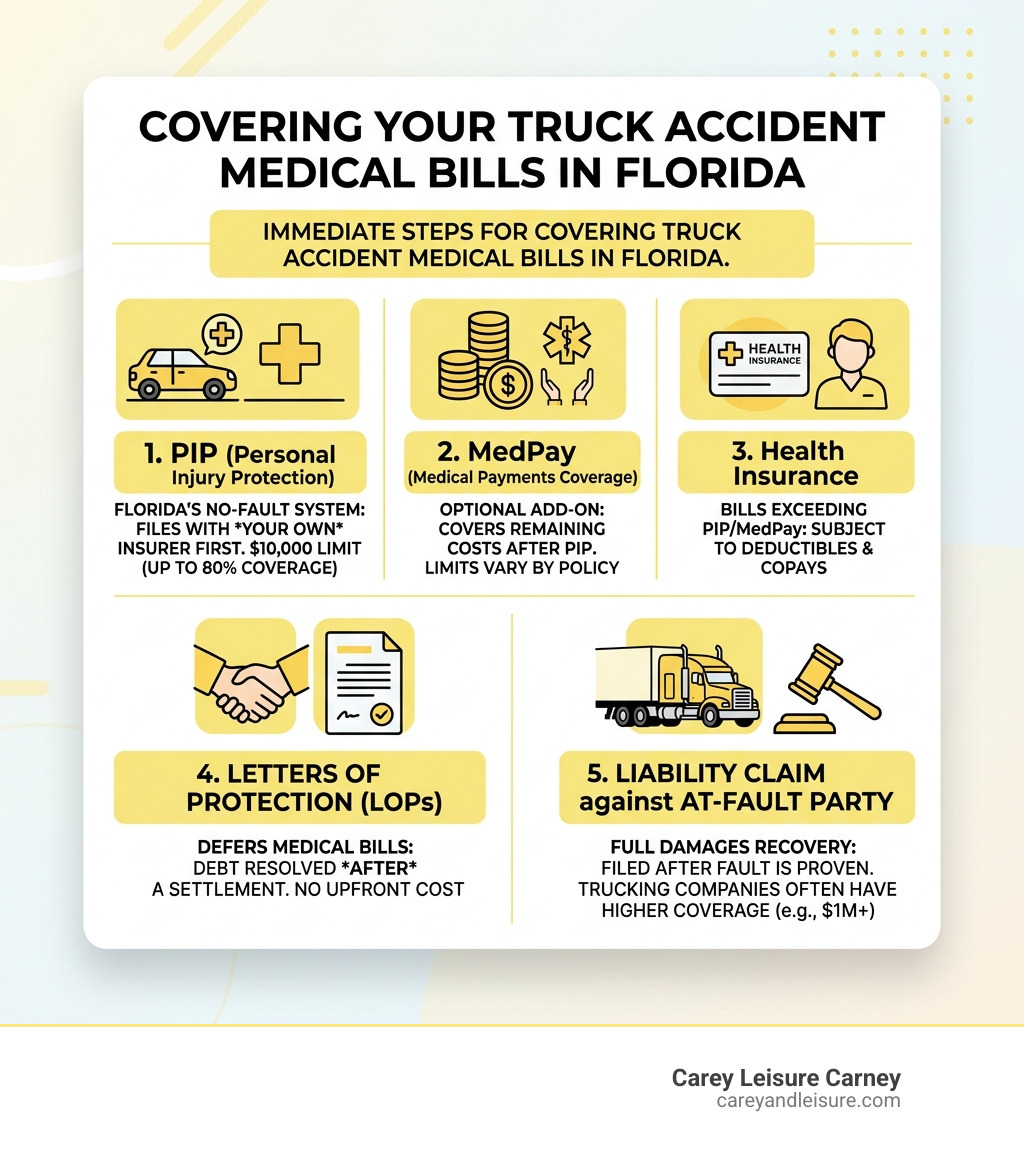
Here’s a quick overview of your main options for covering those costs in Florida:
| Payment Source | What It Covers | Key Limit |
|---|---|---|
| PIP (Personal Injury Protection) | 80% of medical expenses, regardless of fault | $10,000 max |
| MedPay | Remaining medical costs after PIP | Varies by policy |
| Health Insurance | Bills beyond PIP/MedPay | Subject to deductibles |
| Workers’ Compensation | If injured on the job | Replaces lost wages too |
| At-fault party’s liability insurance | Full damages after fault is proven | Often $1M+ for trucking companies |
| Letter of Protection (LOP) | Defers medical bills until settlement | No upfront cost |
The hard truth? Florida’s no-fault system means you file with your own insurer first — not the truck driver’s. And that $10,000 PIP limit gets used up quickly when a commercial truck is involved. These vehicles can weigh up to 30 times more than a passenger car, and the injuries they cause often require long-term care far beyond what basic insurance covers.
I’m Thomas W. Carey, a board-certified civil trial lawyer and founding partner at Carey Leisure Carney, and I’ve spent decades helping Florida injury victims navigate the full scope of truck accident medical bills — from immediate coverage gaps to long-term damages recovery. In this guide, I’ll walk you through exactly how to manage those costs step by step.
Terms related to Truck accident medical bills:
Immediate Steps to Manage Truck Accident Medical Bills
The moments following a collision with an 80,000-pound semi-truck are chaotic. However, what you do in the first few days determines whether your truck accident medical bills get paid or end up in collections. In Florida, we have a very specific set of rules that act as a ticking clock.
The 14-Day Rule
Florida law requires you to seek medical treatment within 14 days of the accident to qualify for Personal Injury Protection (PIP) benefits. If you wait until day 15 because you thought that “stiff neck” would go away, you may forfeit your right to use the $10,000 you’ve been paying for in your auto insurance premiums.
Determining an “Emergency Medical Condition” (EMC)
Not all PIP is created equal. To access the full $10,000 limit, a medical professional must determine that you have an “Emergency Medical Condition.” This is defined as a condition requiring immediate medical attention that could reasonably be expected to result in serious jeopardy to your health, serious impairment to bodily functions, or serious dysfunction of any organ. Without an EMC diagnosis, your PIP coverage is capped at a measly $2,500—which, let’s be honest, barely covers the cost of an ER waiting room chair these days.

Documentation is Your Best Friend
From the second you enter the hospital in Clearwater or New Port Richey, start a “bill binder.” Keep every receipt, every discharge summary, and every “Explanation of Benefits” (EOB). When we go to battle with a trucking company’s insurance, we need a paper trail that is impossible to ignore. For a deeper look at what is actually eligible for reimbursement, check out our guide on What Is Covered Under Personal Injury Protection.
How Florida’s No-Fault Insurance Covers Your Initial Costs
Florida is one of a handful of “no-fault” states. This doesn’t mean no one is at fault for the accident; it simply means that your own insurance company is responsible for paying your initial truck accident medical bills regardless of who caused the crash.
The $10,000 PIP Limit
Your PIP insurance covers 80% of all reasonable and necessary medical expenses. Note the math there: it only covers 80%. That leaves a 20% “gap” that you are technically responsible for out-of-pocket unless you have additional coverage.
What is MedPay?
Medical Payments coverage, or MedPay, is an optional add-on to your Florida auto policy. We highly recommend it. MedPay can be used to cover that 20% gap left by PIP, as well as your deductible. Think of it as the “bridge” that helps keep your bank account intact while you recover.
For more detailed information on how these policies work in our state, see What Is Pip Insurance Florida.
Maximizing PIP and MedPay for Truck Accident Medical Bills
When dealing with catastrophic injuries—the kind often seen in accidents involving commercial rigs in Trinity or Wesley Chapel—PIP disappears in a heartbeat. An air ambulance alone can cost $30,000 to $50,000.
To maximize your benefits, we look at your policy’s deductibles. Some people choose a $1,000 or $2,000 deductible to save on monthly premiums. If you have a deductible, your insurance won’t pay a dime until you’ve covered that amount yourself. We help our clients coordinate these payments so that the most urgent bills are addressed first. You can learn more about the nuances of these policies in Personal Injury Protection Pip Insurance 101 Part 2.
Handling Insurance Denials for Truck Accident Medical Bills
It is a frustrating reality: insurance companies are in the business of keeping money, not giving it away. They may deny your claim for several reasons:
- Lack of Medical Necessity: They claim the MRI or physical therapy wasn’t “necessary.”
- Coding Errors: A simple typo at the doctor’s office can trigger an automated denial.
- Independent Medical Exams (IME): The insurance company may send you to a doctor they pay for, who—surprise, surprise—concludes you are perfectly fine.
If your claim is denied, don’t panic. There is a formal appeal process. We work with medical experts to provide “letters of medical necessity” that challenge these denials and force the insurer to honor the contract you’ve paid for.
Bridging the Gap: Health Insurance, Workers’ Comp, and Liens
Once PIP and MedPay are exhausted (which happens quickly in truck cases), how do you pay the remaining $50,000 or $500,000 in truck accident medical bills? This is where the “collateral source rule” and subrogation come into play.
Using Private Health Insurance
You can and should use your private health insurance (like Blue Cross, United, or Aetna) for your treatment. However, your health insurer will likely keep a close eye on your legal case. Through a process called subrogation, they have the right to be paid back from your final settlement.
The good news? Lawyers can often negotiate these subrogation liens down. If your health insurer paid $20,000 for your surgery, we might negotiate that they accept $12,000 as full reimbursement, putting more money in your pocket at the end of the day.
Using Letters of Protection (LOP) for Truck Accident Medical Bills
What if you don’t have health insurance, or your insurance won’t cover a specific specialist you need? We can issue a Letter of Protection (LOP).
An LOP is a legal agreement between you, your attorney, and your medical provider. It allows you to receive necessary medical care now with no upfront cost. In exchange, the provider agrees to wait for payment until your case settles. This is a lifesaver for victims in St. Petersburg or Largo who need surgery but can’t afford the out-of-pocket costs. It also protects your credit score by keeping the bills out of collections while the legal process unfolds.
Curious about how courts view these costs? Read Medical Bills What Will A Court Consider To Be Reasonable.
The Role of Workers’ Compensation in Commercial Crashes
If you were driving for work when the truck hit you—perhaps you were a delivery driver in Spring Hill or a sales rep traveling between offices—Workers’ Compensation becomes the primary payer.
Workers’ Comp is great because it covers 100% of authorized medical bills and a portion of your lost wages. However, it can be restrictive regarding which doctors you can see. In these cases, we often pursue a “third-party claim” against the trucking company simultaneously. This allows you to get your bills paid by Workers’ Comp while seeking additional damages for pain and suffering from the negligent truck driver.
Proving Liability and Recovering Long-Term Damages
To get the trucking company’s insurance to pay for your truck accident medical bills, we have to prove they were at fault. This is much more complex than a standard car accident.
Investigating Trucking Negligence
Commercial trucks are “black boxes” of data. We immediately move to preserve:
- Electronic Logging Device (ELD) Data: To see if the driver was over their legal hour limits (driver fatigue).
- Event Data Recorders (EDR): To see speed, braking, and steering patterns right before impact.
- Maintenance Logs: To check if the brakes or tires were neglected.
Trucking companies have “rapid response teams” that arrive at crash sites within hours to find ways to blame you. We counter this with our own investigators. For more on how we handle this, see our Truck Accident Lawyer Role Guide.
Calculating Future Truck Accident Medical Bills with Life Care Plans
Many truck accident injuries, such as Traumatic Brain Injuries (TBI) or spinal cord damage, require a lifetime of care. You cannot settle your case based only on the bills you have today. You must account for the bills you will have ten, twenty, or thirty years from now.
We utilize Life Care Planners—medical experts who project every future expense, from wheelchair replacements and home modifications to future surgeries and home health aides. These projections are essential for securing a settlement that truly covers your needs. Learn more about this in What Are Life Care Plans In Personal Injury Cases.
Recovering Compensation Beyond Medical Expenses
While truck accident medical bills are the most immediate concern, they aren’t the only damages you’ve suffered. In a successful claim, we also pursue:
- Lost Wages: Income you missed while recovering.
- Loss of Earning Capacity: If you can no longer work in your previous profession.
- Pain and Suffering: The physical and emotional toll of the accident.
- Property Damage: Repairing or replacing your vehicle.
For a comprehensive look at what you can claim, read our Truck Accident Lawyer Complete Guide.
Frequently Asked Questions about Truck Accident Medical Bills
Who pays if the at-fault truck driver is uninsured?
While federal law requires most interstate trucking companies to carry at least $750,000 to $5 million in liability insurance, sometimes smaller “independent” contractors fly under the radar or have lapsed policies. In these cases, we look to your Uninsured/Underinsured Motorist (UM/UIM) coverage. This is insurance you carry to protect yourself when the other guy didn’t. We also investigate the parent company or the cargo loader to see if corporate liability applies.
How long does it take to get medical bills fully covered?
This is the hardest part: truck accident medical bills are usually not paid “as you go” by the at-fault party. They are paid in a one-time lump sum settlement at the end of your case.
We generally wait until you reach Maximum Medical Improvement (MMI)—the point where your condition has stabilized—before we begin final negotiations. If we settle too early and you discover you need another surgery six months later, you can’t go back for more money. A typical truck case can take anywhere from 12 to 24 months to resolve properly.
Can I recover pain and suffering damages in Florida?
Yes, but Florida has a “permanency threshold.” To recover non-economic damages like pain and suffering, your injury must consist of:
- Significant and permanent loss of an important bodily function.
- Permanent injury within a reasonable degree of medical probability.
- Significant and permanent scarring or disfigurement.
- Death.
Because of the sheer force of a truck impact, most of our clients meet this threshold easily.
Conclusion
Navigating the aftermath of a commercial vehicle collision is a heavy burden to carry alone. Between the aggressive tactics of trucking insurance adjusters and the complex web of Florida no-fault laws, it is easy to feel overwhelmed by the rising tide of truck accident medical bills.
At Carey Leisure Carney, we believe your only job should be healing. Our board-certified attorneys—a distinction held by only the top 2% of lawyers in Florida—have over 100 years of combined experience. We don’t just pass you off to a paralegal; you get direct access to your attorney. We’ve recovered millions for families in Clearwater, St. Petersburg, and across the Tampa Bay area, and we are ready to put that experience to work for you.
If you’re worried about how you’ll pay for your recovery, don’t wait for the bills to hit collections. Contact a Clearwater Truck Accident Attorney today for a free, no-obligation consultation. Let us handle the headache so you can focus on the healing.