
Finding the Right Lawyers for Slip and Fall Accidents Can Save Your Injury Claim
Choosing Lawyers for Slip and Fall Accidents in Tampa Bay
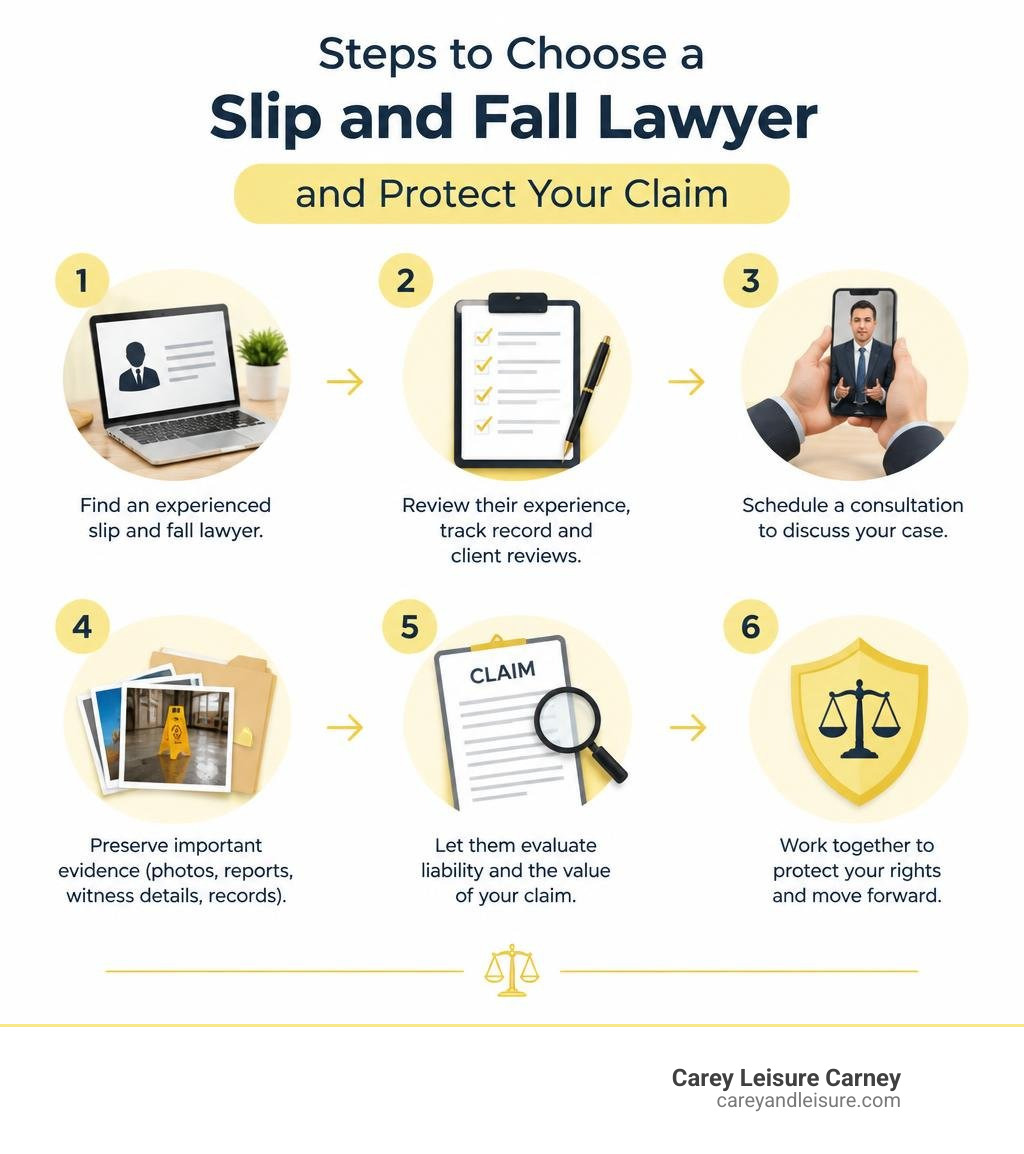
If you were hurt after falling on someone else’s property, speak with a lawyer quickly. Lawyers for slip and fall accidents can preserve video, incident reports, photos, witness details, and maintenance records before they disappear. They can also assess whether a property owner knew, or reasonably should have known, about a dangerous condition and failed to fix or warn about it.
A fall is not automatically a legal claim. But wet floors, uneven walkways, broken handrails, poor lighting, and unsafe stairs may support a premises liability case when negligence caused your injury. Get medical care promptly, report the fall, photograph the hazard if you can do so safely, and keep the shoes and clothing you wore.
Falls can cause serious harm, especially to older adults. They are the leading cause of injury-related death among U.S. adults age 65 and older, according to the CDC.
I am Thomas W. Carey, a board-certified civil trial lawyer and founding partner of Carey Leisure Carney, with decades of experience handling personal injury matters in Tampa Bay. This guide explains what lawyers for slip and fall accidents look for, what evidence matters, and how to protect a possible claim.
Lawyers for slip and fall accidents terms you need:
- best attorney for slip and falls
- best slip and fall attorneys near me
- the best slip and fall attorneys
Understanding Premises Liability and Property Owner Negligence
Premises liability is the area of personal injury law that holds property owners, landlords, business operators, and property managers accountable when their failure to maintain safe premises causes someone harm. Under Florida law, just because an accident takes place on another person’s property does not mean that the property owner is automatically liable. A viable legal claim requires showing that the owner or manager breached their legal duty of care.
The duty of care a property owner owes you depends heavily on your legal status at the time of the incident:
- Invitee (Business or Public Invitee): You enter the property for business purposes (such as shopping in a grocery store in Clearwater or dining at a restaurant in St. Petersburg) or as a member of the public on land opened to the public (such as a community park in Largo). Property owners owe invitees the highest duty of care. They must maintain the premises in a reasonably safe condition, correct known hazards, inspect the property regularly for hidden dangers, and warn visitors of unsafe conditions.
- Licensee (Social Guest): You enter the property with the owner’s express or implied permission for your own convenience or social purposes (like visiting a friend’s home in Trinity or New Port Richey). Owners owe licensees a duty to refrain from wanton negligence and to warn them of known, concealed dangers that the visitor is unlikely to discover.
- Trespasser: You enter the property without permission, license, or legal right. Property owners generally owe undiscovered trespassers no affirmative duty except to refrain from intentional, willful, or wanton harm. However, under the attractive nuisance doctrine, property owners owe a heightened duty of care to protect child trespassers from dangerous features like unguarded swimming pools or unfenced construction sites.
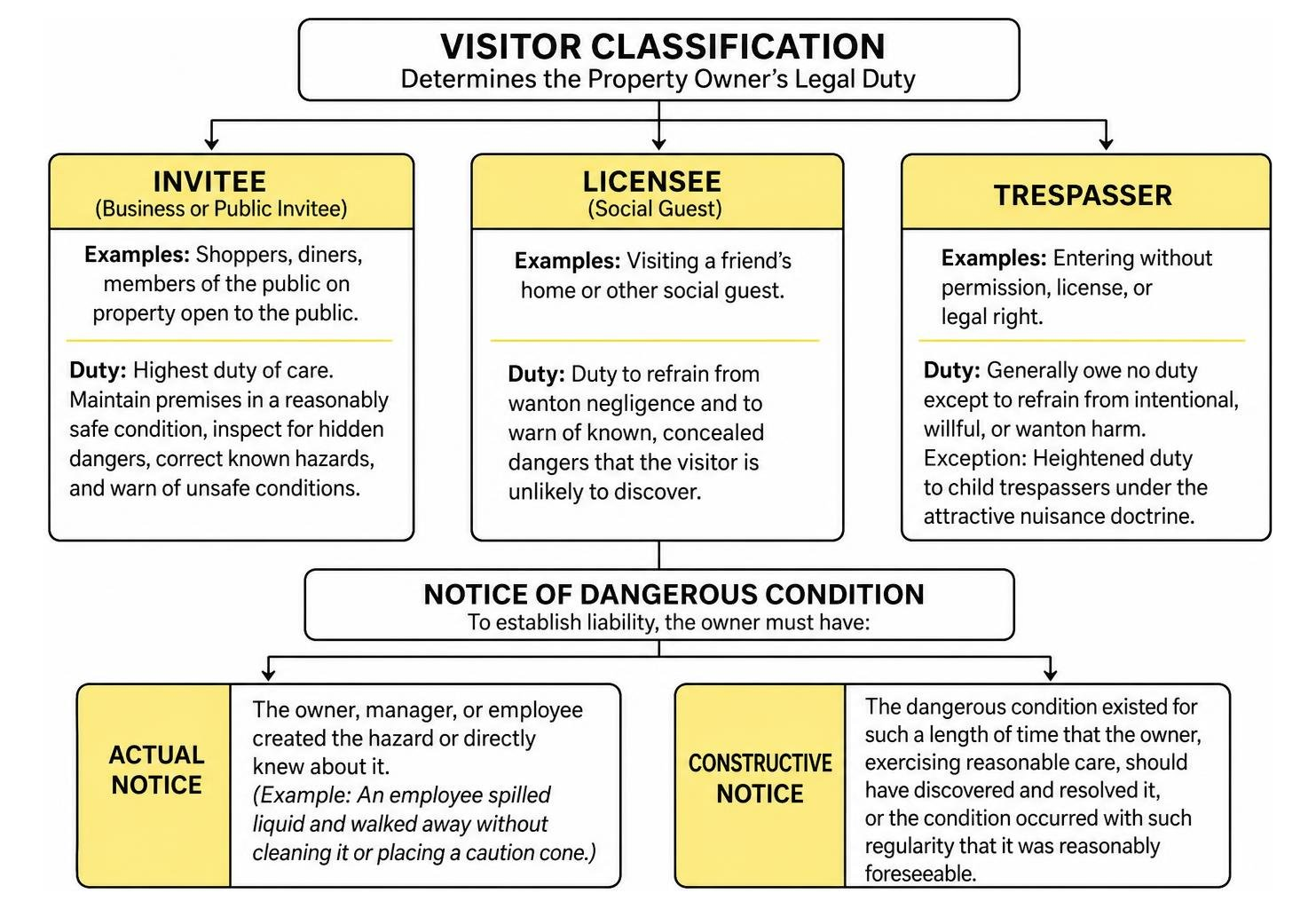
To establish liability, you must also prove whether the owner had actual notice or constructive notice of the dangerous condition:
- Actual Notice: The owner, manager, or employee created the hazard or directly knew about it (for instance, an employee spilled liquid and walked away without cleaning it or placing a caution cone).
- Constructive Notice: The dangerous condition existed for such a length of time that the owner, exercising reasonable care, should have discovered and resolved it, or the condition occurred with such regularity that it was reasonably foreseeable.
| Visitor Classification | Definition & Example | Legal Duty of Care Owed |
|---|---|---|
| Business Invitee | Customer at a retail store, grocery market, or restaurant | Highest duty: inspect premises, repair hazards, and warn of dangers |
| Public Invitee | Visitor at a public library, community center, or park | Highest duty: maintain safe premises and provide adequate warnings |
| Licensee | Social guest, neighbor, or friend visiting private property | Moderate duty: warn of known, concealed dangers not easily seen |
| Trespasser | Uninvited individual on private property without permission | Minimal duty: refrain from intentional harm (heightened for children) |
How Lawyers for Slip and Fall Accidents Prove Fault and Maximize Recovery
Winning a premises liability claim requires satisfying a rigorous burden of proof. We must prove four essential legal elements:
- Duty: The property owner owed you a legal duty to maintain a safe environment.
- Breach: The owner breached that duty by failing to remedy or warn about an unreasonable hazard.
- Causation: The dangerous condition directly caused your slip, trip, or fall.
- Damages: You suffered verifiable physical, financial, and emotional injuries as a result.

Commercial property owners and insurance carriers defend these claims aggressively. Insurers routinely claim that the victim was distracted, that the dangerous condition was “open and obvious,” or that the business had no notice of the hazard. Without prompt investigation and strategic evidence preservation, critical evidence can be deleted or overwritten within days.
Common Dangerous Hazards and Slip and Fall Injuries
Every day, hazardous conditions create preventable accidents across commercial and residential spaces:
- Wet and Slippery Floors: Spills in supermarket aisles, recently mopped flooring without warning signs, tracked-in rainwater at building entryways, and grease buildup near restaurant kitchens.
- Uneven Walking Surfaces: Cracked sidewalks, torn carpeting, loose floorboards, sudden transitions between flooring materials, and hidden potholes in parking lots.
- Defective Stairs and Handrails: Broken, loose, or missing handrails, uneven step risers, worn stair treads, and poorly illuminated stairwells.
- Cluttered Walkways: Merchandise left in store aisles, extension cords across hallways, and loose debris.
The physical consequences of a sudden fall can be life-altering. Common injuries include:
- Hip Fractures: Extremely common among older adults, often requiring emergency surgery, joint replacement, and months of intensive rehabilitation.
- Traumatic Brain Injuries (TBIs): Striking the ground or a hard fixture can lead to concussions, contusions, or subdural hematomas.
- Spinal Cord and Back Injuries: Herniated discs, fractured vertebrae, and nerve impingement that create chronic pain and mobility limitations.
- Fractures and Soft-Tissue Damage: Broken wrists, ankles, and collarbones from natural bracing reflexes, as well as torn ligaments and tendons.
How Lawyers for Slip and Fall Accidents Investigate Dangerous Conditions
Building a compelling premises liability case requires comprehensive evidence gathering right from the start:
- Securing Surveillance Video: Many retail establishments and commercial properties have security cameras. We send immediate spoliation letters to compel property owners to preserve footage showing the hazard, the fall, and how long the condition existed before the accident.
- Reviewing Maintenance and Sweep Logs: Examining store logs helps determine whether employees were conducting regular inspections or neglecting routine safety sweeps.
- Scene Photographs and Measurements: Capturing high-resolution photos of the defect, lighting levels, liquid puddles, and absence of warning signs before the owner repairs or cleans the area.
- Witness Statements: Interviewing eyewitnesses, other shoppers, and former employees regarding their observations and past complaints.
- Footwear Preservation: Preserving the shoes you wore during the fall to prove that your footwear had adequate tread and did not cause the incident.
Calculating Economic and Non-Economic Damages in Florida
Falls represent the second leading cause of accidental injury deaths worldwide, and the financial impact on victims can be devastating. In Florida alone, the annual healthcare cost of older adult falls reaches approximately $4 billion each year.
When we pursue a personal injury claim, we seek comprehensive compensation for:
- Economic Damages:
- Past and future medical expenses (emergency room care, surgeries, hospital stays, doctor visits, medications).
- Physical therapy, chiropractic treatment, and long-term rehabilitation.
- Lost income from missed work time.
- Diminished future earning capacity if your injuries prevent you from returning to your prior career.
- Assistive medical devices, home modifications, and out-of-pocket care costs.
- Non-Economic Damages:
- Physical pain and suffering.
- Emotional distress, depression, and anxiety.
- Loss of enjoyment of life and inability to participate in hobbies.
- Loss of consortium and companionship.
Critical Steps in the Slip and Fall Claim Timeline
What you do immediately following an accident impacts your physical recovery and your legal rights:
- Seek Immediate Medical Attention: Go to an emergency room, urgent care center, or your primary physician right away. Some severe injuries, such as internal bleeding or head trauma, do not present immediate symptoms due to adrenaline. Prompt medical records directly link your injuries to the fall.
- Report the Incident: Notify the property owner, store manager, or landlord immediately. Request that they complete a formal written incident report, and obtain a copy or the report identification number before leaving.
- Document Everything: Take photos and videos of the exact hazard, your injuries, and the surrounding area. Collect names and contact details of all witnesses.
- Preserve Physical Evidence: Place your unwashed clothing and the exact shoes you were wearing in a secure bag.
- Decline Recorded Statements: Do not provide recorded statements or sign settlement releases for insurance adjusters until you consult a legal professional.
What to Bring When Meeting Lawyers for Slip and Fall Accidents
During your initial consultation, having organized documentation allows us to evaluate your claim efficiently:
- Copies of the store or property incident report.
- Photographs and videos of the accident scene, the hazardous condition, and your visible injuries.
- Contact information for any eyewitnesses.
- Medical records, discharge paperwork, diagnostic imaging reports, and doctor notes.
- Medical bills and receipts for out-of-pocket expenses.
- Proof of lost income (such as recent pay stubs or tax forms).
- The shoes and clothing you were wearing when the fall occurred.
- All letters, emails, or claim numbers from insurance adjusters.
How Contingency Fees Work in Personal Injury Claims
You should never have to worry about how to afford high-quality legal representation while recovering from a serious injury. We handle personal injury and premises liability claims on a contingency fee basis.
Under a contingency fee arrangement:
- You pay no upfront costs or out-of-pocket legal retainer fees.
- We cover all expenses related to investigating your claim, hiring expert witnesses, obtaining records, and taking the case to court.
- Our legal fee is a set percentage recovered directly from the final settlement or jury verdict.
- If we do not successfully recover compensation for your case, you owe us nothing in attorney fees.
Frequently Asked Questions About Slip and Fall Claims
Are slip and fall accident cases difficult to prove in Florida?
Yes, premises liability claims can be challenging to prove. Under Florida law, the injured party carries the burden of proving that the property owner had actual or constructive knowledge of the dangerous condition and failed to correct it. Insurance companies often try to shift blame to the injured person under comparative fault rules. Overcoming these defenses requires swift evidence preservation, witness testimony, maintenance record analysis, and medical documentation.
How long do you have to file a slip and fall lawsuit in Florida?
Under Florida Statute 95.11, the statute of limitations for general negligence claims, including premises liability, is strictly enforced. In most cases, you must file your lawsuit within two years from the date of the accident. Failing to file within this statutory window permanently forfeits your right to seek financial compensation in court.
What happens if I fell on government property?
Claims against municipal, county, or state government entities (such as a fall in a public building in Spring Hill or on a damaged sidewalk in Wesley Chapel) involve sovereign immunity laws. These cases have much stricter procedural rules, including mandatory pre-suit notice requirements and substantially shorter deadlines than standard private claims.
Conclusion
A sudden slip, trip, or fall can disrupt your physical health, your family’s stability, and your financial security. You do not have to confront corporate insurance companies and property owners alone.
At Carey Leisure Carney, our board-certified trial attorneys bring over 100 years of combined experience representing injured individuals across Clearwater, Largo, St. Petersburg, New Port Richey, Trinity, Spring Hill, and Wesley Chapel. We provide direct attorney access, personal attention, and dedicated representation to help you secure the full compensation you deserve.
If you or a loved one suffered injuries on someone else’s property, contact our experienced slip and fall attorney team today for a free, no-obligation consultation to protect your rights.