Car accident legal advice: 5 Crucial Steps
Why Car accident legal advice is Essential After a Florida Crash
Car accident legal advice is critical after a collision. A car accident is a shocking experience, often leaving you overwhelmed by medical bills, insurance calls, and legal confusion.
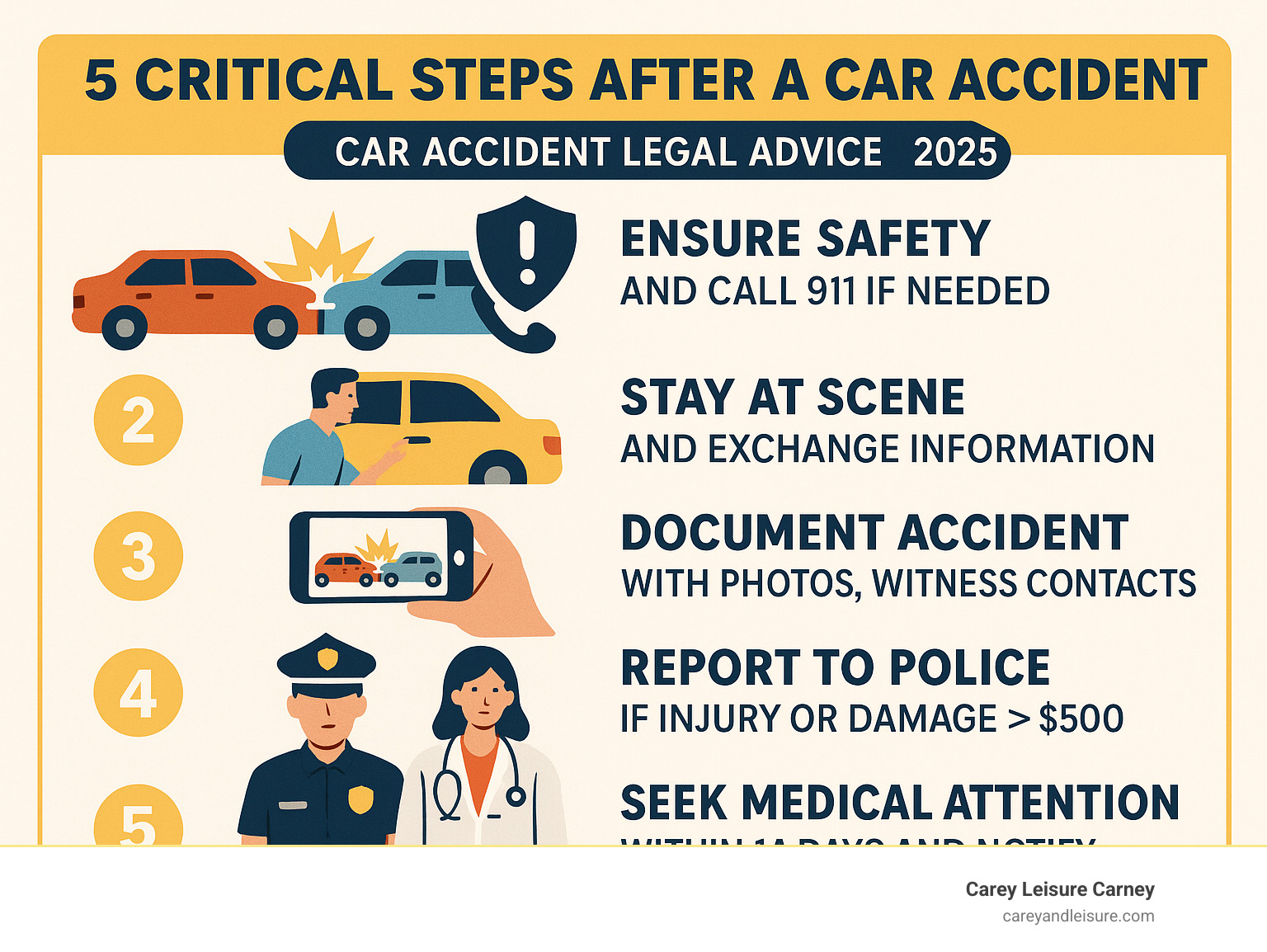
Immediate steps you need to take:
- Stay at the scene – It’s required by Florida law
- Call 911 – For injuries or property damage over $500
- Document everything – Photos, witness info, driver details
- Seek medical attention – Within 14 days to keep PIP benefits
- Contact your insurance – Report the accident promptly
- Consult a lawyer – Before speaking to other insurance companies
In 2018 alone, Florida reported 401,851 accidents with 254,484 resulting in injuries and 3,150 fatal crashes. On an average day, approximately 325 Canadians sustain injuries from motor vehicle accidents, with about one in 10 victims requiring hospitalization.
After an accident, you must steer Florida’s complex no-fault insurance system, understand Personal Injury Protection (PIP) benefits, and face insurance adjusters focused on their company’s bottom line.
The legal process is complex. Florida has specific information exchange and reporting requirements, and it operates under comparative negligence rules that can affect your compensation. You have only two years from the accident date to file a lawsuit, making time a critical factor.
This guide outlines the essential legal steps to protect your rights and secure fair compensation after a Florida car accident.
Your First 24 Hours: Critical Steps After a Florida Car Accident
What you do in the first 24 hours after a car accident can make or break your case. It’s normal to feel overwhelmed, but taking the right steps is crucial.
Your safety comes first. If you can safely move your car, pull over to the shoulder and turn on your hazard lights. If anyone is injured or there’s significant damage, call 911 immediately. For a complete step-by-step guide, check our article on what to do after a car accident in Florida.

Once everyone is safe, document everything with your smartphone: damage to all vehicles, final car positions, road conditions, traffic signs, and skid marks. Take both wide shots and close-ups. If you or your passengers have visible injuries, photograph those as well.
Exchange information with everyone involved, including passengers and witnesses. Get their contact details, insurance information, and driver’s license numbers. You need this information even if the other driver seems friendly and promises to handle it without insurance.
Crucially, avoid admitting fault. Comments like “I’m sorry” or “I didn’t see you” can be used against you later. Stick to the facts. Our guide on documenting evidence in personal injury claims explains what to capture.
Reporting the Accident Under Florida Law
Florida has strict accident reporting laws. Under Florida law, you must report any accident causing over $500 in property damage or any injuries. Leaving the scene without reporting can result in a second-degree misdemeanor with fines and possible jail time.
When police arrive, be cooperative but careful. Answer questions honestly, but do not guess or speculate. The police report is the official record. Make sure to collect the other driver’s full name and contact information, driver’s license number, vehicle registration, insurance company and policy number, and their vehicle’s make, model, year, and license plate number. Also, get witness contact details, as their unbiased accounts are valuable.
Request a copy of the police report once it’s available. If you hear the other driver giving false information to the officer, correct the record.
Seeking Immediate Medical Attention
Don’t make the costly mistake of skipping a doctor’s visit because you “feel fine.” Adrenaline can mask serious injuries like whiplash or a concussion, which may only appear hours or days later.
Florida’s 14-day rule is non-negotiable. You must seek medical treatment within 14 days of your accident to preserve your Personal Injury Protection (PIP) benefits. Missing this deadline could mean losing thousands in medical coverage.
Medical records are the foundation of your claim, creating an official timeline that connects your injuries to the accident. Without this proof, it’s nearly impossible to prove the crash caused your injuries. This is especially true for conditions like traumatic brain injuries, which we cover in our article on car accidents and traumatic brain injuries.
Follow through with all recommended treatments and appointments. Keep every medical bill and record. This documentation proves your injuries and their impact on your life. For more car accident legal advice on post-accident medical care, read our guide: You’ve been in an accident, what’s next? Part 2: Medical Attention. You are treating your injuries and building the medical foundation for your claim.
Navigating Florida’s Insurance System: PIP, Claims, and Compensation
Florida operates under a “no-fault” system. This means your own insurance company pays for your initial medical expenses and lost wages through your Personal Injury Protection (PIP) coverage, regardless of who caused the accident. This system was designed to provide quick access to medical care without waiting for fault to be determined.
Here’s how Florida’s two main compensation paths compare:
| Feature | PIP (No-Fault) Benefits | Tort (At-Fault) Lawsuit Claims |
|---|---|---|
| Payer | Your own insurance company | At-fault driver’s insurance or the driver directly |
| Fault | Doesn’t matter – you’re covered regardless | You must prove the other driver was at fault |
| Coverage | Medical expenses, 80% of lost wages, limited death benefits | All medical bills, full lost wages, pain and suffering, property damage |
| Threshold | Must see doctor within 14 days | Must meet “permanent injury” threshold for non-economic damages |
| Process | File claim with your insurer | Legal lawsuit against at-fault party |
However, the no-fault system has limits. If your injuries are serious enough to meet Florida’s “permanent injury” threshold, you can step outside the system and pursue a tort claim against the at-fault driver. This is where car accident legal advice becomes invaluable.
Insurance companies often try to minimize payouts by rushing a settlement, downplaying your injuries, or creating confusion about fault. Having experienced legal guidance is critical, as we explain in The Role of Insurance Companies in a Car Accident.
Understanding Your Compensation Options
In a tort claim, you can seek two main categories of damages.
Economic damages are tangible costs with a clear dollar amount. This includes your medical bills (current and future), lost wages, future income loss if your earning capacity is diminished, rehabilitation costs, and property damage.
Non-economic damages are harder to quantify but represent significant life impacts. This includes pain and suffering (physical and emotional), mental anguish, loss of enjoyment of life, disfigurement, and loss of consortium.
In rare cases of extreme recklessness, like drunk driving, courts may award punitive damages to punish the wrongdoer.
Properly calculating these damages, especially future costs, requires detailed medical documentation and expert legal guidance. For details on PIP, see our articles Personal Injury Protection (PIP) Insurance 101 – Part 2 and What is covered under Personal Injury Protection?. To understand the full scope of compensation, visit Car Accident Compensation Florida.
Dealing with Uninsured or Underinsured Drivers
Not every driver in Florida carries adequate insurance. This is where Uninsured Motorist (UM) coverage becomes your financial lifeline. If the at-fault driver has no insurance, your UM coverage steps in to cover your medical bills, lost wages, and pain and suffering. Underinsured Motorist (UIM) coverage applies when the at-fault driver’s insurance is insufficient.
UM/UIM coverage protects you when other drivers are uninsured or underinsured. Your own insurer essentially pays what the at-fault driver should have paid.
Policy stacking may allow you to combine the UM limits from multiple vehicles on your policy, creating a larger pool of coverage. For example, stacking two cars with $100,000 in UM coverage could give you access to $200,000.
Hit-and-run accidents are also covered by UM, which treats the fleeing driver as an uninsured motorist.
Without UM/UIM, your only option may be to sue the uninsured driver personally. However, this is often fruitless, as they typically lack assets to pay a judgment. Our guide Uninsured vs. Underinsured Motorist Coverage Explained provides more detail.
Proving Your Case: Fault, Evidence, and Legal Deadlines
Building a strong car accident case is about proving what happened. When seeking car accident legal advice, understanding how to establish fault and gather evidence is critical to your success.

The clock starts ticking immediately. In Florida, you have two years from the accident date to file a lawsuit. This deadline, the statute of limitations, is strict. If you miss it, you lose your right to seek compensation through the courts.
To prove fault, you must establish the four elements of negligence: the other driver had a duty to drive safely; they breached that duty (e.g., by running a red light); this breach caused your injuries; and you suffered real damages as a result.
Your evidence tells this story. The police report, photos from the scene, witness statements, and medical records all help complete the picture of what happened.
For guidance on determining fault, see How to tell who is at fault in a car accident. Understanding The Litigation Process can also help you prepare.
Florida’s Comparative Negligence Rule
Car accidents aren’t always black and white. What if you share some of the blame? Unlike many states, Florida’s law is forgiving.
Florida follows pure comparative negligence, meaning you can still recover compensation even if you were partially responsible. Your award is simply reduced by your percentage of fault.
For example, if a jury awards you $100,000 in damages but finds you were 30% at fault, you would receive $70,000. Even if you were 80% at fault, you could still recover 20% of your damages.
The challenge is that insurance companies will use this rule to assign you as much fault as possible to reduce their payout. This is why experienced car accident legal advice is so important to counter these tactics. Learn more in our guide on Comparative Negligence.
The Importance of Medical Records for Car Accident Legal Advice
Your medical records are the foundation of your legal case. They are crucial for three reasons.
First, they document the severity of your injuries with precision through X-rays, MRI scans, and doctor’s notes. They show the full impact of the injuries on your life.
Second, medical records establish causation—the vital link between the accident and your injuries. A doctor’s opinion connecting your condition to the crash carries tremendous weight.
Third, these records help justify future medical costs. For serious injuries like Spinal Cord Injuries, experts use your records to create a life care plan, a roadmap of future medical needs and their costs. These plans are explained at What are life care plans in personal injury cases? and can be worth hundreds of thousands of dollars.
We work with your healthcare providers to ensure their documentation tells the complete story, clearly establishing causation and the full extent of your injuries, which is vital for your claim.
Why You Need Expert Car accident legal advice
Dealing with a car accident while healing is overwhelming. You shouldn’t have to steer Florida’s complex legal system alone.

Insurance companies have teams of lawyers working to minimize what they pay you. They are businesses focused on their bottom line, not your recovery.
That’s where expert car accident legal advice is invaluable. At Carey Leisure Carney, we level the playing field. Our Board-Certified attorneys represent the top 2% in Florida, with over 100 years of combined experience. We provide direct attorney access and personalized service.
Cost is a common concern, but we work on a contingency fee basis. This means you don’t pay us unless we win your case. This arrangement gives you quality legal representation with no upfront costs. Learn more at How much does it cost to hire a personal injury attorney?.
Having professional legal guidance is critical. We understand Florida’s no-fault system, comparative negligence rules, and insurance company tactics. For more on why representation matters, see Why You Need a Personal Injury Lawyer.
How a Lawyer Strengthens Your Claim
While you focus on healing, we act as your advocates, investigators, and negotiators.
- Calculating true damages is more than adding up medical bills. We assess all losses, including future medical needs, lost earning capacity, and pain and suffering.
- Negotiating settlements is where our experience shines. We counter adjuster tactics and negotiate from a position of strength to secure fair compensation.
- Handling medical liens from health insurers or Medicare can save you money. We negotiate with lien holders to reduce what you owe from your settlement.
- Using expert witnesses, like medical professionals or accident reconstructionists, can definitively establish fault and the extent of your injuries.
- Preparing for court strengthens our negotiating position. While most cases settle, our readiness for trial shows insurers we are serious.
For more insights, Nolo’s legal encyclopedia offers information on How an Attorney Can Help With Your Car Accident Claim.
Handling Specific Accident Types
Different accidents require specialized knowledge.
- Truck accidents are uniquely complex, involving federal regulations, multiple liable parties (driver, trucking company, etc.), and catastrophic injuries. Our Truck Accident Attorney team has the necessary experience.
- Motorcycle accidents have unique challenges, including unfair rider bias and devastating injuries. Our Motorcycle Accident Attorney specialists know how to build strong cases.
- Pedestrian accidents involve vulnerable road users with specific legal protections. These cases often hinge on right-of-way rules and result in severe injuries. Our Pedestrian Accident Attorney team fights for the compensation victims deserve.
Frequently Asked Questions about Florida Car Accident Claims
After a car accident, you’ll have many questions. Here are answers to the most common concerns.
What if the at-fault driver is uninsured or I was in a hit-and-run?
This is a frustrating scenario, but you have options for compensation. Your Uninsured Motorist (UM) coverage is your lifeline. Your own insurance company steps in to cover your medical bills, lost wages, and pain and suffering up to your policy limits.
This protection also applies to hit-and-run accidents, as your UM coverage treats the fleeing driver as an uninsured motorist.
Without UM coverage, you can sue the driver personally, but they often lack assets to pay a judgment. This is why robust UM coverage is so important.
Can I still get compensation if the accident was partially my fault?
Yes. Florida’s pure comparative negligence rule allows you to recover compensation even if you were partially at fault for the accident.
Your compensation is simply reduced by your percentage of fault. For example, if your damages total $80,000 and you are found 25% at fault, you would receive $60,000.
Unlike in many states, there is no cutoff point. Even if you were 70% at fault, you could still recover 30% of your damages. Insurance companies will try to maximize your fault to reduce their payout, which is why experienced car accident legal advice is crucial to minimize your attributed fault.
Do I need a lawyer for a minor accident with no apparent injuries?
The answer is it depends, but you should always consider a legal consultation. The “minor accident” trap is real. Adrenaline can mask serious injuries like whiplash or concussions, which may not appear for days.
Remember Florida’s 14-day rule for PIP benefits. If you develop symptoms later but haven’t seen a doctor, you could forfeit your benefits. A lawyer becomes necessary if the insurance company denies fault, refuses coverage, makes a low offer, or isn’t taking your claim seriously.
Our initial consultations are free. We will assess your situation, explain your rights, and provide honest car accident legal advice on whether you need representation.
Conclusion: Taking the Right Steps to Protect Your Future
A car accident can turn your world upside down, but you don’t have to steer this challenging time alone.
The most important lesson is that time is critical. Florida’s two-year statute of limitations and 14-day PIP window mean you cannot afford to wait. Evidence disappears and witness memories fade.
Document everything, as your future compensation depends on it. Those photos, medical records, and witness statements are the building blocks of your case.
Understanding Florida’s no-fault system, comparative negligence, and PIP rules is vital. Insurance companies know these laws and will use them to their advantage. Don’t try to handle a complex claim alone. You need a skilled professional to counter the insurance adjuster and fight for your interests.
At Carey Leisure Carney, we’ve spent over 100 years combined helping people just like you. Our Board-Certified attorneys (top 2% in Florida) are committed to personalized service. You’ll have direct access to your attorney throughout your case.
We understand the toll an accident takes, which is why we work on a contingency fee basis. You pay nothing unless we win, ensuring we are invested in your success.
Don’t face this alone. Let us provide the expert car accident legal advice you need to protect your future and secure the compensation you deserve.
Contact a personal injury attorney today to schedule your free consultation. We have offices conveniently located in Clearwater, Largo, New Port Richey, Spring Hill, St Petersburg, Trinity, and Wesley Chapel, Florida, ready to serve you.