

Emergency Room Malpractice Lawyer: Expert Guide 2025
Why Emergency Room Errors Demand Immediate Legal Action
An emergency room malpractice lawyer represents patients who have been harmed by negligent care in ER settings. If you or a loved one suffered injury or death due to an ER error, here’s what you need to know:
When to Contact an ER Malpractice Lawyer:
- You experienced a misdiagnosis or delayed diagnosis in the ER
- Your condition worsened due to delayed treatment or medication errors
- You were discharged prematurely and suffered complications
- A loved one died due to suspected ER negligence
- You have medical bills and lost wages from preventable harm
What an ER Malpractice Lawyer Does:
- Reviews your medical records for evidence of negligence
- Consults expert witnesses to establish the standard of care was breached
- Proves the ER error directly caused your injury
- Negotiates with hospitals and insurance companies
- Files a lawsuit within Florida’s strict time limits
Emergency rooms are supposed to save lives. When seconds count, patients trust ER doctors and nurses to act quickly and correctly. Yet medical errors are the third leading cause of death in the United States, and many of these tragedies unfold in the chaotic environment of emergency departments.
Over 136 million Americans visit emergency rooms each year. Most receive appropriate care. But when ER staff fail to diagnose critical conditions like heart attacks, strokes, or sepsis—or when they discharge patients too soon, administer the wrong medication, or misinterpret test results—the consequences can be catastrophic.
The nature of the ER is not an excuse for negligence. When understaffing, poor communication, or systemic failures lead to preventable harm, victims have the right to seek justice and compensation.
I’m Thomas W. Carey, a board-certified civil trial lawyer who has guided roughly 40,000 injury matters across Florida since 1988, including complex medical malpractice cases where emergency room malpractice lawyers must prove that split-second decisions fell below the accepted standard of care. My firm works on a contingency basis, meaning you pay nothing unless we win your case.
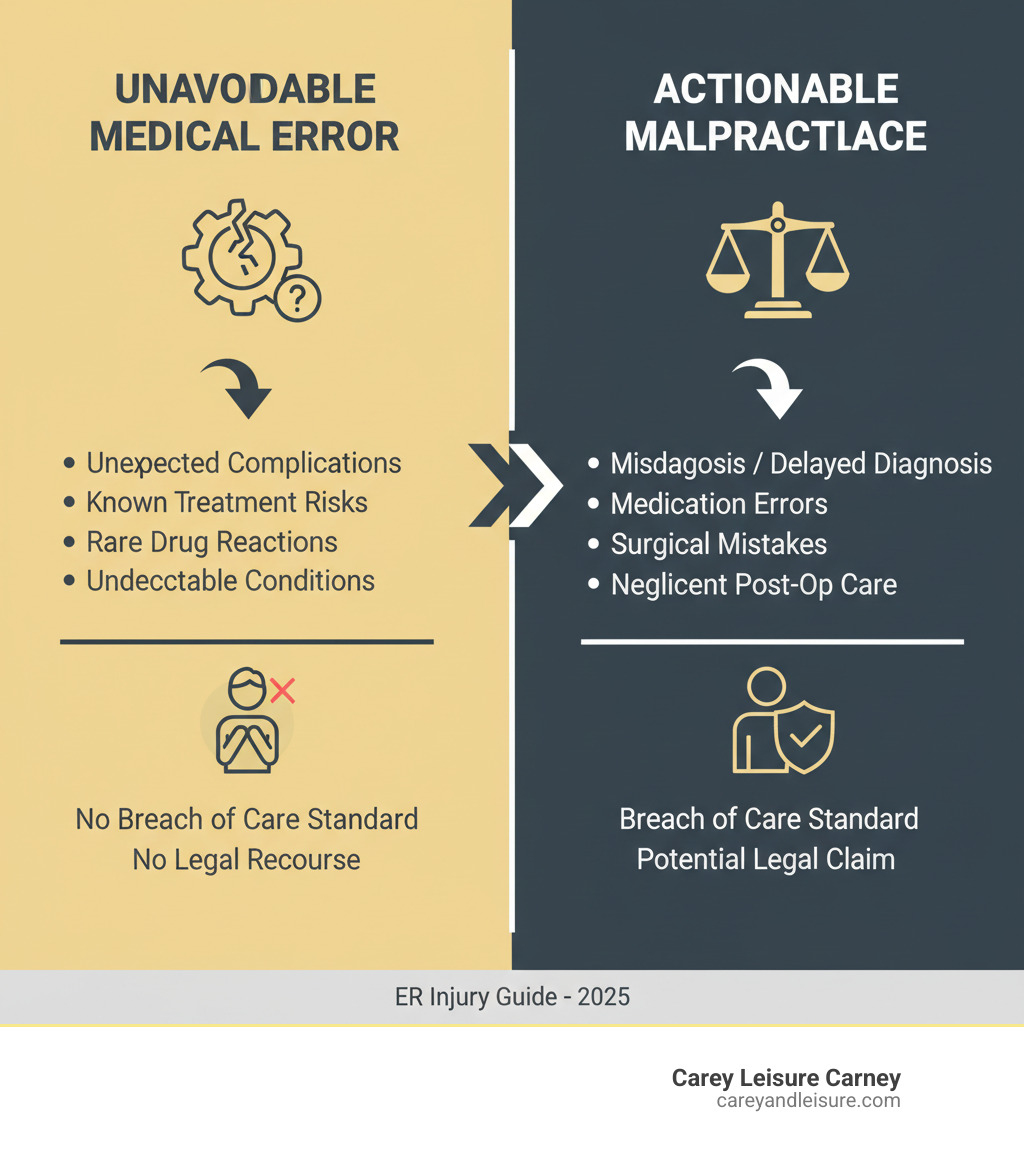
Understanding Emergency Room Malpractice: When Errors Become Negligence
Not every mistake in an emergency room constitutes medical malpractice. An error becomes actionable negligence when a healthcare provider’s actions fall below the accepted standard of care, directly causing a patient’s injury. This means they failed to provide the level of care that a reasonably prudent medical professional would have under similar circumstances.
While the ER is a high-pressure environment, this does not excuse negligence. Systemic issues like understaffing, poor communication, or inadequate resources can lead to preventable, life-threatening mistakes. When these failures result in harm, victims have the right to seek justice.
Common Types of ER Negligence
Our experience has shown that certain errors occur frequently in emergency settings, often with devastating consequences:
- Misdiagnosis or Failure to Diagnose: Mistaking a heart attack for indigestion, a stroke for a migraine, or overlooking signs of sepsis.
- Delayed Treatment: Failing to administer time-sensitive treatments, such as clot-busting drugs for a stroke, leading to permanent damage.
- Medication Errors: Administering the wrong drug, an incorrect dosage, or failing to check for dangerous drug interactions.
- Failure to Order or Interpret Tests: Neglecting to order necessary tests like X-rays or CT scans, or misreading the results of those tests.
- Premature Discharge: Sending a patient home before their condition is stable, resulting in a rapid decline and re-hospitalization.
- Communication Breakdowns: Failures in communication between doctors, nurses, and specialists that lead to critical information being missed.
- Triage Errors: Incorrectly assessing a patient’s condition upon arrival, causing dangerous delays in treatment for those who need it most.
The Devastating Consequences for Patients
The impact of an ER error extends far beyond the initial physical injury. Patients can suffer from worsened conditions, permanent disability, or even wrongful death. A delayed diagnosis of sepsis can lead to organ failure, while a missed stroke can result in paralysis. Beyond the physical toll, victims and their families often face significant emotional trauma and a crushing financial burden from ongoing medical bills and lost income. Holding the responsible parties accountable can provide a measure of justice and help prevent similar tragedies.
Building Your Case: How to Prove ER Malpractice
Proving that an ER error rises to the level of medical malpractice is a complex legal process. It requires more than just showing that a mistake was made or that you had a poor outcome. As your emergency room malpractice lawyer, we must build a strong case by establishing four key elements:
- Duty of Care: We must first show that a doctor-patient relationship existed, which created a legal duty for the provider to deliver competent care.
- Breach of Duty: Next, we must prove that the healthcare provider’s actions (or inaction) fell below the accepted standard of care. This means their performance was not what a reasonably prudent medical professional would have done in the same situation. A key part of this is demonstrating that the provider failed to consider a differential diagnosis—the process of systematically ruling out the most life-threatening conditions first.
- Causation: We must then directly link the provider’s negligence to your injury. This is often the most challenging part, as we need to prove that “but for” the error, your outcome would have been significantly better.
- Damages: Finally, we must document the full extent of the harm you have suffered, including medical bills, lost wages, and pain and suffering.

Building this case involves gathering and analyzing all relevant medical records, hospital policies, and witness statements. For more on this, see our page on Documenting Evidence in Personal Injury Claims.
The Importance of Expert Medical Testimony
Expert medical testimony is the cornerstone of a successful ER malpractice claim. Because these cases involve complex medical issues, a jury needs a qualified medical professional to explain the appropriate standard of care and how the defendant deviated from it. These experts help connect the dots between the negligent act and the resulting harm, translating complex medical information into clear, understandable terms. At Carey Leisure Carney, we work with a network of respected medical experts to ensure your case is built on a solid foundation of evidence. Learn more about the Use of Expert Witnesses and their role in The Litigation Process: Depositions.
The Legal Journey: Compensation, Liability, and Timelines
When you file a claim for ER malpractice, you are often taking on a large hospital system and its insurance company. It’s crucial to understand who can be held responsible and what you can recover.
Hospitals can be held liable for ER malpractice in several ways:
- Vicarious Liability: If the negligent doctor or nurse is a hospital employee, the hospital is responsible for their actions.
- Negligent Hiring: A hospital can be liable if it failed to properly vet a doctor’s credentials and that doctor’s incompetence caused harm.
- Systemic Failures: If the hospital’s own policies or lack thereof—such as chronic understaffing or inadequate procedures—contributed to the error, the institution itself can be held accountable.
Hospitals and their insurers have powerful legal teams dedicated to defending these claims. Having an experienced emergency room malpractice lawyer is essential to level the playing field. We know how to steer these complex cases and negotiate with large insurance companies, as detailed on our page about Lawyers That Sue Insurance Companies.
What Damages Can Victims Recover?
If your claim is successful, you may be entitled to compensation for both economic and non-economic damages.
| Damage Type | Description |
|---|---|
| Economic Damages | These are tangible financial losses, including all past and future medical bills, lost wages, and diminished earning capacity. |
| Non-Economic Damages | These compensate for intangible losses, such as pain and suffering, emotional distress, disfigurement, and loss of enjoyment of life. |
In Florida, there are legal caps on non-economic damages in medical malpractice cases, which can be complex. However, there are no caps on economic damages. We work to maximize your recovery by carefully documenting all your losses. To learn more, visit our page on What is My Personal Injury Case Worth?.
Florida’s Statute of Limitations for ER Errors
Time is critical when filing a medical malpractice claim. In Florida, you generally have two years from the date you knew, or should have known, that an injury occurred due to medical negligence. This is known as the “findy rule.”
However, Florida also has a statute of repose, which sets an absolute deadline of four years from the date of the incident, regardless of when the injury was finded. There are limited exceptions, such as for cases involving fraud or for injuries to young children.
These deadlines are strict. Missing them can permanently bar you from seeking compensation. It is vital to contact an emergency room malpractice lawyer as soon as you suspect an error. For more detailed information, please see our page on How Long Do You Have to File a Medical Malpractice Lawsuit in Florida?.
Why You Need an Experienced Emergency Room Malpractice Lawyer
Navigating an emergency room malpractice claim is not a DIY project. These cases are complex and aggressively defended by hospitals and their insurance companies. Without an experienced emergency room malpractice lawyer, you are at a significant disadvantage.
Our firm levels the playing field. We handle every aspect of your case, from investigating the incident and gathering evidence to negotiating with insurers and, if necessary, taking your case to trial. We work on a contingency fee basis, which means you pay no upfront costs. We only get paid if we win your case. This ensures everyone has access to justice, regardless of their financial situation. For more details, please see our page on Why You Need a Personal Injury Lawyer.
Steps to Take After Suspected ER Malpractice
If you believe you or a loved one was harmed by an ER error, taking these steps can help your case:
- Gather Medical Records: Obtain all records from the ER visit and any subsequent treatment.
- Document Everything: Write down a detailed timeline of events, including symptoms, conversations, and treatments.
- Track Your Condition: Keep a journal of your symptoms, pain levels, and how the injury impacts your daily life.
- List All Providers: Note the names of all doctors, nurses, and other staff involved in your care.
- Do Not Speak to Insurers: Avoid giving statements to the hospital’s insurance company without first consulting your attorney.
- Seek Further Medical Care: Get a second opinion or follow-up care from a different provider to ensure your health is prioritized.
- Be Careful on Social Media: Refrain from posting about your injury or case online, as this can be used against you. Learn more on our page about Personal Injury and Social Media.
What to Look for in an Emergency Room Malpractice Lawyer
Choosing the right attorney is crucial. When searching for representation in Clearwater, Largo, New Port Richey, Spring Hill, St. Petersburg, Trinity, or Wesley Chapel, look for:
- Board Certification: This signifies a high level of expertise in trial law. Our firm has Board-Certified attorneys.
- Proven Track Record: Ask about their experience and success in handling medical malpractice cases.
- Trial Experience: You need a lawyer who is ready and able to take your case to court if a fair settlement isn’t offered.
- Medical Malpractice Focus: Choose a firm that specializes in this complex area of law.
- Local Expertise: A lawyer familiar with local courts and medical facilities in Florida is a significant advantage. Our Medical Malpractice Attorney Clearwater FL page highlights our local presence.
- Client Testimonials: See what past clients say about their experience.
- Personalized Service: You deserve direct access to your attorney, not just their staff.
Frequently Asked Questions about ER Malpractice Claims
Can a hospital be held liable for an ER doctor’s mistake?
Yes. A hospital can be held responsible for an employee’s negligence under the principle of vicarious liability. They can also be found liable for their own negligence, such as failing to properly vet a doctor’s credentials (negligent credentialing) or for systemic issues like understaffing that lead to patient harm.
How much does it cost to hire an attorney for an ER malpractice case?
We handle all medical malpractice cases on a contingency fee basis. This means you pay no upfront fees. We only get paid if we successfully recover compensation for you, either through a settlement or a court verdict. If we don’t win, you owe us nothing. For more information, visit our page on How Much Does It Cost to Hire a Personal Injury Attorney?.
When should I contact a lawyer if I suspect an ER error?
You should contact an emergency room malpractice lawyer as soon as you suspect something went wrong. Florida has a strict two-year statute of limitations for filing these claims, and evidence can be lost over time. An early consultation, which we offer for free, allows us to assess your case and protect your legal rights before it’s too late. You can Schedule a Consultation with us today.
Take the Next Step: Secure Your Rights and Your Future
Experiencing harm in an emergency room can be a traumatic and life-altering event. When negligence is involved, it’s not just about compensation; it’s about holding healthcare providers accountable, preventing future errors, and securing justice for yourself and your family. We believe that no one should suffer due to preventable medical mistakes.
As your emergency room malpractice lawyer, we are committed to being fearless advocates for injured patients across Clearwater, Largo, New Port Richey, Spring Hill, St. Petersburg, Trinity, and Wesley Chapel, Florida. Our firm, Carey Leisure Carney, stands apart with Board-Certified attorneys—a distinction held by a select few in Florida—who bring over 100 years of combined experience to your case. We pride ourselves on offering direct attorney access and personalized service, ensuring you are supported every step of the way.
If you suspect you or a loved one have been a victim of emergency room malpractice, don’t face the complex legal journey alone. Let our dedicated team provide the expert guidance and relentless representation you deserve.
Contact our medical malpractice team for a free consultation today. Visit our Medical Malpractice category page to learn more and reach out to us. We are here to help you understand your rights and pursue the justice you deserve.
