
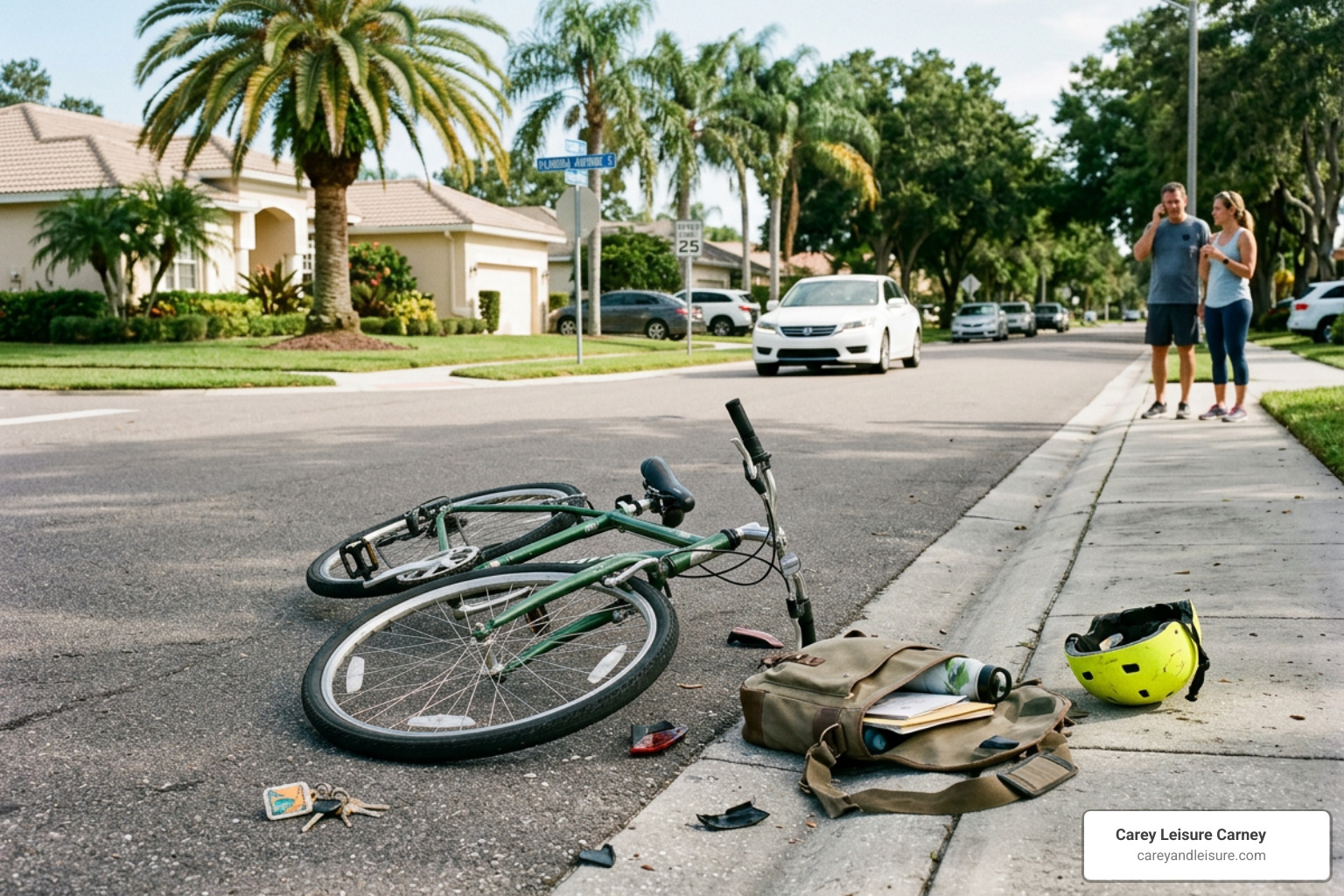
From Pavement to Peace: Navigating the Aftermath of a Bicycle Accident
What to Do After a Bicycle Accident: The First Steps That Protect You
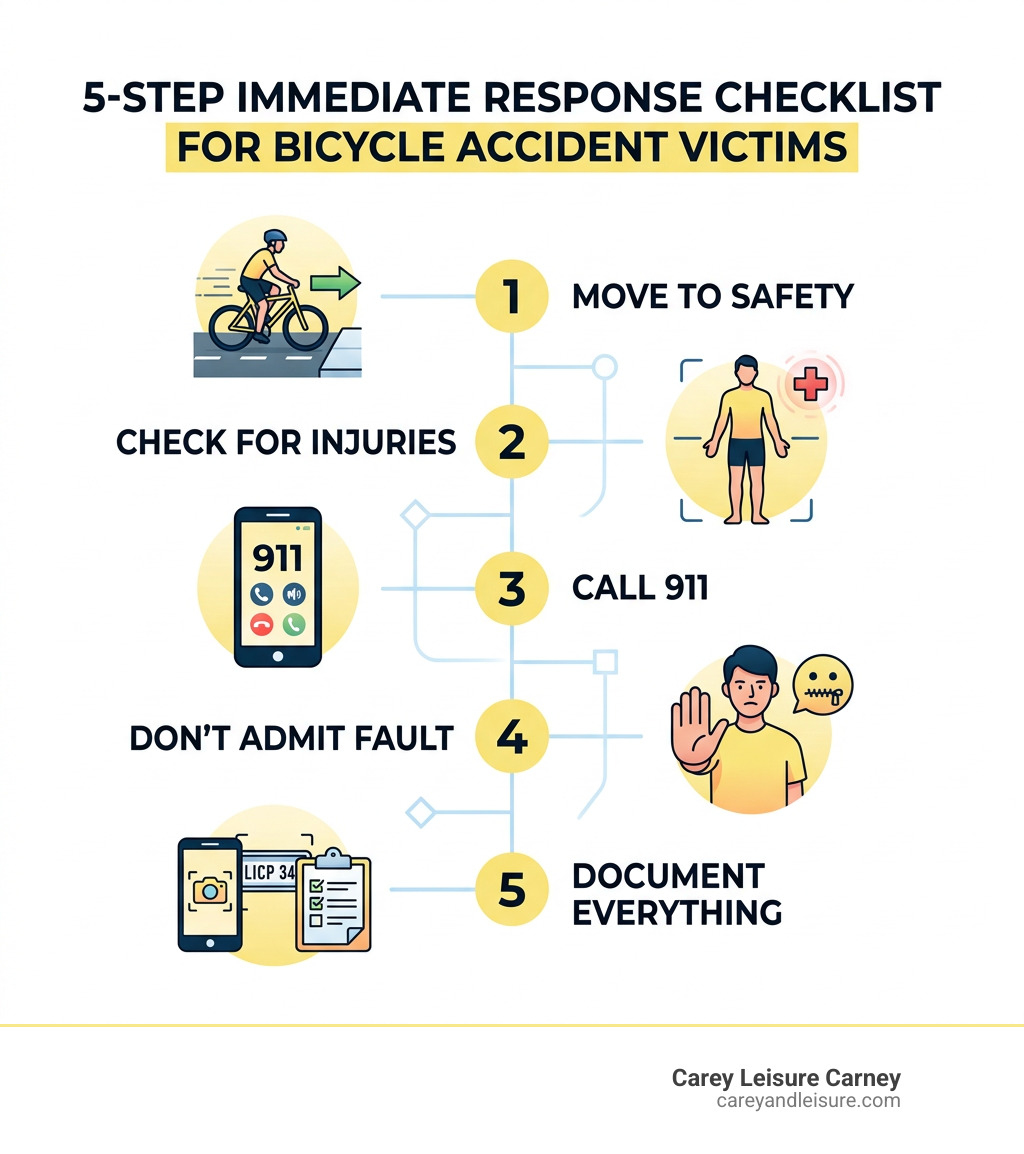
Knowing what to do after a bicycle accident can make a real difference — for your health, your recovery, and any legal claim you may need to make. Here are the most important steps:
- Move to safety — Get out of traffic if you can do so without making injuries worse.
- Check for injuries — Scan your body carefully. Adrenaline can hide pain.
- Call 911 — Report the crash and request medical help, even for minor injuries.
- Don’t admit fault — Say as little as possible to the other driver.
- Document everything — Take photos, get witness contacts, and collect driver information.
- Seek medical attention — Go to a doctor the same day, even if you feel fine.
- Preserve your gear — Don’t repair or wash anything until your case is resolved.
- Consult a bicycle accident attorney — Before speaking to any insurance company.
The numbers tell a sobering story. In 2023 alone, bicycle crashes resulted in 1,377 fatalities and over 405,000 emergency room visits across the United States. In Florida, where Clearwater roads mix heavy traffic with a year-round cycling culture, the stakes are especially high.
A crash happens fast. The moments after it can feel chaotic and overwhelming — especially when you’re hurt, shaken, and unsure of your rights.
That’s exactly why having a clear plan matters.
I’m Thomas W. Carey, founding partner of Carey Leisure Carney and a board-certified civil trial lawyer who has guided clients through roughly 40,000 personal injury matters in Florida — including many bicycle accident cases. Understanding what to do after a bicycle accident is something I’ve helped hundreds of Clearwater-area families navigate, and this guide walks you through every critical step.
Similar topics to what to do after a bicycle accident:
- Motorcycle accident attorney
- what kind of cases do personal injury lawyers handle
- do personal injury lawyers go to court
Immediate Safety: What to Do After a Bicycle Accident

The seconds following a collision are often a blur of adrenaline and shock. Your first priority must always be physical safety. If you are in the middle of a busy Clearwater intersection or a high-traffic road like US-19, try to move yourself and your bike to the shoulder or sidewalk. However, if you feel intense back or neck pain, stay still and wait for paramedics.
Once you are out of the direct line of traffic, perform a “body scan.” Check your extremities for movement and look for signs of heavy bleeding. Even if you feel “fine,” remember that adrenaline is a powerful natural painkiller that can mask serious internal injuries or fractures.
We always recommend that cyclists ride with a form of identification. Carrying a Road ID or having your “In Case of Emergency” (ICE) contacts set up on your smartphone can be lifesaving if you are unconscious or unable to speak when help arrives. For a detailed breakdown of these first few minutes, you can review our guide on What to Do After a Bicycle Accident.
Why You Must Wait for the Police
It is a common mistake to think that if there isn’t “major” damage, you don’t need the police. In Florida, you are legally required to report a crash if it results in injury, death, or at least $500 in property damage.
The police report serves as the official, neutral record of the event. It includes:
- The officer’s observations of the scene.
- Statements from you, the driver, and witnesses.
- Any citations issued to the driver for traffic violations (like failure to yield).
When the officer arrives, ensure they hear your side of the story. Sometimes, if a cyclist is already in an ambulance, the officer only gets the driver’s version. Insist that your statement be included in the official record.
Avoiding Negotiations at the Scene
The driver who hit you might be apologetic. They might offer you cash on the spot to “fix the bike” and avoid involving insurance. Do not accept this.
Never negotiate with the driver or admit fault. Even a simple “I’m sorry, I didn’t see you either” can be used by insurance companies to deny your claim later. In the legal world, silence is often your best friend. Be polite, exchange the necessary insurance information, and wait for the authorities. If you’re feeling pressured, remember our Clearwater Bicycle Injury Lawyer Guide emphasizes that the scene of the accident is for facts, not negotiations.
Securing the Scene and Preserving Evidence
If you are physically able, your smartphone is your best tool for justice. Evidence disappears quickly—skid marks fade, cars are repaired, and memories blur.
Capture the following:
- The Vehicle: Take photos of the car’s license plate, the damage to the bumper or hood, and its position relative to the road.
- The Surroundings: Take wide shots of the intersection, any traffic signals, and road hazards like potholes or obscured signs. Poor road conditions account for roughly 13% of injury-causing accidents.
- Witnesses: Don’t just rely on the police to get witness names. Ask for the phone numbers and emails of anyone who stopped to help.
For more on how these details translate into a successful claim, see our article on Pedal to the Metal Securing Your Bicycle Accident Compensation.
Protecting Your Gear as Evidence
Your bike, clothing, and helmet are more than just damaged property; they are “silent witnesses” to the force and angle of the impact.
- The Helmet: Check your helmet for cracks or compressed foam. Even if it looks okay, a helmet is a single-use safety device. If it hit the ground, it must be replaced.
- Clothing: Do not wash your kit. Bloodstains, tears, and oil marks help prove the severity of the crash.
- The Bike: Do not take your bike to a shop for repairs immediately. An expert may need to inspect the frame for structural failure as part of your legal case.
Documenting Your Injuries After a Bicycle Accident
Documentation doesn’t end at the scene. As the days pass, keep a detailed “injury journal.” Note your pain levels, how the injuries affect your daily life (like being unable to play with your kids or go to work), and take photos of bruising or road rash as it heals.
Keep every receipt. From hospital co-pays to the cost of a ride-share because you can’t drive, these records are vital. Our Auto Accident Attorney / Bicycle Accident Attorney team uses this documentation to build a comprehensive picture of your losses.
Prioritizing Your Health and Recovery
In many bicycle crashes, the “fight or flight” response kicks in. This surge of chemicals can make a broken wrist feel like a minor sprain. It is common for cyclists to realize the extent of their injuries 24 to 48 hours later when the adrenaline wears off.
Be especially wary of head injuries. If you can’t remember the date, feel nauseous, or have a persistent headache, you may have a concussion. Even a minor “bell-ringing” can be a Traumatic Brain Injury (TBI). If you’re unsure, check our resources on Bike Accident Insurance Claim procedures which often start with a proper medical diagnosis.
Treating Common Injuries After a Bicycle Accident
Cyclists often face a specific set of injuries:
- Road Rash: While painful, road rash is actually a sign of energy dispersion. Clean it with mild soap and water, and keep it dressed.
- Fractures: Collarbones (clavicles) and wrists are the most common breaks in cycling.
- Soft Tissue Damage: Strains and sprains should be treated with the RICE method (Rest, Ice, Compression, Elevation).
Always remember that helmets are your best defense. Scientific research on helmet effectiveness shows that wearing one reduces head injury risk by over 60%.
Psychological Recovery and Regaining Confidence
The physical wounds often heal faster than the mental ones. Many cyclists experience Post-Traumatic Stress Disorder (PTSD) or a sudden phobia of riding near cars. This is a normal response to trauma.
To get back on the saddle:
- Start small: Ride on car-free trails like the Pinellas Trail.
- Find a community: Groups like the League of American Bicyclists offer resources for safe riding.
- Seek professional help: If flashbacks or anxiety persist, speaking with a therapist who specializes in trauma can be incredibly beneficial.
Navigating Florida’s No-Fault Insurance and Legal Rights
Florida is a “no-fault” state, which can be confusing for cyclists. This means that regardless of who caused the crash, your own Personal Injury Protection (PIP) insurance is usually the first line of coverage for your medical bills.
| Coverage Type | What it Pays For | Who Provides It |
|---|---|---|
| PIP (Personal Injury Protection) | 80% of medical bills / 60% of lost wages | Your own auto insurance (or the driver’s) |
| Bodily Injury Liability | Pain, suffering, and excess medical bills | The at-fault driver’s insurance |
| Uninsured Motorist (UM) | Covers you if the driver has no insurance | Your own auto insurance policy |
If you own a car in Clearwater, your PIP covers you even when you’re on your bike. If you don’t own a car, you may be covered by the PIP of a resident relative or even the driver who hit you. Navigating these layers is complex, which is why consulting a Clearwater Bicycle Accident Lawyer is essential.
Why You Need a Clearwater Bicycle Accident Lawyer
Insurance adjusters are trained to minimize payouts. They might argue that you weren’t wearing high-visibility gear or that you were “distracted” (distracted cycling is on the rise, with 10-17% of riders using phones).
Florida also follows “comparative negligence” rules. This means if you are found 20% at fault for the accident, your total compensation is reduced by 20%. Our board-certified attorneys understand the Florida PIP statute details and how to fight against unfair fault assignments.
Understanding Your Rights After a Bicycle Accident
In Florida, a bicycle is legally defined as a vehicle. This means you have the same rights—and the same responsibilities—as a motorist.
We often prefer the term “crash” over “accident.” An “accident” implies that it was unavoidable or just “bad luck.” Most collisions are the result of preventable human error, such as a driver failing to yield or a “door-ing” incident. Terminology matters because it shifts the focus to accountability. Advocacy groups like Safe Streets Save Lives work tirelessly to ensure the legal system treats these incidents with the seriousness they deserve.
Frequently Asked Questions about Bicycle Crashes
How long do I have to see a doctor in Florida?
Under Florida law, you generally have 14 days to seek medical treatment to qualify for your PIP benefits. However, for the sake of your health and your legal claim, you should go to the ER or an urgent care center within 24 hours.
What if the accident involved a road hazard or dog?
You may still have a case. If a dog was unrestrained, the owner might be liable under Florida’s strict liability dog bite laws. If a road hazard like a massive pothole or un-marked construction caused the crash, the city or a private contractor might be responsible.
Does my car insurance cover a bike crash?
Yes! Most Florida residents are surprised to learn that their auto policy’s PIP and Uninsured Motorist (UM) coverage follows them even when they are pedaling. This is one of the most important financial safety nets available to cyclists.
Conclusion
At Carey Leisure Carney, we believe that every cyclist deserves to feel safe on our Clearwater roads. When that safety is shattered by a negligent driver, you shouldn’t have to navigate the complex legal and insurance world alone.
Our team offers something unique: Board-Certified expertise (a distinction held by only the top 2% of Florida lawyers) combined with a commitment to direct attorney access. You won’t be passed off to a caseworker; you’ll work with the experts who have over a century of combined experience.
If you are struggling with what to do after a bicycle accident, let us take the weight off your shoulders so you can focus on your recovery. Contact a Clearwater Bicycle Accident Attorney today for a free, no-obligation consultation. We are here to help you move from the pavement back to peace.