

Bicycle accident claims 2026: Secure Justice!
Why Understanding Bicycle Accident Claims Matters for Florida Cyclists
Bicycle accident claims are the legal path to recovering compensation after you’ve been hit by a car, struck by a door, or injured due to dangerous road conditions. In Florida, thousands of cyclists are injured annually, many suffering catastrophic injuries like traumatic brain injuries or spinal cord damage. Because a bicycle offers no frame protection, even a minor collision can be life-altering.
If you’ve been injured in a bicycle accident, here’s what you need to know:
- You have two years from the date of your accident to file a personal injury lawsuit in Florida (statute of limitations).
- You can seek compensation through Florida’s no-fault Personal Injury Protection (PIP) insurance and a liability claim against the at-fault driver.
- You must report your accident within seven days to your insurance company to access statutory accident benefits.
- You can recover damages for medical expenses, lost wages, pain and suffering, and property damage—even if you were partially at fault.
- Comparative negligence may reduce your compensation by your percentage of fault, but you can still recover if you’re less than 51% responsible.
The claims process is complex. Insurance companies often try to minimize payouts by disputing fault or downplaying injuries. While you’re focused on recovery, understanding your rights is crucial to securing the compensation you deserve.
As Thomas W. Carey, I’ve spent over 35 years guiding injury victims through the legal process and securing multi-million-dollar results. My team at Carey Leisure Carney consists of board-certified civil trial lawyers dedicated to helping cyclists steer this challenging journey.
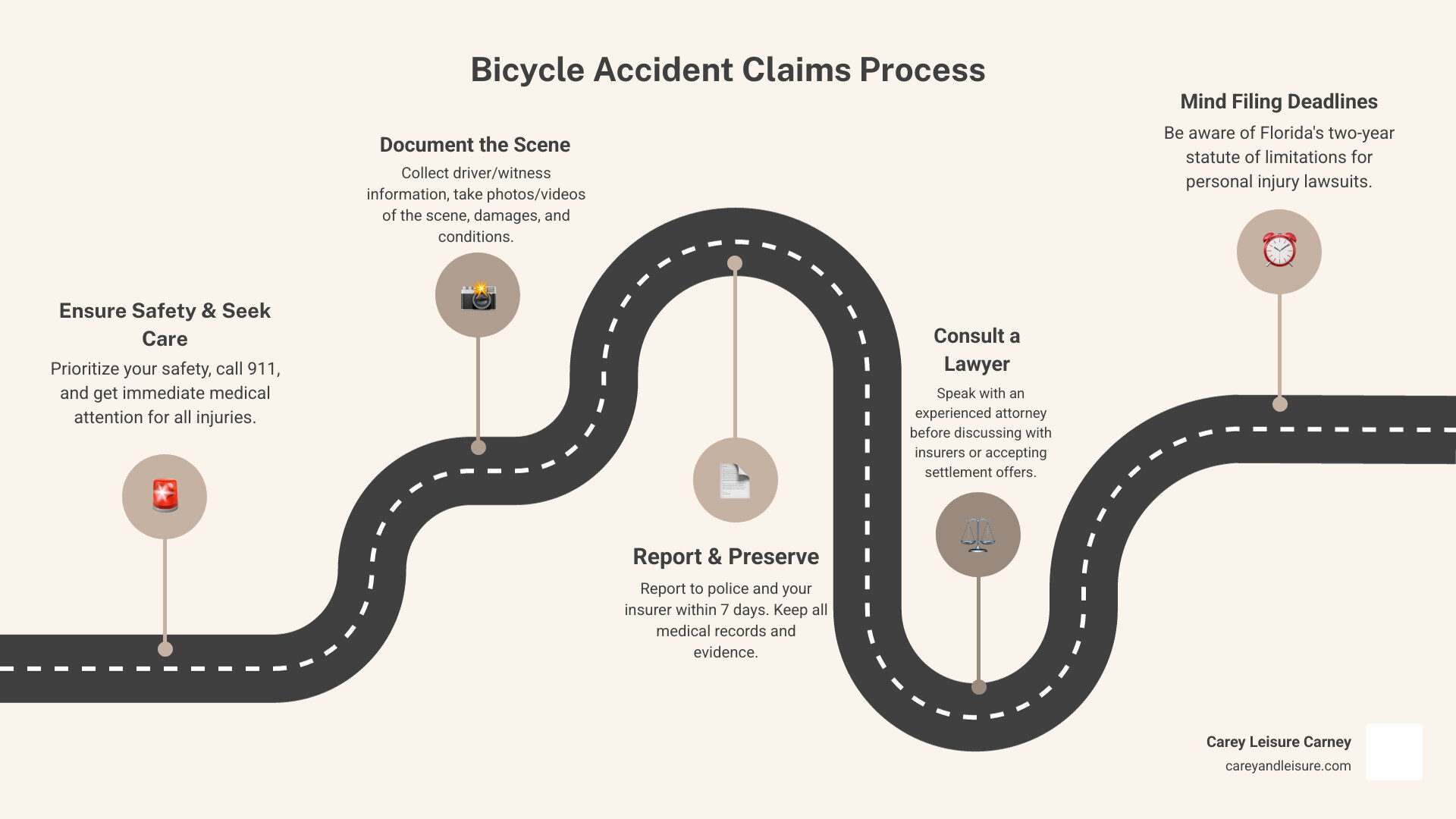
The Immediate Aftermath: Critical First Steps After a Bicycle Crash
The moments after a bicycle accident are chaotic, but the steps you take are critical for your health and any future bicycle accident claims. Your safety is the top priority.
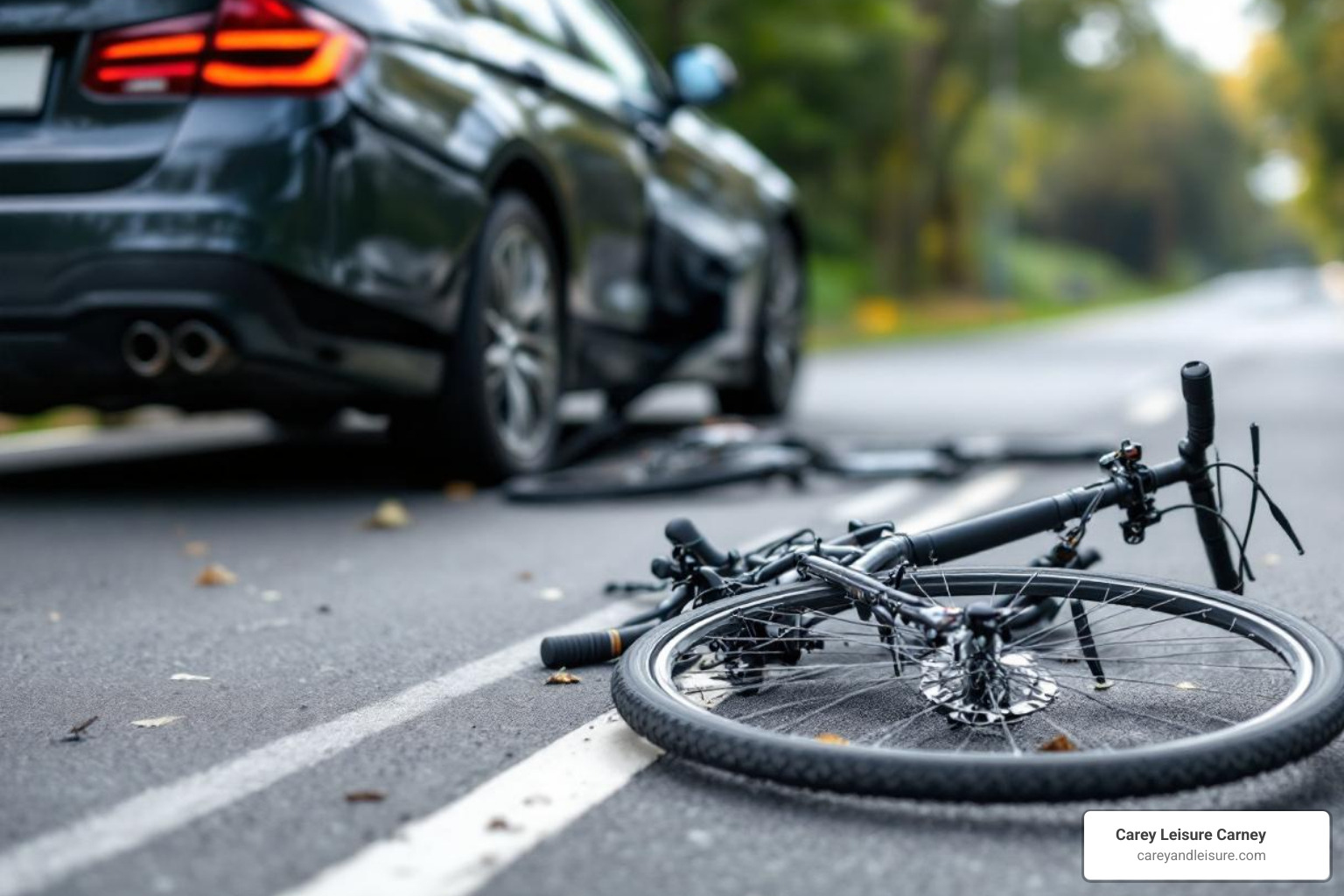
First, if you can, move to a safe location away from traffic. Call 911 immediately if there are any injuries or significant property damage. Emergency services can provide medical attention and dispatch law enforcement. Seeking prompt medical attention is crucial for both your health and your claim, as it creates an official record of your injuries. Some serious injuries, like concussions or internal issues, may not be immediately apparent.
When law enforcement arrives, give them your account of the accident and report all injuries, no matter how minor they seem. This police report is a critical piece of evidence for your bicycle accident claims.
Crucially, do not admit fault or apologize at the scene. Stick to exchanging necessary information. As we emphasize in our guide on What You Should Do After a Bike Accident, your statements can significantly impact your legal standing.
Gather Crucial Evidence at the Scene
If you are able, gather as much information as possible before anything is moved or cleared. This includes:
- Driver information: Get the driver’s name, address, phone number, driver’s license number, vehicle license plate number, and insurance information.
- Witness contacts: Look for anyone who saw the accident occur and obtain their names and contact details. Eyewitness accounts can be invaluable.
- Photo documentation: Use your phone to take detailed photographs. Capture your injuries, damage to your bicycle, damage to the vehicle involved, the position of the vehicles, skid marks, road conditions, traffic signals, and any relevant surroundings. Take photos from various angles and distances.
- Video evidence: If possible, record short videos of the scene, showing the area and any immediate aftermath.
- Damaged property: Photograph all damaged property, including your bicycle, helmet, clothing, and any personal items like phones or glasses.
After the initial collection, preserve all physical evidence. Do not clean or repair your damaged bicycle or clothing. These items can serve as tangible proof of the force of impact and the extent of your losses.
Documenting Your Injuries and Losses
Meticulous documentation is essential for any bicycle accident claims.
- Medical records: Keep every single medical record related to your injuries, including emergency room reports, doctor’s notes, specialist referrals, physical therapy records, prescriptions, and all medical bills. Follow through with all recommended treatments. Gaps in treatment can be used by insurance companies to argue your injuries aren’t serious.
- Injury journal: Start a daily journal detailing your physical symptoms, pain levels, emotional distress, and how the injuries impact your quality of life.
- Lost wages: Keep records of any income you’ve lost due to your injuries, including pay stubs and letters from your employer confirming missed work. If you’re self-employed, gather tax returns and invoices to demonstrate your income loss.
- Out-of-pocket expenses: Track all related expenses, such as transportation costs to medical appointments, over-the-counter medications, or assistive devices. Keep all receipts.
- Bicycle repair costs: Obtain detailed estimates for the repair or replacement of your bicycle and any damaged gear.
This comprehensive record-keeping will provide a clear, factual basis for calculating your damages and presenting a strong case.
Understanding Fault: Who is Liable in a Bicycle Accident?
Determining fault is the cornerstone of a bicycle accident claim. In Florida, bicyclists have the same rights and responsibilities as motorists and must follow all public safety and traffic laws. Because cyclists are so vulnerable, they often suffer significant injuries in a collision, even when they follow all the rules.

Common Causes and Motorist Negligence
Many bicycle accidents result from driver negligence. Common scenarios where a motorist is typically found at fault include:
- Distracted driving: A driver texting, talking on the phone, or otherwise not paying attention may swerve, fail to notice a cyclist, or run a red light.
- Failure to yield right of way: Drivers often fail to yield to cyclists when making turns, using roundabouts, or changing lanes.
- Unsafe lane changes: A driver changing lanes without checking their blind spot can easily side-swipe a cyclist.
- Dooring: This occurs when a driver or passenger opens a car door into the path of an oncoming cyclist.
- Speeding: Excessive speed reduces a driver’s reaction time and increases the severity of impact.
- Impaired driving: Collisions involving a drunk driver often lead to severe injuries and complex legal challenges.
- Aggressive driving: Drivers who exhibit road rage or intentionally drive dangerously around cyclists can be held liable.
- Failure to obey traffic signals: Running red lights or stop signs is a direct cause of many severe bicycle accidents.
- Not respecting the one-meter minimum passing distance: Safe passing distance laws are designed to prevent side-swiping accidents.
When is a motorist at fault in a bicycle accident?
A motorist can be held liable in many situations where their actions violate traffic laws or their duty of care towards other road users. This includes, but is not limited to:
- Changing lanes without checking blind spots.
- Opening a car door into a cyclist’s path.
- Turning right and cutting off a cyclist.
- Failing to obey a traffic signal or stop sign.
- Driving under the influence of alcohol or drugs.
- Driving aggressively or recklessly.
- Distracted driving (e.g., using a cell phone).
- Rear-ending a cyclist.
Cyclist Responsibilities and Comparative Negligence
Cyclists also have responsibilities under Florida law. If a cyclist breaks traffic rules or acts recklessly, they can be found partially at fault for an accident.
Common situations where a cyclist might be held partially liable include:
- Failure to obey traffic signs: Running red lights or stop signs.
- Going in the wrong direction: Cycling against the flow of traffic.
- Failing to signal in advance: Not signaling turns or lane changes.
- Using excessive speed: Riding too fast for conditions.
- Cycling on sidewalks: In many Florida municipalities, cycling on sidewalks is prohibited, particularly in business districts.
- Distracted cycling: Just like distracted driving, distracted cycling is on the rise, with 10-17% of cyclists using phones during rides. This behavior reduces speed and peripheral vision, creating a dangerous situation.
This brings us to the concept of comparative negligence. In Florida, if you are found partially at fault, your compensation is reduced by your percentage of fault. For example, if you are 20% at fault for an accident with $100,000 in damages, you can recover $80,000. However, if you are found 51% or more at fault, you cannot recover any damages. An experienced attorney is crucial to minimize your assigned percentage of fault.
Regarding helmet use, Florida law does not require them for cyclists 16 or older. However, not wearing one can impact your claim. If a helmet could have prevented or lessened your injuries, your compensation may be reduced under comparative negligence. An attorney can help argue against an unfair reduction of your damages.
Beyond individual actions, poor road conditions like potholes, debris, or badly maintained bike paths can also cause accidents. In these cases, the government entity responsible for road maintenance may be held liable. For instance, the City of Clearwater could be liable for an injury caused by a known, unrepaired pothole.
Navigating Your Bicycle Accident Claims: Legal Avenues for Compensation
After a bicycle accident in Florida, you have several legal avenues for compensation. The process can be complex, often involving multiple insurance policies and legal principles.
Filing for No-Fault and Insurance Benefits
Florida is a no-fault state, meaning your own Personal Injury Protection (PIP) insurance is the first source of coverage after an accident with a motor vehicle.
- Florida PIP Coverage: All Florida drivers must carry at least $10,000 in PIP insurance. Your PIP policy will cover 80% of your medical bills and 60% of lost wages, up to your policy limit, regardless of fault. You must seek medical care within 14 days of the accident to use these benefits.
- Medical expense coverage: PIP covers a significant portion of your medical bills, including doctor visits, hospital stays, and rehabilitation.
- Lost wage benefits: If your injuries prevent you from working, PIP can provide compensation for a percentage of your lost income.
- Filing Deadlines: Report the accident to your insurance company as soon as possible, ideally within seven days, to access your benefits.
- Uninsured/Underinsured Motorist (UM/UIM) Coverage: This optional coverage is vital. If the at-fault driver has little or no insurance, your UM/UIM policy can cover your damages.
If you don’t own a car, you may be covered by the PIP policy of a relative in your household or the at-fault driver. An attorney can help you steer these options.
Pursuing a Claim for Full Compensation
PIP benefits often don’t cover all damages, especially in serious accidents. To recover full compensation, you may need to file a claim against the at-fault driver’s insurance or file a personal injury lawsuit.
To pursue a claim beyond PIP, your injuries must meet Florida’s “serious injury” threshold (e.g., a permanent injury, significant loss of a bodily function, or permanent scarring). If you meet this threshold, you can seek a wider range of damages:
Economic damages: These are tangible, quantifiable financial losses directly resulting from the accident. They are typically easier to calculate and prove with receipts, medical bills, and employment records.
- Medical bills (past and future)
- Lost wages (past and future)
- Loss of earning capacity (if your injuries prevent you from returning to your previous work or earning potential)
- Property damage (repair or replacement of your bicycle, helmet, and other damaged gear)
- Out-of-pocket expenses (transportation to appointments, assistive devices, home modifications)
Non-economic damages: These are subjective losses that compensate you for the intangible impact of your injuries on your life. They are harder to quantify but are often a significant component of a settlement or award.
- Pain and suffering (physical pain, discomfort, and emotional distress)
- Mental anguish (anxiety, depression, PTSD)
- Loss of enjoyment of life (inability to participate in hobbies or activities you once enjoyed)
- Disfigurement or scarring (compensation for the physical and emotional impact of permanent changes to your appearance)
TABLE: Economic vs. Non-Economic Damages
| Type of Damage | Description | Examples – |
|---|---|---|
| Economic Damages | Tangible, calculable financial losses from the accident. | – Medical bills (past and future) – Lost wages (past and future) – Loss of earning capacity – Property damage – Out-of-pocket expenses – |
| Non-Economic Damages | Subjective losses for the impact on your quality of life. | – Pain and suffering – Mental anguish – Loss of enjoyment of life – Disfigurement or scarring – |
Punitive damages, meant to punish the at-fault party for extreme negligence, are also possible but rarely awarded in Florida. They are not meant to compensate for losses, so we advise not to count on them in your bicycle accident claims.
A critical step is reaching Maximum Medical Improvement (MMI), the point where your condition has stabilized. We often advise waiting until you reach MMI before settling a claim. This allows us to fully understand your total damages, including future medical needs, which may require expert analysis.
Why You Need a Legal Ally: The Role of a Bicycle Accident Lawyer
Navigating a bicycle accident claim while recovering from your injuries is an uphill battle. An experienced personal injury lawyer is an indispensable ally.
Insurance companies aim to minimize their payouts. They may try to downplay your injuries, dispute fault, or offer a low settlement that won’t cover your long-term needs. Adjusters often try to get information that undermines a cyclist’s claim while they are most vulnerable.
- Protecting your rights: As board-certified civil trial lawyers at Carey Leisure Carney, we understand Florida’s specific laws regarding cyclists, comparative negligence, and insurance regulations. We ensure your rights are protected throughout the entire process.
- Maximizing compensation: We carefully calculate all your damages—economic and non-economic—to ensure you receive fair compensation that truly reflects your losses, including future medical costs and lost earning capacity.
- Proving negligence: Collecting and presenting evidence to prove the other party’s negligence is critical. This often involves accident reconstruction, expert witness testimony, and a deep understanding of traffic laws.
- Insurance negotiations: We handle all communications and negotiations with insurance companies, shielding you from their tactics and ensuring your interests are always prioritized. Going through the claims process without a lawyer is often an unwise decision.
Our team handles the legal complexities so you can focus on your recovery. We serve clients in Clearwater, Largo, New Port Richey, Spring Hill, St Petersburg, Trinity, and Wesley Chapel.
How a Lawyer Handles Your Bicycle Accident Claims
When you hire us for your bicycle accident claims, we begin a comprehensive process to secure the best possible outcome for you:
- Case investigation: We immediately launch a thorough investigation into your accident. This includes reviewing police reports, collecting witness statements, analyzing photographs and videos, and, if necessary, working with accident reconstruction experts to determine precisely how the accident occurred and who was at fault.
- Evidence collection: We gather all necessary documentation, including your medical records, bills, lost wage statements, and property damage estimates. We also work to collect any additional evidence that strengthens your claim, such as traffic camera footage or expert opinions on your long-term prognosis.
- Calculating damages: Our team carefully calculates the full extent of your damages, both economic and non-economic. This often involves projecting future medical costs, lost earning capacity, and accounting for the profound impact your injuries have had on your quality of life.
- Dealing with adjusters: We handle all communications with insurance adjusters. We protect you from giving recorded statements that could be used against you and negotiate fiercely on your behalf to counter any attempts to devalue your claim.
- Litigation and settlement negotiation: Most personal injury cases settle out of court. We are skilled negotiators who strive for a fair settlement that fully compensates you. However, if a fair settlement cannot be reached, our board-certified civil trial lawyers are prepared to take your case to court and advocate for you before a judge and jury.
We can also help coordinate with your medical providers to ensure you receive the care you need while your case progresses.
Understanding Legal Fees for Bicycle Accident Claims
Many accident victims worry about the cost of a lawyer. At Carey Leisure Carney, we believe quality legal help should be accessible to everyone, regardless of their financial situation.
- Contingency Fee: We work on a contingency fee basis, meaning you pay no upfront fees. We only get paid if we win your case through a settlement or court award.
- No Upfront Costs: You won’t owe us anything out-of-pocket as your case progresses, allowing you to focus on recovery without financial stress.
- How Fees Are Calculated: Our fee is a percentage of the total compensation we secure for you. This is typically around 33% but can vary depending on case complexity and whether it goes to trial.
- Case Expenses: We advance the costs of litigation (like filing fees and expert witness fees). These are reimbursed from the settlement or award at the end of the case. If we don’t win, you don’t pay these expenses either.
This arrangement ensures that our interests are aligned with yours: we are motivated to achieve the maximum possible compensation for your bicycle accident claims.
Frequently Asked Questions about Bicycle Accident Claims
Here are answers to common questions we receive from injured cyclists in Florida.
What is the average settlement for a bicycle accident in Florida?
There is no “average” settlement for a bicycle accident in Florida, as each case is unique. The value of your bicycle accident claims depends on many factors, including:
- Severity of injuries: Catastrophic injuries like traumatic brain injuries, spinal cord damage, or permanent disability will lead to significantly higher compensation than minor injuries.
- Medical bills: The total cost of your past and future medical treatment, including rehabilitation, surgeries, and medications.
- Lost income: The amount of wages you’ve lost due to being unable to work, and any future loss of earning capacity.
- Degree of fault: As discussed with comparative negligence, if you are found partially at fault, your compensation will be reduced accordingly.
- Insurance policy limits: The amount of available insurance coverage from the at-fault driver and any UM/UIM coverage you may have.
- Case complexity: Cases involving disputed liability, multiple parties, or extensive medical treatment often require more litigation and can affect the final settlement amount.
We offer a free, no-obligation consultation to discuss your accident and provide an informed estimate of your case’s value.
How long do I have to file a bicycle accident lawsuit in Florida?
In Florida, the statute of limitations for filing a personal injury lawsuit, including those arising from bicycle accident claims, is generally two years from the date of the accident.
It’s critical to understand and adhere to this deadline. If you miss this deadline, you will likely lose your right to seek compensation, no matter how strong your case is.
Some exceptions can change this deadline, so it is vital to act quickly. Contacting an attorney promptly allows them to preserve evidence and build a strong claim on your behalf before evidence is lost or memories fade.
Can I still file a claim if I wasn’t wearing a helmet?
Yes, you can still file a claim even if you weren’t wearing a helmet at the time of your bicycle accident in Florida. Florida law does not require cyclists aged 16 or older to wear a helmet.
However, not wearing a helmet can impact your claim under the principle of comparative negligence. An insurance company may argue to reduce your compensation if they can prove a helmet would have lessened your injuries. This requires showing a causal link between the lack of a helmet and the specific injuries you sustained.
Even so, you are still entitled to compensation for the damages caused by the other party’s negligence. Our role is to fight against unfair reductions to your compensation and ensure you receive what you are rightfully owed.
Conclusion
A bicycle accident can be a life-altering event, causing serious injuries, medical bills, and emotional distress. Understanding your rights and the legal process involved in bicycle accident claims is essential to securing the compensation you deserve.
The key takeaways are clear:
- Act promptly: Seek immediate medical attention and contact law enforcement after an accident.
- Document everything: Carefully collect evidence at the scene and keep detailed records of all your injuries, medical treatments, and financial losses.
- Protect your rights: Be cautious when communicating with insurance companies and avoid admitting fault or accepting quick settlements.
At Carey Leisure Carney, we help injured cyclists across Florida, including Clearwater, Largo, New Port Richey, Spring Hill, St Petersburg, Trinity, and Wesley Chapel. Our board-certified attorneys have over 100 years of combined experience and offer direct, personalized service. We are dedicated advocates fighting for your justice.
Don’t steer this challenging journey alone. Let us handle the legal complexities so you can focus on your recovery.
Contact an experienced auto accident attorney for a free consultation today. We don’t get paid unless you win.