Funeral Home Breach of Contract: 4 Vital Steps
When Trust and Contract Collide: Understanding Funeral Home Obligations
Funeral home breach of contract occurs when a funeral provider fails to deliver the services or goods they agreed to provide in a signed agreement. This can include:
- Improper handling or storage of the deceased’s body
- Failure to provide the specific casket, urn, or services listed in the contract
- Mishandling or loss of personal items intended for burial or cremation
- Unprofessional conduct that violates the implied covenant of dignified service
- Misrepresentation or fraud regarding payment terms or services rendered
When you entrust a funeral home with the care of a loved one, you’re entering into a legally binding agreement during a vulnerable time. The contract outlines the specific obligations the funeral home must fulfill. Unfortunately, breach of contract is a common reason for lawsuits against funeral providers, with failures ranging from lost ashes to improperly stored bodies, as seen in a shocking Colorado case where 190 decaying bodies were found at a single facility.
These contracts also carry an implied covenant of dignified and respectful service. When that trust is broken through negligence or fraud, families face additional trauma. Courts recognize that such breaches can cause severe emotional distress, giving families legal recourse to seek compensation for financial losses and mental anguish.
As Thomas W. Carey, a board-certified civil trial lawyer with over 30 years of experience in personal injury and wrongful death cases, I have guided families through the process of holding funeral homes accountable for funeral home breach of contract and other misconduct. Our firm understands that while no settlement can undo the harm, achieving justice is a vital part of healing.
Simple guide to funeral home breach of contract:
Understanding Your Funeral Service Contract
When entering into a contract with a funeral home, you are often grieving, making it hard to scrutinize every detail. However, this contract is a critical legal document that outlines the funeral home’s specific obligations.
Funeral service contracts are primarily governed by Common Law, which focuses on services. This is important because Common Law allows for broader interpretations of implied duties, such as the expectation of dignity and respect.
A funeral home contract establishes a “duty of care,” legally obligating the provider to perform services as agreed, handle the deceased with dignity, and safeguard personal items. This duty covers everything from the initial consultation to the final disposition.

What Makes a Funeral Contract Legally Binding?
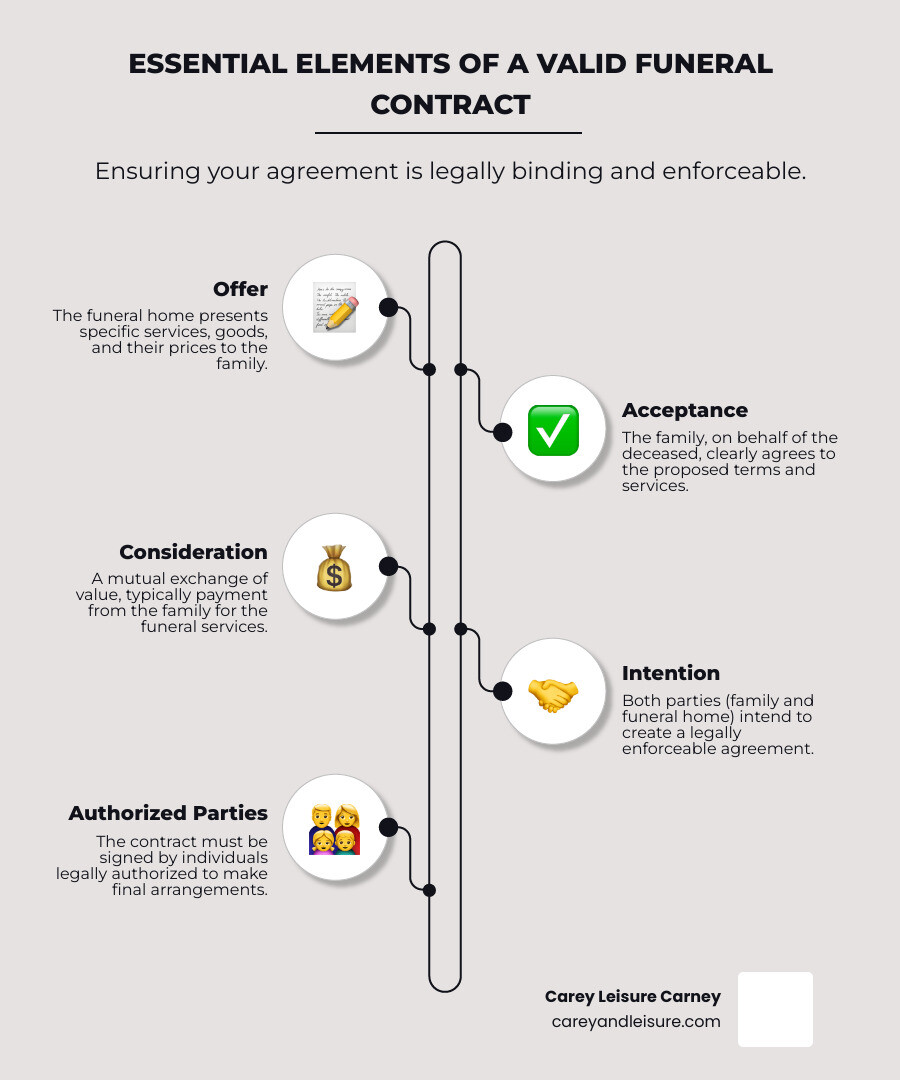
For a funeral service contract to be legally binding, four elements must be present:
- Offer: The funeral home proposes specific services and goods with associated prices.
- Acceptance: The family or authorized party agrees to the offer, typically by signing the contract.
- Consideration: Value is exchanged. The family provides payment, and the funeral home promises to deliver services.
- Intention to Create Legal Relations: Both parties must intend for the agreement to be legally enforceable, which is almost always the case for funeral services.
Who can legally enter into a funeral service contract?
In Florida, specific individuals are authorized to make decisions for a deceased person’s remains under state statutes like Florida Statute 497.459. The hierarchy typically is:
- Surviving spouse
- Surviving adult children
- Surviving parents
- Surviving adult siblings
- Other next of kin or a designated personal representative.
It’s crucial for funeral homes to identify the authorized party to avoid disputes. If you’re unsure who has authority, consult a legal professional. You can learn more about Florida’s funeral contract laws here: https://www.leg.state.fl.us/Statutes/index.cfm?Appmode=DisplayStatute&Search_String=&URL=0400-0499/0497/Sections/0497.459.html. If you believe you’ve been affected by a funeral home’s negligence, our team at Carey Leisure Carney, including our Funeral Home Malpractice Lawyer Wesley Chapel, FL, is here to help.
The ‘Four Corners Rule’ and Its Exceptions
A legal principle known as the “Four Corners Rule” dictates that courts interpret a clear contract based solely on the written text. Outside evidence cannot be used to change its terms, ensuring predictability.
However, there are important exceptions:
- Ambiguous Language: If terms are unclear, external evidence can be used to clarify the parties’ intent. For example, if a “standard memorial service” isn’t defined, oral agreements might explain what was agreed upon.
- Fraud or Misrepresentation: Evidence of deceit or intentional misrepresentation used to induce signing the contract is admissible. This is critical for grieving families who are vulnerable to misleading information.
- Mistake: If both parties made a mutual mistake about a key contract term, external evidence can show the true intended agreement.
- To Prove a Condition Precedent: Evidence may be allowed to show that the contract was only supposed to become effective after a certain condition was met.
These exceptions prevent a funeral home from using a poorly written contract to hide deceptive actions or genuine misunderstandings. Understanding these nuances is key when identifying Funeral Home Negligence Signs that might point to a breach.
What Constitutes a Funeral Home Breach of Contract?
A funeral home breach of contract occurs when the funeral home fails to deliver the services or goods as promised in a valid agreement.
Not every deviation is treated the same. The law distinguishes between a “material breach” and a “minor deviation.”
- Material Breach: This is a significant failure that defeats the contract’s purpose, such as providing a burial instead of a contracted cremation. A material breach can relieve the non-breaching party of their obligations and entitle them to significant damages.
- Minor Deviation (Non-Material Breach): This is a less severe failure, like a slightly different but still appropriate flower arrangement. It is still a breach, but it typically only allows for damages directly related to the deviation, such as a cost difference.
Every funeral contract in Florida also includes an implied covenant of good faith and fair dealing. This means both parties must act honestly. For funeral homes, this extends to providing services with dignity and respect. A failure to uphold this implied duty can also be a breach, as shown in cases like Wilson v. Houston Funeral Home.

Common Examples of a Funeral Home Breach of Contract
Breaches of contract by funeral homes are unfortunately common. Here are some examples that can lead to a funeral home breach of contract claim:
- Improper Embalming or Preparation: Incorrect embalming that leads to decomposition or an undignified appearance is a breach. The case of Flores v. Baca highlighted the severe emotional distress this can cause.
- Wrong Casket, Urn, or Merchandise: Providing a cheaper or incorrect casket, urn, or other merchandise than what was paid for is a clear breach.
- Failure to Provide Agreed-Upon Services: This includes neglecting to perform specific requests like playing certain music, arranging transportation, or holding a planned graveside service.
- Mishandling or Loss of Remains: This is one of the most severe breaches and includes losing or mixing cremated remains or switching bodies. The finding of 190 decaying bodies at a Colorado funeral home is a horrifying example.
- Lost or Stolen Personal Property: The loss or theft of personal items like jewelry or photos entrusted to the funeral home is a breach of contract and trust.
- Unprofessional Conduct: Grossly unprofessional behavior by staff can violate the implied covenant of dignity and respect, as seen in the Wilson v. Houston Funeral Home case.
These examples show the importance of adhering to contractual terms. If you’re in such a situation, our legal team can guide you through Proving Funeral Home Negligence and breach of contract.
The Role of Misrepresentation and Deception
Misrepresentation and deception are insidious forms of funeral home breach of contract. These acts occur when a funeral home intentionally misstates or omits important facts about their services, goods, or pricing.
This can take many forms:
- Intentional Misstatement: Falsely claiming to offer a service or product they do not provide.
- Omission of Facts: Failing to disclose hidden fees, service limitations, or other critical information.
- Overcharging for Services: Marking up third-party services without proper disclosure or charging exorbitant prices.
- Charging for Services Not Rendered: The Colorado funeral home scandal, where owners allegedly took $130,000 for cremations and burials they never provided, is a tragic example.
- Deceptive Practices Regarding Payment: Misrepresenting how payments will be handled or pressuring families for immediate cash.
When misrepresentation is proven, it can invalidate parts of the contract and may lead to significant damages, including punitive damages. It is a serious offense that can result in both civil and criminal charges. If you suspect you’ve been a victim of such deception, our Funeral Home Malpractice Lawyer Largo, FL can help you explore your legal options.
Breach of Contract vs. Other Forms of Funeral Home Negligence
A funeral home breach of contract claim often overlaps with other forms of funeral home negligence. The main difference is the source of the duty that was violated.
| Feature | Breach of Contract | Negligence (Tort) |
|---|---|---|
| Source of Duty | Arises from the explicit or implied terms of a written or oral agreement. | Arises from a general legal “duty of care” owed to others, regardless of contract. |
| Proof Required | Existence of valid contract, plaintiff’s performance, defendant’s breach, damages. | Duty, Breach of Duty, Causation, Damages. |
| Intent | Intent to breach is not always necessary; failure to perform is enough. | Usually involves carelessness or failure to act reasonably. |
| Damages | Aim to put the plaintiff in the position they would have been in if the contract had been performed (economic losses, emotional distress). | Aim to compensate for harm caused (economic losses, pain and suffering, emotional distress). |
| Relationship | Parties have a direct contractual relationship. | Duty can be owed to individuals without a direct contract (e.g., bystanders). |
In many funeral home cases, both breach of contract and negligence claims can be pursued at the same time. For example, improper embalming could be both a breach of a specific contract term and a failure to meet the professional standard of care (negligence).
Intentional acts like fraud or theft can lead to separate legal claims and even criminal charges. Our firm has extensive experience pursuing justice for families affected by such actions. You can learn more about our approach by visiting Sue for Funeral Home Negligence.
The Four Elements of a Negligence Claim
When a funeral home’s conduct falls short of professional standards but doesn’t violate a specific contract clause, a negligence claim may be appropriate. To prove negligence, four elements must be established:
- Duty: The funeral home owed a legal duty of care to the family and the deceased to perform services competently and with dignity.
- Breach: The funeral home breached that duty by failing to act as a reasonably prudent funeral home would.
- Causation: The funeral home’s breach directly caused the family’s harm or injury.
- Damages: The family suffered actual damages, which can be financial (e.g., overpayment) and non-economic (e.g., emotional distress, mental anguish).
For grieving families, the emotional distress from funeral home negligence can be severe and is compensable under Florida law. Our Funeral Home Malpractice Lawyer Trinity, FL understands the unique challenges of these cases.
Case Study: When a Breach Becomes a Crime
The case of the Return to Nature Funeral Home in Colorado is a horrifying example of when a breach becomes a crime. Authorities found 190 decaying bodies stored improperly at the facility. The owners allegedly took over $130,000 from families for cremations and burials that were never performed, providing fake ashes instead.
This led to significant legal consequences:
- Criminal Charges: The owners face hundreds of criminal charges, including abuse of a corpse, theft, and money laundering.
- Civil Lawsuit: A judge ordered the owners to pay $950 million to the victims’ families. While the judgment offers a measure of accountability, actual financial recovery is unlikely due to the defendants’ financial state.
This tragic case shows how contractual failures and intentional misconduct can lead to criminal acts and widespread suffering. It also prompted Colorado to pass new regulations for the funeral home industry, highlighting the need for strict oversight. Our Funeral Home Malpractice Lawyer Spring Hill, FL team recognizes the profound impact these cases have on families. You can read more about this case here: Families whose loved ones were left decaying in Colorado funeral home owed $950M, payout unlikely.
Seeking Justice: Legal Recourse and Potential Damages
When a funeral home breach of contract or negligence occurs, families have the right to seek justice and compensation. Navigating the legal system while grieving is overwhelming, which is why experienced legal representation is so important.
Our goal is to hold funeral homes accountable, which often involves filing a civil lawsuit. However, some funeral contracts include arbitration clauses that attempt to force disputes into private arbitration instead of public court. While arbitration can be faster, it may limit a family’s ability to recover full damages. Our attorneys are prepared to challenge these clauses to ensure our clients have their day in court.
Potential Damages in a Funeral Home Breach of Contract Claim
When a funeral home breaches its contract, the damages can be extensive, covering both financial and emotional harm. Our legal team works to recover all available damages for our clients.
Potential damages in a funeral home breach of contract claim include:
- Economic Damages: These are quantifiable financial losses from the breach.
- Refunds and Overpayments: Reimbursement for services not rendered, goods not provided, or overcharged amounts.
- Cost of Corrective Services: Expenses to fix the funeral home’s errors, such as re-cremation or re-interment.
- Lost Property: Compensation for personal items that were lost, stolen, or mishandled.
- Non-Economic Damages (Emotional Distress and Mental Anguish): This compensates for the emotional suffering caused by the breach. Courts recognize that funeral service contracts are deeply personal, and damages for mental anguish are often recoverable (Flores v. Baca). This trauma goes beyond normal grief and can cause depression, anxiety, and sleeplessness.
- Punitive Damages: In cases of egregious, intentional, or grossly negligent conduct, punitive damages may be awarded. These are intended to punish the funeral home and deter future misconduct, such as in cases of deliberate fraud or mishandling of remains.
Emotional distress is often the most significant damage in these cases. Our Funeral Home Negligence Lawsuit & Damage Claims page provides more insights into how we pursue these vital claims.
Steps to Take if You Suspect a Breach
If you suspect a funeral home breach of contract or other misconduct, taking prompt, organized action is crucial. Here are the steps we recommend:
- Document Everything: Keep detailed records of all interactions, including dates, times, names, and conversation summaries.
- Gather All Contracts and Receipts: Collect all documents related to the funeral services, including the contract, itemized statements, and payment receipts.
- Preserve All Evidence: Secure any physical items related to the breach (e.g., a wrong urn, damaged items). Take photos or videos.
- Communicate in Writing: Send your concerns to the funeral home in writing (email or certified mail). This creates a clear paper trail.
- Talk to Other Family Members or Witnesses: Gather accounts from anyone else who observed the breach or was part of the discussions.
- Avoid Making Further Payments (If Possible): If a significant breach occurred, consult an attorney before making more payments.
- Consult with an Experienced Attorney: This is the most critical step. An attorney can act quickly to preserve evidence and build your case. Our Funeral Home Malpractice Lawyer St. Petersburg, FL team offers free consultations to help you understand your legal options.
Protecting Your Rights After a Funeral Home’s Failure
The loss of a loved one is painful enough without the added trauma of a funeral home breach of contract or negligence. When a funeral home fails in its duties, it violates a legal agreement and deepens a family’s grief, leaving a sense of betrayal.
At Carey Leisure Carney, we know these cases are about restoring dignity and seeking justice for a loved one. We are dedicated to holding funeral homes accountable and securing the compensation families deserve for both financial losses and the immense emotional distress they have suffered.
Our firm is committed to protecting your rights. Our Board-Certified attorneys—a distinction held by only the top 2% of Florida lawyers—have over 100 years of combined experience and offer direct, personalized service. We will guide you through the entire legal process, from investigation to fighting for maximum compensation.
If your family in Clearwater, Largo, New Port Richey, Spring Hill, St. Petersburg, Trinity, or Wesley Chapel, Florida, has been affected by a funeral home’s failure, we are here to help. You don’t have to face this alone. Contact us today for a free consultation to seek the accountability and closure you deserve. Visit our Personal Injury Attorney / Funeral Home Malpractice Attorney page to learn more.