

Hit by a Drunk Driver? Understanding Your Legal Options and Compensation
The Devastating Impact of Drunk Driving
Drunk driving accident lawsuits allow victims to seek financial compensation from impaired drivers who cause crashes. Here’s what you need to know:
- Two separate cases exist: A criminal DUI case (prosecuted by the state) and a civil lawsuit (filed by you for compensation).
- Lower burden of proof: Civil cases require only a “preponderance of evidence” vs. “beyond reasonable doubt” in criminal court.
- Multiple parties may be liable: You can sue the drunk driver, their insurer, and potentially bars or hosts who served them alcohol.
- Damages available: Medical bills, lost wages, pain and suffering, and punitive damages to punish reckless behavior.
- Time limits apply: Florida allows 2 years from the accident date to file a lawsuit.
- No criminal conviction required: You can win your civil case even if the driver isn’t criminally convicted.
The toll of drunk driving is staggering. The National Highway Traffic Safety Administration reports that about 3 in every 10 Americans will be involved in an alcohol-related crash in their lifetime. In a recent year, nearly 12,000 people died in such crashes across the U.S.
If a drunk driver injured you or a loved one, you’re likely facing overwhelming bills, lost income, and trauma. The legal system offers two paths: criminal prosecution by the state and a civil lawsuit that you control. This guide explains how civil lawsuits work and what compensation you can recover.
As Thomas W. Carey, founding partner of Carey Leisure Carney and former Florida State Chairman of Mothers Against Drunk Driving (MADD), I’ve dedicated my career to drunk driving accident lawsuits after losing my wife, Joni, to a drunk driver. Our firm has guided roughly 40,000 injury matters across Florida, securing multi-million-dollar results in DUI cases for families facing similar devastation.
Essential Drunk driving accident lawsuit terms:
Criminal vs. Civil: Understanding the Two Legal Arenas

When a drunk driver causes an accident, two distinct legal processes unfold: a criminal DUI case and a civil personal injury lawsuit. While they stem from the same incident, their purposes and outcomes are different. Understanding this is crucial for victims seeking justice.
What are the key differences between a criminal DUI case and a civil lawsuit?
The differences between a criminal DUI case and a civil lawsuit for a drunk driving accident lawsuit can be summarized as follows:
| Feature | Criminal DUI Case | Civil Lawsuit |
|---|---|---|
| Purpose | Punish the offender, deter future offenses, protect society | Compensate the victim for losses and injuries |
| Who Files | The State (prosecutor) | The injured individual (plaintiff) or their family |
| Burden of Proof | “Beyond a reasonable doubt” (high standard) | “Preponderance of the evidence” (more likely than not, lower standard) |
| Outcome | Jail time, fines, license suspension, probation | Monetary damages (compensation for medical bills, lost wages, pain/suffering) |
| Control | The State controls the prosecution | The victim (with their attorney) controls the lawsuit |
In a criminal case, the state punishes the driver for breaking the law with penalties like jail time, fines, or license suspension. These penalties do not compensate the victim.
Conversely, a civil lawsuit is filed by the victim to recover financial compensation for their harm. You and your attorney control this process, focusing on maximizing your recovery to make you financially whole.
How does a DUI conviction affect a civil lawsuit?
A DUI conviction significantly strengthens your civil claim. In Florida, a conviction can be used as powerful evidence of negligence. Violating a safety law like a DUI statute often establishes “negligence per se.”
Negligence per se simplifies proving fault. If the driver violated a public safety statute (like DUI laws) and caused your injuries, they are presumed negligent. This means the conviction itself helps establish their carelessness.
You can win a civil drunk driving accident lawsuit even if the driver isn’t criminally convicted. The burden of proof is lower: a “preponderance of the evidence” (more likely than not) in a civil case, versus “beyond a reasonable doubt” in criminal court.
While criminal restitution is typically limited and rarely covers non-economic damages like pain and suffering, a civil lawsuit offers a more comprehensive path to full recovery. To learn more about how a DUI conviction affects your case, you can explore resources like Nolo’s explanation of what is a per se DUI?.
Establishing Fault: Proving Negligence and Identifying Liable Parties
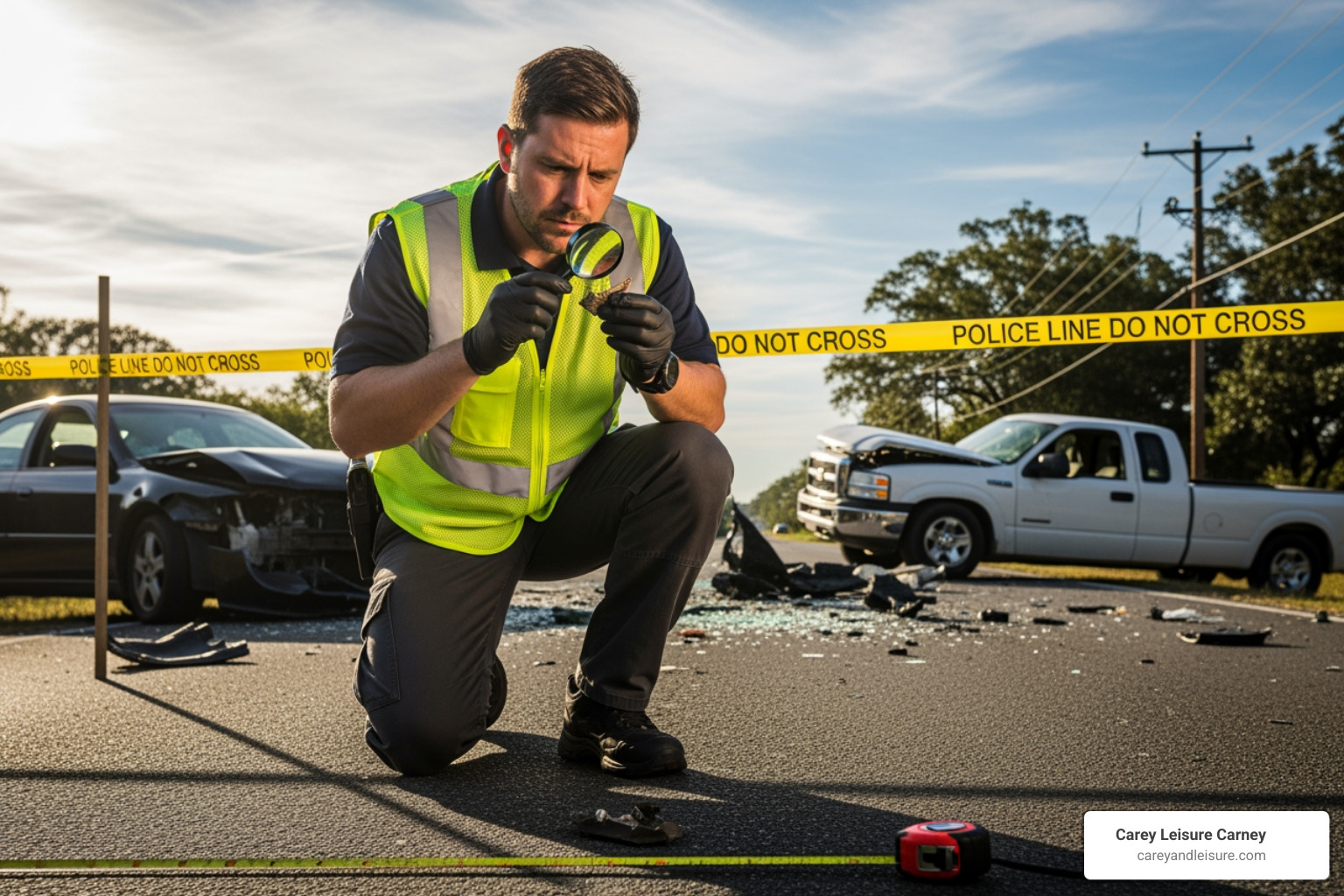
In a drunk driving accident lawsuit, proving the drunk driver’s negligence caused your injuries is paramount. This requires compelling evidence and sometimes identifying other liable parties.
What evidence is needed to prove negligence in a drunk driving accident lawsuit?
To prove negligence, we must show the driver breached their duty of care by driving while intoxicated and that this breach caused your harm. Key evidence includes:
- Police Reports: Contain crucial details, officer observations of impairment, test results, and arrest information.
- BAC Test Results: Objective proof of intoxication from breath, blood, or urine tests. A BAC of 0.08% or higher is illegal for most drivers in Florida.
- Field Sobriety Test Evidence: Notes and video recordings show impairment through the driver’s inability to perform simple tasks.
- Witness Statements: Testimony from those who saw erratic driving or the driver’s behavior at the scene.
- Accident Reconstruction Expert Testimony: Experts can recreate the crash to prove the drunk driver’s actions caused it.
- Medical Records: Document your injuries and treatment, linking them to the accident.
- Driver’s Admission: Any admission of drinking or impairment is compelling evidence.
- Photos and Videos: Visual proof from the scene, including vehicle damage, road conditions, and open containers.
We will carefully investigate every detail to documenting evidence in personal injury claims and build a strong case.
Can parties other than the drunk driver be held liable?
Yes, other parties can sometimes be held responsible for damages in a drunk driving accident lawsuit. This is called third-party liability. Examples include:
- Social Host Liability: Florida law is limited, but an adult who knowingly serves alcohol to a minor who then causes a crash can be held liable.
- Employer Liability (Vicarious Liability): An employer may be liable if the drunk driver was on duty, especially if the employer knew about a drinking problem or provided inadequate training.
- Negligent Entrustment: Someone who knowingly lends their vehicle to an intoxicated person can be held liable.
Identifying all potentially liable parties is crucial for maximizing your compensation. In tragic cases where a loved one is killed, we can pursue a Wrongful Death Attorney claim against all responsible parties.
What is dram shop liability and when can it apply?
Dram shop liability holds establishments that serve alcohol responsible for injuries caused by their intoxicated patrons. In Florida, our dram shop laws are specific.
An establishment can be held liable in a drunk driving accident lawsuit if they:
- Willfully and unlawfully furnish alcoholic beverages to a minor (under 21 years old).
- Knowingly serve a person habitually addicted to alcohol.
This means a bar could be liable if it serves a minor or a known habitually addicted person who then causes a crash. These laws provide another avenue for victims to seek compensation. Learn more on our page about Are Bars Liable for Drunk Drivers? or by consulting a Dram Shop Claims Attorney.
Can passengers or family members of victims sue the drunk driver?
Yes. Passengers injured by a drunk driver have the same right to compensation as other victims. However, knowingly riding with an intoxicated driver could reduce your compensation under Florida’s comparative negligence laws.
Family members also have significant legal options:
- Loss of Consortium: A spouse can file a claim for the loss of companionship, support, and services of their injured partner.
- Wrongful Death Lawsuits: If a crash results in a fatality, close family members can file a wrongful death lawsuit. This type of drunk driving accident lawsuit seeks compensation for funeral expenses, lost financial support, and loss of companionship. Our firm is familiar with the complexities of Fatal Accident Claims in Florida.
Maximizing Your Compensation in a Drunk Driving Accident Lawsuit
When pursuing a drunk driving accident lawsuit, the goal is to secure full compensation for all harm, including financial losses, pain and suffering, and sometimes, punitive damages.
What types of damages can be sought in a drunk driving accident lawsuit?
In a civil lawsuit, you can seek two main categories of compensatory damages:
Economic Damages: These are quantifiable financial losses, including:
- Medical Bills: All past and future medical expenses, from emergency care to long-term rehabilitation.
- Lost Wages & Earning Capacity: Income lost from being unable to work, both now and in the future.
- Property Damage: Costs to repair or replace your vehicle and other property.
- Out-of-Pocket Expenses: Costs for rental cars, household help, and transportation to appointments.
Non-Economic Damages: These are subjective losses that impact your quality of life, including:
- Pain and Suffering: Compensation for physical pain and discomfort.
- Emotional Distress: For psychological trauma like anxiety, depression, and PTSD.
- Loss of Enjoyment of Life: For the inability to enjoy hobbies and daily activities.
- Loss of Consortium: Compensates a spouse for the loss of companionship.
We know how to calculate these damages to ensure you receive fair compensation. For more details, read about Compensation for Pain and Suffering in Florida and the types of damages available.
Can punitive damages be awarded in drunk driving cases?
Yes, punitive damages are often a key part of drunk driving accident lawsuits in Florida. Unlike other damages, they are designed to:
- Punish the at-fault driver for their grossly negligent behavior.
- Deter others from similar conduct.
Florida law often allows punitive damages in drunk driving cases because it is an egregious act showing willful disregard for others’ safety. We must prove the driver’s conduct was so reckless it constituted a conscious disregard for life and safety. Insurance policies typically don’t cover punitive damages, so the driver may have to pay them from personal assets. Our firm has experience pursuing Drunk Driving Punitive Damages and understands when punitive damages may be awarded in Florida.
How do factors like injury severity and insurance limits influence claim value?
The value of your drunk driving accident lawsuit is influenced by several factors:
- Severity of Injuries: This is the most critical factor. Catastrophic injuries like spinal cord injuries or a traumatic brain injury dramatically increase claim value due to extensive medical needs and impact on quality of life. Learn more from our Catastrophic Injury Complete Guide.
- Clear Liability: Undeniable fault (e.g., high BAC, police report) makes a case stronger and a fair settlement more likely.
- Insurance Policy Limits: The at-fault driver’s policy limits often cap the recovery amount. Minimum required coverage in Florida can be insufficient for severe injuries.
- Uninsured/Underinsured Motorist (UM/UIM) Coverage: Your own policy can provide coverage if the at-fault driver has little or no insurance. We strongly advise clients to carry this coverage.
Determining What is My Personal Injury Case Worth? requires a thorough evaluation by an experienced attorney.
What are some examples of notable drunk driving accident settlements?
While every case is unique, past results show the potential value of these lawsuits. Here are some examples of significant settlements in drunk driving cases:
- $45 million settlement for a victim with permanent spinal cord injuries and severe cognitive impairment.
- $8.25 million settlement for a crash that killed three family members and left one survivor paralyzed.
- $3.5 million settlement for a passenger who suffered a traumatic brain injury.
- $1.2 million settlement for a woman with multiple fractures and PTSD after being hit by a drunk driver.
These examples illustrate that settlements can be substantial for catastrophic injuries or wrongful death. Our firm has achieved multi-million-dollar results for clients in Florida. You can view more Personal Injury Settlement Examples on our website.
Navigating the Claims Process: Insurance, Deadlines, and Legal Counsel
The aftermath of a drunk driving accident is chaotic. Knowing the right steps regarding insurance, deadlines, and legal help is vital to protecting your rights and securing compensation.
What steps should someone take immediately after a drunk driving accident?
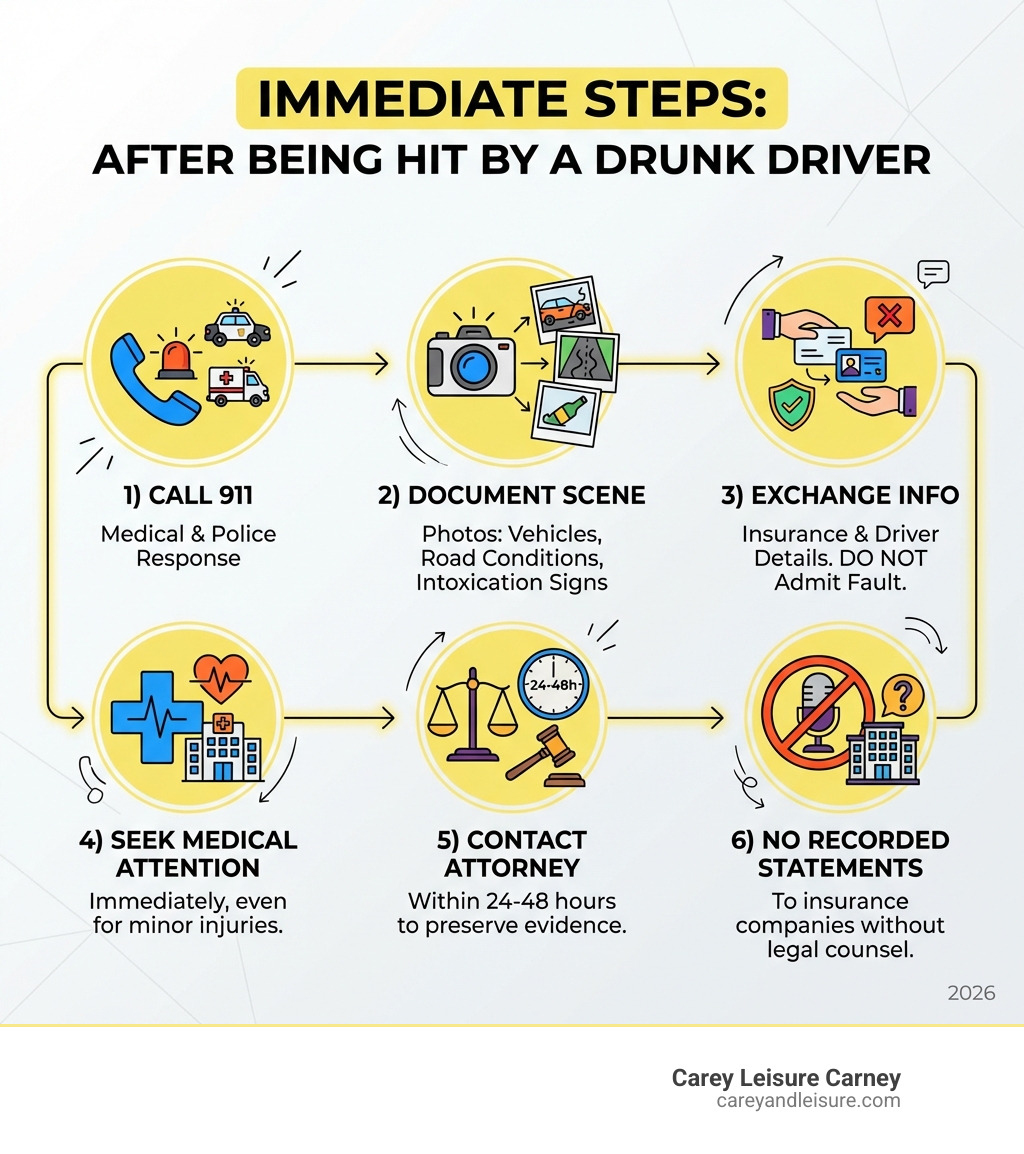
Your actions immediately following an accident can impact your legal claim. Here’s a checklist:
- Call 911: To get medical help and a police response. The police report is crucial evidence.
- Seek Medical Attention: Get checked by a doctor even if you feel fine. Some injuries have delayed symptoms, and this creates a medical record.
- Document the Scene: If safe, take photos and videos of vehicle damage, the scene, and any signs of intoxication.
- Exchange Information: Get the other driver’s contact and insurance info, and contact details for any witnesses.
- Do Not Admit Fault: Never apologize or admit fault, as it can be used against you.
- Contact an Attorney: Contact an experienced attorney immediately to preserve evidence and protect your rights.
For a detailed guide, see our page on What to do After a Car Accident Florida.
How do insurance policies typically cover drunk driving accidents?
Insurance plays a central role in any drunk driving accident lawsuit. Here’s how different policies come into play in Florida:
- At-Fault Driver’s Liability Coverage: The primary source for compensation, but these policies have limits.
- Your Personal Injury Protection (PIP): As Florida is a “no-fault” state, your PIP covers a portion of your initial medical bills and lost wages.
- Uninsured/Underinsured Motorist (UM/UIM) Coverage: Critical coverage on your own policy that pays if the at-fault driver has little or no insurance.
Dealing with insurers is complex, as they often try to minimize payouts. We are skilled negotiators and will protect you from bad faith practices. We are the Lawyers That Sue Insurance Companies. Learn more about The Role of Insurance Companies in a Car Accident.
What is the statute of limitations for filing a lawsuit?
The “statute of limitations” is a strict deadline for filing a drunk driving accident lawsuit. Missing it means you lose your right to sue.
In Florida, the statute of limitations for personal injury and wrongful death claims from a car accident is two (2) years from the date of the incident or death.
It is crucial to act quickly. Investigating a case and gathering evidence takes time, and delaying can harm your case. There are very limited exceptions to this rule, so consult an attorney immediately to ensure you file on time.
What is the role of a personal injury attorney in a drunk driving case?
As your attorneys in a drunk driving accident lawsuit, we are your advocates, handling the legal complexities so you can focus on recovery. Our services include:
- Investigating the Accident: Gathering all evidence like police reports, BAC results, and witness statements.
- Proving Damages: Collecting medical records and proof of lost wages to document your losses.
- Calculating Damages: Working with experts to assess all economic, non-economic, and punitive damages.
- Negotiating with Insurers: Handling all communications to secure the maximum settlement.
- Filing a Lawsuit: Preparing and filing a lawsuit if a fair settlement isn’t reached.
- Trial Representation: Taking your case to trial and presenting compelling arguments to a jury.
Having a dedicated legal team makes a difference. Learn more about Why You Need a Personal Injury Lawyer to understand the full scope of our assistance.
Conclusion: Secure the Justice You Deserve with Board-Certified Representation
Being the victim of a drunk driver is traumatic, but you don’t have to face the legal process alone. Understanding your rights in a drunk driving accident lawsuit is the first step toward justice. This guide has covered the differences between criminal and civil cases, establishing fault, available damages, and the crucial steps to take after a crash.
These cases are complex, involving multiple liable parties, insurance negotiations, and strict deadlines. Without an experienced attorney, you risk not receiving the full compensation you deserve, especially against aggressive defense tactics.
At Carey Leisure Carney, we help drunk driving accident victims across Clearwater, Largo, New Port Richey, Spring Hill, St. Petersburg, Trinity, and Wesley Chapel, Florida. Our attorneys are Board-Certified—a distinction held by less than 2% of Florida lawyers—reflecting our exceptional expertise. With over 100 years of combined experience, we offer direct attorney access and personalized service, keeping you supported and informed.
If you or a loved one has been impacted by a drunk driver, don’t delay. Let us put our passion and expertise to work for you. Contact a Drunk Driving Accident Attorney for a free consultation today. We are here to help you secure the justice you deserve.