St Petersburg legal: Ultimate 2024 Guide
Why Understanding St. Petersburg Legal Resources Matters
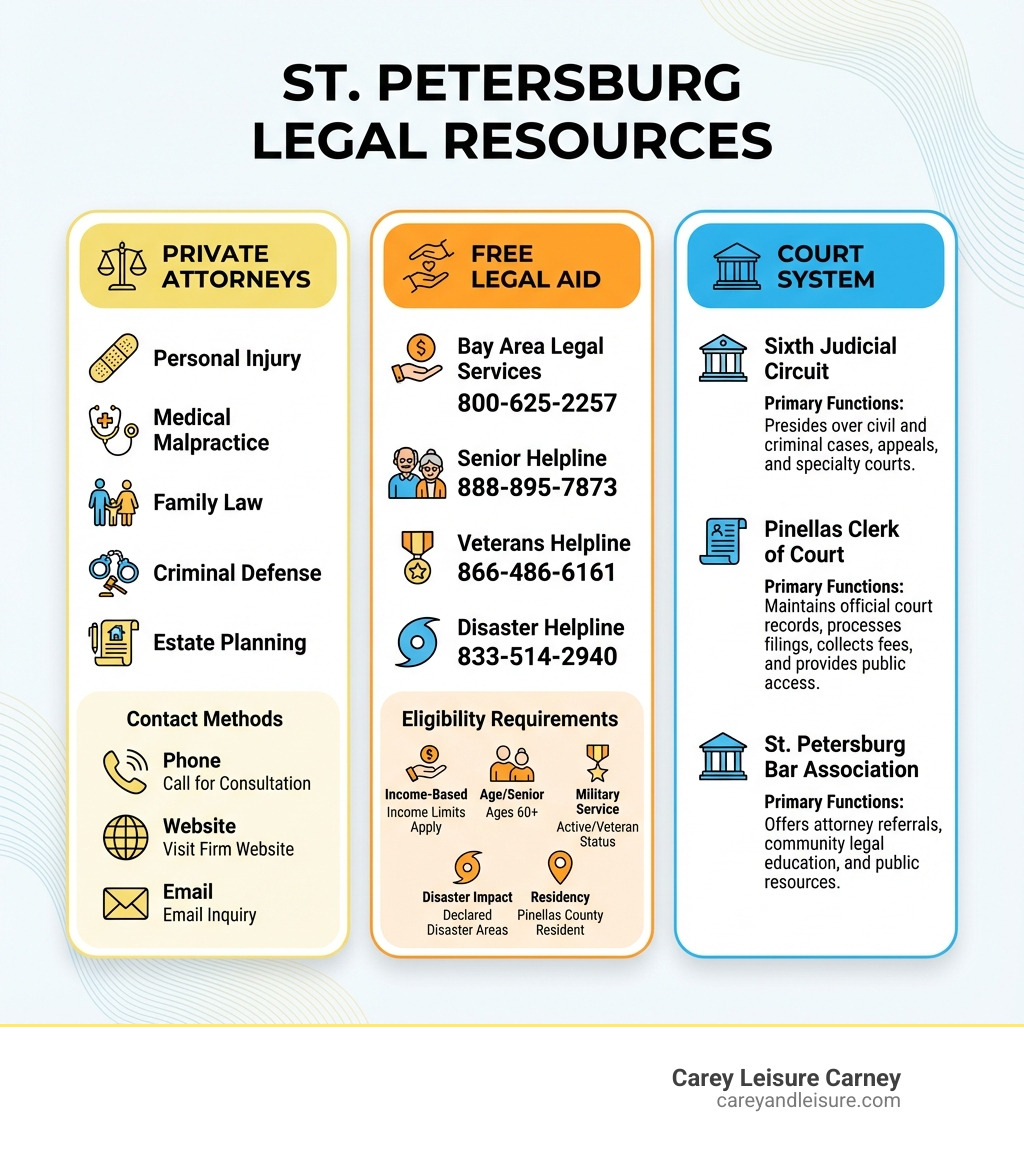
St Petersburg legal services encompass a wide range of options for residents facing legal challenges. Whether you need help with a personal injury claim, medical malpractice case, family law matter, or simply require affordable legal advice, the city offers multiple pathways to justice:
Quick Answer: Finding Legal Help in St. Petersburg
- Private Attorneys: Specialized lawyers in personal injury, medical malpractice, family law, and more
- Free Legal Aid: Bay Area Legal Services provides assistance to eligible residents in Pinellas County (call 800-625-2257)
- Bar Association: St. Petersburg Bar Association offers attorney referrals and public resources
- Specialized Helplines: Free services for seniors (888-895-7873), veterans (866-486-6161), and disaster victims (833-514-2940)
- Government Resources: Sixth Judicial Circuit courts and Pinellas Clerk of Court for official proceedings
If you’ve been injured in an accident or lost a loved one due to someone else’s negligence, understanding your legal options can feel overwhelming. Medical bills pile up, income stops, and the legal system seems impossibly complex. You’re not alone in feeling this way.
The Tampa Bay area has built a comprehensive network of legal resources designed to help people exactly like you. From experienced personal injury attorneys who work on contingency (meaning you pay nothing unless you win) to free legal aid programs for those who qualify, St. Petersburg offers multiple pathways to justice.
The challenge isn’t a lack of resources—it’s knowing where to start.
Florida’s legal system has specific rules that differ from other states. For example, Florida’s no-fault insurance system requires you to use your own Personal Injury Protection (PIP) coverage first, typically limited to $10,000, before you can pursue a claim against the person who caused your accident. But if your injuries are serious—permanent injury, significant disfigurement, or loss of bodily function—you may be able to step outside this system and pursue full compensation.
The statute of limitations in Florida gives you a limited window to act. For most personal injury cases, you have just two years from the date of injury to file a lawsuit. For medical malpractice, the process is even more complex, requiring a notarized affidavit from another medical provider before you can even file your claim.
Time matters. Evidence disappears. Witnesses forget. Insurance companies move quickly to protect their interests.
I’m Thomas W. Carey, a board-certified civil trial lawyer who has practiced St. Petersburg legal matters since 1988, guiding over 40,000 injury cases across Florida and securing multi-million-dollar results for clients throughout the Tampa Bay area. After losing my wife Joni to a drunk driver early in our marriage, I dedicated my career to helping injury victims and their families steer the legal system and secure the compensation they deserve.
St Petersburg legal terms made easy:
Understanding the Spectrum of Legal Services in St. Petersburg
The vibrant city of St. Petersburg, Florida, offers a comprehensive array of legal services to meet the diverse needs of its residents and businesses. From the everyday legal challenges that life throws our way to the more complex and specialized issues, you can find qualified legal professionals ready to assist. Understanding the types of services available is the first step in navigating the St. Petersburg legal landscape.
Common practice areas you’ll encounter include:
- Personal Injury: Dealing with injuries caused by someone else’s negligence, such as car accidents, slip and falls, or wrongful death.
- Medical Malpractice: Cases involving harm due to a healthcare provider’s negligence.
- Family Law: Matters like divorce, child custody, and adoption.
- Criminal Defense: Representation for individuals accused of crimes.
- Estate Planning: Preparing wills, trusts, and other documents to manage assets and healthcare decisions.
- Business Law: Assisting with business formation, contracts, and commercial disputes.
- Real Estate Law: Handling property transactions, landlord-tenant issues, and property disputes.
Beyond private practice, governmental bodies also play a crucial role in the St. Petersburg legal system, such as the St. Petersburg Police Department’s Legal Division, which handles specific municipal legal functions.
Primary Areas of Law
Attorneys in St. Petersburg specialize in a broad spectrum of legal fields, ensuring that whatever your specific need, there’s likely an expert available. Some of the key specializations include:
- Civil Litigation: This covers a vast area of disputes between individuals or organizations, seeking to resolve conflicts through the court system. Many personal injury and medical malpractice cases fall under this umbrella.
- Insurance Claims: Lawyers specializing in this area help clients steer complex insurance policies and battle insurance companies that may deny legitimate claims.
- Social Security Disability: Assisting individuals in applying for or appealing denials of Social Security Disability benefits.
- Elder Law: Focusing on the unique legal needs of older adults, including estate planning, guardianship, long-term care planning, and protection against elder abuse.
- Veterans’ Affairs: Providing legal support to veterans on issues ranging from benefits to housing and employment.
- Disaster Relief: Offering legal assistance to residents affected by natural disasters, helping with insurance claims, FEMA applications, and other recovery efforts.
Governmental Legal Services
The City of St. Petersburg has its own legal framework and departments to manage municipal affairs and uphold local laws.
- City Attorney’s Office: This office provides legal counsel to the City Council, the Mayor, and various city departments. While they don’t typically represent individual citizens in private disputes, their work impacts the legal environment of the city.
- Local Ordinances: St. Petersburg operates under a comprehensive set of local laws and regulations. You can explore the city’s specific rules and regulations through the St. Petersburg Code of Ordinances. These ordinances cover everything from zoning and building codes to public conduct.
- Nuisance Abatement: The St. Petersburg Police Department’s Legal Division plays a role in enforcing nuisance abatement laws, addressing issues that negatively impact public health, safety, or welfare. If you have concerns about a property creating a public nuisance, this division might be involved.
- Seizure and Forfeiture: This division also handles legal processes related to the seizure and forfeiture of property involved in criminal activities. They manage the legal aspects of these actions, ensuring compliance with state and federal laws.
Finding a Qualified Attorney: Resources and Directories
When facing a legal challenge, finding the right attorney is paramount. It’s like finding a trusted guide for a journey through unfamiliar territory. Fortunately, St. Petersburg offers several excellent resources to help you locate a qualified legal professional.

The Role of the St. Petersburg Bar Association
The St. Petersburg Bar Association is a cornerstone of the local St. Petersburg legal community. Its mission is clear: to serve the legal community, strengthen the practice of law, and foster excellence in the profession. But its services extend beyond its members to benefit the public directly.
The association provides:
- Professional Development: Offering Continuing Legal Education (CLE) courses, which are essential for attorneys to stay updated on legal changes and maintain their licenses.
- Lawyer Referral Service: If you’re unsure where to start, the Bar Association can help connect you with attorneys specializing in your particular legal need.
- Public Resources: Providing access to legal information and guidance, helping explain the legal process for residents.
- Community Outreach: Through initiatives like the St. Pete Bar Foundation, the association supports programs that give back to the community, including pro bono services.
Educational Programs and Local Expertise
The quality of legal services in St. Petersburg is bolstered by strong educational foundations nearby. Institutions like Stetson University College of Law, located just a short drive from St. Petersburg, are renowned for producing highly skilled legal professionals. Additionally, Florida Gulf Coast University offers a Bachelor of Science in Legal Studies program, designed to prepare students for careers in legal assisting, paralegal, and other law-related professions. This program aims to provide an in-depth understanding of the legal system, including its relation to law, courts, clients, and lawyers. These programs contribute significantly to building and maintaining a robust pool of local legal talent right here in our community.
How to Verify an Attorney’s Credentials
Before entrusting your legal matter to an attorney, it’s always wise to verify their credentials. This due diligence can save you considerable time, money, and stress.
The most authoritative source for verifying an attorney’s standing in Florida is The Florida Bar. Their website offers a public “Find a Lawyer” search tool where you can:
- Search the Member Directory: Confirm an attorney’s active license status.
- Check Disciplinary History: See if an attorney has faced any disciplinary actions.
- Verify Board Certification Status: Board certification signifies a lawyer’s special knowledge, skills, and proficiency in a particular area of law, as well as professionalism and ethics in practice. For instance, our firm prides itself on having Board-Certified attorneys, a distinction held by only the top 2% of Florida lawyers.
Making an informed choice about your legal representation is crucial. We encourage you to use these resources to ensure you select a qualified and ethical attorney for your St. Petersburg legal needs.
Accessing Affordable Legal Assistance in St. Petersburg
Access to justice shouldn’t be limited by one’s ability to pay. St. Petersburg is committed to ensuring that all residents, regardless of income, have pathways to legal assistance. We understand that legal fees can be daunting, and we want you to know about the resources available for free or low-cost legal aid.

Community Programs and Local Legal Resources
Several organizations in the St. Petersburg area are dedicated to providing legal aid and pro bono services to those who qualify.
- Community Law Program: This program, often supported by the St. Petersburg Bar Association, connects low-income individuals with volunteer attorneys who provide legal services free of charge. These opportunities can be invaluable for navigating various civil legal issues.
- Pro Bono Opportunities: Many private attorneys and law firms, including ours, dedicate a portion of their practice to pro bono work, offering their expertise to those who cannot afford legal representation.
- Bay Area Legal Services: This is a critical resource for eligible clients across Hillsborough, Pasco, Pinellas, Manatee, and Sarasota counties. They offer Free Legal Help in Pinellas County for a variety of civil legal issues. You can apply online or call their Legal Aid Line at (800) 625-2257, Monday through Friday, 9 a.m. to 4:30 p.m. Language interpreters are available at no cost, services are by appointment only—no walk-ins.
Specialized Helplines for St Petersburg Legal Needs
Florida has established specialized helplines to cater to the unique legal needs of specific demographics, ensuring custom assistance for vulnerable populations.
- Florida Senior Legal Helpline: This service is available to eligible applicants aged 60 and older who are Florida residents or have a legal issue pending in Florida. You can reach them at (888) 895-7873, Monday through Friday, 9 a.m. to 4:30 p.m.
- Florida Veterans Legal Helpline: Designed for eligible veterans living in Florida or those with a legal issue pending in Florida. Call (866) 486-6161, Monday through Friday, 9 a.m. to 4:30 p.m.
- Florida Disaster Legal Aid Helpline: In the wake of natural disasters, this helpline provides crucial support to eligible residents living in Florida or with a legal issue pending in Florida. This lifeline is available 24 hours a day at (833) 514-2940.
These helplines provide an essential first point of contact for many, offering guidance and connecting individuals with the legal support they need during challenging times.
Navigating Personal Injury and Medical Malpractice Claims
When an unexpected injury or medical error turns your life upside down, understanding your legal rights becomes critically important. Florida’s tort law governs how we seek compensation for harm caused by another’s negligence. These laws can be complex, involving strict deadlines, specific definitions of negligence, and unique rules regarding damages and insurance. Our firm specializes in these areas, and we’re here to help you understand the path forward.
The Personal Injury Claims Process in Florida
Being involved in an accident due to someone else’s carelessness can be a jarring experience. In St. Petersburg, as elsewhere in Florida, the personal injury claims process is designed to help victims recover damages for their losses.
- Filing a Claim: The first step typically involves notifying the at-fault party’s insurance company and initiating a claim. This is where an experienced attorney can be invaluable, handling all communications and paperwork on your behalf.
- Florida’s Negligence Laws: Florida follows a comparative negligence rule, meaning that if you are partially at fault for an accident, your recoverable damages may be reduced by your percentage of fault. These laws are detailed in Florida’s negligence laws.
- Damages You Can Recover:
- Economic Damages: These are quantifiable financial losses, including medical expenses, lost wages, property damage, and future medical care.
- Non-economic Damages: These cover intangible losses like pain and suffering, emotional distress, loss of enjoyment of life, and disfigurement.
- Punitive Damages: In cases where the at-fault party’s conduct was grossly negligent, malicious, fraudulent, or intentional, punitive damages may be awarded to punish the defendant and deter similar actions. These can sometimes exceed economic and non-economic damages.
- Florida’s No-Fault Auto Insurance Rules: Florida operates under a no-fault auto insurance system, which means your own Personal Injury Protection (PIP) insurance typically covers your initial medical expenses and lost wages, regardless of who caused the accident. Drivers are required to carry at least $10,000 in PIP coverage.
- Suing a Negligent Driver for Serious Injuries: While the no-fault system limits your ability to sue, you can step outside this system and pursue a claim against the at-fault driver if you’ve sustained “serious injuries.” According to Florida law, these include permanent injury, permanent and significant disfigurement or scarring, permanent and significant loss of a vital bodily function, or death. For more details, refer to Florida Statute 627.737.
Key Considerations for Medical Malpractice Cases
Medical malpractice cases are notoriously complex, requiring a deep understanding of both medical standards and legal procedures. In St. Petersburg, we’ve seen the unique challenges involved.
- Pre-suit Investigation Requirements: Before you can even file a medical malpractice lawsuit in Florida, state law mandates a rigorous pre-suit investigation. This involves gathering medical records and having them reviewed by a similarly situated medical provider.
- Notarized Affidavit from a Medical Provider: A critical hurdle is obtaining a notarized affidavit from this reviewing medical professional, confirming that they believe medical malpractice occurred. Without this, your claim cannot proceed. We often find that St. Petersburg’s close-knit medical community can make it challenging to find physicians willing to testify against peers.
- Statute of Repose: While the statute of limitations for medical malpractice is generally two years from the date of findy, Florida also has a “statute of repose” which states that no medical malpractice claim can be brought more than four years from the date the medical negligence was committed, regardless of when it was finded. This strict deadline makes timely action absolutely essential.
- Judgment Proof Defendants: A peculiar pitfall we’ve observed in St. Petersburg involves some medical carriers divesting assets, potentially making them “judgment proof.” This means even if you win your case, recovering significant damages might be difficult due to minimal insurance coverage.
- Finding Expert Witnesses: Due to the technical nature of these cases, securing credible medical expert witnesses is crucial for proving negligence and causation. This is an area where our experience and network can make a significant difference.
Key Local Courts and Governmental Resources
Navigating the local court system is an integral part of understanding the St. Petersburg legal landscape. These institutions are where justice is administered, disputes are resolved, and public records are maintained.
The Sixth Judicial Circuit and Pinellas Clerk of Court
For residents of St. Petersburg, the primary judicial authority is the Sixth Judicial Circuit, which serves both Pinellas and Pasco counties.
- Sixth Judicial Circuit: This circuit court handles a wide range of cases, including felony criminal cases, civil disputes involving amounts over $15,000, family law matters, probate, and juvenile cases. Understanding their procedures is vital for anyone involved in a lawsuit.
- Pinellas Clerk of Court: The Clerk of the Circuit Court and County Comptroller serves as the official record keeper for the judicial system. Their office is where you:
- File Documents: All legal documents related to cases in the Sixth Judicial Circuit are filed here.
- Access Court Records: You can search for court dockets, case information, and even official records online. This is a valuable resource for attorneys and the public alike.
- Judicial Procedures: The Clerk’s office also provides information on various judicial procedures, helping to guide individuals through the court process.
These governmental resources are essential for the proper functioning of the legal system and provide transparency and access to information for all citizens.
Frequently Asked Questions about St. Petersburg Legal Matters
We understand that legal questions can arise at any time. Here are answers to some of the most common inquiries we receive regarding St. Petersburg legal matters.
What is the first step if I need legal help but can’t afford a lawyer?
The first step is to determine your eligibility for free or low-cost legal assistance. You can contact local community legal programs like Bay Area Legal Services at (800) 625-2257, or call one of Florida’s specialized helplines for seniors (888-895-7873), veterans (866-486-6161), or disaster victims (833-514-2940) to see if you qualify for services. These resources are designed to ensure equal access to justice.
How do I check if a St. Petersburg lawyer is in good standing?
You can verify an attorney’s credentials and disciplinary history by using the “Find a Lawyer” search tool on The Florida Bar’s official website. This resource is available to the public and provides up-to-date information on all licensed attorneys in the state, including any past disciplinary actions or their board certification status.
What is the time limit for filing a personal injury lawsuit in St. Petersburg?
In Florida, the time limit, known as the statute of limitations, for most personal injury cases is generally two years from the date of the injury. However, this can vary depending on the type of case. For instance, medical malpractice cases have a two-year statute of limitations from the date of findy, but also a four-year statute of repose from the date of the incident. Because these deadlines are strict and can impact your right to compensation, it is crucial to consult with an attorney promptly to ensure your claim is filed within the appropriate timeframe.
Conclusion
Navigating the St. Petersburg legal landscape can feel like a complex journey, but with the right information and resources, it doesn’t have to be overwhelming. We’ve explored the wide spectrum of legal services available, from specialized private attorneys to vital community programs and governmental resources. The key takeaway is the importance of seeking timely and qualified legal advice.
Whether you’re dealing with a personal injury, a family matter, or simply need to understand your rights, St. Petersburg offers a robust network of support. Remember to use resources like The Florida Bar and the St. Petersburg Bar Association to find reputable attorneys, and don’t hesitate to explore legal aid options if affordability is a concern.
For complex cases, such as those involving personal injury or medical malpractice, experienced legal guidance is essential. The nuances of Florida’s tort laws, comparative negligence, and no-fault insurance system require a seasoned hand. For example, if you’ve been involved in a rideshare accident, understanding the specific legalities can be particularly challenging.
At Carey Leisure Carney, we bring over a century of combined experience and a commitment to personalized service to every case. We are here to help you understand your options and fight for the justice you deserve.