PTSD After a Car Accident: Understanding Your Claim
Understanding Your Rights to Compensation After a Traumatic Collision
Compensation for PTSD after a car accident can include payment for medical treatment, therapy costs, lost wages, pain and suffering, and diminished quality of life. In Florida, you may recover both economic damages (bills, lost income) and non-economic damages (emotional distress, mental anguish) if you can prove the accident caused your PTSD and that another party was at fault.
What You Can Claim for PTSD:
- Medical expenses – therapy, psychiatric care, medication
- Lost income – time off work due to symptoms
- Pain and suffering – anxiety, fear, sleep disturbances
- Future care costs – ongoing treatment needs
- Loss of enjoyment of life – inability to participate in activities you once loved
Car accidents leave more than dents and bruises. Research shows that 22 to 33 percent of crash survivors develop PTSD within 30 days of the collision. Yet many people don’t realize that psychological injuries like flashbacks, panic attacks, and chronic anxiety are just as compensable under Florida law as broken bones or torn ligaments.
PTSD is not “all in your head” in the dismissive sense—it’s a real, diagnosable condition that can upend your work, relationships, and sense of safety. Nightmares about the crash, avoiding driving, and constant hypervigilance are common symptoms that courts recognize as legitimate grounds for damages.
The challenge is that PTSD is invisible. Insurance adjusters may downplay your claim because there’s no cast or surgical scar. That’s why documentation—medical records, expert testimony, and a clear link between the accident and your symptoms—becomes critical.
I’m Thomas W. Carey, a board-certified civil trial lawyer who has handled thousands of injury cases across Florida since 1988, including claims for emotional trauma and compensation for PTSD after a car accident. My firm, Carey Leisure Carney, focuses exclusively on personal injury, ensuring you get direct attorney access and the trial expertise needed to prove psychological harm and secure fair recovery.
Related content about compensation for ptsd after car accident:
What is PTSD and How Does it Manifest After a Crash?
Post-Traumatic Stress Disorder (PTSD) is a serious mental health condition triggered by experiencing or witnessing a terrifying event. Car accidents, even seemingly minor ones, can be incredibly traumatic, leading to PTSD in a significant number of survivors. It’s not just the physical impact that leaves its mark; the emotional and psychological aftermath can be just as, if not more, debilitating. According to scientific research on PTSD symptoms and causes, these symptoms can significantly interfere with your ability to function in social or work situations and in relationships.
When we talk about a car accident, we often picture broken bones or visible injuries. However, the brain’s response to such a sudden, violent, and life-threatening event can be profound. The fear, helplessness, and horror experienced during and immediately after a crash can embed deeply, leading to a cascade of symptoms that manifest as PTSD.
For example, you might be driving down a familiar road in Clearwater, Largo, or any of our Florida communities, and suddenly a memory of the crash hits you, making your heart race. This isn’t just a bad memory; it’s a symptom of PTSD. The condition is tied more to a person’s reaction to an event than the severity of physical injuries, meaning even if you walked away without a scratch, you could still develop PTSD.

The symptoms of PTSD can emerge hours, days, weeks, months, or even years after the accident. This delayed onset can make it challenging to connect your symptoms directly to the crash, but it doesn’t diminish the validity of your suffering or your right to compensation for PTSD after a car accident.
Common manifestations of PTSD after a crash include:
- Flashbacks: Feeling like you are reliving the accident, as if it’s happening all over again. These can be triggered by sights, sounds, smells, or even thoughts related to the crash.
- Nightmares: Recurring, disturbing dreams about the car accident or other traumatic content. These can severely disrupt sleep and lead to chronic fatigue.
- Hypervigilance: Being constantly on edge, easily startled, and overly aware of your surroundings, especially when driving or riding in a vehicle. It’s like your brain is always scanning for danger.
- Avoidance Behaviors: Actively steering clear of anything that reminds you of the accident. This could mean avoiding driving, certain routes, specific types of vehicles, or even talking about the crash.
- Intrusive Memories: Unwanted and uncontrollable thoughts or images of the accident that pop into your mind.
- Emotional Numbing: Feeling detached from others, losing interest in activities you once enjoyed, or having difficulty experiencing positive emotions.
- Anxiety: Persistent feelings of worry, nervousness, and fear, often generalized but sometimes specific to driving or car-related situations.
- Irritability and Anger: Experiencing sudden outbursts of anger or increased irritability, often disproportionate to the situation.
- Difficulty Concentrating: Struggling to focus on tasks at work, school, or even during conversations.
- Sleep Disturbances: Insomnia, difficulty falling or staying asleep, unrelated to nightmares.
- Social Withdrawal: Pulling away from friends, family, and social activities due to feelings of isolation, fear, or an inability to cope with social situations.
- Fear of Driving/Riding: Developing a phobia of cars, driving, or being a passenger.
These symptoms can disrupt every aspect of your life, from your ability to work and maintain relationships to your overall well-being. For more information on head trauma which can often accompany severe accidents, you can visit our page on Post Concussion Syndrome.
Common Symptoms to Watch For
After a car accident in Florida, it’s crucial to be aware of the psychological symptoms that might indicate PTSD. These aren’t just “stress” or “feeling down”; they are specific indicators of a serious condition.
Key symptoms often include:
- Panic attacks: Sudden, intense episodes of fear that trigger severe physical reactions when there is no real danger or apparent cause.
- Irritability or anger outbursts: A reduced ability to regulate emotions, leading to frequent frustration or explosive anger.
- Difficulty concentrating: Struggling to maintain focus on tasks, conversations, or even simple activities.
- Sleep disturbances: Persistent problems with falling or staying asleep, often accompanied by nightmares related to the accident.
- Social withdrawal: A tendency to isolate oneself from friends, family, and social gatherings.
- Fear of driving or being a passenger: A phobia that can severely impact your independence and daily routine.
If you or a loved one in Clearwater, St. Petersburg, New Port Richey, or any surrounding Florida area are experiencing these symptoms, seeking medical attention is vital.
How PTSD is Diagnosed After an Accident
Diagnosing PTSD is a clinical process that requires the expertise of a mental health professional, such as a psychiatrist or psychologist. It’s not something you can self-diagnose, nor is it something an insurance company should dismiss without proper evaluation.
The diagnostic process typically involves:
- Psychological Evaluation: A thorough assessment by a mental health professional who will ask about your symptoms, their duration, their impact on your daily life, and your history.
- DSM-5 Criteria: The mental health professional will use the criteria outlined in the Diagnostic and Statistical Manual of Mental Disorders, Fifth Edition (DSM-5), which is the standard classification of mental disorders used by mental health professionals in the U.S. This manual specifies symptom clusters for PTSD, including intrusion symptoms, avoidance, negative alterations in cognitions and mood, and marked alterations in arousal and reactivity.
- Clinical Assessment: This involves ruling out other conditions and confirming that your symptoms are directly linked to the traumatic car accident.
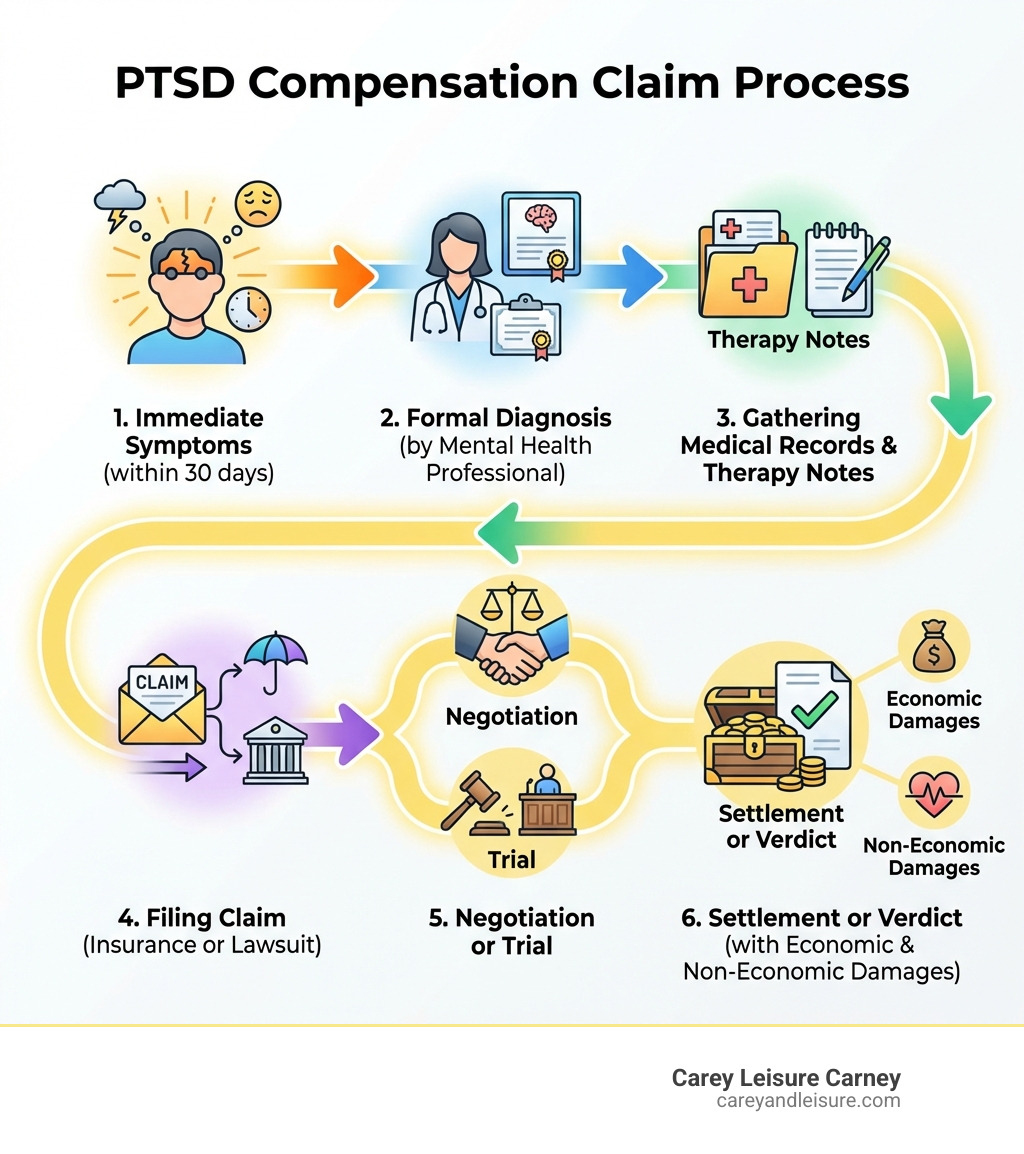
- Medical Documentation: The diagnosis, along with therapy notes and treatment plans, becomes critical medical documentation for your claim. This documentation provides objective evidence of your subjective experience, which is essential when seeking compensation for PTSD after a car accident.
A formal diagnosis from a qualified professional is the cornerstone of proving your PTSD claim.
Legal Grounds for Seeking Compensation for PTSD After a Car Accident
In Florida, just like with physical injuries, you have legal grounds to seek compensation for PTSD after a car accident if another party’s negligence caused the accident. Our state’s personal injury laws recognize that psychological harm can be as devastating as physical harm, and victims deserve to be compensated for their suffering.
The core legal principles for a personal injury claim involving PTSD in Florida revolve around:
- Negligence: We must demonstrate that the other driver acted carelessly, recklessly, or unlawfully, and this behavior directly led to the car accident. This could involve distracted driving, speeding, drunk driving, or failing to obey traffic laws.
- Duty of Care: Every driver on Florida roads has a legal “duty of care” to operate their vehicle safely and avoid harming others. When this duty is breached, and an accident occurs, negligence is established.
- Liability: Once negligence is proven, the at-fault driver (or their insurance company) is held liable for the damages caused.
- Proximate Cause: We must establish a clear link, or “proximate cause,” between the negligent act, the car accident, and your resulting PTSD. This means showing that your PTSD was a direct consequence of the traumatic event.
- Emotional Distress: PTSD falls under the umbrella of emotional distress, which is a compensable non-economic damage in Florida personal injury claims. While Florida’s “impact rule” historically required some physical impact for emotional distress claims, its application has evolved, and significant psychological injuries directly resulting from a traumatic event caused by negligence are often recognized. For more details on this, see our guide on Compensation for Pain and Suffering in Florida: What You Need to Know.
Our role at Carey Leisure Carney is to carefully build your case, gathering the necessary evidence to prove these elements and secure the compensation you deserve in Clearwater, Largo, New Port Richey, Spring Hill, St. Petersburg, Trinity, and Wesley Chapel.
Proving Your Case to Maximize Compensation for PTSD After a Car Accident
Proving PTSD for compensation after a car accident can be more complex than proving a broken bone because it’s an “invisible” injury. However, with the right approach and legal guidance, we can build a strong case.
Here’s how we help maximize your claim:
- Expert Testimony: We work with qualified mental health professionals—psychiatrists and psychologists—who can provide expert testimony. They can explain your diagnosis, the severity of your PTSD, its direct link to the car accident, and its long-term prognosis to the court or insurance adjusters.
- Witness Statements: Statements from friends, family, and colleagues who can attest to changes in your behavior, mood, and daily functioning since the accident can be powerful evidence. They can describe how the PTSD has impacted your relationships, work performance, and social life.
- Medical Records: Comprehensive medical records from all your treating physicians, therapists, and mental health specialists are paramount. These documents confirm your diagnosis, detail your treatment history, medication prescriptions, and the progress (or lack thereof) of your recovery.
- Journaling: We often advise our clients to keep a daily journal. Documenting your symptoms, emotional setbacks, daily struggles, and how the PTSD prevents you from performing normal activities can provide a vivid, personal account of your suffering. This includes details about pain intensity, discomfort from treatment, and how PTSD affects household tasks or family events. This personal narrative can be incredibly compelling. For more on this, check our page on Documenting Evidence in Personal Injury Claims.
- Link to Accident: Crucially, all evidence must clearly establish a direct causal link between the car accident and the onset of your PTSD. This is where a thorough medical evaluation and expert opinions become indispensable.
Insurance companies are notorious for trying to minimize non-economic damages like PTSD. They might suggest your symptoms are pre-existing or unrelated to the crash. That’s why having an experienced personal injury attorney in Florida is vital. We anticipate these tactics and build an undeniable case.
Can I Claim PTSD Without Physical Injuries?
Absolutely, yes. You can claim compensation for PTSD after a car accident even if you did not sustain physical injuries. Florida law, like many other jurisdictions, recognizes that psychological trauma can be just as debilitating, if not more so, than physical injuries. The emotional and mental impact of a terrifying event can be severe, regardless of whether your body bears visible scars.
Imagine witnessing a horrific accident in St. Petersburg where a loved one is severely injured, or experiencing a near-fatal collision yourself where you narrowly escape physical harm. The shock, fear, and helplessness in such situations can directly lead to PTSD. The key is proving the psychological injury itself.
- Psychological Trauma: The legal focus shifts from physical harm to the profound psychological distress and impairment caused by the event. This includes flashbacks, severe anxiety, avoidance behaviors, and other classic PTSD symptoms.
- Mental Anguish: This is a recognized component of non-economic damages in Florida. If the car accident directly caused you mental anguish that manifests as PTSD, you have a valid claim.
- Florida Law Requirements: While early interpretations of Florida’s “impact rule” sometimes made it difficult to claim emotional distress without physical contact, modern legal understanding and precedents recognize that serious psychological injuries stemming from a traumatic event caused by another’s negligence are compensable. The focus is on the severity and diagnosable nature of the mental injury and its causal link to the accident.
So, if you’re in New Port Richey, Trinity, or anywhere in Florida and developed PTSD after a car accident, even without physical injuries, don’t hesitate to seek legal advice. Your mental health is just as important as your physical health, and we are here to help you seek justice. For more information on various types of injuries resulting from car accidents, visit our page on Types of Car Accident Injuries.
Calculating Your Compensation for PTSD After a Car Accident
Determining the value of your compensation for PTSD after a car accident is a complex process, as it involves both easily quantifiable financial losses and subjective, intangible suffering. There isn’t a simple formula, but rather a detailed assessment of all your damages.
Generally, damages in a personal injury claim are categorized into two main types:
| Damage Type | Description | | Special Damages | These are objectively measurable financial losses. They are quantifiable and directly calculable from financial records. Examples include:
- Medical bills (past and future)
- Lost wages (past and future)
- Rehabilitation costs
- Therapy costs (e.g., cognitive behavioral therapy, EMDR)
- Medication expenses
- Travel expenses to medical appointments | | General Damages | These are often referred to as “pain and suffering” damages. They are difficult to quantify due to their subjective nature but are typically calculated based on the severity and permanency of the injury, and its impact on your life. For PTSD, this includes:
- Pain and suffering (mental and emotional anguish)
- Loss of enjoyment of life
- Emotional distress (anxiety, depression, fear)
- Loss of companionship or consortium
- Inconvenience and disruption to daily life
- Permanent psychological impairment | | Future Care Costs | This is a specific type of economic damage that covers the projected costs of ongoing medical care, therapy, medications, and support services related to your PTSD for the rest of your life. This can be substantial, especially for severe cases.
- Long-term psychiatric care
- Ongoing therapy
- Future medication needs
- Specialized treatment programs
- In-home support if daily functioning is severely impacted | | Future Care Costs | This is a specific type of economic damage that covers the projected costs of ongoing medical care, therapy, medications, and support services related to your PTSD for the rest of your life. This can be substantial, especially for severe cases.
- Long-term psychiatric care
- Ongoing therapy
- Future medication needs
- Specialized treatment programs
- In-home support if daily functioning is severely impacted |