

TBI legal rights: Essential 2025 Guide
Understanding Your TBI Legal Rights After an Accident
TBI legal rights protect your ability to seek compensation after a traumatic brain injury. A TBI occurs when an external force disrupts normal brain function, resulting from a blow, jolt, or penetrating head injury. When someone else’s negligence is the cause, you have several important legal protections.
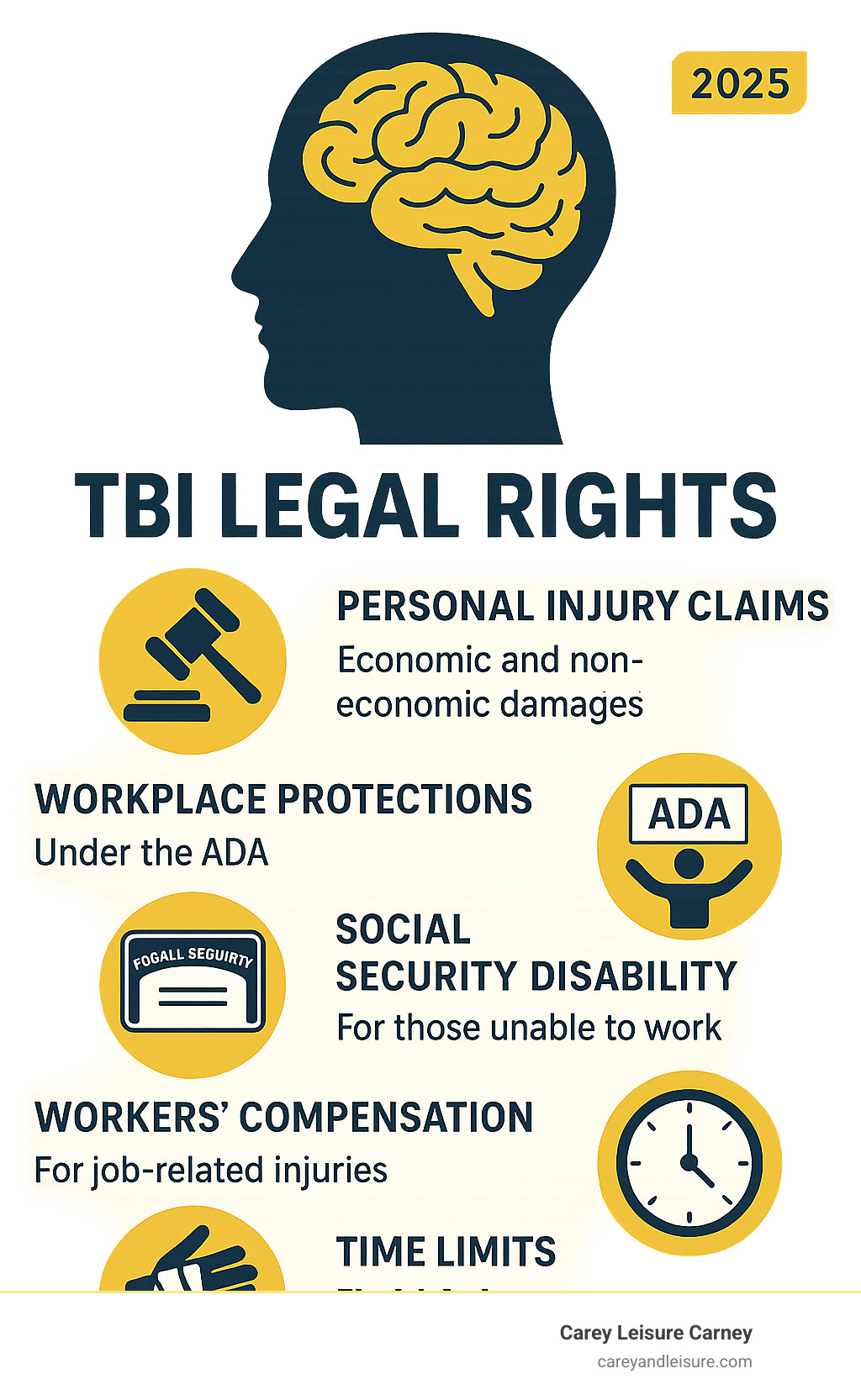
Your Core Legal Rights:
- Right to compensation for medical expenses, lost wages, and pain and suffering
- Right to reasonable accommodations at work under the Americans with Disabilities Act (ADA)
- Right to disability benefits through Social Security (SSDI/SSI)
- Right to workers’ compensation if injured on the job
- Protection from discrimination based on your disability
TBIs commonly result from motor vehicle accidents, falls, workplace accidents, and assaults. These injuries can cause lasting physical, cognitive, and emotional challenges. Symptoms may not appear immediately, making TBIs “invisible injuries” that are often underestimated. Medical professionals categorize TBIs into three types based on severity, but even a “mild” TBI can have life-changing effects. For example, a Minor Impact Can Cause Long-Term Damage.
Understanding your legal rights is crucial because you have limited time to act. In Florida, you typically have four years to file a personal injury claim, but building a strong case takes time.
What Constitutes a Traumatic Brain Injury?
A traumatic brain injury (TBI) is a complex injury from a sudden external force, like a blow or jolt, that disrupts the brain’s normal function. The effects can range from temporary disruptions to permanent changes, with symptoms that can be physical (headaches, dizziness), cognitive (memory problems, difficulty concentrating), and emotional (irritability, anxiety). These symptoms can be subtle and may not appear for days or weeks, making diagnosis tricky.
Common Causes of TBIs in Accidents
In a legal context, we focus on TBIs caused by another’s negligence. Common causes include:
- Motor Vehicle Accidents: Car, motorcycle, and pedestrian accidents are a leading cause of TBIs.
- Slip and Fall Accidents: Falls are the most common cause, often due to unsafe property conditions.
- Workplace Accidents: Construction and manufacturing industries have inherent risks from falls or equipment malfunctions.
- Assaults and Acts of Violence: Direct blows to the head can cause severe brain injuries.
Understanding Your Core TBI Legal Rights
When a TBI is caused by someone else’s carelessness, or negligence, you have important TBI legal rights to help you rebuild. Negligence is a failure to act with reasonable care, like a distracted driver running a red light. When that failure leads to your brain injury, the legal system provides a path to financial recovery.
Your primary option is a tort claim, also known as a Personal Injury Lawsuit. This allows you to seek comprehensive compensation from the at-fault party. While your own Personal Injury Protection (PIP) insurance may cover initial costs, it is rarely enough for a serious TBI.
Your TBI Legal Rights in a Personal Injury Claim
Filing a lawsuit holds the at-fault party accountable. To do this, we must prove negligence by showing they owed you a duty of care, breached that duty, and directly caused your TBI and resulting damages.
Compensation falls into three categories:
- Economic damages cover financial losses like medical bills and lost wages.
- Non-economic damages address personal impacts like physical pain and emotional suffering. Florida has specific rules for Compensation for Pain and Suffering in Florida – What You Need to Know.
- Punitive damages may apply in rare cases of extreme recklessness to punish the wrongdoer.
What Types of Compensation Can You Seek?
A TBI affects your entire life, and brain injuries are among the most expensive to treat. Comprehensive compensation is essential. We seek recovery for:
- Current and future medical expenses, from emergency care to long-term neurological treatment.
- Lost wages and loss of earning capacity, accounting for how the TBI impacts your ability to work now and in the future.
- Rehabilitation costs, including physical, occupational, speech, and cognitive therapy.
- Home modifications and assistive technologies.
- Pain and suffering for physical discomfort and emotional distress like anxiety or depression.
- Loss of enjoyment of life for the inability to pursue hobbies or activities you once loved.
To accurately project these long-term costs, we often use detailed Life Care Plans in Personal Injury Cases to ensure no future need is overlooked.
Building Your TBI Claim: Evidence and Deadlines
Building a strong TBI case requires moving quickly to gather the right evidence. Traumatic brain injuries are often “invisible injuries,” making solid documentation and expert testimony crucial to proving your TBI legal rights. We handle the heavy lifting of Documenting Evidence in Personal Injury Claims so you can focus on recovery.

Essential Evidence to Support Your TBI Claim
A compelling TBI case is built on a foundation of strong evidence. Key items include:
- Medical records and diagnostic imaging (MRIs, CT scans) to document the injury and its effects.
- Neuropsychological evaluations to provide objective proof of cognitive changes.
- Police and accident reports to establish the facts of the incident.
- Witness statements from people who saw the accident or can describe changes in your condition.
- Expert testimony from neurologists and other specialists who can explain your injury. The Use of Expert Witnesses is often critical.
- Photos, videos, and proof of financial loss (pay stubs, bills) to show the real-world impact.
Statutes of Limitations and Why Prompt Action is Crucial
Even the strongest case is worthless if you wait too long. In Florida, you typically have four years from the date of injury to file a personal injury lawsuit. This deadline is called the “statute of limitations,” and missing it means losing your rights forever.
Acting quickly is also vital because evidence disappears. Witnesses move, memories fade, and security footage is deleted. Seeking prompt medical attention is also important for your health and your case. We are often asked How much time do I have to see doctor after car accident?, and the answer is always as soon as possible.
What is Contributory or Comparative Negligence?
Sometimes, more than one person is at fault for an accident. Florida follows a “modified comparative negligence” rule, which means you can still recover damages even if you were partially to blame.
Your compensation will be reduced by your percentage of fault. For example, if you are found 20% at fault in an accident where you were awarded $100,000, you would receive $80,000. This is a much fairer system than in states where being even 1% at fault bars you from any recovery. Our job is to minimize any fault assigned to you. You can learn more in our explanation of Comparative Negligence.
TBI Rights Beyond the Accident: Workplace and Disability Protections
When a TBI’s challenges extend beyond the initial injury, affecting your work and daily life, your TBI legal rights include a network of laws designed to protect you from discrimination and provide support.

Navigating Your TBI Legal Rights in the Workplace
Returning to work after a TBI can be difficult, but you have powerful legal protections. The Americans with Disabilities Act (ADA) is your greatest ally. It requires employers to provide reasonable accommodations, such as a quieter workspace, modified duties, or a flexible schedule, unless doing so causes undue hardship.
The ADA also shields you from discrimination in hiring, firing, promotions, and pay. If you feel your rights have been violated, you can file a complaint with the Equal Employment Opportunity Commission (EEOC). Resources like Traumatic Brain Injuries and Work | Equip For Equality can offer further guidance.
Workers’ Compensation for On-the-Job TBIs
If your TBI happened at work, workers’ compensation is a crucial part of your TBI legal rights. This is a no-fault system, meaning you are generally covered if you were injured while doing your job, regardless of who was at fault. It provides medical benefits and lost wage benefits.
However, workers’ comp is usually an “exclusive remedy,” meaning you typically can’t sue your employer for other damages like pain and suffering. An important exception is a third-party claim. If someone other than your employer (like a negligent driver or the maker of faulty equipment) caused your injury, you may be able to file a separate personal injury lawsuit against them. Understanding the difference between What is Difference Intentional Misconduct and Gross Negligence? can be important in these cases.
Applying for Disability Benefits (SSDI & SSI)
If a TBI is so severe that you cannot work, you may have the right to federal disability benefits. There are two main programs: Social Security Disability Insurance (SSDI) for those with a sufficient work history, and Supplemental Security Income (SSI), which is need-based.
To qualify, you must prove your TBI prevents you from doing substantial work for at least a year. The Social Security Administration uses a medical guide, “The Blue Book,” to evaluate claims. Because TBIs are often “invisible” disabilities, comprehensive medical documentation is essential. The application process is complex and many initial claims are denied, making experienced legal help invaluable.
Frequently Asked Questions about TBI Legal Claims
When you’re dealing with a TBI, you have questions. Here are answers to some of the most common concerns we hear about TBI legal rights.
Should I accept the insurance company’s first settlement offer?
No. At least, not without speaking to an experienced TBI attorney first. Insurance companies are businesses focused on minimizing payouts. Their initial offers are almost always low-ball settlements made before the full, long-term impact of your brain injury is known. Once you accept an offer, you cannot ask for more money later, even if your condition worsens. An attorney can assess your claim’s true value and protect you from settling for less than you deserve. Learn more about The Role of Insurance Companies in a Car Accident.
How much does it cost to hire a TBI lawyer?
Hiring a TBI attorney should cost you nothing out of pocket. We work on a contingency fee basis, which means we only get paid if we win your case. Our fee is a pre-agreed percentage of the compensation we recover for you. If we don’t win, you owe us nothing. This system ensures everyone has access to quality legal help. We also offer free consultations to discuss your case and our fee structure. You can learn more in our guide about How much does it cost to hire a personal injury attorney?.
What if my loved one with a TBI cannot make legal decisions?
A severe TBI can impair a person’s ability to make sound decisions. However, their legal rights are not lost. If your loved one created a durable power of attorney before the injury, the person they designated can handle their legal and financial affairs. If no such document exists, a family member may need to petition a court for guardianship (or conservatorship). This process legally appoints someone to act in the TBI victim’s best interests. Navigating this can be complex, and understanding issues like Who Can Override a Power of Attorney in Florida? requires specialized knowledge. We can guide your family through this sensitive process.
Securing Your Future: How a TBI Attorney Can Help
When a traumatic brain injury changes everything, you shouldn’t have to steer the legal maze alone. The medical challenges are overwhelming enough. We are here to shoulder the legal burden so you can focus on what truly matters: your recovery.

Insurance companies have teams of lawyers working to pay as little as possible. Having experienced legal counsel fighting for your TBI legal rights levels the playing field. At Carey Leisure Carney, our approach is deeply personal because we know your injury happened to you and your family.
We handle every aspect of your case. We start by thoroughly investigating your accident, identifying all liable parties. We then work with medical and financial experts to calculate the full, long-term cost of your injury, including future medical care and lost earning potential. We use this evidence to negotiate aggressively with insurance companies. While most cases settle, our opponents know we are always prepared for trial. Our status as Board-Certified attorneys—a distinction held by only the top 2% in Florida—signals that we are serious.
What sets us apart is our commitment to treating you like family. You’ll have direct access to your attorney and will always know what’s happening with your case. We understand Why you need a personal injury lawyer who not only has legal expertise but also reduces the stress in your life.
Your path forward doesn’t have to be uncertain. With over 100 years of combined experience, we’ve helped countless TBI survivors secure the compensation they need. Whether you’re in Clearwater, Largo, New Port Richey, Spring Hill, St. Petersburg, Trinity, Wesley Chapel, or anywhere in Florida, we’re here to help.
Contact a Board-Certified Traumatic Brain Injury Attorney at Carey Leisure Carney today for a free consultation. Let us put our experience to work for you.