
Uncovering the Truth: Where to Find Fatality Reports
Why Fatality Reports Matter After a Tragic Loss
Fatality reports are official documents prepared by government agencies that detail the circumstances, causes, and contributing factors of incidents resulting in death. These reports are essential for families seeking answers, supporting insurance claims, and pursuing legal action for wrongful death.
Quick Guide: Where to Find Fatality Reports
| Type of Incident | Issuing Agency | How to Access |
|---|---|---|
| Motor Vehicle Accident | State Highway Patrol, Local Police, NHTSA (FARS) | State crash portals (e.g., Florida’s Crash Portal), mail requests, or in-person at agency offices |
| Workplace Fatality | OSHA (general industry), MSHA (mining) | OSHA Fatality Inspection Data, MSHA website, or direct agency contact |
| Transportation Accident | NTSB (aviation, rail, marine, highway) | NTSB Investigation Database (CAROL) or downloadable datasets |
Access Note: In Florida and many states, crash reports have a 60-day restricted period during which only involved parties, their attorneys, and insurance companies can access them. After 60 days, they become public record.
When a loved one dies in an accident, families face overwhelming grief alongside urgent practical questions: What happened? Who was at fault? What are my legal rights? Fatality reports provide critical answers. They document everything from weather conditions and witness statements to the investigating officer’s conclusions about cause and liability.
These reports serve multiple purposes. For families, they offer a factual account of events during an impossibly difficult time. For attorneys, they form the foundation of wrongful death claims and personal injury cases. For safety advocates and policymakers, they reveal patterns that can prevent future tragedies.
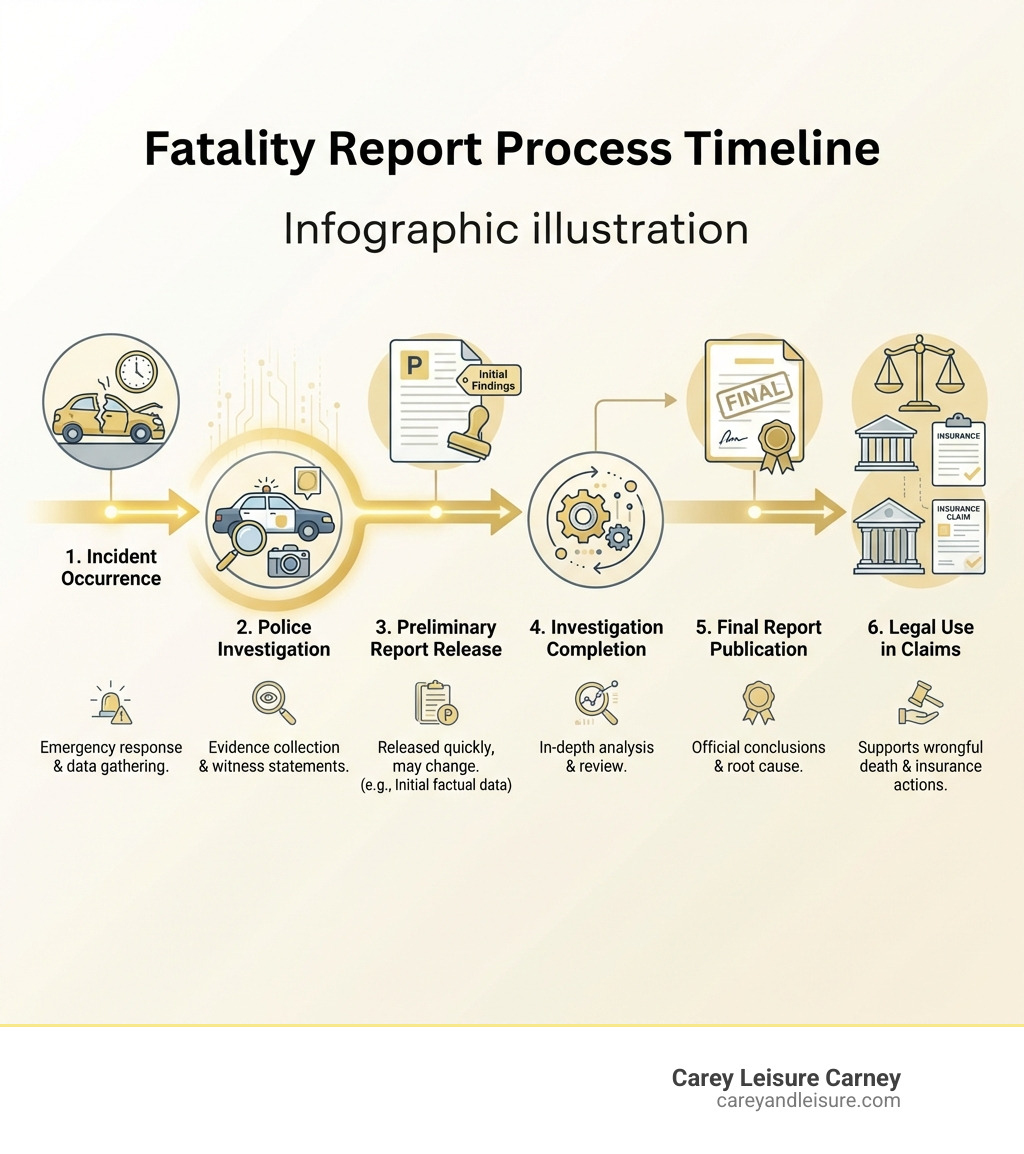
Understanding the difference between preliminary and final reports is crucial. Preliminary reports are released quickly with initial findings, but details may change. Final reports include in-depth analysis, root cause determination, and official conclusions – these carry the most weight in legal proceedings.
Whether you’re seeking closure, building an insurance claim, or pursuing justice through the courts, knowing where to find these reports and what they contain is the first step forward.
As Thomas W. Carey, I’ve spent over three decades representing families who’ve lost loved ones to negligence, and I understand how vital fatality reports are in uncovering the truth and securing justice. My experience guiding thousands of injury and wrongful death cases has shown me that obtaining and properly interpreting these documents is often the turning point in holding responsible parties accountable.
Must-know fatality reports terms:
What Are Fatality Reports and What Do They Contain?

Fatality reports are official, legally recognized documents that carefully detail the circumstances surrounding an incident that resulted in a death. Think of them as the official story of what happened, compiled by trained investigators. These reports serve as crucial incident documentation and can become vital legal evidence in subsequent proceedings.
A key distinction to understand is between preliminary and final fatality reports. Preliminary reports are often generated quickly after an incident to provide initial findings. They might contain basic facts, initial observations, and perhaps some early witness accounts. However, they are subject to change as the investigation progresses and more information becomes available.
Final reports, on the other hand, are the culmination of a thorough and often extensive investigation. They include in-depth analysis, root cause determination, and official conclusions. These reports are considered the definitive account and carry significant weight in legal and regulatory contexts.
| Feature | Preliminary Report | Final Report |
|---|---|---|
| Timing | Released quickly, often within days or weeks | Released after a full investigation, may take months or even years |
| Content | Initial findings, brief description, basic facts | Detailed analysis, root causes, contributing factors, official conclusions, recommendations |
| Completeness | May be incomplete, subject to change | Comprehensive, definitive account |
| Purpose | Immediate notification, early warning, initial understanding | Accountability, prevention, legal evidence, policy changes |
| Legal Weight | Limited, serves as a starting point | Significant, often forms the basis for legal claims and regulatory actions |
Understanding these differences is especially important when pursuing Fatal Accident Claims. A preliminary report might give you a general idea, but a final report provides the detailed evidence needed to build a strong case.
Key Information in a Report
While the exact format and content can vary slightly between agencies and incident types, most fatality reports aim to capture a comprehensive picture of the incident. Here’s what you can typically expect to find:
- Date and Time of Incident: The precise moment the tragedy occurred.
- Location of Incident: Specific address, intersection, highway mile marker, or coordinates.
- Weather and Road Conditions: For motor vehicle accidents, this includes details like visibility, precipitation, road surface (wet, dry, icy), and lighting conditions.
- Involved Parties’ Information: Names, contact details, and any relevant identifying information for individuals, vehicles, or entities directly involved. In some cases, personal identifying information may be redacted for privacy.
- Witness Statements: Accounts from individuals who observed the incident, providing crucial perspectives.
- Narrative Description: A written account by the investigating officer or agency, detailing the sequence of events leading up to, during, and immediately after the incident.
- Scene Diagram or Sketch: A visual representation of the incident scene, showing positions of vehicles, individuals, objects, and relevant environmental factors.
- Officer’s Opinion on Cause: The investigator’s professional assessment of the primary and contributing factors that led to the fatality. This can be critical for determining fault.
- Citations Issued: Any traffic tickets or regulatory violations issued to involved parties as a result of the investigation.
For example, a Florida Highway Patrol (FHP) report for a car accident will contain information such as the location, time, and date of the traffic accident, weather and road conditions, names and contact information for parties involved, description of vehicle damage, statements from parties and eyewitnesses, a sketch of the accident scene, and whether traffic tickets were issued. This critical information can support an insurance claim and provide insight into the investigators’ belief about the cause of the collision.
Who Issues Fatality Reports and How Do They Differ?

Various government agencies at both federal and state levels are responsible for investigating and issuing fatality reports, each specializing in different types of incidents. Their focus and the depth of their reports will differ based on their jurisdiction and mandate. Understanding which agency is involved is the first step in accessing the relevant report.
Motor Vehicle Accident Reports
When a death occurs as a result of a motor vehicle accident, several agencies may be involved in generating fatality reports.
- National Highway Traffic Safety Administration (NHTSA): At the federal level, NHTSA oversees the Fatality Analysis Reporting System (FARS). FARS, operational since 1975, is a comprehensive database containing data on a census of fatal motor vehicle traffic crashes across the United States. To be included, a crash must involve a motor vehicle on a public trafficway and result in death within 30 days. FARS data is collected through cooperative agreements with states, using information from police reports, death certificates, and toxicology reports. Importantly, FARS data does not include personal identifying information, such as names or addresses, to protect privacy. This system is invaluable for identifying trends and patterns in traffic fatalities to inform safety initiatives and evaluate the effectiveness of traffic safety programs. You can find More info on FARS data.
- State Highway Patrols (e.g., Florida Highway Patrol – FHP): In Florida, the Florida Highway Patrol (FHP) often responds to and investigates accidents, especially those on state highways or involving serious injury or death. Florida law requires any driver involved in an accident resulting in injury, death, or property damage over $500 to report it to the local police department. FHP reports focus on crash dynamics, driver behavior, and vehicle information specific to the incident.
- Local Police Departments: City police departments or county sheriff’s offices investigate fatal accidents that occur within their specific jurisdictions. Their reports will also detail the crash circumstances, involved parties, and their findings regarding fault.
These reports are crucial for anyone involved in Car Accidents that result in a fatality, providing the foundation for legal actions and insurance claims.
Workplace & Industrial Fatality Reports
Tragically, some fatalities occur in the workplace. These incidents fall under the purview of agencies dedicated to occupational safety.
- Occupational Safety and Health Administration (OSHA): OSHA is the primary federal agency responsible for ensuring safe and healthful working conditions. They investigate work-related fatalities and catastrophes. OSHA’s fatality inspection data includes Federal inspections opened after April 2011 and State Plan inspections opened around or after October 2014. This data helps identify safety violations, equipment failures, and procedural errors that led to the death. Sometimes, victim names may be blank in OSHA reports if the incident was not work-related or if OSHA lacked jurisdictional coverage. Their reports often highlight best practices for prevention, aiming to prevent similar occurrences in the future.
- Mine Safety and Health Administration (MSHA): For fatalities occurring in mining operations, MSHA takes the lead. MSHA investigates each mining fatality and prepares a series of documents: a Fatality Alert (describing the accident and best practices for prevention), a Preliminary Report (initial findings), and a Final Report (investigative findings, root causes, and enforcement actions). Some deaths on mining property might be determined to be unrelated to mining activity and are therefore not included in MSHA’s fatality statistics. These reports are critical for understanding the specific dangers of mining environments and improving safety protocols.
Transportation Accident Reports
Beyond motor vehicles, fatalities can occur in other modes of transportation.
- National Transportation Safety Board (NTSB): The NTSB is an independent federal agency charged with investigating every civil aviation accident in the U.S. and significant accidents in other transportation modes – railroad, highway, marine, and pipeline. The NTSB focuses on determining the probable cause of the accident and issuing safety recommendations to prevent future occurrences. Their investigations often dig into systemic failures, not just immediate causes. The NTSB provides a searchable database called CAROL (Case Analysis and Reporting Online) for investigations and recommendations across all modes. They also offer downloadable datasets for historical aviation accident research, complete with coding manuals and data definitions. These comprehensive reports are instrumental in advancing transportation safety across the nation.
How to Access and Use Fatality Reports
Accessing fatality reports can feel like navigating a maze, but understanding the process is key. These reports are often considered public records, yet come with specific procedures and limitations, particularly concerning privacy. Once obtained, their data can be incredibly valuable for various purposes, from personal legal claims to broader safety improvements. Effective utilization of this data, along with proper Documenting evidence in personal injury claims, can make a significant difference.
Step-by-Step Guide to Obtaining Fatality Reports
The procedure for obtaining a fatality report depends on the type of incident and the jurisdiction. Here’s a general guide, with a focus on our Florida locations:
- Identify the Correct Agency: This is the most crucial first step.
- For motor vehicle accidents in Clearwater, Largo, New Port Richey, Spring Hill, St Petersburg, Trinity, or Wesley Chapel, Florida, the report would typically be filed by the Florida Highway Patrol (FHP), the local police department (e.g., Clearwater Police Department, St. Petersburg Police Department), or the county sheriff’s office (e.g., Pinellas County Sheriff’s Office, Pasco County Sheriff’s Office, Hillsborough County Sheriff’s Office).
- For workplace fatalities, it would be OSHA or MSHA.
- For major transportation incidents (aviation, rail, significant highway/marine), it would be the NTSB.
- Online Portals: Many agencies now offer online access to reports.
- For Florida traffic crash reports, the Florida’s Crash Portal is the primary resource. You can request a copy of a report prepared by an FHP officer here. If you can’t locate the report after ten days, the FLHSMV recommends contacting the responding agency directly.
- OSHA provides an online portal for Fatality Inspection Data.
- The NTSB offers its CAROL database for investigations and recommendations.
- Mail-in Requests: If online access isn’t available or suitable, you can often request reports by mail. For Florida crash reports, you might need to submit a Sworn Statement to Obtain Traffic Crash Report Information along with payment to the Florida Department of Highway Safety and Motor Vehicles.
- In-Person Requests: For some reports, especially older ones or those requiring specific documentation, you may need to visit the agency’s records division in person. For FHP reports, you might need to contact the nearest FHP Troop Station.
- Associated Fees: Be prepared for potential fees. For example, Florida crash reports typically cost $10 per report, plus a $2 convenience fee for online requests.
- Timelines: Reports are not always immediately available. FLHSMV states it may take up to ten days for a crash report to become available online, and once available, you must download it within 48 hours. Mailed requests for recent reports can take four to six weeks.
Knowing What to do after a car accident Florida includes understanding how to obtain these vital documents.
Understanding Access Limitations and Restrictions
While many fatality reports eventually become public record, there are often significant limitations and restrictions, primarily due to privacy concerns and ongoing investigations.
- Privacy Concerns: To protect the privacy of individuals involved, especially victims and their families, personal identifying information is often redacted from publicly available reports. FARS data, for instance, explicitly excludes names, addresses, and social security numbers.
- Waiting Periods: Florida law provides a crucial example of access restrictions. Traffic accident reports are public record, but for the first 60 days after a crash, access is restricted. During this period, only specific parties can obtain the report:
- Drivers and passengers involved
- Their legal representatives (like our attorneys at Carey Leisure Carney)
- Car insurance companies
- Law enforcement officials
- News organizations publishing legal notices
- FCC-licensed broadcast stations
- Prosecutor’s offices and victim service programs
After this 60-day period, the reports become fully public. These waiting periods are designed to give involved parties and their legal teams time to gather crucial information before it’s widely disseminated.
- Redacted Information: Even after a report becomes public, sensitive details, such as medical information or specific personal identifiers, may be redacted.
- Anonymized Data: Federal databases like FARS provide aggregated, anonymized data for statistical analysis, not individual incident reports with identifying details.
This restricted access period highlights the benefit of having legal representation. Our team can often access these reports on your behalf during the restricted period, ensuring you get the information you need as quickly as possible.
The Significance of Fatality Reports in Legal and Safety Contexts
Fatality reports are more than just documents; they are powerful tools used for accountability, justice, and prevention.
- Insurance Claims: These reports are foundational for initiating and resolving insurance claims. They provide official documentation of the incident, supporting claims for vehicle damage, medical expenses, and other losses.
- Wrongful Death Claims: If you’ve lost a loved one due to someone else’s negligence, a fatality report is a cornerstone of a Wrongful Death Lawyer case. It establishes the facts of the incident, identifies potentially at-fault parties, and can be used to prove negligence.
- Accident Reconstruction: Experts use the detailed information within these reports, including diagrams, witness statements, and officer’s opinions, to reconstruct the incident, providing a clearer picture of how and why it occurred.
- Identifying Safety Trends: Aggregated data from thousands of fatality reports, such as that collected by FARS, helps identify common causes of deaths, dangerous locations, or flawed products.
- Informing Policy Changes: When trends emerge, these reports inform legislative changes, safety campaigns, and infrastructure improvements aimed at reducing future fatalities.
- Preventing Future Incidents: The ultimate goal of many investigations and reports is to learn from past tragedies. MSHA’s reports, for example, specifically include best practices to prevent similar mining accidents.
Legal Implications and Your Rights
When an incident results in a fatality, the legal landscape for those involved, especially the surviving family members, becomes complex. Fatality reports are not just informational documents; they carry significant legal weight, impacting rights, responsibilities, and potential recourse. Understanding these implications and your rights is crucial, and knowing How attorneys use investigations for your personal injury claim can be invaluable.
Using a Report in a Wrongful Death Claim
For families who have lost a loved one due to another party’s negligence or misconduct, a fatality report is often the bedrock of a wrongful death claim.
- Establishing Negligence: The report’s narrative, witness statements, and the investigating officer’s opinion on causation can provide strong evidence of negligence. For instance, if a traffic accident report indicates a driver was speeding or ran a red light, it directly points to their negligent actions.
- Evidence of Fault: The report formally documents who was involved and often, who was deemed at fault or issued citations. This official determination can be persuasive in court or during settlement negotiations.
- Supporting Testimony: Details within the report can corroborate witness testimony or expert opinions during a trial.
- Calculating Damages: While the report doesn’t quantify damages, it lays the factual groundwork upon which economic and non-economic damages (such as lost income, medical expenses, funeral costs, and pain and suffering) are calculated in a Wrongful Death Attorney Florida Complete Guide case.
When to Contact an Attorney
Navigating the aftermath of a fatal incident, especially when it involves a fatality report, is not something you should do alone. Our firm, Carey Leisure Carney, strongly advises contacting an attorney in several key situations:
- If You Are a Surviving Family Member: If you have lost a loved one due to an accident, you likely have questions, and potentially legal rights to compensation. An attorney can help you understand these rights, obtain the necessary reports, and guide you through the process of seeking justice.
- If the Report Contains Errors: Investigators are human, and mistakes can happen. If you believe a fatality report contains factual inaccuracies or omissions that could negatively impact your case, an attorney can help challenge and correct these errors.
- If Liability is Disputed: Sometimes, the report’s findings are ambiguous, or other parties dispute their fault. An attorney can conduct an independent investigation, gather additional evidence, and advocate on your behalf to establish clear liability.
- To Understand Your Legal Options: The legal implications of a fatality are vast. An attorney can explain the nuances of personal injury and wrongful death law, helping you make informed decisions about your next steps.
As board-certified attorneys with over 100 years of combined experience, we understand that this is a profoundly difficult time. We are here to provide direct attorney access and personalized service to help you. This is precisely Why you need a personal injury lawyer.
Frequently Asked Questions about Fatality Reports
We often hear similar questions from individuals trying to understand fatality reports and their implications. Here are some of the most common ones:
What is the difference between a preliminary and a final fatality report?
As we discussed earlier, the main difference lies in their completeness and purpose. Preliminary reports are initial documents, quickly compiled with basic facts and early observations. They serve to provide immediate information and are subject to change as the investigation progresses. Think of them as a snapshot.
Final reports, conversely, are the result of a thorough, in-depth investigation. They include comprehensive analysis, identify root causes, offer official conclusions, and may even propose safety recommendations. These reports are considered definitive and hold greater legal and evidentiary weight.
Are fatality reports public record?
Generally, yes, fatality reports eventually become public record. However, there are often significant nuances and restrictions, particularly in the initial stages.
In Florida, for example, traffic accident reports are public record, but they are subject to a 60-day restriction period. During this time, only specific individuals and entities – such as those involved in the accident, their legal representatives, and insurance companies – can access them. After these 60 days, the reports are made available to the general public. This waiting period is designed to protect the privacy of those involved and allow them to gather necessary information without immediate public scrutiny. For other types of fatality reports, like those from OSHA or MSHA, public access procedures may vary, but privacy redactions are common to protect personal identifying information.
What are some common causes of fatalities documented in these reports?
Fatality reports reveal a wide range of causes, but some patterns emerge consistently across different incident types.
For motor vehicle accidents, common causes include:
- Speeding: Exceeding the speed limit or driving too fast for conditions is a frequent contributing factor.
- Impaired Driving: Alcohol or drug use, as detailed in a Drunk driving accident attorney case, significantly impairs a driver’s ability to operate a vehicle safely.
- Distracted Driving: Activities like texting, talking on the phone, or other distractions behind the wheel divert attention from the road, leading to tragic outcomes.
- Reckless Driving: Aggressive maneuvers, weaving through traffic, or ignoring traffic laws.
In workplace incidents, common causes often involve:
- Falls: Falls from heights, or slips and trips on the same level, are leading causes of workplace fatalities.
- Powered Haulage Accidents: Incidents involving forklifts, trucks, or other heavy machinery used for moving materials, particularly prevalent in industries like mining.
- Machinery Accidents: Crush injuries or impacts from unguarded or malfunctioning machinery.
- Electrocution: Contact with live wires, faulty equipment, or improper electrical procedures.
- Struck-by Objects: Being hit by falling objects, vehicles, or equipment.
These patterns, documented in fatality reports, are crucial for developing targeted safety interventions and regulations across various sectors.
Navigating the Aftermath and Seeking Justice
The loss of a loved one is an unimaginable tragedy, and the days, weeks, and months that follow can be filled with grief, confusion, and a desperate need for answers. Fatality reports are vital documents that can help piece together what happened, providing the clarity needed to move forward. Whether it’s a preliminary report offering initial insights or a final report delivering comprehensive conclusions, these documents are an indispensable tool for understanding, accountability, and ultimately, seeking justice.
At Carey Leisure Carney, we understand the profound impact a fatal accident can have on families in Clearwater, Largo, New Port Richey, Spring Hill, St Petersburg, Trinity, and Wesley Chapel, Florida. Our experienced, board-certified attorneys are dedicated to helping you steer this challenging time. If you have lost a loved one and need help obtaining and interpreting a fatality report for a potential legal claim, our experienced attorneys are here to help. We offer direct attorney access and personalized service, ensuring you have the support and expertise you need to uncover the truth and pursue the compensation you deserve.
Contact our wrongful death attorneys for a free consultation today. We are here to stand by your side.