ATV accident lawsuit: Your 2025 Guide to Justice
The Hidden Dangers of Off-Road Thrills
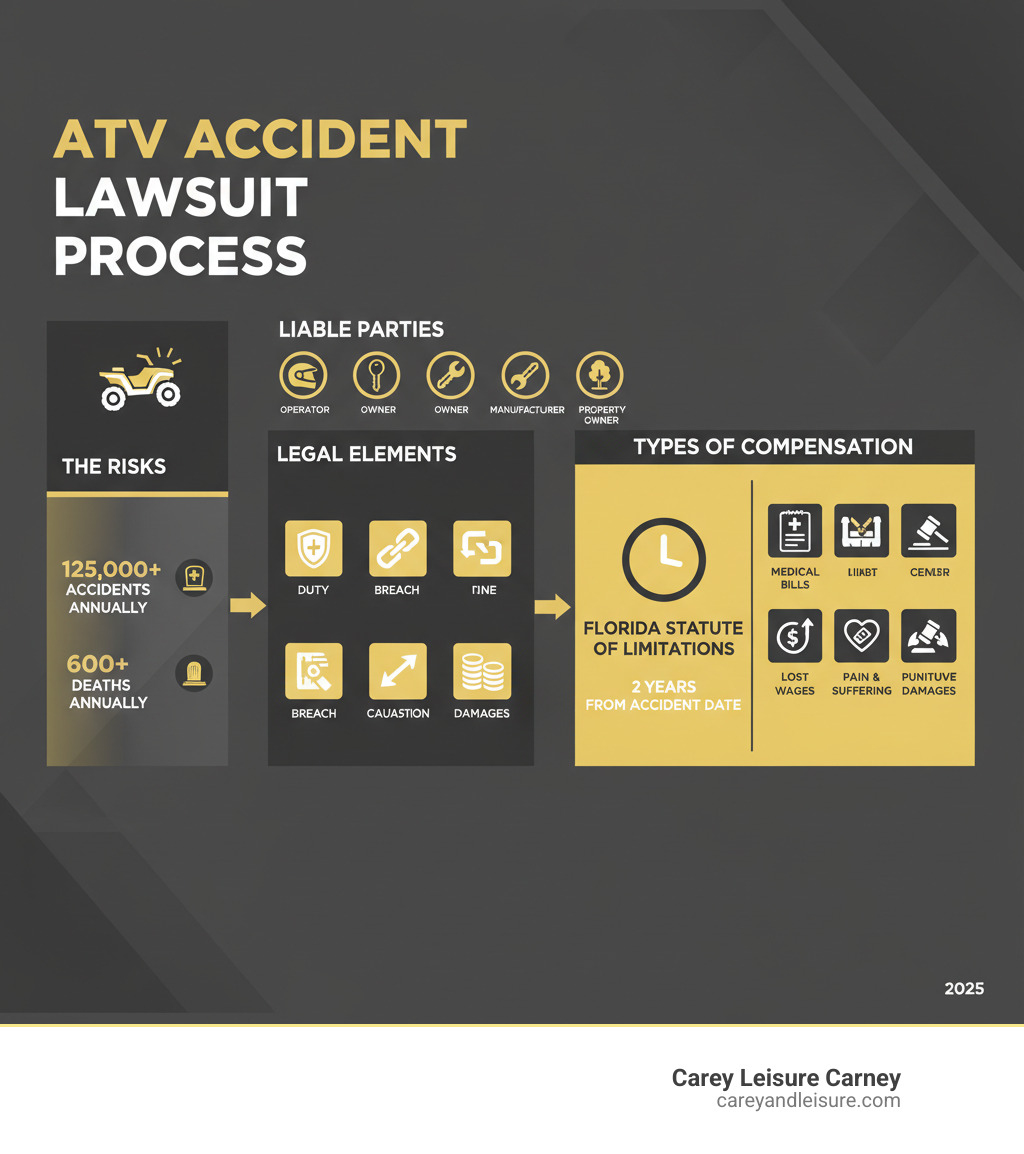
An ATV accident lawsuit allows injured riders, passengers, or their families to seek compensation from negligent parties, such as the operator, owner, manufacturer, or property owner where the crash occurred. Here’s what you need to know:
Key Steps in an ATV Accident Lawsuit:
- Establish liability – Prove who owed you a duty of care and breached it
- Document damages – Gather medical records, bills, wage loss, and evidence of pain and suffering
- File within the deadline – Florida gives you two years from the accident date
- Prove negligence – Show that the defendant’s actions directly caused your injuries
- Negotiate or litigate – Most cases settle, but some require a trial to secure fair compensation
All-terrain vehicles are responsible for more than 125,000 accidents and over 600 deaths annually in the U.S., with those 16 and younger being most affected. What begins as an outdoor thrill can end in catastrophic injury—traumatic brain damage, spinal cord trauma, or even wrongful death.
The legal landscape is complex, as liability can fall on multiple parties: a reckless rider, a parent who allowed an inexperienced teen to operate a powerful machine, a manufacturer of a defective part, or a landowner with an unmarked hazard. Florida law imposes specific duties on ATV owners and operators, including helmet requirements for minors and a two-year statute of limitations to file your claim.
If you or a loved one has been hurt, you’re likely overwhelmed. You need answers, not legal jargon. You need someone who understands that behind every case file is a family in crisis.
I’m Thomas W. Carey, a board-certified civil trial lawyer. Since 1988, my firm has handled thousands of injury matters across Florida, securing multi-million-dollar results. My experience with ATV accident lawsuits means I know how to identify every liable party, preserve critical evidence, and fight insurance companies that try to minimize your claim.
The Devastating Reality: Common Causes and Catastrophic Injuries
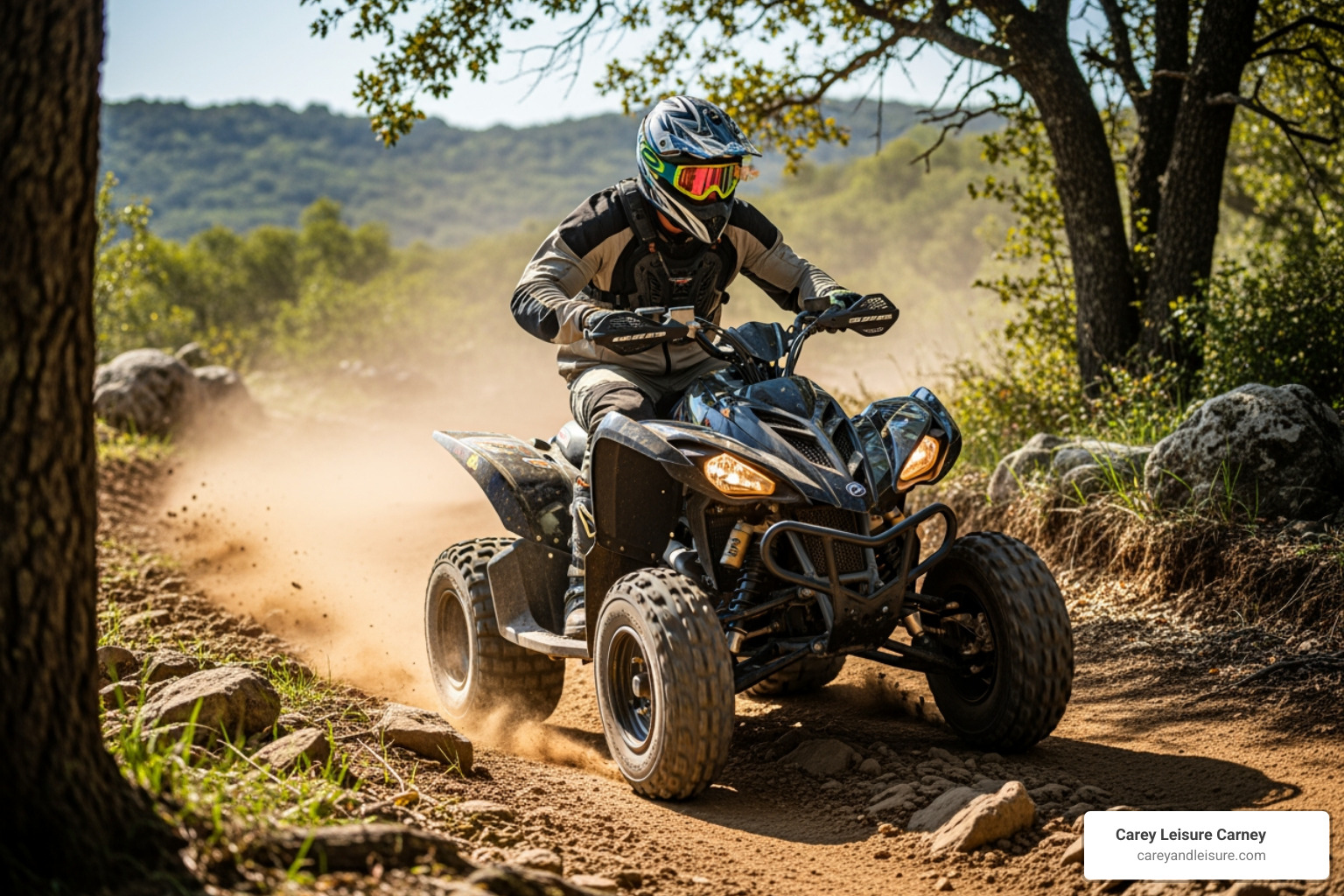
An ATV is a 600-pound machine capable of high speeds but with no seatbelt, airbags, or protective shell. The thrill is real—but so is the danger. I’ve sat with too many families whose lives changed in an instant, which fuels my commitment to hold negligent parties accountable in every ATV accident lawsuit we handle.
Crashes typically stem from three sources. Operator error is the most common, including inexperience, reckless behavior, and impairment from alcohol or drugs. Environmental factors like uneven terrain, unmarked obstacles, and poorly maintained trails also cause accidents. Finally, mechanical failures such as faulty brakes, defective throttles, or tire blowouts can cause even skilled riders to lose control.
When these factors collide, the human body cannot withstand the impact.
- Traumatic brain injuries (TBIs) are devastatingly common, causing permanent cognitive damage, memory loss, and personality changes.
- Spinal cord injuries from rollovers or ejections often result in partial or complete paralysis, requiring a lifetime of specialized care.
- Fractures account for 30% of all ATV injuries, often complex breaks of arms, legs, and ribs that require multiple surgeries.
- Internal organ damage from blunt force trauma can be life-threatening.
- Wrongful death is the ultimate tragedy. Between 1982 and 2018, nearly 16,000 people died in ATV accidents, 21% of whom were children under 16. In 2018 alone, 81,800 people visited emergency rooms after ATV crashes. Behind each number is a family torn apart.
Why ATVs Don’t Belong on Public Roads
ATVs are designed for dirt, not pavement, and taking them on public roads is extremely dangerous. Their high center of gravity makes them prone to rollovers on flat surfaces, especially in turns. They lack basic safety features like roll cages or airbags. Furthermore, their braking and steering systems are designed for soft soil and perform poorly on asphalt, increasing stopping distances and making the vehicle difficult to control at speed. The aggressive, low-pressure tires offer poor traction on paved surfaces. Florida law recognizes these dangers, generally prohibiting ATVs on public roads. The Consumer Product Safety Commission makes it clear that operating ATVs on paved surfaces is extremely dangerous. These preventable accidents often overlap with other types of motor vehicle accidents we handle, but the outcomes are especially severe for vulnerable ATV riders.
The Most Frequent Causes of ATV Wrecks
Understanding common accident causes is essential for building a strong ATV accident lawsuit. Speeding and reckless driving are the deadliest factors, as riders underestimate how quickly things can go wrong on uneven ground. Alcohol or drug impairment destroys the coordination and judgment needed to operate an ATV safely. Inadequate training, especially with younger riders, is another major contributor. Finally, carrying passengers improperly on a single-rider ATV makes the vehicle unstable and prone to rollovers. Each of these factors represents a potential basis for negligence in your case.
Establishing Fault: Who Can Be Held Liable in an ATV Accident?
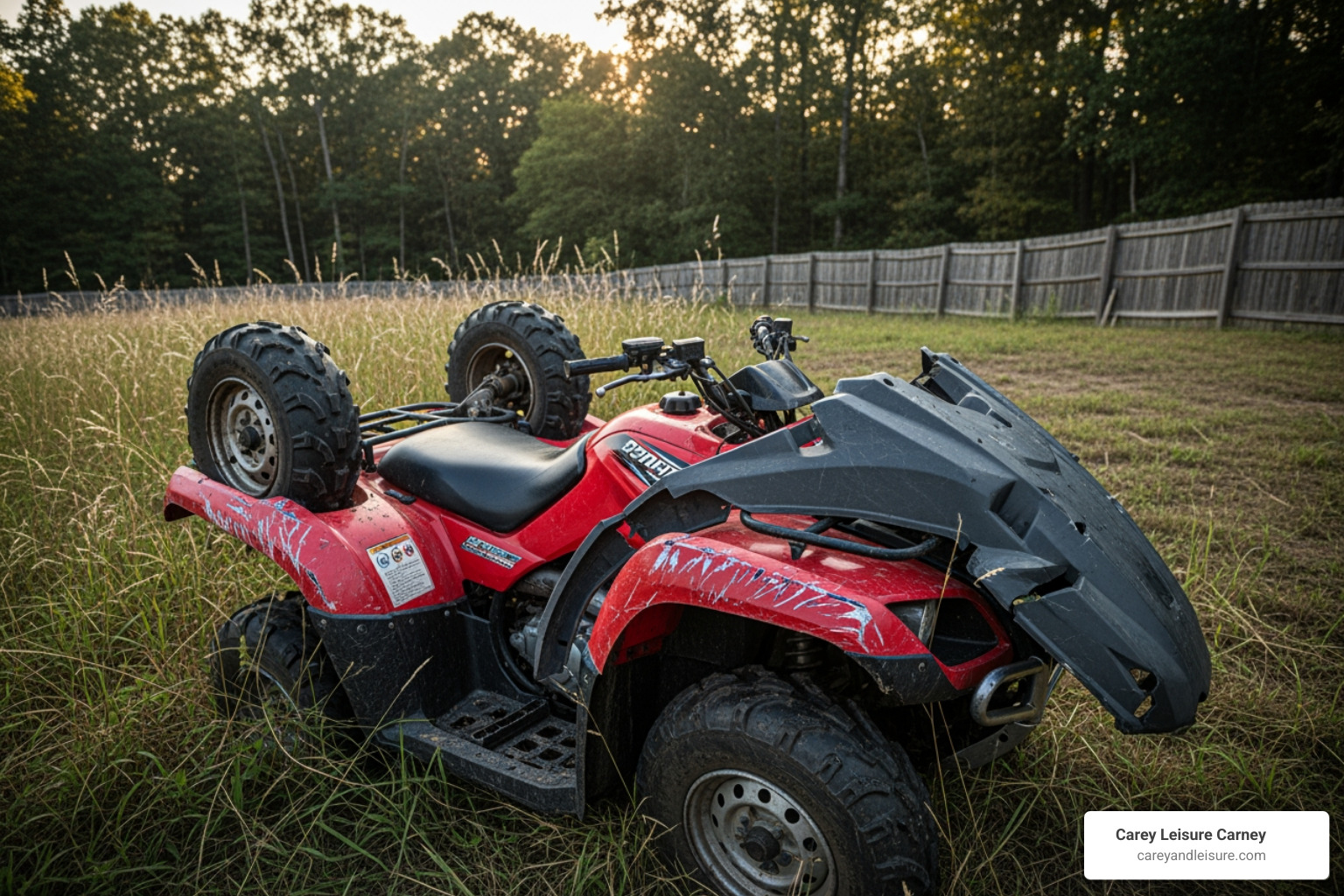
One of the most challenging parts of an ATV accident lawsuit is identifying all responsible parties. Unlike a simple car crash, ATV accidents often involve shared blame. Our legal team investigates thoroughly to find every person or entity whose negligence contributed to your injuries, including the operator, owner, manufacturer, and property owner.
Operator and Owner Liability
The rider is the most obvious party. If someone was speeding, driving recklessly, or operating under the influence, they can be held liable. However, the owner of an ATV can also be held responsible under a legal doctrine called negligent entrustment.
Negligent entrustment occurs when an owner lends an ATV to someone they know, or should know, is too young, inexperienced, or impaired to ride safely. If the owner allowed them to ride anyway, they can be held liable for the resulting injuries.
This is particularly relevant in cases involving parental responsibility. When parents allow a child to use an ATV without proper supervision, training, or safety gear, they can face serious legal consequences. If you own an ATV, you have a duty to ensure anyone using it is competent and properly equipped. Failure in that duty can lead to liability.
The Legal Terrain Of Liability In ATV Accidents
Product Liability: When the Machine is to Blame
Sometimes, an accident happens even when the rider does everything right. This can occur when the ATV itself is defective. Manufacturers have a legal duty to build safe vehicles. In a product liability claim, we can hold the manufacturer, distributor, or retailer responsible for injuries caused by their defective product.
We investigate three main types of defects: design defects (an inherently unstable design), manufacturing flaws (faulty brakes or frames), and failure to warn (inadequate safety instructions or age restrictions). We have handled cases involving brake failures, throttle defects causing unintended acceleration, and tire blowouts. To prove these claims, we work with engineering experts who can identify the defect and testify how it caused the accident.
Premises Liability: The Property Owner’s Responsibility
Where an accident happened is as important as how it happened. If you were riding on someone else’s property, the owner might be liable if unsafe conditions contributed to your crash.
Property owners must maintain their land in a reasonably safe condition and warn visitors about non-obvious hazards. This includes unmarked steep drop-offs, deep ruts, hidden tree stumps, or low-hanging wires. If an owner knows about a dangerous condition and fails to fix it or post warnings, they can be held responsible.
Additionally, the attractive nuisance doctrine can apply to children. If a property owner leaves an ATV accessible to minors who then get injured, the owner can be held liable. Our investigation examines the terrain, maintenance records, and any posted warnings to build your ATV accident lawsuit.
Navigating Your Florida ATV Accident Lawsuit
After an ATV crash, the legal process can seem intimidating. An ATV accident lawsuit in Florida follows a clear path, and we will guide you through every step.
Key Steps in an ATV Accident Lawsuit
Your case begins with an investigation phase, where we gather police reports, witness statements, photos, and medical records. We often hire accident reconstruction experts to determine what happened. Next, we file a formal complaint with the court, outlining the facts and identifying the negligent parties. The findy phase follows, where both sides exchange information through depositions and written questions. Most cases then proceed to settlement negotiations. If a fair offer isn’t made, we are prepared to take your case to trial. The steps you take immediately after a crash are also vital; What to do after a car accident Florida offers relevant guidance for ATV accidents as well.
Proving Negligence in Your ATV Accident Lawsuit
Winning an ATV accident lawsuit requires proving negligence. To do this, we must establish four elements: duty of care (the defendant had a responsibility to act safely), breach of duty (they failed in that responsibility), causation (their breach directly caused your injuries), and damages (you suffered actual harm).
We build this case using powerful evidence:
- Police reports provide an official account of the accident.
- Medical records detail the extent of your injuries and treatment.
- Witness statements offer crucial perspectives.
- Photographs and videos capture the scene and the severity of the damage.
- Expert witnesses, such as accident reconstructionists and medical professionals, add credibility and clarity to your claim.
Florida’s ATV Laws and Statute of Limitations
Florida has specific rules that impact your case. An ATV is legally defined as an off-highway vehicle 55 inches or less in width and weighing 1,500 pounds or less. Age restrictions require operators to be licensed drivers unless a minor is under the direct supervision of a licensed adult. For anyone under 16, eye protection and a safety helmet are mandatory.
Crucially, Florida’s statute of limitations gives you only two years from the accident date to file your ATV accident lawsuit. If you miss this deadline, you lose your right to sue. Florida also uses a comparative negligence rule. If you are found partially at fault, your compensation is reduced by your percentage of fault. If you are found 51% or more at fault, you may recover nothing. Insurance companies use this to shift blame, which is why you need an experienced advocate to protect your rights.
Securing Fair Compensation: What Your Claim is Worth
After an ATV accident, families rightly ask, “What is our case worth?” The value of every ATV accident lawsuit is unique, depending on the severity of your injuries and the impact on your life. Our goal is to secure the compensation you need to rebuild, considering not just current bills but your long-term needs, lost income, and emotional suffering.
Economic vs. Non-Economic Damages Explained
Compensation in an ATV accident lawsuit covers two types of losses: economic and non-economic.
Economic damages are your tangible, out-of-pocket losses. This includes medical expenses (past and future), from emergency care to long-term rehabilitation. Lost wages cover missed paychecks, while diminished earning capacity compensates for a permanent inability to earn at your previous level. We also seek recovery for property damage to your ATV and gear, as well as costs for household services or vocational retraining if needed.
Non-economic damages address intangible but devastating losses. This includes pain and suffering for your physical and mental anguish, emotional distress like anxiety or PTSD, and loss of enjoyment of life for the hobbies and activities you can no longer do. Compensation may also be awarded for disfigurement or permanent scarring and loss of consortium, which recognizes the impact on a marital relationship.
| Economic Damages | Non-Economic Damages |
|---|---|
| Medical expenses (past and future) | Pain and suffering |
| Lost wages (past and future) | Emotional distress (anxiety, depression) |
| Property damage (ATV, gear, etc.) | Loss of enjoyment of life |
| Rehabilitation costs | Disfigurement or permanent scarring |
| Household services | Loss of consortium (impact on marital relations) |
| Vocational retraining |
In cases of extreme recklessness, punitive damages may be awarded to punish the wrongdoer. For wrongful death claims, families can seek compensation for funeral expenses, lost financial support, and the victim’s suffering before passing. We document every aspect of your damages to build a comprehensive picture of what this accident has cost you.
How an Experienced Attorney Can Make the Difference

After an ATV accident, you face insurance adjusters, mounting medical bills, and a complex legal system. Trying to steer this alone while healing is a monumental task. An experienced attorney can change everything in your ATV accident lawsuit.
At Carey Leisure Carney, we bring over 100 years of combined experience. Our Board-Certified attorneys—a distinction earned by only 2% of Florida lawyers—become your advocate and your voice. You’ll work directly with an attorney, not a case manager. That’s our promise.
The Role of a Personal Injury Lawyer
Time is critical after a crash. Our first priority is evidence preservation: securing the damaged ATV, documenting the accident scene, and interviewing witnesses before memories fade. A key part of our job is identifying all liable parties, which can include the operator, owner, manufacturer, or property owner. Each represents a potential source of compensation.
We work with a network of trusted experts—accident reconstructionists, medical specialists, and mechanical engineers—to provide compelling testimony that strengthens your case. When it comes to negotiating settlements, our reputation for securing multi-million-dollar verdicts and our willingness to go to trial gives us leverage for better offers. We understand and counter the tactics adjusters use to minimize your claim.
If a fair settlement isn’t reached, our Board-Certified trial attorneys are fully prepared to represent you in court. We have argued cases in courtrooms across Clearwater, Largo, New Port Richey, and beyond, and we know how to present complex ATV accident cases to juries. The legal burden shouldn’t be yours to carry while you’re healing. That’s what we’re here for.
Why you need a personal injury lawyer
How much does it cost to hire a personal injury attorney?
Conclusion: Taking the First Step Towards Justice
ATV accidents are more than statistics; they are life-altering events that devastate families. With more than 125,000 accidents and over 600 fatalities annually in the U.S., the danger is real. These tragedies are often preventable, caused by a reckless choice, a defective product, or an ignored hazard.
If you or a loved one was hurt in an ATV accident due to someone else’s negligence, you have rights. Florida law provides a path to hold negligent parties accountable, whether it’s a reckless operator, a negligent owner, a manufacturer, or a property owner.
But this path is not simple. You face complex legal issues, powerful insurance companies, and Florida’s strict two-year statute of limitations. Miss that deadline, and your right to compensation is lost forever.
You don’t have to face this alone. At Carey Leisure Carney, our Board-Certified attorneys—a distinction held by only 2% of Florida lawyers—have over 100 years of combined experience helping families like yours. We give you direct access to your attorney and treat you like family, because we understand that behind every case is a person who deserves justice.
Taking the first step can feel overwhelming, but one phone call can change everything. We’ll listen to your story, explain your options, and start fighting for you immediately. There’s no cost unless we win. Let us handle the legal battle while you focus on healing.
If you’ve been injured, contact our experienced ATV Accident Attorneys for a free consultation