
Florida car crash lawyer: Maximize Your 2026 Claim
Why Your First Call After a Florida Car Crash Matters Most
A Florida car crash lawyer helps accident victims steer insurance claims, prove negligence, and recover compensation for medical bills, lost wages, and pain and suffering—especially critical in Florida’s no-fault system with its strict two-year filing deadline.
Key reasons to hire a Florida car crash lawyer:
- Steer the no-fault system – Florida’s PIP insurance and “serious injury threshold” create unique barriers to full compensation
- Meet critical deadlines – You have just two years to file a lawsuit and 14 days to see a doctor for PIP coverage
- Counter insurance tactics – Adjusters work to minimize payouts; an attorney levels the playing field
- Prove negligence – Building a strong case requires evidence, expert witnesses, and legal expertise
- Maximize recovery – Attorneys identify all damages and liability sources you might miss on your own
Florida’s roads saw 392,515 crashes in 2023 alone, injuring 250,716 people and killing 3,351. If you or a loved one is among those statistics, the aftermath can feel overwhelming. Medical bills pile up. Insurance adjusters call with lowball offers. Legal deadlines tick away. You’re in pain, out of work, and unsure where to turn.
This guide walks you through what to do after a crash, explains Florida’s unique laws, and shows you why the right legal help isn’t optional—protect your recovery and your future.
I’m Thomas W. Carey, a board-certified civil trial lawyer and founding partner of Carey Leisure Carney, where I’ve guided roughly 40,000 injury matters across Florida since 1988, including complex motor-vehicle and DUI cases. As a Florida car crash lawyer with decades of courtroom experience, I’ve seen how the right legal strategy can transform an overwhelming situation into a path toward justice and financial recovery.
The Aftermath: Critical First Steps After a Florida Car Crash
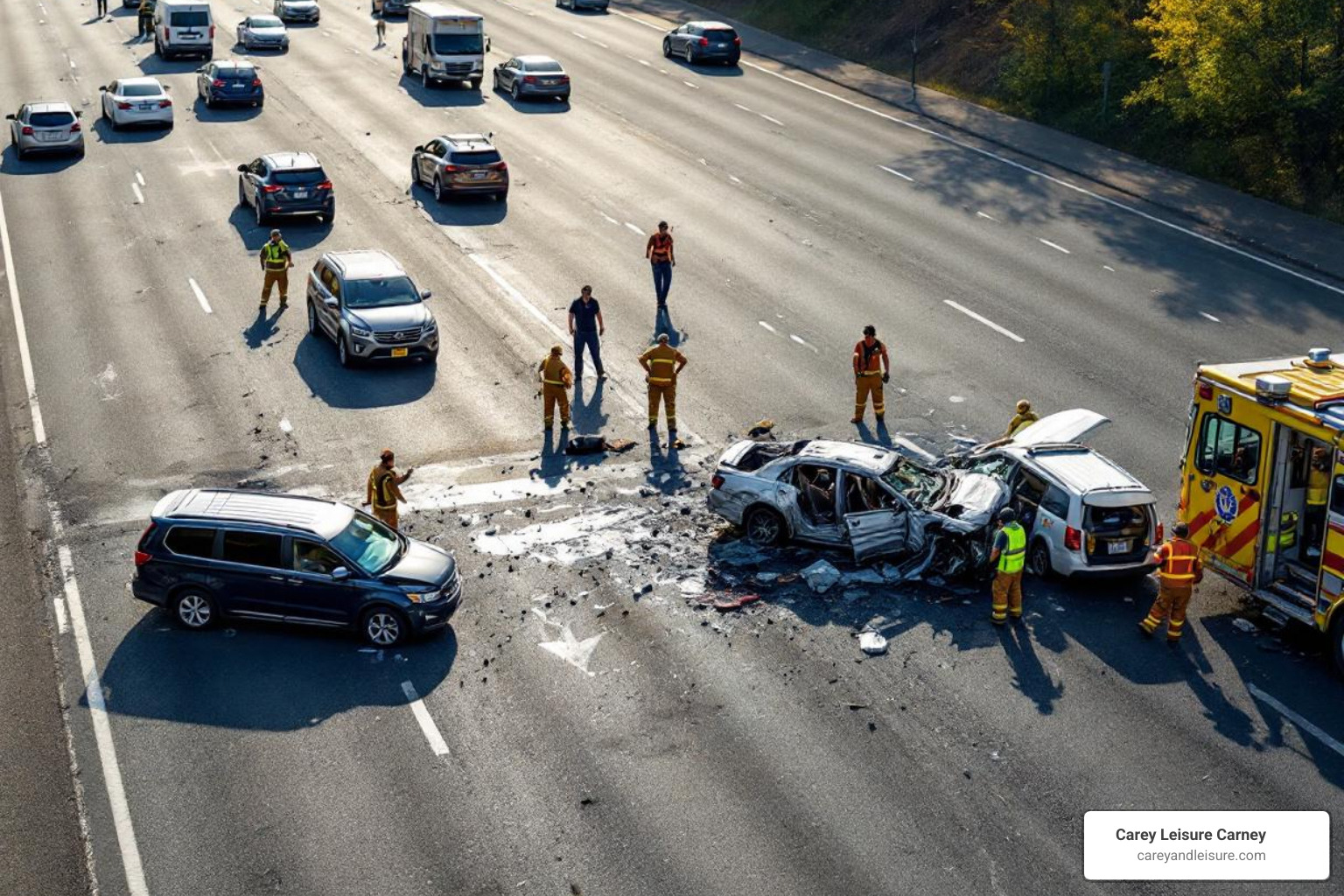
When you’ve been involved in a car crash in Florida, the moments immediately following the incident are crucial. What you do—and don’t do—can significantly impact your health, safety, and any potential legal claim. Taking the right steps can make all the difference in protecting your rights. For a comprehensive overview, see our guide on What to do after a car accident Florida.
At the Scene: Your Immediate Priorities
Your first priority after any accident is always safety.
- Ensure Safety: Move your vehicle to a safe location if possible and if there are no serious injuries. If you can’t move your car, turn on your hazard lights.
- Call 911: If anyone is injured, or if there’s significant property damage (typically over $500), you are legally required to call 911. Our Florida law also requires you to render aid and help anyone who is injured. Even if injuries seem minor, a police report is vital for documenting the incident.
- Exchange Information: Get the other driver’s name, contact details, insurance information, and vehicle details (make, model, license plate).
- Document the Scene: If you’re able, take photos and videos of the accident scene from multiple angles. Capture vehicle damage, road conditions, traffic signs, skid marks, and any visible injuries.
- Get Witness Contacts: If there are any witnesses, ask for their names and contact information. Their unbiased accounts can be invaluable.
- Do Not Admit Fault: This is perhaps the most critical advice. Even a casual apology can be misconstrued as an admission of fault and used against you later. Stick to the facts.
For more detailed guidance on these initial steps, refer to What to do when you are involved in a car accident part 1.

Seeking Medical Attention: The 14-Day Rule
Even if you feel fine after a car crash, it’s crucial to seek medical attention. Adrenaline can mask pain, and many serious injuries, like whiplash or concussions, may not manifest symptoms until days or even weeks later. Prompt medical evaluation not only protects your health but also creates a vital record for your claim.
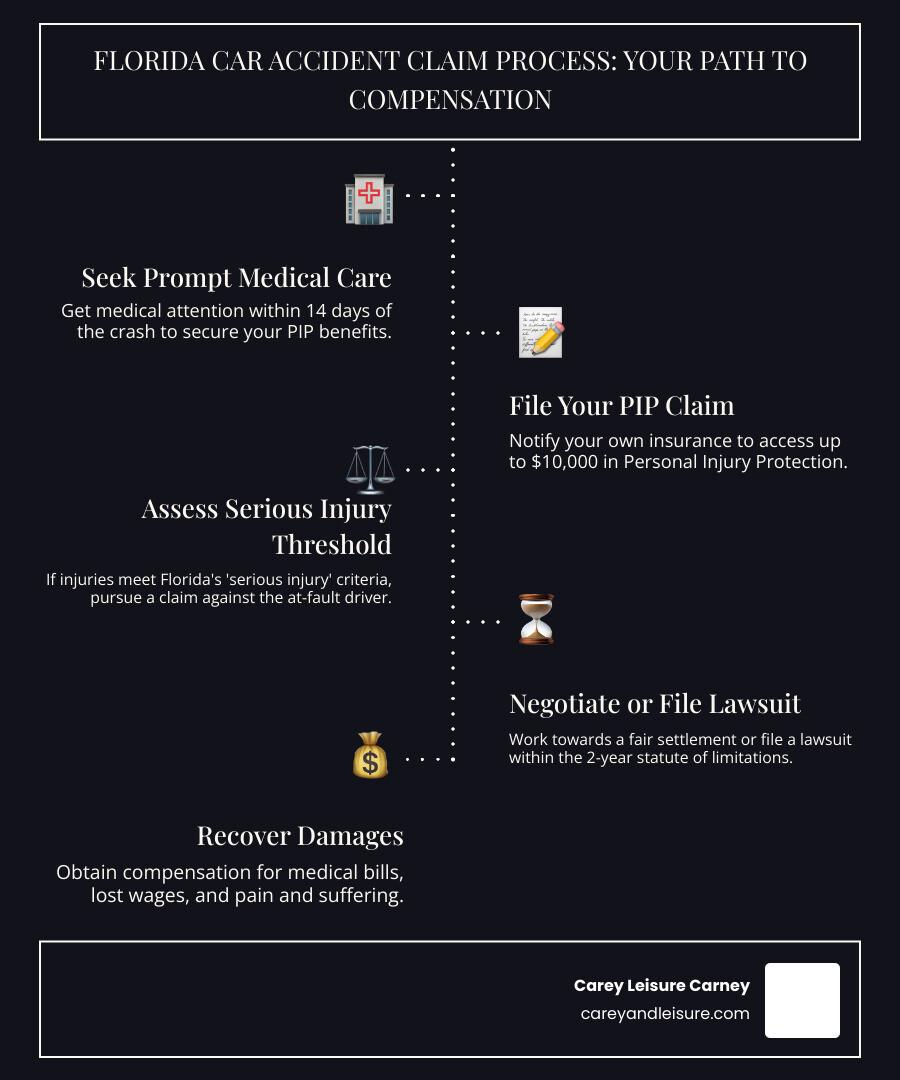
In Florida, there’s a strict 14-day rule for Personal Injury Protection (PIP) benefits. You must seek initial medical treatment from a qualified healthcare provider within 14 days of the accident to be eligible for PIP coverage. Missing this deadline means you’ll likely forfeit your right to these benefits, leaving you to pay for your initial medical care out of pocket. We dig deeper into this on our page How much time do I have to see doctor after car accident.
Common injuries sustained in Florida car accidents that often require significant and costly treatment include:
- Whiplash and other neck/back injuries
- Broken bones
- Lacerations and severe bruising
- Head injuries, including concussions and Traumatic Brain Injuries (TBI)
- Spinal cord injuries
- Internal injuries
For example, a knee replacement can cost around $50,000, while treatment for a severe traumatic brain injury can escalate to $3 million. Spinal injury surgery can easily reach $150,000. These are not minor expenses, and protecting your right to compensation for them is paramount. Learn more about Car Accidents and Traumatic Brain Injuries and how we help victims of such devastating injuries.
Handling Special Situations: Hit-and-Runs and Uninsured Drivers
Sometimes, a car accident isn’t straightforward. What if the other driver flees the scene? Or what if they don’t have insurance? These situations present unique challenges.
Hit-and-run accidents are a shockingly common occurrence in Florida. In 2023 alone, there were 104,293 hit-and-run crashes, resulting in 22,465 injuries and 270 deaths. If you’re involved in a hit-and-run, immediately call the police, document everything you can about the vehicle (even a partial license plate or description), and seek medical attention.
Florida also has a significant problem with uninsured drivers. Approximately 6.6% of drivers in Florida are uninsured, amounting to an estimated 1,059,674 uninsured vehicles on our roads. This means that if an uninsured driver hits you, their lack of insurance can complicate your recovery. This is where Uninsured Motorist (UM) coverage on your own policy becomes a lifesaver. UM coverage can step in to cover your medical bills, lost wages, and pain and suffering when the at-fault driver has no insurance. We explain this in detail on our page What Happens If an Uninsured Driver Hits You.
Navigating Florida’s Complex Car Accident Laws
Florida’s legal landscape for car accidents is unique, often described as a maze of no-fault rules, strict deadlines, and specific insurance requirements. Understanding these complexities is critical to protecting your rights and securing the compensation you deserve.
Florida’s “No-Fault” System and PIP Insurance Explained
Florida operates under a “no-fault” car insurance system. What does this mean for you? It means that, regardless of who caused the accident, your own insurance typically covers your initial medical bills and lost wages through your Personal Injury Protection (PIP) coverage. This system is designed to simplify claims for minor injuries and ensure prompt medical treatment. You can find more information on our No Fault Insurance Florida page.
Under Florida law, every vehicle owner must carry a minimum of $10,000 in PIP coverage, as outlined by state requirements. This coverage pays for 80% of your reasonable medical expenses and 60% of your lost wages, up to the $10,000 limit, and also includes a $5,000 death benefit.
However, the “no-fault” system has its limitations. If your injuries are serious enough—meaning they meet Florida’s “serious injury threshold” (significant and permanent loss of an important bodily function, permanent injury, or significant and permanent scarring or disfigurement)—you can then “step outside” the no-fault system. This allows you to pursue a claim against the at-fault driver for full damages, including pain and suffering, which PIP does not cover.
The Clock is Ticking: Florida’s Statute of Limitations
Time is of the essence after a car accident in Florida. There is a strict deadline, known as the statute of limitations, for filing a personal injury lawsuit. For most car accident personal injury claims, you have two years from the date of the accident to file a lawsuit, as detailed in Florida Statute § 95.11. This two-year deadline applies to accidents occurring after March 24, 2023. If you lose a loved one in a car crash due to negligence, the deadline for filing a wrongful death claim is also two years from the date of death.
Missing this deadline means you forfeit your right to pursue compensation, regardless of the severity of your injuries or the clarity of fault. That’s why acting quickly to consult a Florida car crash lawyer is so important—it ensures your claim is filed on time and all crucial evidence is preserved.
What if I Was Partially at Fault? Modified Comparative Negligence
What happens if you were partly to blame for the accident? Florida law addresses this through its comparative negligence system. As of March 24, 2023, Florida shifted from a “pure” comparative negligence system to a “modified” comparative negligence system, as enacted in Florida Statute § 768.81.
Under this modified rule, you can still recover damages even if you were partially at fault, but your compensation will be reduced by your percentage of fault. For example, if you are found 20% at fault for an accident, your total damages award will be reduced by 20%. However, there’s a critical catch: if you are found to be 51% or more at fault, you are completely barred from recovering any compensation. This is often referred to as the “51% at-fault bar.”
This rule makes it incredibly important to have an experienced Florida car crash lawyer on your side. Insurance companies will often try to shift as much blame as possible onto you to reduce or eliminate their payout. Our attorneys are skilled at arguing fault percentages and protecting your right to maximum compensation. Learn more about this concept on our Comparative Negligence page.
Why You Need an Experienced Florida Car Crash Lawyer
After a car accident, you might wonder if you really need a lawyer. The truth is, without one, you could be leaving a significant amount of money on the table and facing an uphill battle against seasoned insurance professionals. An experienced Florida car crash lawyer is your advocate, guide, and protector through this challenging time. Our page Why You Need a Personal Injury Lawyer offers more insights.
Leveling the Playing Field Against Insurance Companies
Let’s be honest: insurance companies are businesses. Their primary goal is to make money, and that often means minimizing the payouts on claims. They have teams of adjusters and lawyers whose job it is to pay you as little as possible. They might offer a quick, lowball settlement hoping you’ll take it just to get it over with, or they might try to get you to give a recorded statement that could harm your case.
When you have us on your side, you instantly level the playing field. We handle all communications with the insurance companies, protecting you from common traps like admitting fault or downplaying your injuries. We understand The Role of Insurance Companies in a Car Accident and ensure your rights are protected every step of the way.
Proving Negligence: Building a Winning Case
To recover compensation in a car accident, we typically need to prove that the other driver was negligent. In legal terms, negligence refers to a failure to exercise the care that a reasonable person would in the same situation. This involves establishing four key elements:
- Duty of Care: The other driver owed you a duty to drive safely.
- Breach of Duty: They failed to uphold that duty (e.g., by speeding, texting, or running a red light).
- Causation: Their breach of duty directly caused your accident and injuries.
- Damages: You suffered actual losses as a result (medical bills, lost wages, pain).
Building a strong case requires meticulous evidence gathering, which includes police reports, witness statements, medical records, traffic camera footage, and sometimes even accident reconstruction. Our Board-Certified attorneys have over a century of combined experience in gathering and presenting this evidence. We know How Attorneys Use Investigations for Your Personal Injury Claim to build an undeniable case.
Maximizing Your Financial Recovery
The true cost of a car accident goes far beyond immediate medical bills. It includes future medical care, lost income, diminished earning capacity, and the profound impact on your quality of life. An experienced Florida car crash lawyer will carefully calculate all your current and future damages, identify all potential sources of liability, and negotiate from a position of strength to maximize your financial recovery.
We understand What Is My Personal Injury Case Worth by evaluating every aspect of your claim, ensuring you receive compensation for everything you’ve lost, not just what the insurance company wants to offer.
Understanding Your Right to Compensation
When you’ve been injured in a car accident due to someone else’s negligence, you have the right to seek compensation for a wide range of damages. These damages generally fall into a few categories, all of which we pursue vigorously on your behalf. For a general overview, you can visit our page on Compensation After Accident.
Economic Damages: Recovering Your Financial Losses
Economic damages are the quantifiable financial losses you incur due to the accident. These are often easier to calculate because they come with bills, receipts, or wage statements. They include:
- Medical Expenses: Past and future costs for doctor visits, hospital stays, surgeries, medications, physical therapy, and rehabilitation. These costs can be astronomical. For example, the average treatment costs for specific types of injuries can be:
- Knee replacement – $50,000
- Treatment for severe traumatic brain injury – $3 million
- Surgery for spine injuries – $150,000
- Lost Wages: Income you’ve lost because you couldn’t work due to your injuries.
- Diminished Earning Capacity: If your injuries prevent you from performing your previous job or working at the same capacity, leading to a long-term reduction in your income potential.
- Property Damage: The cost to repair or replace your vehicle and any other damaged property. This can also include Diminished Car Value—the reduction in your vehicle’s market value after an accident, even if repaired.
The total average economic cost of a car accident for disabling injuries in Florida is $155,000, and this skyrockets to $1,778,000 for injuries resulting in death. We work to ensure every dollar of your financial loss is accounted for.
Non-Economic Damages: Compensation for Your Suffering
Non-economic damages are the less tangible, but equally impactful, losses that don’t have a direct dollar amount attached. These compensate you for the pain and suffering you’ve endured. They include:
- Pain and Suffering: Physical pain from your injuries and the ongoing discomfort.
- Emotional Distress: Anxiety, depression, fear, and other psychological impacts of the accident.
- Mental Anguish: Intense emotional suffering.
- Loss of Enjoyment of Life: When your injuries prevent you from participating in hobbies, activities, or aspects of daily life you once enjoyed.
- Scarring and Disfigurement: Compensation for permanent physical alterations.
Calculating these damages requires skill and experience. We help our clients understand Compensation for Pain and Suffering in Florida What You Need to Know and ensure your non-economic losses are fully recognized.
Punitive Damages and Wrongful Death Claims
In cases of extreme negligence or intentional misconduct, Florida law may allow for punitive damages. These are not meant to compensate the victim but rather to punish the at-fault party and deter similar behavior in the future. In Florida, punitive damages are limited to three times the total of your economic and non-economic damages or $500,000, whichever is greater.
When a car accident tragically results in a fatality, the surviving family members may be able to file a wrongful death claim. This type of claim seeks compensation for the profound losses experienced by the family. Damages in a fatal accident claim can include medical and funeral expenses, lost financial support the deceased would have provided, and compensation for the loss of companionship, protection, and guidance. Our Wrongful Death Attorney Florida Complete Guide provides comprehensive information on these sensitive cases.
Frequently Asked Questions for a Florida Car Crash Lawyer
We understand you have many questions after a car crash. Here are answers to some of the most common inquiries we receive as Florida car crash lawyer specialists.
What are the most common causes of accidents in Florida?
Unfortunately, many car accidents are not truly “accidents” but are the direct result of driver negligence. The most common causes we see in Florida include:
- Distracted Driving: Texting, talking on the phone, eating, or any activity that takes a driver’s attention from the road. In 2021, distracted driving caused 155,406 crashes in Florida, killing 344 people and injuring up to 48,189. The FCC has a guide on the dangers of texting while driving.
- Speeding: Driving too fast for conditions increases the risk of losing control and the severity of a crash. In 2021, speeding resulted in 17,797 collisions in Florida, causing 211 deaths and at least 509 incapacitating injuries.
- Driving Under the Influence (DUI): Impaired judgment from alcohol or drugs is a major contributor to severe and fatal accidents. In 2023, Florida saw 5,132 alcohol-confirmed crashes resulting in 330 fatalities.
- Aggressive Driving: Tailgating, weaving through traffic, running red lights, or other reckless behaviors. In 2021, aggressive driving caused 14,303 car accidents in Florida, resulting in 132 deaths and at least 1,809 injuries.
- Failure to Yield: Disregarding right-of-way rules at intersections or when merging. This caused 474 fatal accidents throughout Florida in 2021.
- Drowsy Driving: Fatigued drivers can be as dangerous as impaired drivers. In 2021, drowsy driving resulted in 18 fatalities and 275 incapacitating injuries in Florida.
Are some roads in Florida more dangerous than others?
Yes, absolutely. Florida has the unfortunate distinction of being home to four of the 10 most dangerous highways in the United States, based on the number of deaths per mile.
Among the most notorious is Interstate 4 (I-4), particularly the stretch around Orlando, which has consistently ranked as one of the deadliest roads. Other high-risk roadways include:
- Interstate 95 (I-95): A major north-south artery with high traffic volumes and speeds.
- U.S. 92 and U.S. 192: These state roads, especially through urban and tourist areas, are prone to accidents due to congestion and diverse driver populations.
High traffic volume, a constant influx of tourists unfamiliar with local roads, and ongoing construction zones all contribute to the increased risk on these and other major thoroughfares across Clearwater, Largo, New Port Richey, Spring Hill, St Petersburg, Trinity, and Wesley Chapel.
How are Uber/Lyft accidents different from other car accidents?
Rideshare accidents (involving services like Uber or Lyft) are significantly more complex than standard car accidents due to unique insurance structures. The key difference lies in the layers of insurance coverage that might apply, depending on the rideshare driver’s status at the time of the crash:
- Driver is Off-Duty: Their personal auto insurance applies.
- Driver is Logged In, Awaiting a Ride Request: A lower level of coverage from the rideshare company’s insurance may apply, often secondary to the driver’s personal policy.
- Driver is En Route to Pick Up a Passenger or Has a Passenger: A higher level of commercial insurance from the rideshare company (typically $1 million in liability coverage) applies.
Navigating these complex insurance layers requires specialized knowledge. Determining which policy applies, and therefore which insurance company to pursue, can be a major hurdle. This is why you need a specialized Rideshare Accident Attorney—a Florida car crash lawyer with experience in rideshare cases—to ensure you access all available coverage and receive fair compensation.
Don’t Steer the Aftermath Alone
We’ve covered a lot of ground, from the critical steps you need to take immediately after a crash to the intricacies of Florida’s no-fault laws, statute of limitations, and comparative negligence rules. The message is clear: the aftermath of a car accident in Florida is not a journey you should undertake alone.
The stakes are high. Your physical recovery, financial stability, and peace of mind depend on making the right choices. Florida’s laws are complex, insurance companies are powerful, and legal deadlines are unforgiving. Trying to steer this landscape while recovering from injuries can be overwhelming and lead to costly mistakes.
An experienced Florida car crash lawyer is your best ally. We provide direct attorney access and personalized service, ensuring you always know the status of your case and have your questions answered. With over 100 years of combined experience, our Board-Certified attorneys at Carey Leisure Carney are dedicated to protecting your rights and securing your future. We serve clients across Clearwater, Largo, New Port Richey, Spring Hill, St Petersburg, Trinity, and Wesley Chapel, Florida.
Don’t let a car crash wreck your life twice. Reach out to us for guidance and tenacious legal representation.
Contact our experienced Car Accident Attorneys for a free consultation today. Let us help you steer towards justice and recovery.