
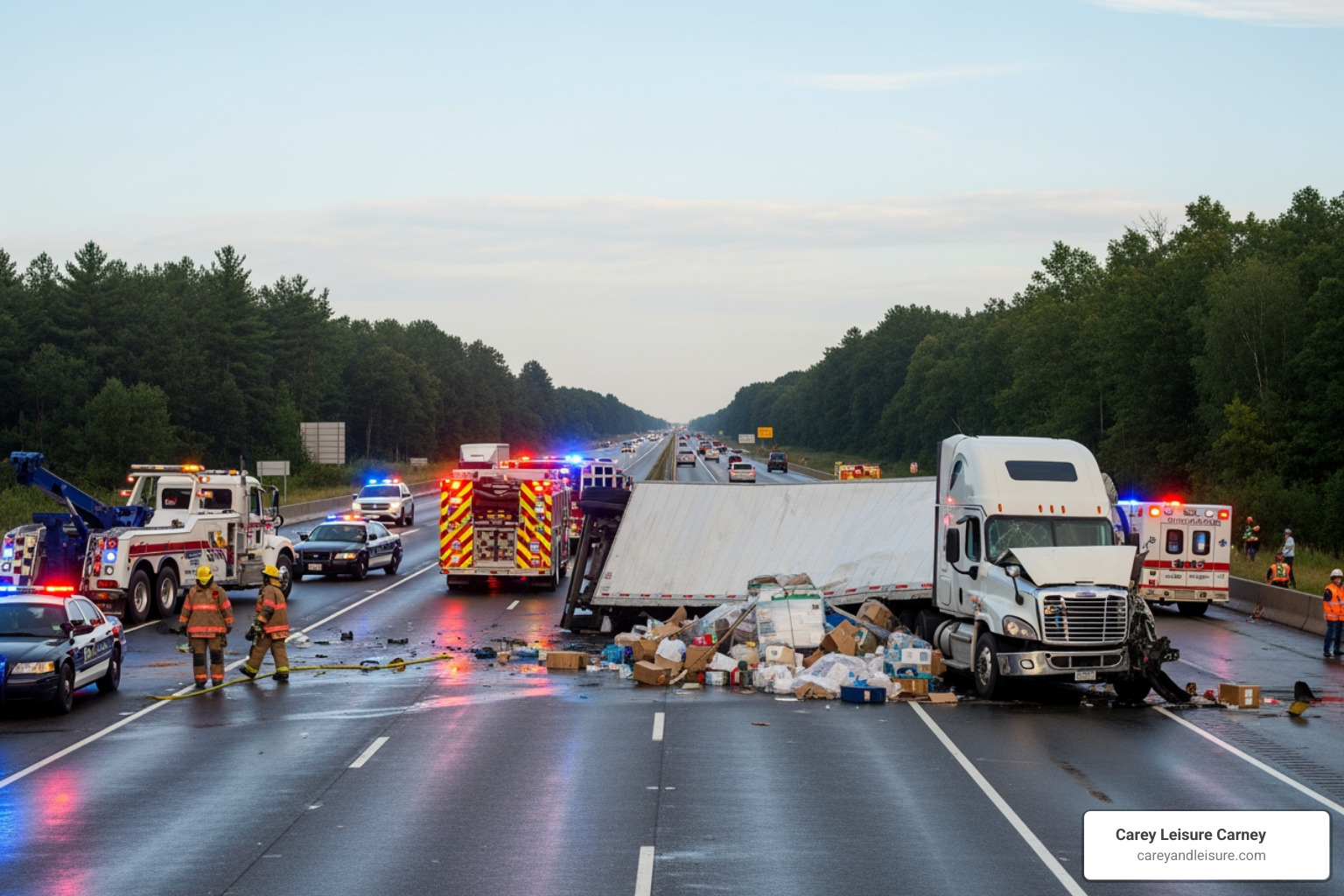
Semi truck accident claims: 5 Critical Steps to Win!
Why Semi Truck Accident Claims Demand Specialized Expertise
Semi truck accident claims are fundamentally different from standard car accident cases. Understanding these differences is critical for securing a fair settlement.
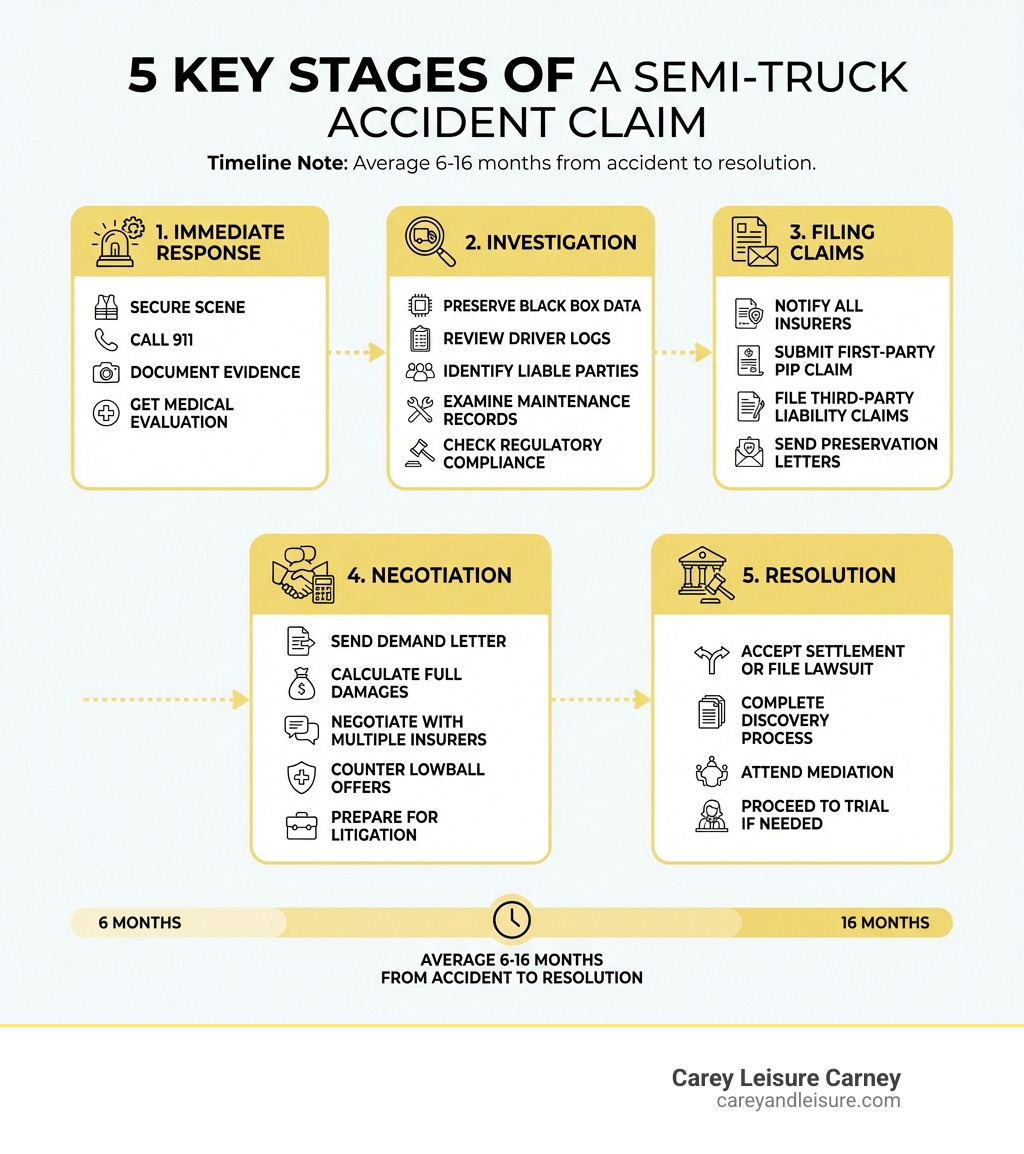
Key Stages of the Semi Truck Claims Process:
- Immediate Response: Secure the scene, gather evidence, and seek medical care.
- Investigation: Identify all liable parties, preserve truck data, and review federal compliance.
- Filing Claims: Submit claims to multiple insurance policies (driver, company, cargo).
- Negotiation: Steer complex coverage layers and regulatory violations.
- Resolution: Settle or litigate, a process that typically takes 6-16 months.
Why These Claims Are More Complex:
- Catastrophic Injuries: Semi-trucks weigh 20-30 times more than cars, causing devastating harm.
- Multiple Liable Parties: Liability can include the driver, trucking company, manufacturer, loader, and maintenance provider.
- Federal Regulations: Strict FMCSA rules on hours-of-service and maintenance add layers of proof.
- Aggressive Defense: Commercial insurance policies are substantial, and insurers defend them aggressively.
- Critical Evidence: “Black box” data and driver logs must be preserved immediately before they are destroyed.
Average Settlements:
- Typical range: $100,000-$150,000
- Severe injury cases: $1 million+
- Wrongful death: Multi-million dollar potential
Accidents involving commercial trucks have increased by 20% over the last two decades. These massive vehicles—often 80,000 pounds fully loaded—cause devastating results when they collide with passenger cars. In fact, 97% of fatalities in large truck accidents are occupants of the smaller vehicle.
I’m Thomas W. Carey, founder of Carey Leisure Carney. As a board-certified civil trial attorney who has handled semi truck accident claims in Florida since 1988, I know that swift action and specialized legal expertise are essential for victims to get the compensation they deserve.
Semi truck accident claims definitions:
After the Crash: Critical First Steps to Protect Your Rights
An accident with a semi-truck is a terrifying experience that often leads to catastrophic damage and severe injuries. The actions you take in the immediate aftermath are crucial for your safety, health, and any future semi truck accident claims. While it’s difficult to think clearly in such a stressful situation, following these steps can protect your rights. For a general guide, see our article on What to do after a car accident Florida.

What to Do Immediately After a Semi-Truck Accident
Your safety is paramount. Here are the immediate actions to take:
- Ensure Safety and Call 911: If possible, move your vehicle to a safe location. Call 911 immediately to report the accident and get law enforcement and medical services dispatched. A police report is vital.
- Seek Immediate Medical Evaluation: Never refuse medical attention. Adrenaline can mask serious injuries like internal bleeding or brain trauma. Accepting medical care creates an official record critical for your claim.
- Document the Scene: Use your phone to take extensive photos and videos of vehicle positions, damage, license plates, road conditions, skid marks, traffic signals, and any visible injuries.
- Exchange Information: Get the truck driver’s name, contact info, driver’s license and CDL numbers, insurance information, and the trucking company’s name and contact details. Note the truck’s license plate and DOT number.
- Get Witness Information: Ask any witnesses for their names and phone numbers. Their unbiased testimony can be invaluable in proving fault.
- Do Not Admit Fault: Avoid apologizing or admitting fault to anyone. Statements made at the scene can be used against you later.
- Contact an Attorney: As soon as possible, contact an attorney specializing in semi truck accident claims. They can guide you, preserve evidence, and handle all communications with insurance companies.
Crucial Evidence to Gather at the Scene
Evidence from the scene forms the foundation of your claim. Prioritize gathering:
- Police Report: The official report contains the officer’s assessment, witness statements, and any citations.
- Driver and Trucking Company Information: Collect the driver’s license details and the company name displayed on the truck, including any DOT or fleet numbers.
- Photos and Videos: Document all vehicle damage from multiple angles, plus road conditions, skid marks, and traffic signals.
- Witness Contact Details: Get names and phone numbers from anyone who saw the accident.
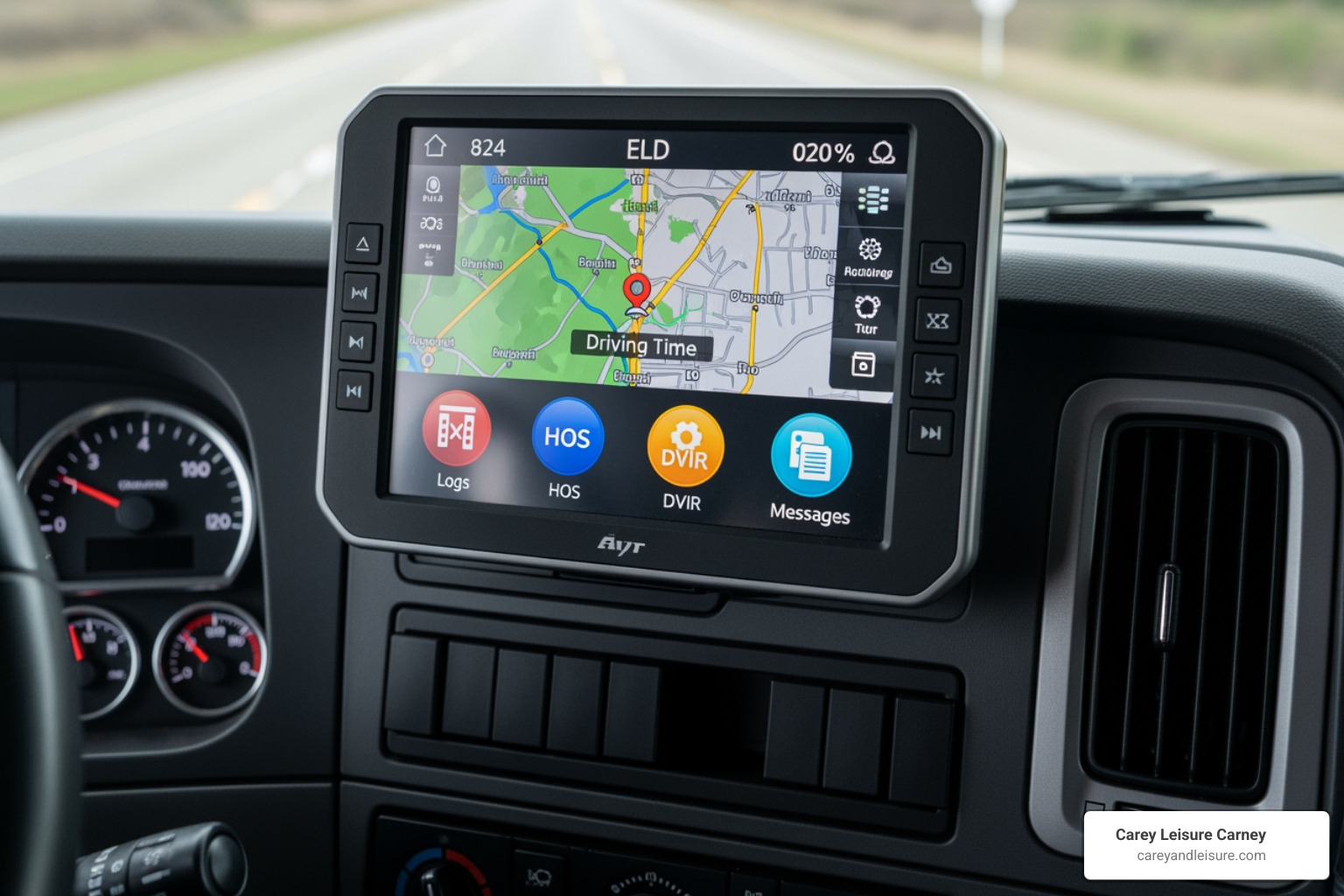
- Black Box and Logbooks: Commercial trucks have Event Data Recorders (EDRs) and driver logbooks. An attorney must act quickly to send a preservation letter to secure this data before it is destroyed. This evidence can prove violations of speed or federal rest period regulations.
Gathering this evidence strengthens your case. Our article on How Attorneys Use Investigations for Your Personal Injury Claim explains how legal teams build a robust case.
Solving Liability: Who Is At Fault in a Truck Accident?
Determining fault in a semi truck accident claims case is complex because liability often extends beyond the driver to multiple parties. The trucking industry is governed by a web of federal and state regulations, and proving who is responsible requires a thorough investigation. According to the Federal Motor Carrier Safety Administration (FMCSA), large truck crashes are on the rise, making it critical to understand liability.
Common Causes of Semi-Truck Accidents
Many factors can cause a truck accident. A Federal Motor Carrier Safety Administration (FMCSA) study identified brake problems, traffic flow interruption, and speeding as top causes. Other common factors include:
- Driver Fatigue: Violating federal Hours of Service (HOS) rules to meet deadlines impairs judgment.
- Distracted Driving: Using cell phones or other devices diverts a driver’s attention.
- Improper Loading: Unsecured or overweight cargo can cause the truck to become unstable, jackknife, or overturn.
- Poor Maintenance: Failure to maintain critical components like brakes, tires, or steering can lead to mechanical failure.
- Driving Under the Influence: Operating a commercial vehicle under the influence of alcohol or drugs is a severe breach of duty. Our Drunk Driving Accident Attorney page has more information on this topic.
- Lack of Driver Training: Inadequate training can contribute to driver error.
Identifying All Potentially Liable Parties
One of the key complexities of semi truck accident claims is identifying all responsible parties, which can include:
- The Truck Driver: For direct negligence like speeding, distracted driving, or driving while fatigued.
- The Trucking Company (Carrier): Companies can be held liable for their driver’s actions and for their own negligence, such as negligent hiring, poor training, failure to maintain vehicles, or encouraging drivers to violate hours-of-service rules.
- Cargo Loaders/Shippers: If improperly loaded cargo caused the accident, the loading company may be at fault.
- Vehicle and Parts Manufacturer: If a defective truck part (e.g., brakes, tires) contributed to the crash, the manufacturer could be liable.
- Maintenance Companies: Third-party mechanics can be held responsible if negligent repairs led to a failure.
- Government Entities: In rare cases, a government body may be liable for poor road design or maintenance, though these claims have strict rules.
Identifying all liable parties is crucial for maximizing compensation. Our guide on truck accident lawsuits and liability offers more detail.
How Federal and State Regulations Impact Liability
The trucking industry is heavily regulated. Violating these safety rules is often strong evidence of negligence in semi truck accident claims.
- Hours of Service (HOS) Rules: The FMCSA sets strict limits on driving time and mandatory rest periods. Violations of these hours-of-service rules are a common cause of fatigue-related crashes.
- Driver Qualifications: Drivers must have a valid Commercial Driver’s License (CDL) and be medically fit. Companies are responsible for verifying these qualifications.
- Maintenance and Inspections: Trucks require regular maintenance and inspections, with detailed logs. Falsified or missing logs can prove company negligence.
- Drug and Alcohol Testing: The FMCSA mandates strict drug and alcohol testing protocols. A violation can establish significant liability.
- Comparative Negligence in Florida: Florida law reduces your compensation by your percentage of fault. If you are found 20% at fault, your award is reduced by 20%. Our Comparative Negligence guide explains this further.
A violation of these regulations can be considered negligence per se, simplifying the process of proving fault.
The Road to Recovery: Understanding Semi-Truck Accident Claims
After the crash, the focus shifts to the legal process of pursuing your semi truck accident claims. This journey involves investigation, filing claims, negotiation, and potential litigation. The complexity of these cases makes an experienced attorney essential, as detailed in our Truck Accident Lawyer Role Guide.
What is the Process for Filing Semi-Truck Accident Claims?
Filing a claim is a multi-step process that requires legal expertise:
- Investigation and Evidence Preservation: Your attorney will quickly work to secure critical evidence like the truck’s “black box” data, driver logs, and maintenance records by sending a spoliation letter to the trucking company.
- Filing the Claim: After identifying all liable parties and their insurers, your attorney will initiate claims with each one.
- Sending a Demand Letter: Once your medical condition has stabilized, your attorney will send a comprehensive demand letter to the insurers. This letter outlines liability, details your damages, and proposes a settlement amount.
- Negotiation: Your attorney will negotiate with the aggressive defense teams employed by trucking insurers, countering lowball offers and fighting for a fair settlement.
- Filing a Lawsuit: If negotiations fail, a personal injury lawsuit is filed, initiating the formal litigation process.
- Findy Process: Both sides exchange information through depositions (sworn testimony), interrogatories, and requests for documents. Learn more in our guide on The Litigation Process: Depositions.
- Mediation and Trial: Before trial, parties often attempt mediation to reach a settlement. If that fails, the case proceeds to trial, where a judge or jury determines the outcome.
First-Party vs. Third-Party Claims Explained
In semi truck accident claims, you will likely deal with two types of claims:
- First-Party Claim: A claim filed with your own insurance company. In Florida, this typically involves your Personal Injury Protection (PIP) coverage for initial medical bills and lost wages. Our article on Personal Injury Protection (PIP) Insurance 101 – Part 2 explains this further.
- Third-Party Claim: A claim filed against the at-fault party’s insurance—in this case, the trucking company’s substantial commercial liability policy. These insurers use aggressive tactics to minimize payouts, as highlighted in our article on The Role of Insurance Companies in a Car Accident.
Always have your attorney manage communication with all insurance companies.
How Long Does a Settlement Take?
The timeline for a semi truck accident claims settlement varies. While some cases settle in months, the average is six to 16 months, with complex cases taking years. Factors influencing the timeline include:
- Injury Severity: Waiting until you reach Maximum Medical Improvement (MMI) to calculate full damages.
- Investigation Complexity: Time needed to analyze black box data, company records, and other evidence.
- Negotiation Disputes: Protracted negotiations with aggressive insurers.
- Litigation: Filing a lawsuit naturally extends the timeline.
An experienced truck driving attorney can steer these factors to move your case forward efficiently while pursuing fair compensation.
Calculating Your Compensation: Damages You Can Recover
The financial toll of a semi-truck accident can be overwhelming. Understanding the damages you can recover is crucial for assessing what is my personal injury case worth?
Types of Damages in a Truck Accident Claim
In Florida, damages in semi truck accident claims fall into three main categories:
- Economic Damages: These are quantifiable financial losses from the accident.
- Medical Expenses: All past, present, and future medical care, including hospital stays, surgeries, therapy, and medications.
- Lost Wages and Earning Capacity: Compensation for lost income and reduced future earning potential due to your injuries.
- Property Damage: Costs to repair or replace your vehicle.
- Other Costs: Rehabilitation, assistive devices, and home modifications.
- Non-Economic Damages: These compensate for intangible, quality-of-life losses.
- Pain and Suffering: For the physical pain and emotional distress caused by your injuries. Learn more about Compensation for Pain and Suffering in Florida: What You Need to Know.
- Loss of Enjoyment of Life: For the inability to participate in hobbies and activities.
- Loss of Consortium: Compensates a spouse or family for the loss of companionship. See our Wrongful Death Lawyer page for related information.
- Punitive Damages: These are rare and intended to punish the at-fault party for gross negligence, such as knowingly allowing an impaired driver on the road. They are meant to deter similar future conduct.
Why Semi-Truck Accident Claims Are More Complex
These claims are more complex than typical car accidents due to:
- Multiple Liable Parties: Liability can involve the driver, trucking company, cargo loaders, and manufacturers.
- Complex Federal Regulations: Proving violations of FMCSA rules is key to establishing negligence, as trucking companies must comply with federal regulations.
- Large Insurance Policies: Commercial policies are substantial, leading to aggressive defense tactics from insurers.
- Severe Injuries: The massive size of trucks often causes catastrophic injuries or death, resulting in high-value, fiercely contested claims.
- Evidence Preservation: Critical evidence like black box data can be destroyed quickly if an attorney does not act fast to preserve it.
Are Truck Accident Settlements Taxable?
Taxability of settlements is a common concern. According to the IRS, compensation for physical injuries or sickness is generally not taxable. This includes money for:
- Medical expenses
- Lost wages related to physical injury
- Pain and suffering stemming from physical injuries
However, punitive damages are almost always taxable. Emotional distress damages not linked to a physical injury may also be taxable. The Internal Revenue Service (IRS) has specific rules, so it is always best to consult a tax professional about your settlement.
Frequently Asked Questions about Semi-Truck Accident Claims
Here are answers to common questions we receive from clients in Clearwater, Largo, New Port Richey, and across Florida regarding semi truck accident claims:
How much is the average settlement for a semi-truck accident?
There is no single average, as settlements vary widely. While some national averages suggest a range of $100,000 to $150,000, the value of a claim depends entirely on the specifics. Minor injury claims may settle for a few thousand dollars, while catastrophic injury or wrongful death cases can result in multi-million dollar settlements or verdicts. For example, a case involving multiple fractures could settle for over $1 million, while one involving an amputation could be worth several million. The unique circumstances of your injuries and losses determine your case’s value. Our page on Compensation After Accident provides more context.
Should I talk to the trucking company’s insurance adjuster?
No. We strongly advise against speaking with the trucking company’s insurance adjuster without an attorney. Adjusters are trained to protect their company’s interests, not yours. They will try to get a recorded statement to use against you, offer a quick lowball settlement, or ask leading questions to shift blame. Politely decline to speak with them and refer them to your attorney. Our firm acts as Lawyers that sue insurance companies to protect our clients’ rights during these interactions.
Why do I need a lawyer for a truck accident?
Hiring an experienced lawyer for semi truck accident claims is essential. Here’s why:
- Navigating Complexity: These cases involve multiple liable parties, complex federal regulations, and aggressive insurance companies.
- Proving Negligence: An attorney understands FMCSA regulations and can use violations to prove negligence.
- Maximizing Compensation: Lawyers are experts at valuing claims and negotiating with insurers to secure full and fair compensation.
- Leveling the Playing Field: You need an expert to counter the powerful legal teams representing trucking corporations.
- Preserving Evidence: An attorney will act immediately to preserve critical evidence like black box data before it is destroyed.
- Peace of Mind: You can focus on recovery while your lawyer handles all the legal complexities.
For more information, visit our page on Why You Need a Personal Injury Lawyer.
Conclusion: Get a Board-Certified Attorney on Your Side
Navigating semi truck accident claims is a journey fraught with legal complexities, aggressive insurance tactics, and a critical need for specialized knowledge. Protecting your rights and securing the compensation you deserve after such a devastating event is paramount.
At Carey Leisure Carney, we understand the immense challenges you face. Our firm brings together Board-Certified attorneys—a distinction held by only the top 2% of lawyers in Florida—with over 100 years of combined experience in handling complex personal injury and auto accident claims across Clearwater, Largo, New Port Richey, Spring Hill, St Petersburg, Trinity, and Wesley Chapel, Florida.
We pride ourselves on offering direct attorney access and personalized service. When you choose us, you’re not just getting legal representation; you’re getting a dedicated team committed to fighting for your future. Let us put our expertise to work for you, ensuring every aspect of your claim is carefully handled while you focus on healing.
Don’t face the powerful trucking companies and their insurers alone. Contact a Truck Accident Attorney at Carey Leisure Carney today for a free consultation. We’re here to help you rebuild your life.