

The Clock is Running: A Guide to Accident Statute of Limitations
Why the Statute of Limitations Accident Deadline Could Make or Break Your Case
A statute of limitations accident deadline is the legal time limit you have to file a lawsuit after being injured. In Florida, that window is two years from the date of your accident for most personal injury claims — and missing it almost always means losing your right to compensation permanently.
Quick answer — Florida accident filing deadlines at a glance:
| Claim Type | Time Limit |
|---|---|
| General personal injury | 2 years from date of injury |
| Wrongful death | 2 years from date of death |
| Medical malpractice | 2 years from discovery (4-year hard cap) |
| Claims against government entities | 3-year notice + 180-day wait |
| PIP insurance (no-fault car accidents) | 14 days to seek treatment |
These deadlines are strict. Florida courts rarely make exceptions, and insurance companies are well aware of exactly when your time runs out.
Two years can feel like a long time when you’re focused on recovering from your injuries. But between gathering evidence, identifying all liable parties, and building a strong case, that window closes faster than most people expect.
I’m Thomas W. Carey, founding partner of Carey Leisure Carney, and over nearly four decades of handling personal injury cases across Florida, I’ve seen how a missed statute of limitations accident deadline can strip a deserving victim of every legal option they had. Understanding these deadlines — and acting before they expire — is the single most important step you can take to protect your rights.
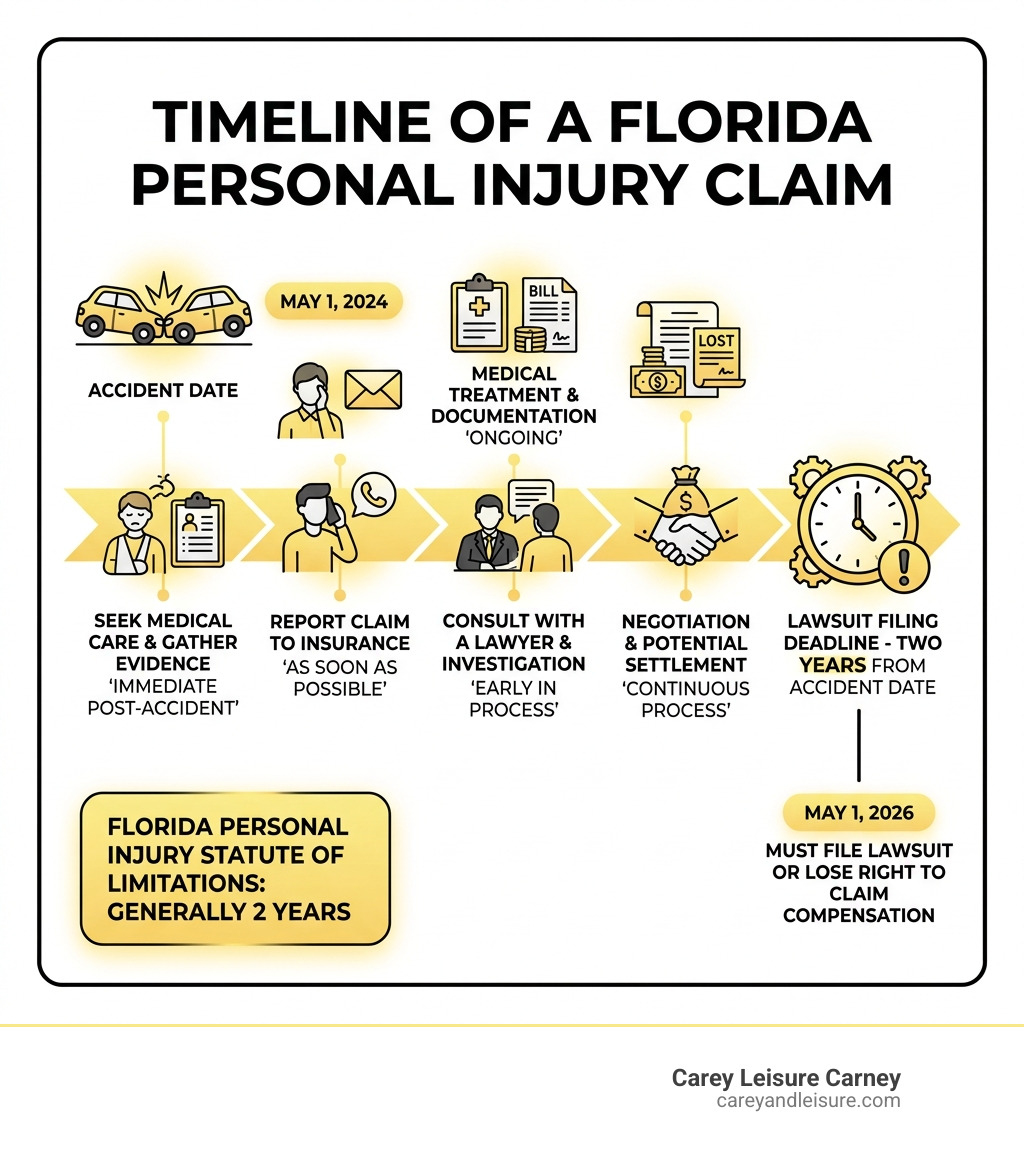
Statute of limitations accident glossary:
Understanding the Statute of Limitations Accident Deadline in Florida
When we talk about the statute of limitations accident rules in Florida, we are talking about the “expiration date” on your right to seek justice in a courtroom. These laws exist to ensure that disputes are resolved while evidence is fresh and witnesses can still remember what happened. If you wait too long, the law assumes you’ve sat on your rights, and the “clock” runs out.

For a long time, Florida was known for having a generous four-year window for negligence claims. However, the legal landscape shifted significantly with the passage of Florida House Bill 837, which was signed into law on March 24, 2023. This legislation slashed the deadline for most negligence-based personal injury claims from four years down to two years.
This change applies to almost any accident involving bodily injury or property damage caused by someone else’s carelessness, including:
- Car, truck, and motorcycle accidents
- Slip and fall incidents (premises liability)
- Boating accidents in the Gulf or local waterways
- Pedestrian and bicycle accidents
If your accident occurred after March 24, 2023, you are likely under this new two-year rule. Understanding these lawsuit basics is essential because if you file your complaint even one day late, the defendant’s attorney will file a motion to dismiss, and the judge will have no choice but to grant it.
How the Statute of Limitations Accident Clock Starts
In most cases, the “clock” starts ticking on the date of the injury. In legal terms, this is when the “cause of action accrues.” For a car accident in Clearwater or a slip and fall in a St. Petersburg grocery store, the accrual date is the day the crash or fall happened.
However, there are instances where the discovery rule comes into play. This rule is designed for situations where an injury isn’t immediately obvious. For example, if you were exposed to a toxic substance and didn’t develop symptoms for months, or if a medical tool was left inside you during surgery, the clock might not start until you discovered (or reasonably should have discovered) the injury.
For standard “impact” accidents, like a rear-end collision, the discovery rule is rarely applied because the harm is usually apparent immediately. You cannot simply claim you didn’t know you could sue; the court looks at when a “reasonable person” would have known they were hurt.
The 14-Day PIP Rule for Florida Drivers
While the statute of limitations accident deadline for a lawsuit is two years, Florida drivers face a much more urgent deadline regarding their own insurance. Florida is a “no-fault” state, meaning your own insurance company pays for a portion of your medical bills through Personal Injury Protection (PIP), regardless of who caused the crash.
To qualify for PIP benefits, you must seek medical treatment within 14 days of the accident. If you wait 15 days to see a doctor in Largo or New Port Richey, you may lose your right to access the $10,000 in medical coverage you’ve been paying for. Furthermore, to unlock the full $10,000 benefit, a medical professional must determine that you have an Emergency Medical Condition (EMC). Without an EMC diagnosis, your PIP benefits are capped at just $2,500.
Knowing what kind of lawyer you need early on can help you navigate these overlapping deadlines so you don’t accidentally forfeit your insurance coverage while waiting to file a lawsuit.
Exceptions and Tolling Provisions for Injury Claims
“Tolling” is a legal term that means “pausing” the clock. While Florida is strict about its deadlines, there are rare circumstances where the statute of limitations accident period can be extended.
Tolling typically applies when a plaintiff suffers from a “legal disability” that prevents them from filing a suit. Common reasons for tolling in Florida include:
- Minors: If the injured person is under 18, the clock may be paused, though Florida law generally requires that an action be brought within seven years regardless of age.
- Mental Incapacity: If the victim is declared legally incompetent or incapacitated at the time of the accident.
- Fraudulent Concealment: If the person who caused the injury intentionally hid their identity or the facts of the accident to prevent you from suing.
- Defendant Absence: If the person you are suing leaves the state of Florida or hides so they cannot be served with legal papers.
It is important to note that these exceptions are interpreted very narrowly by Florida courts. You should never assume the clock has been tolled without a formal legal opinion from a board-certified attorney.
Special Deadlines for Medical Malpractice and Wrongful Death
Not all accidents fall under the general two-year negligence rule. Some have even more complex structures.
Medical Malpractice: These cases have a two-year statute of limitations that begins when the injury is discovered. However, Florida also imposes a statute of repose, which is a “hard cap.” No matter when the injury is discovered, you generally cannot sue more than four years after the actual incident occurred (unless there was fraud or the victim was a young child). You can learn more about these specific timelines in our guide on how long you have to file a medical malpractice lawsuit in Florida.
Wrongful Death: If an accident results in a fatality, the family has two years from the date of death to file a claim. This is a critical distinction because the date of death might be weeks or months after the initial accident.
Notice Requirements for Claims Against Government Entities
If you are injured by a government employee—such as a Clearwater city bus driver or a maintenance worker in a Pinellas County park—the rules change completely. Under Florida Statute Section 768.28, the government has “sovereign immunity,” but they waive it under specific conditions.
Before you can even file a lawsuit against a government entity in New Port Richey or St. Petersburg, you must:
- Provide Written Notice: You must notify the agency and the Florida Department of Financial Services within three years of the incident.
- Wait 180 Days: The government has six months to investigate your claim. You cannot file a lawsuit until this period ends or they deny your claim.
- Accept Damage Caps: Even if you win, damages are generally capped at $200,000 per person or $300,000 per incident, unless the legislature passes a special “claims bill.”
Why You Shouldn’t Wait to File Your Statute of Limitations Accident Claim
We often tell our clients: “Just because you have two years doesn’t mean you should use two years.” Waiting until the final months of the statute of limitations accident period is a recipe for disaster.
Building a winning case requires fresh evidence, and evidence has a nasty habit of disappearing:
- Surveillance Footage: Most businesses in Wesley Chapel or Trinity overwrite their security camera footage every 7 to 30 days. If we don’t send a “spoliation letter” immediately, that video of your slip and fall is gone forever.
- Black Box Data: Modern cars and commercial trucks have “event data recorders.” This data proves speed, braking, and steering at the moment of impact. If the vehicle is repaired or scrapped before we download that data, vital proof is lost.
- Witness Memory: People forget details. A witness who saw a red-light runner in Largo today will likely have a hazy memory two years from now.
- Insurance Stalling: Insurance adjusters are experts at “friendly” delays. They may act like they are working toward a settlement just to keep you from hiring a lawyer until the deadline is dangerously close.
By the time you realize the insurance company isn’t going to play fair, you may only have weeks left on your clock. This leaves your attorney very little time to conduct a proper investigation. Understanding when to hire a lawyer is about more than just the deadline; it’s about preserving your ability to win. Early action is the key to successful personal injury lawsuits.
Frequently Asked Questions about Accident Deadlines
What happens if I miss the filing deadline?
If you miss the statute of limitations accident deadline, your case is effectively over. If you try to file anyway, the defendant will file a motion to dismiss. The court will view your claim as “time-barred,” and the judge will dismiss it with prejudice, meaning you can never file it again. You lose all leverage for a settlement, and the insurance company will stop talking to you entirely. It is a permanent waiver of your rights.
Does filing an insurance claim stop the clock?
No. This is one of the most dangerous myths in personal injury law. Filing a claim with State Farm, GEICO, or Progressive does not toll or pause the statute of limitations. The only thing that “stops the clock” is filing a formal summons and complaint with the court clerk. You can be in the middle of “final” settlement negotiations, but if the clock strikes midnight on the second anniversary of your accident without a lawsuit being filed, your claim dies.
Can the discovery rule apply to car accident injuries?
It is very rare, but possible. In most car accidents, you know you are hurt immediately. However, some injuries like a Traumatic Brain Injury (TBI) or internal scarring might not manifest until months later. For the discovery rule to apply, you must show that you exercised “reasonable diligence”—meaning you saw doctors and tried to figure out what was wrong, but the medical diagnosis simply wasn’t possible until later. Because this is so hard to prove, we always advise clients to file based on the accident date to be safe.
Conclusion
The “clock” is more than just a metaphor in Florida law; it is a rigid boundary that determines whether you get the medical care and financial support you deserve. Whether you are in Clearwater, St. Petersburg, Largo, or Wesley Chapel, the statute of limitations accident rules apply to you.
At Carey Leisure Carney, we don’t just watch the clock; we use it to our advantage. With over 100 years of combined experience and board-certified expertise that puts us in the top 2% of Florida lawyers, we know exactly how to move quickly to preserve evidence and protect your claim. When you call us, you don’t get a paralegal or a junior associate; you get direct attorney access and the personalized service that a complex case requires.
Don’t let the insurance companies wait you out. If you’ve been injured in Spring Hill, Trinity, or New Port Richey, take the first step today. Contact our Clearwater personal injury lawyers for a free consultation, and let us put our experience to work for you before time runs out.