Funeral Home Body Mix-Up: Devastating Guide 2026
When Trust Is Broken: Understanding Funeral Home Body Mix-Ups
A funeral home body mix-up occurs when a funeral home misidentifies a deceased person, leading to the wrong body being prepared, displayed, buried, or cremated. These errors shatter the sacred trust we place in those who care for our deceased loved ones during a time of immense vulnerability.
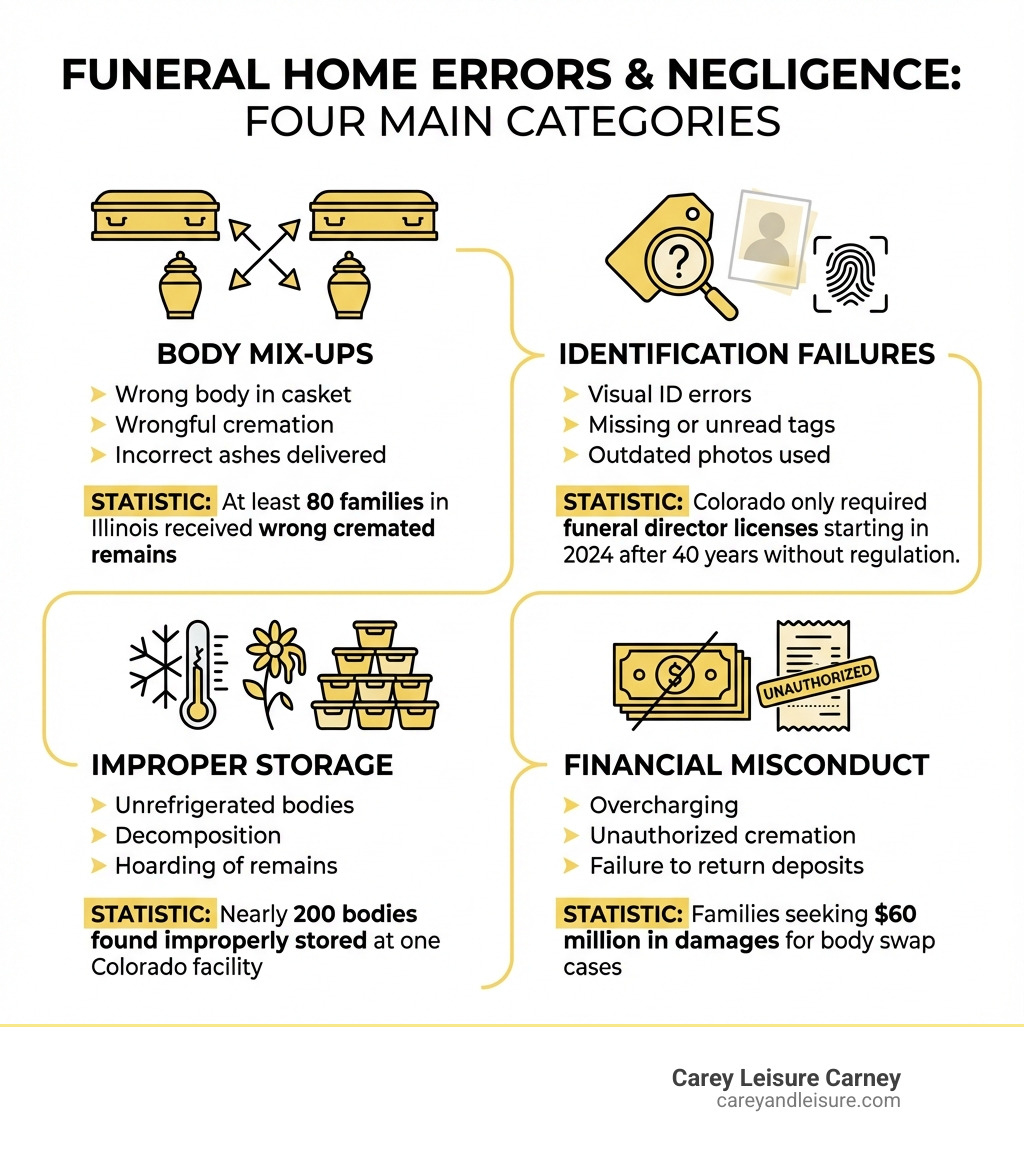
The headlines sound like nightmares. A family watches their father’s funeral via livestream, only to realize the person in the casket is a stranger. A daughter notices her father lacks his distinctive facial hair during a viewing, later finding he was buried in another state while a stranger rests in their family plot. In Colorado, authorities found nearly 200 improperly stored bodies at a single funeral home, while families in Illinois learned they’d been spreading the ashes of complete strangers.
These aren’t isolated incidents. When a loved one dies, families are grieving and trusting funeral directors to handle the deceased with dignity. The last thing anyone expects is to find they’ve buried the wrong person or that their loved one’s body was mishandled, lost, or cremated without consent.
The consequences are devastating, leading to compounded grief, the trauma of exhumations, and the psychological burden of knowing they couldn’t properly honor their loved one. Families who experience a body mix-up may suffer profound emotional trauma and financial losses. Legal recourse is available through negligence claims, breach of contract suits, and claims for intentional infliction of emotional distress.
The funeral industry faces significant regulatory gaps. Until 2024, Colorado was the only state that didn’t require funeral directors to hold professional licenses—a stunning fact given their responsibilities. While some states are tightening regulations, the patchwork of oversight remains insufficient.
Body mix-ups often stem from preventable failures:
- Using visual identification from old photos instead of proper verification methods
- Staff failing to read or verify permanent identification tags
- Inadequate protocols during body transfers between facilities
- Workforce shortages leading to rushed procedures and skipped steps
- Poor record-keeping and communication breakdowns
Families who experience these errors can hold funeral homes liable for negligence, breach of contract, and intentional infliction of emotional distress. Lawsuits have resulted in multi-million-dollar settlements, though no amount of money can truly compensate for the violation of trust.
As Thomas W. Carey, founder of Carey Leisure Carney, I have represented families in funeral home malpractice cases throughout Florida, holding negligent providers accountable. Our board-certified trial attorneys understand the profound impact these errors have on grieving families and fight to ensure both compensation and industry accountability.
Funeral home body mix-up definitions:
How Errors Happen: Uncovering the Causes of Funeral Home Negligence
When we entrust a funeral home with our loved ones, we expect professionalism and respect. Unfortunately, the causes of funeral home negligence, particularly those leading to a funeral home body mix-up, are often rooted in systemic failures and human error. Understanding these causes is the first step toward preventing future tragedies.
Identification Failures
The most critical errors occur during identification. Proper identification is the bedrock of accurate funeral services, and when it fails, the consequences are devastating.
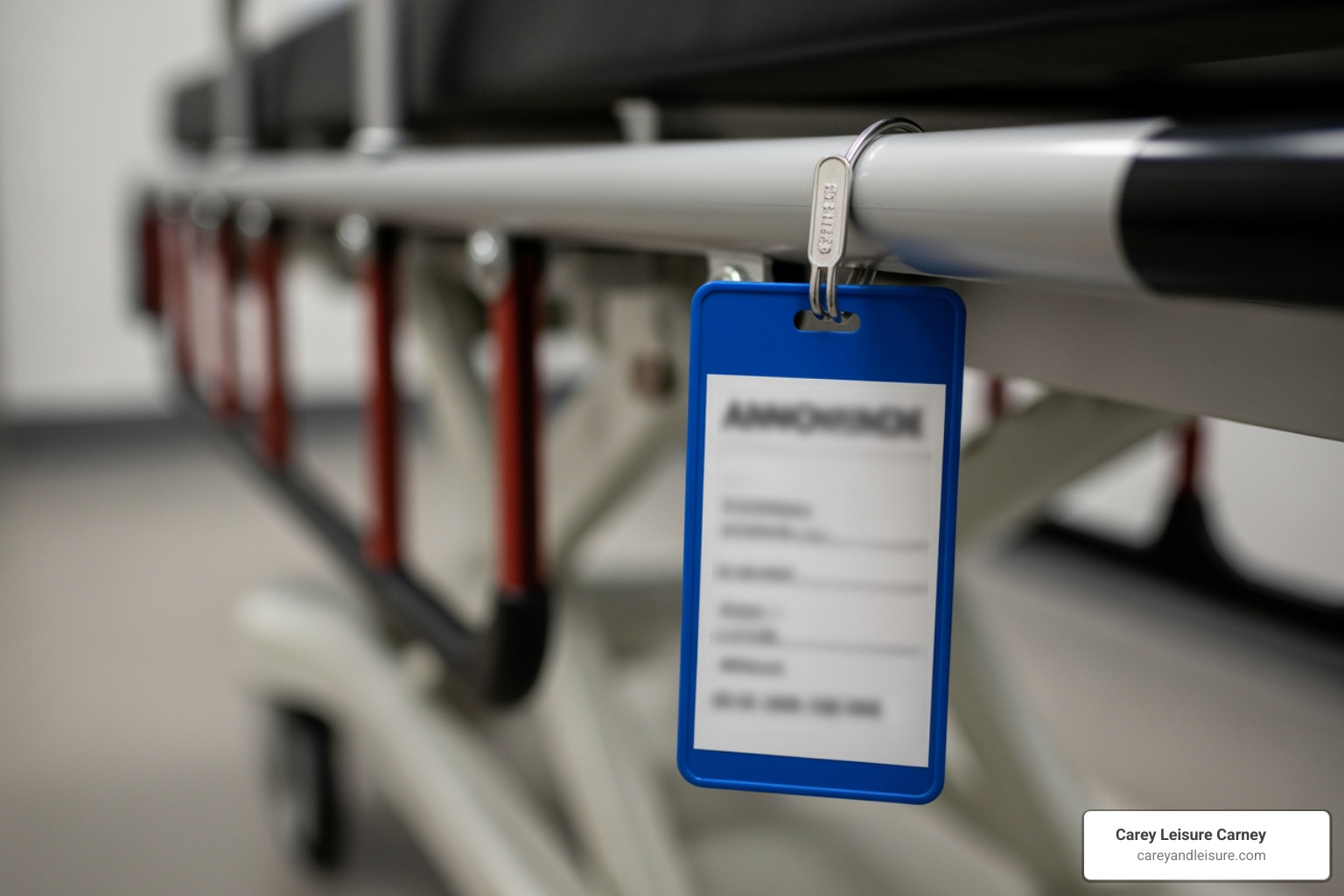
- Inadequate Tagging Systems: Deceased individuals should be clearly and permanently tagged. Failure to use or regularly verify tags with vital information like name and date of death creates a high risk of mix-ups.
- Visual ID Errors: Relying on visual identification is a recipe for disaster, as a grieving family may not notice discrepancies. A daughter noticed the absence of her father’s facial hair and an unexplained scar, leading to the horrifying realization it wasn’t him. Using outdated photos without corroborating evidence is also a critical failure.
- Lack of Protocols: Many funeral homes lack comprehensive, written protocols for handling and identifying bodies. Without clear procedures, employees may improvise, leading to errors.
- Employee Negligence and Overworked Staff: Even the best protocols are useless if not followed. Carelessness, insufficient training, or overworked staff rushing to manage multiple cases might skip vital verification steps, increasing the likelihood of a funeral home body mix-up.
Proving funeral home negligence often requires demonstrating that the funeral home failed to uphold its duty of care. For more on this, visit our page on Proving Funeral Home Negligence.
The Chain of Custody: Where Identification Breaks Down
A deceased individual’s journey involves multiple transfers, and each is a potential vulnerability in the chain of custody where a funeral home body mix-up can occur.
- Body Transport: The transportation phase from a hospital, nursing home, or residence is critical. Without rigorous checks and documentation at each handover, bodies can be misidentified.
- Morgue Transfers: During transfers to external morgues or medical examiners’ offices, clear and consistent identification is paramount. Mislabeling or failure to re-verify can propagate errors.
- Crematory Process: The cremation process is irreversible, making accurate identification vital. Wrongful cremation or returning the wrong ashes is one of the most egregious errors.
- Communication Breakdown: Poor communication between facilities is a significant contributor to errors. A local coroner once uncovered inconsistencies with cremated remains dating back years, illustrating how a breakdown in tracking has long-lasting repercussions. For more information, see our guide on Funeral Home Negligence Signs.
How Does a Funeral Home Body Mix-Up Happen?
These underlying causes manifest in several devastating ways:
- Wrong Body in Casket: A family arrives for a viewing only to find a stranger in the casket. In one instance, a family finded the error during a live-streamed funeral. Another family realized the body presented was not their father after finding a picture of the correct person on the funeral home’s website.
- Wrongful Cremation: This occurs when a body intended for burial is accidentally cremated, or the wrong body is cremated. This is irreversible and can violate profound religious or personal wishes.
- Incorrect Ashes: Receiving a stranger’s ashes is a heartbreaking error. Families have unwittingly spread these ashes in meaningful places, only to later learn the truth.
Case Study: Wilmington Funeral Home (General Principle, not Florida Specific)
While not in Florida, a recent case illustrates the anguish of these errors. A Wilmington funeral home was accused in a lawsuit of accidentally cremating a man and presenting his family with another man’s body for burial. The family finded the mistake by finding their father’s obituary and photo on the funeral home’s website. This incident underscores the critical need for vigilance and accountability. For more on this, you can read the news report: Delaware funeral home wrongfully cremated man, then lied: lawsuit.
The Devastating Consequences of a Funeral Home Body Mix-Up
The impact of a funeral home body mix-up extends far beyond inconvenience, inflicting deep, lasting wounds on grieving families and turning sorrow into a nightmare of confusion and distress.
Emotional and Psychological Toll on Families
Finding that the person in the casket isn’t your loved one, or that the ashes you cherish belong to a stranger, carries an immense emotional and psychological toll.
- Compounded Grief: A body mix-up adds a traumatic new layer of suffering to the grieving process. It can feel as though the loved one’s memory has been violated.
- Broken Trust: The sacred trust placed in a funeral home is shattered, leaving families feeling betrayed, disrespected, and angry. This breach can make it difficult to find closure.
- Desecration of Memory: A mix-up can feel like a desecration of a loved one’s memory, violating their dignity and the family’s right to a proper farewell.
- Cultural and Religious Impact: These errors can deeply offend cultural and religious beliefs about handling the deceased, causing immense spiritual anguish if proper rituals cannot be performed.

Financial and Legal Ramifications
Beyond the emotional devastation, a funeral home body mix-up has significant financial and legal consequences for families and negligent funeral homes.
- Lawsuit Costs: Pursuing justice involves legal expenses. Our firm, Carey Leisure Carney, understands this burden and offers free consultations and works on a contingency fee basis for personal injury claims.
- Refunding Funeral Expenses: Families may demand refunds for all services, including caskets and memorial services.
- Exhumation Costs: If the wrong body was buried, exhumation is emotionally harrowing and costly.
- Compensation for Damages: Families can seek compensation for emotional distress, mental anguish, and economic damages for funeral costs. In Florida, understanding what you can claim is crucial. Learn more about Compensation for Pain and Suffering in Florida: What You Need to Know.
- Funeral Home Financial Implications: Negligent funeral homes face significant penalties, including multi-million dollar lawsuits, severe reputational damage, and potential regulatory fines or closure.
The value of a personal injury case can vary widely. To get an idea of what your case might be worth, explore What is my Personal Injury Case Worth?.
Industry Oversight: Are Funeral Home Regulations Strong Enough?
The headlines about mishandled bodies and mixed-up remains raise a critical question: are the regulations governing funeral homes sufficient to protect grieving families? The answer, unfortunately, is often no.
State Licensing Boards and Patchwork Regulations
Funeral homes operate under a complex and often inconsistent patchwork of state and local regulations. While Florida has specific laws regarding the preservation and storage of deceased individuals, the level of oversight can vary significantly.
- State Licensing Boards: Most states have licensing boards that oversee funeral directors, embalmers, and funeral establishments. These boards are responsible for setting standards, issuing licenses, and investigating complaints. However, the effectiveness of these boards can vary.
- Inconsistent Requirements: The requirements for licensure, training, and facility standards are not uniform across the country. As we’ve seen, until recently, Colorado didn’t even require funeral directors to be licensed, making it the only state with such lenient rules for 40 years. This glaring loophole contributed to incidents where nearly 200 improperly stored bodies were finded at one funeral home, and another case involved a body decomposing for two years in a hearse.
- Inspection Failures: Even where regulations exist, enforcement can be lax. Insufficient staffing or resources for state inspection agencies can lead to long periods between inspections, allowing problems to fester undetected.
- Workforce Challenges: The funeral industry faces nationwide workforce challenges. A tight labor market can sometimes lead to less experienced staff or pressure to cut corners, which can increase the risk of errors.
In Florida, we have specific laws in place to ensure the dignified handling of the deceased. Understanding these regulations is important for both consumers and professionals. You can find more information on Florida Deceased Preservation and Storage Laws.
State Responses to Grisly Incidents
The shocking incidents of funeral home body mix-ups and mishandling have, in some instances, spurred states to action, leading to tougher regulations. While these examples are from other states, they highlight the types of legislative changes that can occur when public trust is severely eroded.
- Colorado’s New Licensing Law: Following the findy of hundreds of improperly stored bodies and families receiving fake ashes, Colorado passed new laws. One law expanded the state’s ability to inspect funeral homes and crematories. Another critical law, passed in 2024, now requires funeral directors, embalmers, and cremationists to be licensed by the state, requiring academic degrees or professional experience. This was a direct response to the public outrage and trauma experienced by families.
- Illinois’ Unique Identifier Law: After a local coroner uncovered inconsistencies with cremated remains dating back years, where at least 80 families received the wrong ashes, Illinois introduced legislation requiring unique identifiers on bodies and body bags. This aims to strengthen the chain of custody and prevent future mix-ups.
- Michigan’s Refrigeration Efforts: Incidents of unrefrigerated bodies decomposing in a funeral home’s garage and another storing over 50 infant and fetal remains without permission prompted Michigan lawmakers to seek changes, attempting to ensure bodies are properly refrigerated while awaiting burial or cremation.
These reactive measures, while necessary, underscore the need for proactive, robust regulation to prevent such horrors from occurring in the first place.
The Role of Technology in Preventing Errors
Technology offers promising solutions to improve identification, tracking, and record-keeping in funeral homes, significantly reducing the risk of a funeral home body mix-up.
- Barcode Tracking: Implementing barcode or RFID (Radio-Frequency Identification) tags on each deceased individual, their belongings, and corresponding paperwork could create a foolproof tracking system. Scanners at each stage of the process—from intake to embalming, viewing, and final disposition—would ensure accurate identification and a verifiable chain of custody.
- Digital Records Management: Moving away from paper records to comprehensive digital systems can minimize human error in data entry and retrieval. Centralized databases would allow for instant verification and reduce the chances of miscommunication.
- DNA Verification: While perhaps not practical for every case, DNA sampling could be used in high-risk situations or as a failsafe, offering absolute certainty of identity.
- Improved Communication Systems: Secure, standardized digital platforms for communication between funeral homes, hospitals, coroners, and crematories could streamline information exchange and prevent critical details from being lost or misinterpreted.
Embracing these technological advancements could dramatically improve accountability and prevent the devastating errors associated with funeral home negligence. For more insights into this critical issue, visit our resource on Category: Funeral Home Negligence.
What to Do When the Unthinkable Happens: Your Legal Options
Finding a funeral home body mix-up or other misconduct is an incredibly distressing experience. While no legal action can erase the pain, seeking justice can provide accountability, compensation for your losses, and potentially prevent future errors from happening to other families. If you suspect or confirm that a funeral home has made a grave error with your loved one, here are the steps you should consider.
Documenting Evidence and Contacting Authorities
The first crucial step is to gather as much information and evidence as possible. This will be invaluable for any subsequent legal action.
- Document Everything: Keep a detailed log of all communications with the funeral home, including dates, times, names of individuals you spoke with, and summaries of conversations. Save all contracts, receipts, and any other relevant paperwork. Take photographs or videos if possible and safe to do so.
- Seek Immediate Clarification: If you notice anything amiss, such as discrepancies in appearance or documentation, immediately bring it to the attention of the funeral home management. Insist on a thorough investigation and clear answers.
- Contact Regulatory Authorities: Report the incident to the appropriate state licensing board that oversees funeral homes in Florida. This could trigger an official investigation and potential disciplinary action against the funeral home.
- Consult with a Legal Professional: Do not delay in contacting an attorney experienced in funeral home malpractice. They can guide you through the process, help you understand your rights, and ensure that crucial evidence is preserved. The basics of legal action can seem daunting, but we’re here to help you steer it. Learn more about Lawsuit Basics.
- Preserve Evidence: Your attorney will advise you on how to properly document and preserve evidence, which is critical for any personal injury claim. For more detailed guidance, refer to Documenting Evidence in Personal Injury Claims.
Filing a Lawsuit for a Funeral Home Body Mix-Up
When a funeral home’s negligence leads to a funeral home body mix-up or other severe errors, families have several legal avenues to pursue compensation and justice.
- Negligence Claims: This is the most common basis for a lawsuit. We would argue that the funeral home failed to exercise reasonable care in handling your loved one’s remains, leading directly to the mix-up or misconduct. This could involve failures in identification protocols, supervision of staff, or maintenance of facilities.
- Breach of Contract: When you engage a funeral home, you enter into a contract for specific services. If they fail to provide those services as agreed, or if their actions violate the terms of the contract (e.g., cremating a body intended for burial), you may have a claim for breach of contract.
- Intentional Infliction of Emotional Distress (IIED): In cases where the funeral home’s conduct is particularly egregious, reckless, or intentional, families may be able to claim intentional infliction of emotional distress. This applies when the conduct is so outrageous that it goes beyond all bounds of decency and causes severe emotional suffering.
- Gross Negligence: This goes beyond ordinary negligence and involves a conscious and voluntary disregard of the need to use reasonable care, which is likely to cause foreseeable grave injury or harm to persons, property, or both. If a funeral home repeatedly ignores basic safety or identification protocols, it could be deemed grossly negligent. For a comprehensive understanding, see our Gross Negligence Law Complete Guide.
- The Litigation Process: Filing a lawsuit involves several stages, including findy, where evidence is exchanged, and depositions, where sworn testimonies are taken. Understanding this process can help alleviate some of the stress. Our guide to The Litigation Process: Depositions provides more information.
Finding the Right Legal Representation
Navigating the complexities of a funeral home malpractice lawsuit requires experienced legal counsel. Choosing the right attorney is paramount to securing the justice and compensation your family deserves.
- Personal Injury Lawyers with Specific Experience: While many personal injury lawyers handle a broad range of cases, look for a firm with specific experience in funeral home malpractice or negligence. These cases are unique and require a nuanced understanding of industry practices, regulations, and the profound emotional impact on families.
- Board-Certified Attorneys: In Florida, attorneys can become Board Certified by The Florida Bar in specific areas of law, signifying a high level of experience, expertise, and professionalism. Our firm, Carey Leisure Carney, is proud to have Board-Certified attorneys who are recognized as specialists in civil trial law. This distinction means they are among the top 2% of Florida lawyers.
- Direct Attorney Access and Personalized Service: During such a sensitive time, you deserve direct access to your attorney and personalized attention. We believe in providing compassionate, client-focused representation, ensuring you’re informed and supported every step of the way.
- Local Expertise: Having legal representation familiar with Florida’s specific laws and court systems is a significant advantage. Our firm serves clients throughout Clearwater, Largo, New Port Richey, Spring Hill, St. Petersburg, Trinity, and Wesley Chapel, Florida. If you’re in Spring Hill, for instance, we have dedicated resources to help you. Find out more about how we can assist as your Funeral Home Malpractice Lawyer Spring Hill, FL. We also have specialized attorneys ready to assist you in New Port Richey, St. Petersburg, Largo, Trinity, and Wesley Chapel.
Conclusion: Protecting Your Rights and Honoring Your Loved One
The thought of a funeral home body mix-up is horrifying, a scenario no grieving family should ever have to endure. Yet, as we’ve explored, these errors are a painful reality for too many, driven by lapses in identification, breakdowns in the chain of custody, and insufficient oversight within the funeral industry. The emotional, psychological, and financial consequences are profound, leaving families with compounded grief and a deep sense of betrayal.
As consumers, we must maintain a degree of vigilance, even in our most vulnerable moments. While we place immense trust in funeral professionals, asking questions, observing details, and confirming identities can be crucial safeguards. However, the ultimate responsibility lies with the funeral homes themselves and the regulatory bodies tasked with overseeing them.
For industry accountability, stronger regulations, consistent enforcement, and the adoption of modern technologies are essential to prevent future mix-ups and misconduct. Every deceased individual deserves to be treated with the utmost dignity and respect, and every family deserves the peace of mind that their loved one’s final arrangements will be handled flawlessly.
If your family has suffered due to a funeral home’s error, know that you are not alone, and you have rights. Seeking justice can help you steer the complex aftermath, hold negligent parties accountable, and ensure that such heartbreaking mistakes are less likely to happen again. At Carey Leisure Carney, we are committed to Seeking Justice for Funeral Cemetery Cremation Malpractice. Our Board-Certified attorneys have over 100 years of combined experience fighting for families in Florida, offering direct attorney access and personalized service during these challenging times.
If your family has suffered due to a funeral home’s error, contact a Funeral Home Malpractice Attorney to understand your rights.