

Rideshare Accident Lawyer: Secure Justice in 2025
The Rise of Ridesharing and the Risk of Accidents
A rideshare accident lawyer specializes in complex claims involving companies like Uber and Lyft. These cases require navigating multiple insurance policies, proving fault when drivers are independent contractors, and handling claims that differ based on the driver’s app status. You may need a lawyer if you were injured as a passenger, pedestrian, or other driver and are facing a denied claim or serious injuries requiring long-term care.
Ridesharing is incredibly popular, with over 90 million Americans using these services in 2023. However, this convenience has a downside: in 2022, there were 10,575 rideshare vehicle accidents in the U.S., causing 3,716 injuries and 140 fatalities.
These accidents are more complex than typical car crashes because drivers are independent contractors, which creates layered insurance coverage that changes with their app status. While the average settlement for rideshare accident claims ranges from $20,000 to $150,000, achieving a fair outcome requires proper legal representation.
I’m Thomas W. Carey, a board-certified civil trial lawyer. Since 1988, I’ve handled roughly 40,000 injury cases across Florida. As a rideshare accident lawyer, I use my specialized knowledge of transportation network company regulations and multi-tiered insurance policies to help my clients.
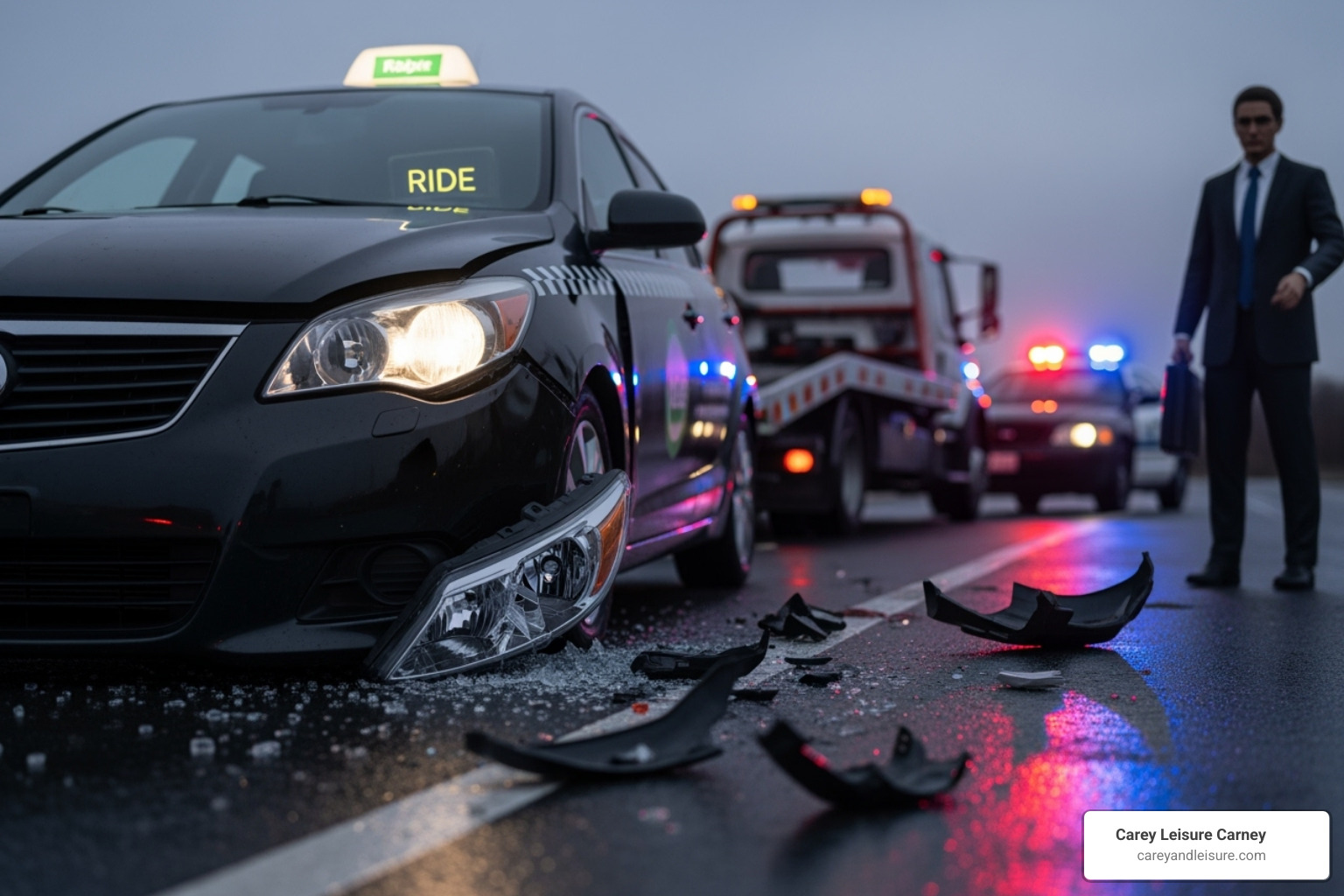
Navigating the Complexities: Why Rideshare Accidents Are Different
A regular car accident is stressful, but a crash involving a rideshare vehicle adds layers of complexity. These cases involve multiple insurance policies, independent contractor laws, and crucial app data, making them far more complicated than a typical collision.
When a rideshare vehicle is in an accident, you’re not just dealing with one driver and their insurance. You’re navigating a maze of coverage that changes based on whether the driver’s app was on, off, or actively transporting a passenger.

The biggest factor is that rideshare drivers are independent contractors, not employees. This legal distinction fundamentally changes who is responsible when an accident occurs. These Transportation Network Companies (TNCs) operate under different rules than traditional taxi services. Another key element is the digital evidence trail. Every trip generates data—GPS locations, timestamps, and communication logs—that becomes crucial evidence. Accessing and interpreting this data is vital for your case.
The Challenge of Proving Fault in an Uber or Lyft Accident
Determining fault in a rideshare accident is a complex puzzle. Driver negligence is often the starting point. Was the driver distracted by the app or speeding to complete more trips? These factors matter, but the driver’s independent contractor status complicates the rideshare company’s liability.
Company liability is harder to prove. While Uber and Lyft distance themselves from their drivers’ actions, their policies or app features could contribute to accidents, such as by encouraging unsafe driving behaviors. Most rideshare accidents involve multiple parties sharing fault, such as a distracted rideshare driver and another motorist who ran a red light. Sorting this out requires an expert who knows how to tell who is at fault in a car accident in these unique situations.
Evidence collection is also different. In addition to police reports and photos, you need the crucial app data—GPS logs, communication records, and trip details—to prove what really happened.
Who is Liable? The Driver, the Company, or Someone Else?
This is the million-dollar question. Rideshare companies built their business model on classifying drivers as independent contractors to shield themselves from liability. When an accident happens, they often use this vicarious liability defense, claiming they are just a technology platform.
This leaves several options for seeking compensation:
- Suing the driver is the most direct path, targeting their personal auto insurance.
- Suing the company’s insurance is often possible and more lucrative, as their commercial policies provide significant coverage under specific circumstances.
- Pursuing other negligent drivers is necessary if another motorist caused the crash.
Passenger vs. Pedestrian: Key Differences in Accident Claims
Your role in the accident significantly impacts your claim. Passengers generally have the strongest rights, as they are almost never at fault. They can seek compensation from the at-fault driver and have access to the rideshare company’s $1 million commercial insurance policy.
Pedestrian claims have unique challenges. If hit by a rideshare driver who is logged into their app, the company’s contingent insurance may apply. These injuries are often severe, leading to substantial medical costs.
Other motorists involved in a crash with a rideshare vehicle will deal with the same layers of insurance, making their claims more complex than a standard accident.
In any of these scenarios, your own Uninsured/Underinsured Motorist (UM/UIM) coverage can be a critical safety net if the at-fault driver lacks sufficient insurance. This is especially true in serious cases, like those handled by a Drunk Driving Accident Attorney, where damages can be extensive.
Understanding Uber & Lyft’s Layered Insurance Policies
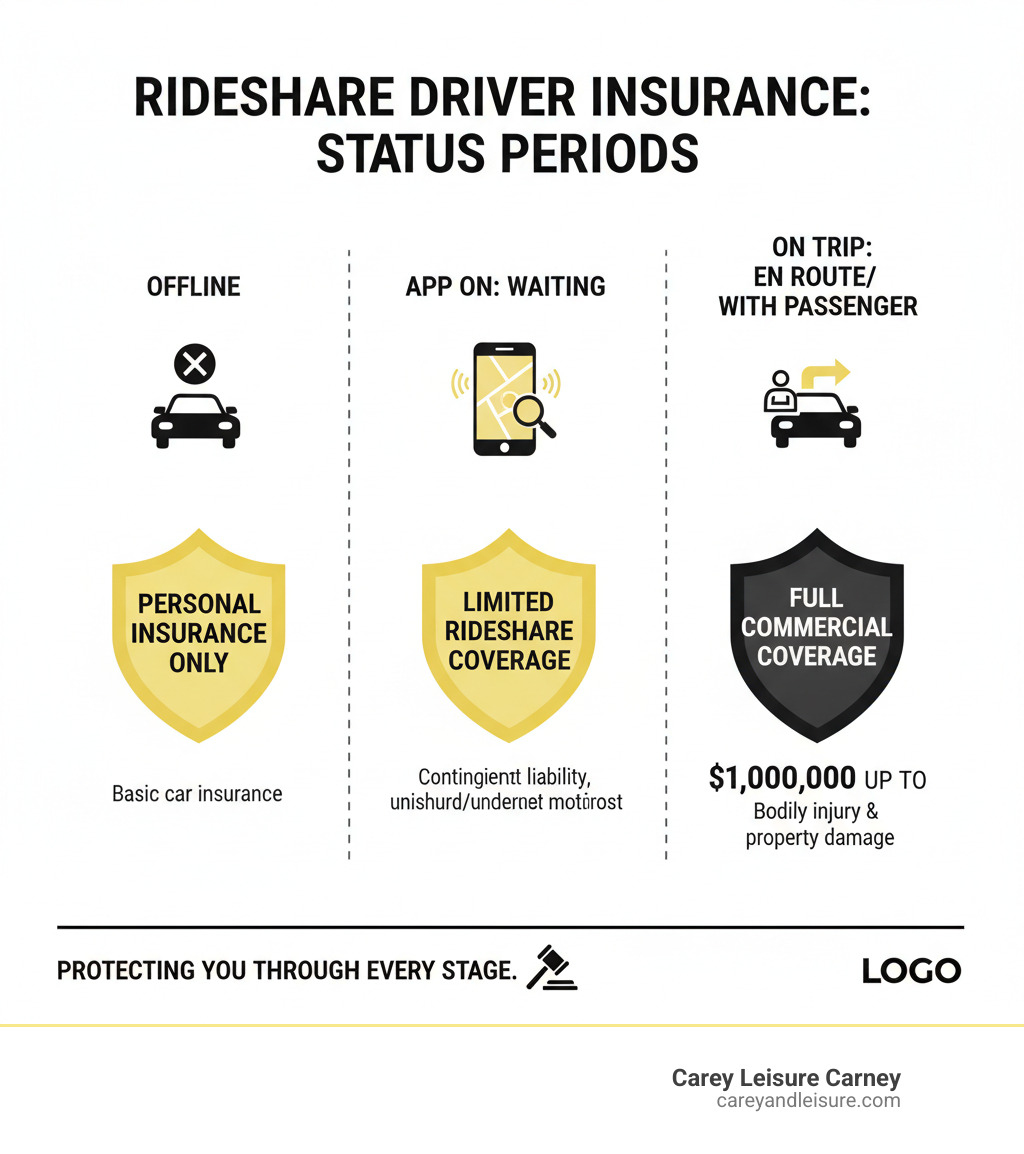
Rideshare insurance is a tiered system that changes based on the driver’s activity at the time of the crash. This complexity is a primary reason to consult a rideshare accident lawyer who understands these intricate policies.
One major complication is that most standard car insurance policies have a “business use” exclusion. This means a driver’s personal auto policy may deny coverage if they were driving for Uber or Lyft. To address this, rideshare companies provide commercial liability policies that fill the gaps. Both Uber’s insurance information and Lyft’s insurance policies detail these coverage levels.
The applicable coverage depends entirely on the driver’s app status at the moment of the crash. Each scenario triggers different insurance coverage with vastly different limits.
Uber & Lyft Insurance Coverage by Driver Status
| Driver Status | Primary Insurance | Rideshare Company Coverage Limits |
|---|---|---|
| App Off / Offline | Driver’s Personal Auto Insurance | None |
| App On / Waiting for Request | Driver’s Personal (if covered) or Rideshare’s Contingent Policy | $50,000 bodily injury per person / $100,000 per accident; $25,000 property damage |
| En Route to Pick Up / On Trip | Rideshare Company’s Commercial Policy | $1,000,000 Third-Party Liability |
This table shows the dramatic difference in coverage, from potentially none to $1 million in liability, all depending on the driver’s app status. When the app is offline, the accident is treated like any other car crash, relying on the driver’s personal insurance. The middle tier, when a driver is waiting for a request, offers modest coverage that can be quickly exhausted by serious injuries.
The highest tier of coverage applies once a driver accepts a ride. This $1,000,000 commercial policy is designed to cover serious accidents. Insurance companies often dispute which policy was in effect to minimize their payout. This is why app data evidence is so crucial to prove the driver’s exact status at the time of impact. A skilled rideshare accident lawyer knows how to investigate the driver’s status and pursue the correct insurance policy for maximum compensation.
Your Rights and What to Do After a Rideshare Accident
Being in a rideshare accident is overwhelming and confusing. However, knowing your rights and taking the right steps immediately after the crash is critical to protecting your claim. While your health is the top priority, protecting your legal rights is a close second. Every piece of evidence matters, and time is of the essence.

Immediate Steps to Protect Your Claim
Following a clear plan after an accident can help you stay focused and protect your case.
Call 911 immediately. A police report creates an official record of the accident, which is vital for your insurance claim.
Seek medical attention. Even if you feel fine, get a medical evaluation. Adrenaline can mask serious injuries like concussions or internal damage. Medical records are crucial evidence.
Document everything. If it’s safe, take photos and videos of the vehicles, road conditions, traffic signals, skid marks, and your injuries. This visual evidence can be invaluable.
Exchange information. Get names, phone numbers, and insurance details from all drivers. For the rideshare driver, also note their vehicle information and ask for their personal insurance details. Collect contact information from any witnesses.
Report the accident in the app. As a passenger, report the crash through the Uber or Lyft app to create a digital record with the company.
Do not give recorded statements. Never give a recorded statement to an insurance adjuster without first speaking to a rideshare accident lawyer. Their goal is to minimize the insurance company’s payout, not to help you.
For more guidance, see our guide on what to do after a car accident.
Common Injuries and Recoverable Damages
Rideshare accidents can cause a wide range of injuries, from minor to life-altering. Common injuries include:
- Soft tissue injuries: Whiplash, sprains, and strains are frequent and can lead to chronic pain.
- Broken bones: These often require surgery and extensive physical therapy, leading to significant time off work.
- Traumatic Brain Injuries (TBI): These injuries are not always immediately apparent but can have lasting effects on memory, cognition, and personality.
- Spinal cord injuries: These are among the most devastating injuries and can lead to paralysis, with lifetime care costs reaching millions.
For a full list, see our page on types of car accident injuries.
We fight to recover compensation for all your losses, including:
- Medical bills: Both current and future medical expenses.
- Lost wages: Compensation for missed work and reduced future earning capacity.
- Property damage: Costs to repair or replace your vehicle and other damaged property.
- Pain and suffering: Compensation for the physical pain and emotional distress the accident has caused. Understanding compensation for pain and suffering in Florida is key to a fair recovery.
- Punitive damages: In cases of extreme negligence, these may be awarded to punish the wrongdoer.
The Legal Process: How a Rideshare Accident Lawyer Can Secure Justice
While you recover from a rideshare accident, the last thing you need is a battle with insurance companies. A rideshare accident lawyer is your strongest ally, handling the complex legal strategy and negotiations so you can focus on healing.

We act as your advocate, building a solid case designed to maximize your compensation. We prepare every case for trial, which gives us significant leverage during settlement negotiations.
Navigating State-Specific Laws and Deadlines
Every state has unique rules for personal injury claims, and missing a deadline can be fatal to your case. The statute of limitations is the most critical deadline—it’s your legal window to file a lawsuit. In Florida, the statute of limitations for negligence claims is generally two years. Missing this deadline means losing your right to compensation forever.
An attorney familiar with Florida’s specific ridesharing regulations can ensure all deadlines are met and that your case complies with all state-specific requirements. This knowledge directly impacts how we build your case and what evidence we gather.
Why You Need an Experienced Rideshare Accident Lawyer
Insurance companies have teams of professionals working to minimize your claim. A lawyer levels the playing field. Our role includes:
- Investigating the crash: We dig into police reports, interview witnesses, and obtain the crucial rideshare app data to prove what happened.
- Calculating total damages: We go beyond current bills, working with experts to project your future medical needs, lost earning capacity, and ongoing pain and suffering.
- Handling communication with insurers: We take over all communication, protecting you from adjusters’ tactics designed to weaken your claim.
- Negotiating a fair settlement: We know the true value of your case and fight back against lowball offers. If a fair settlement isn’t reached, we are prepared to file a lawsuit and go to court.
We work on a contingency fee basis, meaning you pay nothing unless we win your case. This removes the financial risk of seeking justice. Learn more on our Rideshare Accident Attorney page.
Maximizing Your Compensation with a Rideshare Accident Lawyer
Our goal is not just to get a settlement, but to maximize your compensation. Average settlements for rideshare accidents range from $20,000 to $150,000, but the final amount depends on injury severity and the quality of legal representation.
We excel at proving future damages, working with medical and financial experts to document the long-term impact of your injuries. We are skilled at fighting lowball offers by presenting strong evidence and expert testimony. Our access to expert witnesses, such as accident reconstructionists and medical specialists, can be the key to proving your case and securing the full compensation you deserve as your Personal Injury Attorney.
Frequently Asked Questions about Rideshare Accident Claims
After handling thousands of injury cases, I know the questions that arise after a rideshare accident. Here are straight answers to the most common concerns.
Can I sue Uber or Lyft directly for an accident?
Suing a rideshare company directly is complicated, but not impossible. Uber and Lyft classify their drivers as independent contractors to shield themselves from liability for driver negligence. This is known as the “independent contractor defense.”
However, we have several paths to pursue compensation:
- Targeting the driver’s insurance is often the first step.
- Going after the company’s insurance is where significant compensation is typically found, especially the $1 million commercial policy.
- Proving direct company negligence is a higher bar but possible if we can show the company’s own actions contributed to the crash, such as by failing to properly screen a driver.
What if the rideshare driver’s app was off when the accident happened?
If the driver’s app was completely offline, the rideshare company’s insurance does not apply. The case is treated like any other car accident, and the driver’s personal auto insurance is the primary target for compensation. If that policy is insufficient, your own uninsured/underinsured motorist coverage may apply.
Proving the app’s status is critical, as insurance companies will dispute it to avoid liability. This type of case falls under standard Car Accident Attorney representation.
How much does it cost to hire a rideshare accident lawyer?
Hiring our firm costs you nothing upfront. We work on a contingency fee basis, which means we only get paid if we win your case. Our fee is a percentage of the compensation we recover for you. If we don’t win, you owe us nothing.
We also offer a free initial consultation to review your case and explain your legal options with no obligation. This system ensures our interests are aligned with yours: we are motivated to get you the maximum possible compensation. This model has helped thousands of injured people get justice when they couldn’t otherwise afford it.
Conclusion: Take the First Step Towards Your Recovery
The convenience of ridesharing comes with unique legal complexities when accidents happen. These cases are not typical car crashes; they involve tiered insurance policies, independent contractor issues, and specific state laws that demand specialized legal knowledge.

At Carey Leisure Carney, we understand these intricate details. Our Board-Certified attorneys—a distinction held by only the top 2% in Florida—bring over 100 years of combined experience to your case. We provide direct attorney access and personalized service, ensuring you’re never just a case number. We have helped thousands of clients throughout Florida, including in Clearwater, Largo, New Port Richey, Spring Hill, St. Petersburg, Trinity, and Wesley Chapel, secure the justice they deserve.
If you or a loved one was injured in a rideshare accident, do not face the insurance companies alone. The clock is ticking on your claim. Let us take on the legal burden so you can focus on your recovery.
Take the first step today. Contact our New Port Richey personal injury lawyers for a free, no-obligation consultation. We’re here to fight for you.